



Community hub
Recent from talks
Knowledge base stats:
Talk channels stats:
Members stats:
Common ringtail possum
The common ringtail possum (Pseudocheirus peregrinus, Greek for "false hand" and Latin for "pilgrim" or "alien") is an Australian marsupial.
It lives in a variety of habitats and eats a variety of leaves of both native and introduced plants, as well as flowers, fruits and sap. This possum also consumes caecotropes, which is material fermented in the caecum and expelled during the daytime when it is resting in a nest. This behaviour is called caecotrophy and is similar to that seen in rabbits.
The common ringtail possum is currently classified as one of the two living species in the genus Pseudocheirus; the species of Pseudochirulus and other ringtail genera were formerly also classified in Pseudocheirus. Several subspecies have been described:
Pseudocheirus occidentalis (Ngwayir, or the Western ringtail possum), found in the south west of Australia, used to be considered a subspecies of Pseudocheirus peregrinus; however, it is now formally considered a separate species.
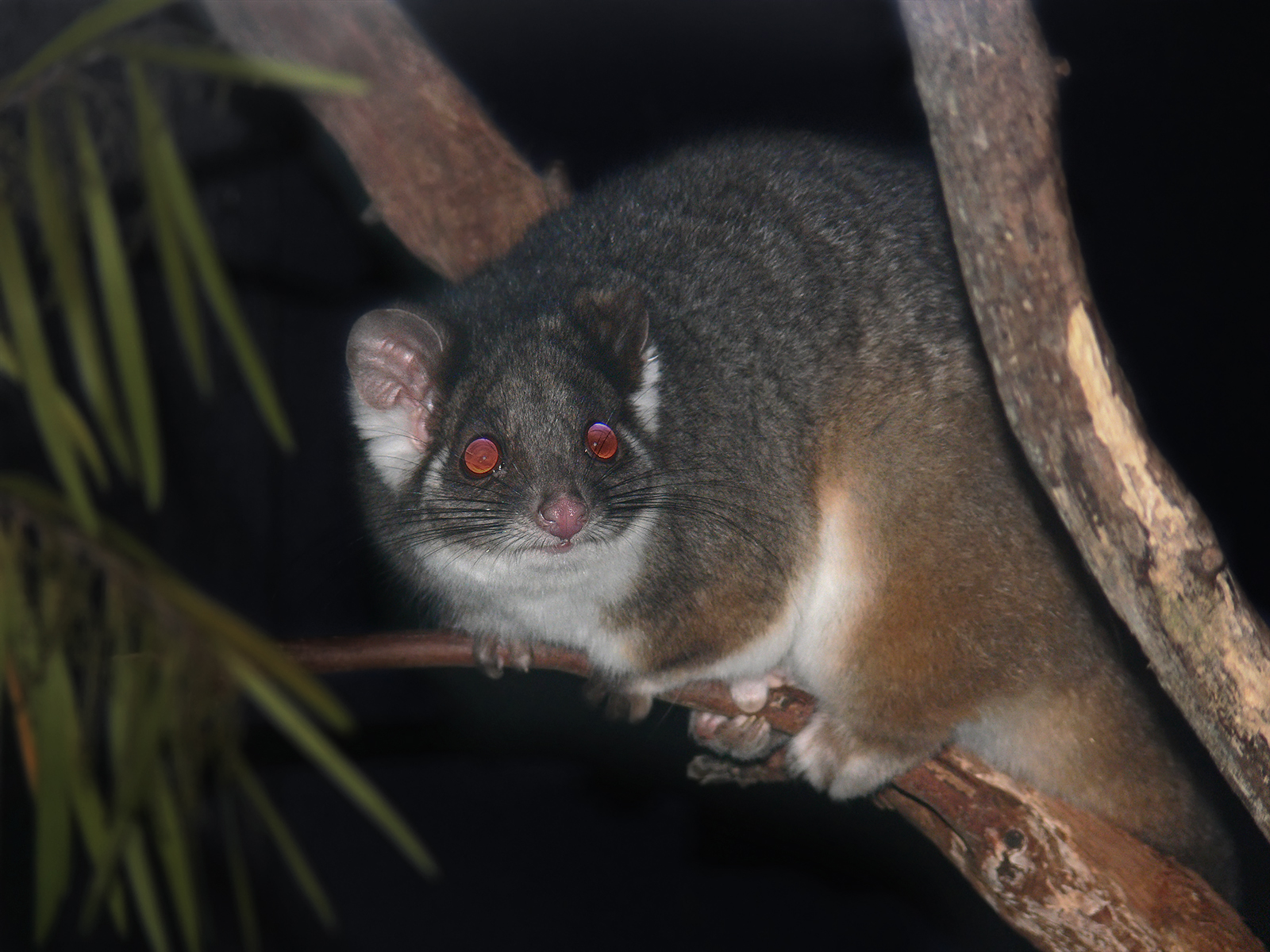
The common ringtail possum weighs between 550 and 1,100 g (19 and 39 oz) and is approximately 30–35 cm (12–14 in) cm long when grown (excluding the tail, which is roughly the same length again). It has grey or black fur with white patches behind the eyes and usually a cream-coloured belly. It has a long prehensile tail which normally displays a distinctive white tip over 25% of its length. The back feet are syndactyl, which helps it to climb. The ringtail possum's molars have sharp and pointed cusps.
The common ringtail possum ranges on the east coast of Australia, as well as Tasmania and a part of southwestern Australia. They generally live in temperate and tropical environments and are rare in drier environments. Ringtail possums prefer forests of dense brush, particularly eucalyptus forests. The common ringtail possum and its relatives occupy a range of niches similar to those of lemurs, monkeys, squirrels, and bushbabies in similar forests on other continents. It is less prolific and less widespread than the common brushtail possum.
The common ringtail possum is nocturnal and well adapted to arboreal life. It relies on its prehensile tail and sometimes will descend to the ground. They communicate with soft, high-pitched, and twittering calls.
The common ringtail possum feeds on a wide variety of plants in the family Myrtaceae including the foliage, flowers and fruits from shrubs and lower canopy. Some populations are also known to feed on the leaves of cypress pine (Callitris), wattles (Acacia spp.) and plant gum or resins.
Hub AI
Common ringtail possum AI simulator
(@Common ringtail possum_simulator)
Common ringtail possum
The common ringtail possum (Pseudocheirus peregrinus, Greek for "false hand" and Latin for "pilgrim" or "alien") is an Australian marsupial.
It lives in a variety of habitats and eats a variety of leaves of both native and introduced plants, as well as flowers, fruits and sap. This possum also consumes caecotropes, which is material fermented in the caecum and expelled during the daytime when it is resting in a nest. This behaviour is called caecotrophy and is similar to that seen in rabbits.
The common ringtail possum is currently classified as one of the two living species in the genus Pseudocheirus; the species of Pseudochirulus and other ringtail genera were formerly also classified in Pseudocheirus. Several subspecies have been described:
Pseudocheirus occidentalis (Ngwayir, or the Western ringtail possum), found in the south west of Australia, used to be considered a subspecies of Pseudocheirus peregrinus; however, it is now formally considered a separate species.
The common ringtail possum weighs between 550 and 1,100 g (19 and 39 oz) and is approximately 30–35 cm (12–14 in) cm long when grown (excluding the tail, which is roughly the same length again). It has grey or black fur with white patches behind the eyes and usually a cream-coloured belly. It has a long prehensile tail which normally displays a distinctive white tip over 25% of its length. The back feet are syndactyl, which helps it to climb. The ringtail possum's molars have sharp and pointed cusps.
The common ringtail possum ranges on the east coast of Australia, as well as Tasmania and a part of southwestern Australia. They generally live in temperate and tropical environments and are rare in drier environments. Ringtail possums prefer forests of dense brush, particularly eucalyptus forests. The common ringtail possum and its relatives occupy a range of niches similar to those of lemurs, monkeys, squirrels, and bushbabies in similar forests on other continents. It is less prolific and less widespread than the common brushtail possum.
The common ringtail possum is nocturnal and well adapted to arboreal life. It relies on its prehensile tail and sometimes will descend to the ground. They communicate with soft, high-pitched, and twittering calls.
The common ringtail possum feeds on a wide variety of plants in the family Myrtaceae including the foliage, flowers and fruits from shrubs and lower canopy. Some populations are also known to feed on the leaves of cypress pine (Callitris), wattles (Acacia spp.) and plant gum or resins.