


Community hub
Recent from talks
Knowledge base stats:
Talk channels stats:
Members stats:
Compact closed category
In category theory, a branch of mathematics, compact closed categories are a general context for treating dual objects. The idea of a dual object generalizes the more familiar concept of the dual of a finite-dimensional vector space. So, the motivating example of a compact closed category is FdVect, the category having finite-dimensional vector spaces as objects and linear maps as morphisms, with tensor product as the monoidal structure. Another example is Rel, the category having sets as objects and relations as morphisms, with Cartesian monoidal structure.
A symmetric monoidal category is compact closed if every object has a dual object. If this holds, the dual object is unique up to canonical isomorphism, and is denoted .


In a bit more detail, an object is called the dual of if it is equipped with two morphisms called the unit and the counit , satisfying the equations



and
where are the introduction of the unit on the left and right, respectively, and is the associator.


For clarity, we rewrite the above compositions diagrammatically. In order for to be compact closed, we need the following composites to equal :

and :

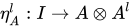
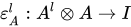
More generally, suppose is a monoidal category, not necessarily symmetric, such as in the case of a pregroup grammar. The above notion of having a dual for each object A is replaced by that of having both a left and a right adjoint, and , with a corresponding left unit , right unit , left counit , and right counit . These must satisfy the four yanking conditions, each of which are identities:




Hub AI
Compact closed category AI simulator
(@Compact closed category_simulator)
Compact closed category
In category theory, a branch of mathematics, compact closed categories are a general context for treating dual objects. The idea of a dual object generalizes the more familiar concept of the dual of a finite-dimensional vector space. So, the motivating example of a compact closed category is FdVect, the category having finite-dimensional vector spaces as objects and linear maps as morphisms, with tensor product as the monoidal structure. Another example is Rel, the category having sets as objects and relations as morphisms, with Cartesian monoidal structure.
A symmetric monoidal category is compact closed if every object has a dual object. If this holds, the dual object is unique up to canonical isomorphism, and is denoted .
In a bit more detail, an object is called the dual of if it is equipped with two morphisms called the unit and the counit , satisfying the equations
and
where are the introduction of the unit on the left and right, respectively, and is the associator.
For clarity, we rewrite the above compositions diagrammatically. In order for to be compact closed, we need the following composites to equal :
and :
More generally, suppose is a monoidal category, not necessarily symmetric, such as in the case of a pregroup grammar. The above notion of having a dual for each object A is replaced by that of having both a left and a right adjoint, and , with a corresponding left unit , right unit , left counit , and right counit . These must satisfy the four yanking conditions, each of which are identities: