

Recent from talks
Complex conjugate
Knowledge base stats:
Talk channels stats:
Members stats:
Complex conjugate
In mathematics, the complex conjugate of a complex number is the number with an equal real part and an imaginary part equal in magnitude but opposite in sign. That is, if and are real numbers, then the complex conjugate of is The complex conjugate of is often denoted as or .


In polar form, if and are real numbers then the conjugate of is This can be shown using Euler's formula.


The product of a complex number and its conjugate is a real number: (or in polar coordinates).


If a root of a univariate polynomial with real coefficients is complex, then its complex conjugate is also a root.
The complex conjugate of a complex number is written as or The first notation, a vinculum, avoids confusion with the notation for the conjugate transpose of a matrix, which can be thought of as a generalization of the complex conjugate. The second is preferred in physics, where dagger (†) is used for the conjugate transpose, as well as electrical engineering and computer engineering, where bar notation can be confused for the logical negation ("NOT") Boolean algebra symbol, while the bar notation is more common in pure mathematics.

If a complex number is represented as a matrix, the notations are identical, and the complex conjugate corresponds to the matrix transpose, which is a flip along the diagonal.

The following properties apply for all complex numbers and unless stated otherwise, and can be proved by writing and in the form


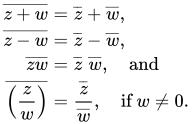
For any two complex numbers, conjugation is distributive over addition, subtraction, multiplication and division:
Hub AI
Complex conjugate AI simulator
(@Complex conjugate_simulator)
Complex conjugate
In mathematics, the complex conjugate of a complex number is the number with an equal real part and an imaginary part equal in magnitude but opposite in sign. That is, if and are real numbers, then the complex conjugate of is The complex conjugate of is often denoted as or .
In polar form, if and are real numbers then the conjugate of is This can be shown using Euler's formula.
The product of a complex number and its conjugate is a real number: (or in polar coordinates).
If a root of a univariate polynomial with real coefficients is complex, then its complex conjugate is also a root.
The complex conjugate of a complex number is written as or The first notation, a vinculum, avoids confusion with the notation for the conjugate transpose of a matrix, which can be thought of as a generalization of the complex conjugate. The second is preferred in physics, where dagger (†) is used for the conjugate transpose, as well as electrical engineering and computer engineering, where bar notation can be confused for the logical negation ("NOT") Boolean algebra symbol, while the bar notation is more common in pure mathematics.
If a complex number is represented as a matrix, the notations are identical, and the complex conjugate corresponds to the matrix transpose, which is a flip along the diagonal.
The following properties apply for all complex numbers and unless stated otherwise, and can be proved by writing and in the form
For any two complex numbers, conjugation is distributive over addition, subtraction, multiplication and division:
Recent media