Hubbry Logo
Pure mathematicsPure mathematicsMain
Open search
Pure mathematics
Community hub
Pure mathematics
logo
8 pages, 0 posts
0 subscribers
Be the first to start a discussion here.
Pure mathematics
Pure mathematics
from Wikipedia
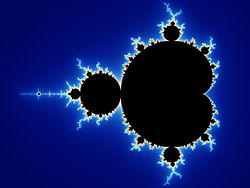
Pure mathematics studies the properties and structure of abstract objects,[1] such as the Mandelbrot set. This may be done without focusing on concrete applications of concepts in the physical world.

Pure mathematics is the study of mathematical concepts independently of any application outside mathematics. These concepts may originate in real-world concerns, and the results obtained may later turn out to be useful for practical applications, but pure mathematicians are not primarily motivated by such applications. Instead, the appeal is attributed to the intellectual challenge and aesthetic beauty of working out the logical consequences of basic principles.

While pure mathematics has existed as an activity since at least ancient Greece, the concept was elaborated upon around the year 1900,[2] after the introduction of theories with counter-intuitive properties (such as non-Euclidean geometries and Cantor's theory of infinite sets), and the discovery of apparent paradoxes (such as continuous functions that are nowhere differentiable, and Russell's paradox). This introduced the need to renew the concept of mathematical rigor and rewrite all mathematics accordingly, with a systematic use of axiomatic methods. This led many mathematicians to focus on mathematics for its own sake, that is, pure mathematics.

Nevertheless, almost all mathematical theories remained motivated by problems coming from the real world or from less abstract mathematical theories. Also, many mathematical theories, which had seemed to be totally pure mathematics, were eventually used in applied areas, mainly physics and computer science. A famous early example is Isaac Newton's demonstration that his law of universal gravitation implied that planets move in orbits that are conic sections, geometrical curves that had been studied in antiquity by Apollonius. Another example is the problem of factoring large integers, which is the basis of the RSA cryptosystem, widely used to secure internet communications.[3]

It follows that, currently, the distinction between pure and applied mathematics is more a philosophical point of view or a mathematician's preference rather than a rigid subdivision of mathematics.[4]

History

[edit]

Ancient Greece

[edit]

Ancient Greek mathematicians were amongst the earliest to make a distinction between pure and applied mathematics. Plato helped to create the gap between "arithmetic", now called number theory, and "logistic", now called arithmetic. Plato regarded logistic (arithmetic) as appropriate for businessmen and men of war who "must learn the art of numbers or [they] will not know how to array [their] troops" and arithmetic (number theory) as appropriate for philosophers "because [they have] to arise out of the sea of change and lay hold of true being."[5] In this wise Euclid of Alexandria, when asked by one of his students of what use was the study of geometry, asked his slave to give the student threepence, "since he must make gain of what he learns."[6] The Greek mathematician Apollonius of Perga, asked about the usefulness of some of his theorems in Book IV of Conics, asserted that[7]

They are worthy of acceptance for the sake of the demonstrations themselves, in the same way as we accept many other things in mathematics for this and for no other reason.

And since many of his results were not applicable to the science or engineering of his day, Apollonius further argued in the preface of the fifth book of Conics that the subject is one of those that "...seem worthy of study for their own sake."[7]

19th century

[edit]

The term itself is enshrined in the full title of the Sadleirian Chair, "Sadleirian Professor of Pure Mathematics", founded (as a professorship) in the mid-nineteenth century. The idea of a separate discipline of pure mathematics may have emerged at that time. The generation of Carl Friedrich Gauss (1777 to 1885) made no sweeping distinction of the kind between pure and applied. In the following years, specialisation and professionalisation (particularly in the Weierstrass approach to mathematical analysis) started to make a rift more apparent.

20th century

[edit]

At the start of the twentieth century mathematicians took up the axiomatic method, strongly influenced by David Hilbert's example. The logical formulation of pure mathematics suggested by Bertrand Russell in terms of a quantifier structure of propositions seemed more and more plausible, as large parts of mathematics became axiomatised and thus subject to the simple criteria of rigorous proof.

Pure mathematics, according to a view that can be ascribed to the Bourbaki group, is what is proved. "Pure mathematician" became a recognized vocation, achievable through training. That said, the case has been made pure mathematics is useful in engineering education:[8]

There is a training in habits of thought, points of view, and intellectual comprehension of ordinary engineering problems, which only the study of higher mathematics can give.

Generality and abstraction

[edit]
An illustration of the Banach–Tarski paradox, a famous result in pure mathematics. Although it is proven that it is possible to convert one sphere into two using nothing but cuts and rotations, the transformation involves objects that cannot exist in the physical world.

One central concept in pure mathematics is the idea of generality; pure mathematics often exhibits a trend towards increased generality. Uses and advantages of generality include the following:

  • Generalizing theorems or mathematical structures can lead to deeper understanding of the original theorems or structures
  • Generality can simplify the presentation of material, resulting in shorter proofs or arguments that are easier to follow.
  • One can use generality to avoid duplication of effort, proving a general result instead of having to prove separate cases independently, or using results from other areas of mathematics.
  • Generality can facilitate connections between different branches of mathematics. Category theory is one area of mathematics dedicated to exploring this commonality of structure as it plays out in some areas of math.

Generality's impact on intuition is both dependent on the subject and a matter of personal preference or learning style. Often generality is seen as a hindrance to intuition, although it can certainly function as an aid to it, especially when it provides analogies to material for which one already has good intuition.

As a prime example of generality, the Erlangen program involved an expansion of geometry to accommodate non-Euclidean geometries as well as the field of topology, and other forms of geometry, by viewing geometry as the study of a space together with a group of transformations. The study of numbers, called algebra at the beginning undergraduate level, extends to abstract algebra at a more advanced level; and the study of functions, called calculus at the college freshman level becomes mathematical analysis and functional analysis at a more advanced level. Each of these branches of more abstract mathematics have many sub-specialties, and there are in fact many connections between pure mathematics and applied mathematics disciplines. A steep rise in abstraction was seen mid 20th century.

In practice, however, these developments led to a sharp divergence from physics, particularly from 1950 to 1983. Later this was criticised, for example by Vladimir Arnold, as too much Hilbert, not enough Poincaré. The point does not yet seem to be settled: string theory pulls one way towards abstraction, while discrete mathematics pulls back towards proof as central.

Pure versus applied mathematics

[edit]

Mathematicians have always had differing opinions regarding the distinction between pure and applied mathematics. One of the most famous (but perhaps misunderstood) modern examples of this debate can be found in G.H. Hardy's 1940 essay A Mathematician's Apology.

It is widely believed that Hardy considered applied mathematics to be ugly and dull. Although it is true that Hardy preferred pure mathematics, which he often compared to painting and poetry, Hardy saw the distinction between pure and applied mathematics to be simply that applied mathematics sought to express physical truth in a mathematical framework, whereas pure mathematics expressed truths that were independent of the physical world. Hardy made a separate distinction in mathematics between what he called "real" mathematics, "which has permanent aesthetic value", and "the dull and elementary parts of mathematics" that have practical use.[9]

Hardy considered some physicists, such as Einstein and Dirac, to be among the "real" mathematicians, but at the time that he was writing his Apology, he considered general relativity and quantum mechanics to be "useless", which allowed him to hold the opinion that only "dull" mathematics was useful. Moreover, Hardy briefly admitted that—just as the application of matrix theory and group theory to physics had come about unexpectedly—the time may come where some kinds of beautiful, "real" mathematics may be useful as well.

Another insightful view is offered by American mathematician Andy Magid:

I've always thought that a good model here could be drawn from ring theory. In that subject, one has the subareas of commutative ring theory and non-commutative ring theory. An uninformed observer might think that these represent a dichotomy, but in fact the latter subsumes the former: a non-commutative ring is a not-necessarily-commutative ring. If we use similar conventions, then we could refer to applied mathematics and nonapplied mathematics, where by the latter we mean not-necessarily-applied mathematics... [emphasis added][10]

Friedrich Engels argued in his 1878 book Anti-Dühring that "it is not at all true that in pure mathematics the mind deals only with its own creations and imaginations. The concepts of number and figure have not been invented from any source other than the world of reality".[11]: 36  He further argued that "Before one came upon the idea of deducing the form of a cylinder from the rotation of a rectangle about one of its sides, a number of real rectangles and cylinders, however imperfect in form, must have been examined. Like all other sciences, mathematics arose out of the needs of men...But, as in every department of thought, at a certain stage of development the laws, which were abstracted from the real world, become divorced from the real world, and are set up against it as something independent, as laws coming from outside, to which the world has to conform."[11]: 37 

See also

[edit]

References

[edit]
[edit]
Revisions and contributorsEdit on WikipediaRead on Wikipedia
from Grokipedia
Pure mathematics is the branch of mathematics devoted to the exploration of abstract concepts, structures, and relationships for their own sake, emphasizing logical rigor, deductive proofs, and theoretical depth rather than direct applications to real-world problems. It seeks to uncover fundamental truths about numbers, shapes, patterns, and infinities through axiomatic systems and hypothetical reasoning, often leading to unforeseen practical insights over time. Unlike , which models physical phenomena or solves specific problems, pure mathematics prioritizes internal consistency and beauty within its own framework. The discipline encompasses several core branches that form its foundation. investigates operations on symbols and the structures they form, such as groups, rings, and fields, providing tools for abstract generalization. examines limits, continuity, series, and functions, underpinning the study of change and infinity through concepts like calculus and real/complex numbers. explores spatial properties and transformations, from Euclidean planes to higher-dimensional manifolds and non-Euclidean spaces. focuses on the properties of integers, primes, and Diophantine equations, revealing deep patterns in whole numbers. Additional areas include , which studies properties invariant under continuous deformations, , which provide the foundational frameworks for mathematical reasoning and structures, and combinatorics, dealing with counting, arrangements, and discrete structures. These branches interconnect, driving advancements through shared methods like proof by contradiction or induction. Historically, pure mathematics emerged prominently in , where philosophers like championed it as a pursuit of eternal truths, dismissing practical utility in favor of intellectual purity; Euclid's Elements (c. 300 BCE) exemplified this by systematizing through axioms and proofs. The field evolved through medieval Islamic scholars who preserved and expanded Greek works, and figures like Descartes who linked algebra to . In the , a "rigorization" movement—led by mathematicians such as Cauchy, Weierstrass, and Riemann—elevated pure mathematics by formalizing and emphasizing foundational principles, solidifying its modern identity amid growing specialization. Today, pure mathematics continues to advance frontiers in areas like and , influencing fields from to physics while remaining rooted in theoretical inquiry.

Introduction

Definition

Pure mathematics is the branch of mathematics devoted to the study of abstract structures, properties, and relationships among mathematical objects, pursued primarily for their own sake and intrinsic interest rather than for immediate practical or external applications. This field focuses on developing and exploring mathematical concepts through , prioritizing elegance, generality, and logical coherence. Unlike , which seeks to model and solve real-world problems, pure mathematics emphasizes theoretical depth and , relying on axiomatic systems and rigorous proofs rather than empirical observation or experimentation. Its pursuits often lead to unexpected connections and foundational insights that may later influence other disciplines, though such outcomes are not the primary motivation. The term "pure mathematics" emerged in the 19th century to distinguish this theoretical endeavor from applied branches, building on ancient philosophical traditions that regarded mathematics as one of the liberal arts essential for intellectual cultivation. In his 1940 essay , articulated this ethos, asserting that the "real" mathematics of pure inquiry is "almost wholly 'useless'" in a practical sense yet profoundly valuable for its pursuit of timeless truths and aesthetic beauty.

Scope and Importance

Pure mathematics encompasses the study of abstract objects such as numbers, sets, functions, and spaces, which are investigated primarily through deductive reasoning from a set of axioms, independent of any external applications. This scope emphasizes the internal consistency and generality of mathematical structures, allowing for the exploration of fundamental principles that underpin all branches of the discipline. By focusing on abstraction as a core method, pure mathematics seeks to uncover universal truths about logical forms, often revealing connections between seemingly disparate concepts. The importance of pure mathematics extends to its role in advancing human understanding of logical structures and the inherent patterns of reality, serving as the foundational framework for all and many scientific endeavors. It fosters intellectual creativity and rigorous thinking, often leading to unexpected practical applications; for instance, foundational work in , once purely theoretical, became essential to the development of modern through algorithms like RSA. This dual capacity for theoretical depth and eventual utility underscores its enduring value in intellectual progress. Philosophically, pure mathematics aligns with , the doctrine that mathematical objects exist independently of human cognition in an objective, abstract domain, accessible through reason. This view positions pure mathematics centrally in , as axiomatic proofs provide a for indubitable derived from self-evident . Additionally, the of proofs—characterized by elegance, simplicity, and unexpected insight—contribute to its intrinsic appeal, with studies showing that such beauty in mathematical arguments is perceptible and valued similarly to artistic forms. As a , pure mathematics transcends cultural and linguistic barriers, enabling precise communication of ideas that influence through logical analysis, art via explorations of and , and indirectly by providing conceptual tools for modeling complex systems. Its cultural impact lies in this shared intellectual heritage, promoting a global appreciation for and abstract beauty across diverse fields.

Historical Development

Ancient Origins

The origins of pure mathematics trace back to ancient civilizations where practical needs in astronomy, , and spurred the development of arithmetic and geometric techniques, gradually evolving toward more abstract reasoning. dates back to around 3000 BCE, when scribes used fractions and geometric methods to calculate areas and volumes for land measurement after floods. This is evidenced in papyri such as the (c. 1650 BCE), which demonstrates systematic problem-solving approaches that hinted at early abstraction. , flourishing from approximately 2000 BCE, advanced this further with a (base-60) system that enabled precise calculations for astronomy and commerce; clay tablets like (c. 1800 BCE) reveal Pythagorean triples, suggesting geometric insights applied to right triangles, potentially including rudimentary proofs of the . These contributions, while initially utilitarian, laid groundwork for by emphasizing patterns and relationships beyond immediate applications. In , from the 6th century BCE, mathematics transitioned prominently toward pure inquiry, detached from mere practicality, with philosophers viewing it as a pursuit of eternal truths. (c. 624–546 BCE) is credited with introducing deductive proofs, such as demonstrating that a circle is bisected by its , marking an early shift to logical argumentation in . (c. 570–495 BCE) and his school expanded this by exploring the mystical properties of numbers and discovering the existence of irrational numbers, like the , through geometric constructions that challenged commensurability assumptions. Plato's Academy (founded c. 387 BCE) institutionalized this abstraction, positing mathematics as the study of ideal forms separate from the physical world, influencing rigorous inquiry. Euclid's Elements (c. 300 BCE), a cornerstone text, systematized Greek into axioms, postulates, and theorems, providing a model for axiomatic deduction that prioritized proof over empirical verification. (384–322 BCE) further bolstered this foundation by formalizing syllogistic logic, essential for mathematical argumentation. Parallel developments occurred in ancient and , where religious and calendrical needs fostered independent mathematical traditions. The Indian Sulba Sutras (c. 800–500 BCE), part of Vedic literature, detailed geometric constructions for altars, including approximations of √2 and the with near-proofs using transformations, emphasizing precision in ritual spaces. In , texts like the Nine Chapters on the Mathematical Art (c. 200 BCE, with earlier roots) introduced methods akin to the for solving congruences in astronomy, showcasing modular arithmetic precursors that abstracted divisibility patterns. These non-Western traditions, while intertwined with practical ends, contributed universal concepts like algebraic identities and geometric invariants, enriching the global tapestry of pure mathematics' emergence.

Medieval and Early Modern Periods

During the (8th–13th centuries), scholars in the preserved ancient Greek mathematical knowledge through systematic translations of texts by , , and Apollonius into , often enhancing them with commentaries that integrated Indian and Persian influences. This translation movement, centered in Baghdad's , ensured the survival of works like Euclid's Elements and facilitated original advancements in pure mathematics. Muhammad ibn Musa al-Khwarizmi's Al-Kitab al-mukhtasar fi hisab wa-l-muqabala (The Compendious Book on Calculation by Completion and Balancing), composed around 820 CE, established as a distinct by providing systematic geometric proofs for solving linear and quadratic equations, treating unknowns as quantities to be balanced. Al-Khwarizmi's methods emphasized completion (al-jabr) to eliminate negative terms and balancing to equate sides, laying foundational principles for algebraic manipulation without symbolic notation. Building on this legacy, 11th-century Persian mathematician advanced algebraic techniques in his Treatise on Demonstration of Problems of Algebra (c. 1070), where he classified and geometrically solved 25 types of cubic equations using intersections of conic sections, such as parabolas and circles, to find positive roots. Khayyam's approach treated equations as geometric problems, avoiding algebraic symbols but achieving general solutions for forms like x3+ax2=bxx^3 + a x^2 = b x, which represented progress toward higher-degree polynomials. These Islamic contributions synthesized Hellenistic geometry with novel algebraic problem-solving, influencing later European developments. In medieval Europe, mathematical activity revived through the adoption of Islamic innovations, notably via Leonardo of Pisa (Fibonacci)'s Liber Abaci (1202), which introduced the Hindu-Arabic numeral system—including zero and place-value notation—to Western merchants and scholars, replacing cumbersome Roman numerals for arithmetic computations. Fibonacci's text covered practical applications like coin problems and sequences, while demonstrating the system's efficiency for multiplication and division, thus bridging Eastern and Western numerical traditions. By the 13th century, European universities, such as those at Paris and Oxford, integrated mathematics into the quadrivium curriculum—the advanced liberal arts comprising arithmetic, geometry, music, and astronomy—drawing from Boethius's translations of Greek works to emphasize quantitative reasoning and cosmic order. This educational framework preserved classical geometry while fostering computation skills essential for scholastic philosophy and astronomy. The and early modern periods (16th–17th centuries) saw a pivotal revival, with pioneering symbolic algebra in works like Isagoge ad locos planos et solidos (1591), where he used letters (vowels for unknowns, consonants for knowns) to represent general quantities, enabling the manipulation of equations in a non-specific, abstract manner. Viète's notation transformed algebra from rhetorical descriptions to a concise symbolic language, facilitating solutions to equations through proportional analogies. further revolutionized the field in (1637), an appendix to Discours de la méthode, by inventing : assigning coordinates to points and expressing curves via algebraic equations, such as the circle x2+y2=r2x^2 + y^2 = r^2, to solve geometric problems algebraically. Concurrently, , in correspondence and marginal notes from the 1630s, advanced by studying Diophantine equations, proving results like the impossibility of certain Pythagorean triples and exploring properties of primes and sums of squares. This era marked a profound shift from predominantly geometric proofs—rooted in Euclidean constructions—to algebraic methods that prioritized symbolic abstraction and general formulas, enabling broader applications and setting the stage for the infinitesimal techniques of in the late 17th century.

19th-Century Foundations

The marked a pivotal era in pure mathematics, characterized by a concerted effort to establish rigorous foundations amid growing awareness of inconsistencies in earlier developments, particularly in . Mathematicians sought to replace intuitive notions with precise definitions and proofs, professionalizing the field and laying the groundwork for modern abstraction. This period saw the refinement of through formal definitions of key concepts, challenges to longstanding geometric axioms, advancements in algebraic structures, and innovative approaches to complex functions, all contributing to a deeper understanding of mathematical certainty. A cornerstone of this rigorization was the work in by and . In his 1821 textbook Cours d'analyse de l'École Royale Polytechnique, Cauchy introduced systematic treatments of limits, continuity, and convergence of series, aiming to provide a solid basis for by defining these concepts without reliance on infinitesimals or vague intuitions. He defined a function as continuous at a point if the difference between the function values at nearby points becomes arbitrarily small as the points approach each other, emphasizing conditions for infinite series convergence to avoid paradoxes like those in earlier Fourier analyses. Building on this, Weierstrass in the 1870s further formalized the limit concept through the ε-δ definition, stating that a function f(x) approaches L as x approaches a if for every ε > 0 there exists δ > 0 such that if 0 < |x - a| < δ, then |f(x) - L| < ε. This arithmetic criterion, taught in his Berlin lectures, eliminated ambiguities and became the standard for rigorous analysis, influencing subsequent axiomatic developments. In geometry, the 19th century witnessed a profound challenge to Euclidean foundations through the discovery of non-Euclidean geometries. Nikolai Lobachevsky published the first account of hyperbolic geometry in 1829 in the Kazan Messenger, independently developing a consistent system where the parallel postulate fails: through a point not on a line, infinitely many parallels can be drawn. János Bolyai, unaware of Lobachevsky's work, formulated a similar absolute geometry by 1823 and published his treatise Scientiam spatii absolute veram exhibens as an appendix to his father's book in 1832, demonstrating that Euclid's fifth postulate is independent and that hyperbolic geometry satisfies the other axioms. These innovations, though initially met with skepticism, revealed the relativity of geometric axioms and spurred the crisis in foundations, paving the way for broader explorations of axiomatic systems. Algebraic structures also evolved toward abstraction during this period, with Évariste Galois's theory providing insights into the solvability of polynomial equations. In manuscripts from the early 1830s, posthumously published in 1846, Galois linked the solvability of equations by radicals to the structure of permutation groups associated with their roots, showing that the general quintic equation is not solvable by radicals due to the alternating group A5's simplicity. His approach introduced group theory as a tool for equation theory, emphasizing permutations' closure under composition. Arthur Cayley advanced this further in 1854 with his paper "On the theory of groups, as depending on the symbolic equation θn = 1," where he provided the first abstract definition of a finite group as a set of symbols closed under a binary operation, generalizing beyond permutations to include matrices and quaternions. This conceptualization shifted algebra from concrete realizations to structural properties, influencing the field's development. Contributions to complex analysis further solidified 19th-century foundations, particularly through Bernhard Riemann's innovative frameworks. In his 1851 doctoral dissertation Grundlagen für eine allgemeine Theorie der Functionen einer veränderlichen complexen Grösse, Riemann introduced multi-valued functions and the concept of Riemann surfaces—topological constructs resolving branch points by "unfolding" the into sheets connected along cuts—to study analytic functions holistically. He employed , which posits that solutions to boundary value problems for harmonic functions exist by minimizing a , to prove the existence of conformal mappings and analytic continuations, though the principle's validity required later justification by Weierstrass's students. Riemann's ideas, expanded in his 1854 habilitation lecture, connected to and , establishing a geometric viewpoint that transformed function theory.

20th-Century Abstraction

The early 20th century marked a pivotal shift in pure mathematics toward abstraction, driven by efforts to resolve foundational paradoxes arising from 19th-century set theory. Georg Cantor's development of transfinite numbers in the 1870s, which posited the existence of multiple infinities of differing cardinalities, continued to influence mathematicians into the 20th century, challenging traditional notions of infinity and prompting deeper inquiries into the nature of mathematical objects. This framework encountered a severe crisis with Bertrand Russell's discovery of the paradox in 1901, which demonstrated that the naive comprehension axiom in set theory leads to contradictions, such as the set of all sets that do not contain themselves. In response, Ernst Zermelo proposed the first axiomatic system for set theory in 1908, introducing axioms like extensionality, power set, and union to avoid such paradoxes while enabling the construction of the real numbers and other essential structures; Abraham Fraenkel later refined this in 1922 by clarifying the axiom of replacement, forming the basis of Zermelo-Fraenkel set theory (ZF). Amid these developments, the French collective known as , formed in 1935, advanced a structuralist program to unify through set-theoretic foundations. Bourbaki's approach emphasized the identification of common structures across mathematical disciplines, such as algebraic, topological, and order structures, viewing as the study of these abstract patterns rather than isolated objects; their multi-volume , beginning publication in 1939, exemplified this by deriving all branches from axioms. This influenced mid-20th-century by promoting generality and abstraction, though it faced criticism for its rigid set-based hierarchy. Parallel to Bourbaki's efforts, category theory emerged as a tool for even higher abstraction, introduced by and in their paper "General Theory of Natural Equivalences." This framework formalized mappings between mathematical structures via categories, functors, and natural transformations, providing a language to study relationships and equivalences across fields like algebra and without delving into internal details. By the 1950s, it had become integral to areas such as , offering a meta-perspective on unification beyond . Foundational abstraction also confronted inherent limitations through meta-mathematical results. Kurt Gödel's 1931 incompleteness theorems proved that any sufficiently powerful , such as one encompassing Peano arithmetic, is either incomplete (containing true but unprovable statements) or inconsistent, shattering Hilbert's dream of a complete axiomatization of mathematics. Complementing this, Alan Turing's 1936 analysis of computability introduced the concept of a universal machine and demonstrated the undecidability of the , showing that no exists to determine whether an arbitrary program terminates on given input. These results underscored the boundaries of formal systems, shifting focus toward constructive and computable mathematics. In the post-2000 era, (HoTT) has emerged as a promising alternative foundation, integrating with to model mathematical structures via higher-dimensional paths and equivalences. Pioneered by in the 2010s through his univalent foundations project, HoTT incorporates the univalence axiom, which equates isomorphic structures, and supports in proof assistants like Coq, potentially resolving issues in while aligning with categorical abstractions. It remains an active area of research, with ongoing seminars and publications as of 2025.

Fundamental Concepts

Abstraction and Generality

In pure mathematics, involves distilling the essential properties from specific, instances to construct general mathematical objects that capture underlying patterns and relations, independent of particular applications or physical interpretations. This process transforms intuitive notions, such as counting discrete objects like apples into the abstract framework of natural numbers under , or recognizing patterns of repetition in daily activities into the iterative structures of sequences and limits. By focusing on structural invariants rather than contextual details, enables mathematicians to study phenomena in their purest form, free from extraneous assumptions. A prime example of this abstraction arises in the study of symmetries, where concrete observations of rotational or reflectional invariances in geometric shapes—such as the facets of a crystal or the orbits of planets—are generalized into the algebraic structure of groups. Introduced formally in the 19th century, a group consists of a set equipped with a binary operation satisfying closure, associativity, identity, and invertibility axioms, providing a versatile tool for modeling transformations across diverse contexts without reference to the original geometric inspirations. The principle of generality complements abstraction by emphasizing theorems and structures that apply uniformly across mathematical domains, fostering reusability and broader applicability. Vector spaces exemplify this, originally conceived for finite-dimensional geometric vectors in Euclidean settings but extended axiomatically to encompass infinite-dimensional function spaces and abstract modules over rings; fundamental results, such as the dimension theorem stating that all bases of a have the same , hold invariantly whether in linear algebra, , or even . Notable instances of such generality include Hilbert spaces, which extend the inner product and orthogonality of finite-dimensional Euclidean spaces to complete normed spaces of infinite dimension, underpinning operator theory and spectral analysis. In category theory, functoriality abstracts mappings between mathematical structures by preserving their compositional relations, as defined in the seminal work where functors translate objects and morphisms while maintaining natural equivalences. Similarly, Grothendieck's schemes generalize classical algebraic varieties to affine schemes associated with commutative rings, unifying commutative algebra and geometry through the spectrum functor. These abstractions yield profound benefits by unifying disparate mathematical areas and uncovering hidden connections; for instance, schemes bridge and , allowing algebraic tools to resolve geometric problems and vice versa, thus revealing isomorphic structures that might otherwise remain obscured. This approach not only streamlines proofs and classifications but also drives new discoveries through the transfer of techniques across fields.

Axiomatic Systems and Proofs

The axiomatic method forms the cornerstone of pure mathematics, wherein a system is constructed by positing a set of undefined terms and axioms—self-evident truths or assumptions—from which all further statements are logically derived. This approach ensures that mathematical knowledge is systematic and free from empirical contingencies, allowing for the exploration of abstract structures. A seminal example is the , introduced in 1889, which axiomatize the natural numbers through five postulates defining zero, the , and properties of induction, providing a rigorous foundation for arithmetic. In a related foundational effort, David Hilbert's 1900 address outlined 23 problems, including the second problem calling for a consistency proof of arithmetic using finitary methods—demonstrating that no contradictions arise from the axioms—thereby initiating what became known as to secure the reliability of axiomatic systems through metamathematical analysis. Proofs within axiomatic systems rely on , where theorems are established by deriving necessary consequences from the axioms and previously proven statements, ensuring logical validity without gaps or assumptions. This process contrasts synthetic proofs, which proceed directly from geometric or intuitive first principles without auxiliary constructs, as in classical Euclidean deductions, with analytic proofs that employ algebraic tools such as coordinates or equations to decompose and resolve problems. Synthetic proofs emphasize qualitative relationships and spatial , while analytic ones leverage quantitative analysis for precision, both serving to validate theorems within the axiomatic framework. A classic illustration of the axiomatic method and proof derivation appears in , where five postulates, including the parallel postulate stating that through a point not on a given line exactly one parallel line can be drawn, yield theorems such as the through successive deductions. The independence of the parallel postulate from the other four was demonstrated in the when János Bolyai and independently developed consistent non-Euclidean geometries by assuming its negation—allowing multiple parallels—thus proving it neither provable nor disprovable from the remaining axioms. Rigor in axiomatic proofs is paramount to eliminate fallacies and hidden assumptions, fostering trust in mathematical conclusions through exhaustive logical scrutiny. This emphasis on precision has extended to computer-assisted proofs, where algorithms verify vast case analyses unattainable by hand; a landmark case is the , established in 1976 by Kenneth Appel and Wolfgang Haken, which used computational methods to confirm that every planar map can be colored with four colors such that no adjacent regions share the same color, marking a pivotal acceptance of machine-aided deduction in pure mathematics.

Major Branches

Algebra

Algebra is a major branch of pure mathematics that studies algebraic structures, which are sets equipped with operations satisfying specific axioms, and their properties. Abstract algebra, in particular, emphasizes generality and abstraction, moving beyond concrete number systems to explore patterns and symmetries in a unified framework. This field emerged in the 19th century as mathematicians sought to understand equations and symmetries through structural properties rather than computational manipulation. Central to algebra are core structures such as groups, rings, and fields. A group is a set GG with a \cdot that is associative, has an ee such that ge=eg=gg \cdot e = e \cdot g = g for all gGg \in G, and every element gg has an inverse g1g^{-1} satisfying gg1=g1g=eg \cdot g^{-1} = g^{-1} \cdot g = e. Groups capture notions of ; for example, the special SO(3)SO(3) consists of all 3×33 \times 3 orthogonal matrices with 1, representing rotations in . A ring is a set RR with two s, addition ++ and multiplication \cdot, where (R,+)(R, +) forms an , multiplication is associative and distributive over addition. An example is the ring of integers modulo nn, denoted Z/nZ\mathbb{Z}/n\mathbb{Z}, which consists of equivalence classes of integers under congruence modulo nn, with operations defined componentwise. Fields extend rings by requiring multiplicative inverses for nonzero elements; thus, a field is a commutative ring with unity where every non-zero element is a unit. The rational numbers Q\mathbb{Q}, formed as fractions of integers with nonzero denominators, exemplify a field, serving as the prime field of characteristic zero. Key theorems illuminate the properties of these structures. states that if HH is a of a GG, then the order of HH divides the order of GG. This result, first articulated by in 1771 in his work on permutations and equations, underpins the analysis of subgroup structures and symmetry breaking. The asserts that every non-constant with complex coefficients has at least one complex root, and more precisely, a of degree nn factors completely into nn linear factors over the complex numbers, counting multiplicities. provided the first fully rigorous proof in his 1799 doctoral dissertation, demonstrating that the complex numbers form an by arguing that any 's roots must exist within it, using arguments from and continuity, though later proofs refined this approach. Homological algebra extends these ideas by studying sequences of algebraic structures and their homologies. A chain complex is a sequence of abelian groups or modules Cn+1dn+1CndnCn1\cdots \to C_{n+1} \xrightarrow{d_{n+1}} C_n \xrightarrow{d_n} C_{n-1} \to \cdots
Add your contribution
Related Hubs
User Avatar
No comments yet.