
Recent from talks
Constantinople Conference
Knowledge base stats:
Talk channels stats:
Members stats:
Constantinople Conference
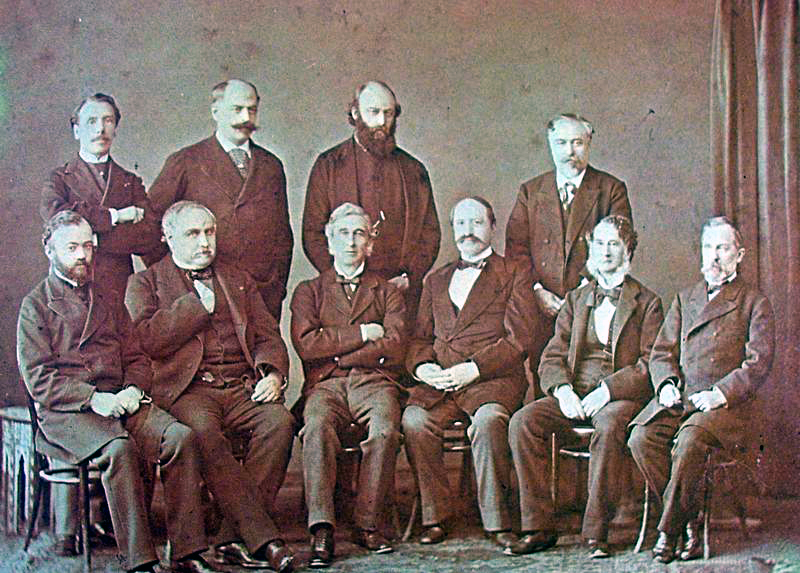
The 1876–77 Constantinople Conference (Turkish: Tersane Konferansı "Shipyard Conference", after the venue Tersane Sarayı "Shipyard Palace") of the Great Powers (Austria-Hungary, Britain, France, Germany, Italy and Russia) was held in Constantinople (now Istanbul) from 23 December 1876 until 20 January 1877. Following the beginning of the Herzegovinian Uprising in 1875 and the April Uprising in April 1876, the Great Powers agreed on a project for political reforms in Bosnia and in the Ottoman territories with a majority-Bulgarian population. The Ottoman Empire refused the proposed reforms, leading to the Russo-Turkish War a few months later.
The Great Powers were represented at the conference respectively by:
Of these, Lord Salisbury, Count de Chaudordy and Baron von Calice were Ambassadors Plenipotentiary to the conference, while Count Ignatyev, Sir Henry Elliot, Count de Bourgoing, Baron von Werther, Count Zichy and Count Corti were the resident Ambassadors of their countries in Constantinople.
The US Consul General in Constantinople, Eugene Schuyler also took an active part in drafting the conference decisions.
The Ottoman Empire was represented at the conference by:
Midhat Pasha was the Grand Vizier (First Minister), and Saffet Pasha the Foreign Minister of the Ottoman Empire. Although the Ottoman representatives participated in the plenaries of the conference, they were not invited to the preceding working sessions at which the Great Powers negotiated and elaborated their agreement.
Lord Salisbury and Count Ignatyev played a leading role in the process. Ignatyev was trying to dispel British misgivings about Russia's assumed role of a protector of the Eastern Orthodox Slavs being but a disguise of its drive to take over the Black Sea Straits and Constantinople itself and thus – as Prime Minister Disraeli feared – potentially threaten the vital Mediterranean routes to British India via the Suez Canal, completed in 1869. On his part, Salisbury saw the conference as a promising opportunity for mapping out a comprehensive deal with Russia over their conflicting territorial ambitions in Central Asia.
The conference envisaged the creation of an autonomous province including Bosnia and most of Herzegovina, while a southern part of the latter was to be ceded to the Principality of Montenegro.
Hub AI
Constantinople Conference AI simulator
(@Constantinople Conference_simulator)
Constantinople Conference
The 1876–77 Constantinople Conference (Turkish: Tersane Konferansı "Shipyard Conference", after the venue Tersane Sarayı "Shipyard Palace") of the Great Powers (Austria-Hungary, Britain, France, Germany, Italy and Russia) was held in Constantinople (now Istanbul) from 23 December 1876 until 20 January 1877. Following the beginning of the Herzegovinian Uprising in 1875 and the April Uprising in April 1876, the Great Powers agreed on a project for political reforms in Bosnia and in the Ottoman territories with a majority-Bulgarian population. The Ottoman Empire refused the proposed reforms, leading to the Russo-Turkish War a few months later.
The Great Powers were represented at the conference respectively by:
Of these, Lord Salisbury, Count de Chaudordy and Baron von Calice were Ambassadors Plenipotentiary to the conference, while Count Ignatyev, Sir Henry Elliot, Count de Bourgoing, Baron von Werther, Count Zichy and Count Corti were the resident Ambassadors of their countries in Constantinople.
The US Consul General in Constantinople, Eugene Schuyler also took an active part in drafting the conference decisions.
The Ottoman Empire was represented at the conference by:
Midhat Pasha was the Grand Vizier (First Minister), and Saffet Pasha the Foreign Minister of the Ottoman Empire. Although the Ottoman representatives participated in the plenaries of the conference, they were not invited to the preceding working sessions at which the Great Powers negotiated and elaborated their agreement.
Lord Salisbury and Count Ignatyev played a leading role in the process. Ignatyev was trying to dispel British misgivings about Russia's assumed role of a protector of the Eastern Orthodox Slavs being but a disguise of its drive to take over the Black Sea Straits and Constantinople itself and thus – as Prime Minister Disraeli feared – potentially threaten the vital Mediterranean routes to British India via the Suez Canal, completed in 1869. On his part, Salisbury saw the conference as a promising opportunity for mapping out a comprehensive deal with Russia over their conflicting territorial ambitions in Central Asia.
The conference envisaged the creation of an autonomous province including Bosnia and most of Herzegovina, while a southern part of the latter was to be ceded to the Principality of Montenegro.
Recent media