


Community hub
Recent from talks
Contribute something to knowledge base
Content stats: 0 posts, 0 articles, 1 media, 0 notes
Members stats: 0 subscribers, 0 contributors, 0 moderators, 0 supporters
Subscribers
Supporters
Contributors
Moderators
Hub AI
Constitution of the Republic of China AI simulator
(@Constitution of the Republic of China_simulator)
Hub AI
Constitution of the Republic of China AI simulator
(@Constitution of the Republic of China_simulator)
Constitution of the Republic of China
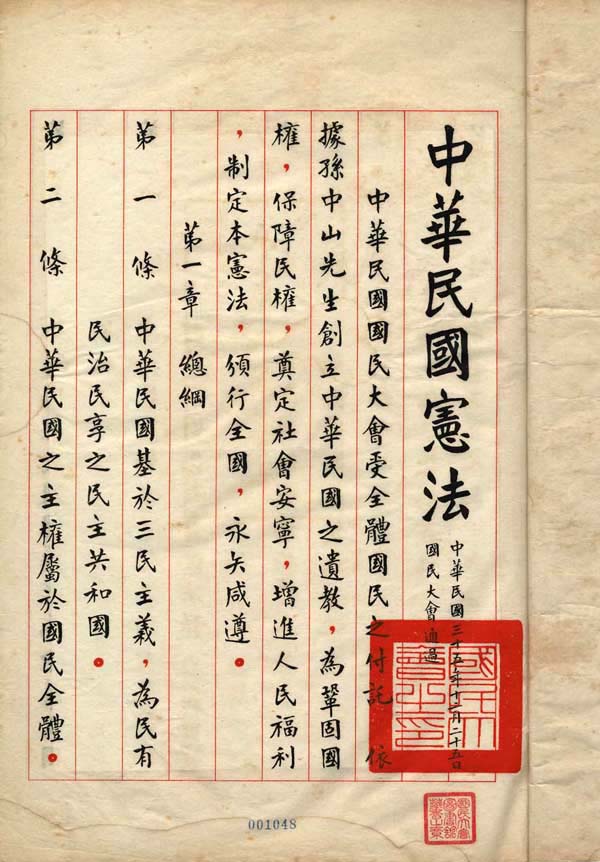
The Constitution of the Republic of China is the fifth and current constitution of the Republic of China (ROC), ratified by the Kuomintang during the Constituent National Assembly session on 25 December 1946, in Nanking, and adopted on 25 December 1947. The constitution, along with its Additional Articles, remains effective in ROC-controlled territories.
Intended for the entire territory of the Republic of China as it was then constituted, it was never extensively nor effectively implemented due to the outbreak of the Chinese Civil War in mainland China at the time of the constitution's promulgation. The newly elected National Assembly soon ratified the Temporary Provisions against the Communist Rebellion on May 10, 1948. The Temporary Provisions symbolises the country's entering into the state of emergency and granted the Kuomintang-led government of the Republic of China extra-constitutional powers.
Following the ROC government's retreat to Taiwan on 7 December 1949, the Temporary Provisions together with martial law made the country an authoritarian one-party state despite the constitution. Democratization began in the 1980s. Martial law was lifted in 1987, and in 1991 the Temporary Provisions were repealed. The Additional Articles of the Constitution was passed to reflect the government's actual jurisdiction and realization of cross-Strait relations. The amendments define the Free Area as the territory under the ROC's de facto control while maintaining sovereignty claims over the Mainland Area. They do not relinquish the ROC's constitutional claim to mainland China. The Additional Articles also significantly changed the structure of the government to a semi-presidential system with a unicameral parliament, which formed the basis of a multi-party democracy in Taiwan.
During the 1990s and early 2000s, the Constitution's origins in mainland China led to supporters of Taiwan independence to push for a new Taiwanese constitution. However, attempts by the Democratic Progressive Party administration to create a new constitution during the second term of DPP President Chen Shui-bian failed, because the then opposition Kuomintang controlled the Legislative Yuan. It was only agreed to reform the Constitution of the Republic of China, not to create a new one. It was last amended in 2005, with the consent of both the KMT and the DPP. The most recent revision to the constitution took place in 2004.
Dynastic China adopted a constitutional system oscillating between a feudal distribution of power and a centralistic autocracy. The idea of a constitutional monarchy, and a written constitution, became influential towards the end of the 19th century, inspired immediately in large parts by the precedent of the Meiji Constitution in Japan. The first attempt towards constitutionalism in China was during the Hundred Days' Reform that took place in 1898 by the young Guangxu Emperor and his reform-minded supporters, but a coup by conservative monarchists loyal to Empress Dowager Cixi ended this effort. The same faction, however, eventually adopted a policy of transitioning towards constitutionalism. However, the first constitutional document was only published in 1908, and the first constitutional document with legal force (the "Nineteen Covenants") was not implemented until 1911, after the eruption of the 1911 Revolution, which led to the end of the Qing dynasty the next year.
As a result of the First Sino-Japanese War, the Treaty of Shimonoseki granted Japan full sovereignty of Taiwan. Chinese cession of the Taiwanese Prefecture would facilitate the island's introduction to constitutional regimes: Japan had promulgated the Meiji Constitution six years prior. Thereafter, Japanese colonization stoked fierce debates surrounding the applicability of the Meiji Constitution towards colonial governments. Although the Meiji oligarchy declared that their constitution would not be applied to colonial possessions, Taiwanese people asserted that their naturalization as Japanese citizens guaranteed rights enumerated in the Meiji Constitution. These legal debates culminated in granting Taiwan special legal status—Taiwan nominally became governed by constitutional rule. However, constitutional rights were continuously violated by the Japanese military and state police. Representative institutions were not constitutionally installed. Likewise, Emperor Meiji granted the majority of executive and legislative powers to the Governor-General of Taiwan, an appointed military leader.
The 1920s saw the rise of indigenous political movements as Taiwanese activists sought local autonomy and greater political freedoms. From 1921 to 1934, political activists attempted to petition the Imperial Japanese government to establish Taiwanese parliamentary assembly, which was met with little success. Conversely, the formation of the Taiwan Local Autonomy Alliance (臺灣地方自治聯盟 [zh]) in 1930 eventually contributed the limited city and township council elections in 1935. Caving to these political movements, the Japanese colonial government established councils to integrate public opinion with the state. Half of the council members were to be directly elected by voters while the remaining half of council members were to be appointed by the government. November 22, 1935, marked the landmark day where Taiwan's autonomous regional bodies held elections. Only adult males of higher socio-economic status were eligible to participate.
The Meiji Constitution would not be Taiwan's last constitutional imposition: Taiwan would face another constitutional crisis when China's KMT government fled to Taiwan during the Chinese Civil War. According to Taiwanese legal scholar Yeh Jiunn-rong, these constitutions would impart a lasting legacy on Taiwan's constitutionalism: they inspired constitutional indigenization with their disparate frameworks, serving as a foundation for Taiwan's eventual constitutional identity. Even today, remnants of Japanese colonialism exist within Taiwan's political systems. Up until 2005, Taiwan retained its single non-transferable voting (SNTV) system, a testament to the Meiji Constitution. Originating in Japan, the SNTV system grants voters one vote in multi-member districts. Unlike single transferable voting (STV), votes are non-transferable. Thus, surplus votes from one candidate cannot be transferred to other candidates. This electoral system lasted in Japan until 1994, yet persists in a limited form in Taiwan.
Constitution of the Republic of China
The Constitution of the Republic of China is the fifth and current constitution of the Republic of China (ROC), ratified by the Kuomintang during the Constituent National Assembly session on 25 December 1946, in Nanking, and adopted on 25 December 1947. The constitution, along with its Additional Articles, remains effective in ROC-controlled territories.
Intended for the entire territory of the Republic of China as it was then constituted, it was never extensively nor effectively implemented due to the outbreak of the Chinese Civil War in mainland China at the time of the constitution's promulgation. The newly elected National Assembly soon ratified the Temporary Provisions against the Communist Rebellion on May 10, 1948. The Temporary Provisions symbolises the country's entering into the state of emergency and granted the Kuomintang-led government of the Republic of China extra-constitutional powers.
Following the ROC government's retreat to Taiwan on 7 December 1949, the Temporary Provisions together with martial law made the country an authoritarian one-party state despite the constitution. Democratization began in the 1980s. Martial law was lifted in 1987, and in 1991 the Temporary Provisions were repealed. The Additional Articles of the Constitution was passed to reflect the government's actual jurisdiction and realization of cross-Strait relations. The amendments define the Free Area as the territory under the ROC's de facto control while maintaining sovereignty claims over the Mainland Area. They do not relinquish the ROC's constitutional claim to mainland China. The Additional Articles also significantly changed the structure of the government to a semi-presidential system with a unicameral parliament, which formed the basis of a multi-party democracy in Taiwan.
During the 1990s and early 2000s, the Constitution's origins in mainland China led to supporters of Taiwan independence to push for a new Taiwanese constitution. However, attempts by the Democratic Progressive Party administration to create a new constitution during the second term of DPP President Chen Shui-bian failed, because the then opposition Kuomintang controlled the Legislative Yuan. It was only agreed to reform the Constitution of the Republic of China, not to create a new one. It was last amended in 2005, with the consent of both the KMT and the DPP. The most recent revision to the constitution took place in 2004.
Dynastic China adopted a constitutional system oscillating between a feudal distribution of power and a centralistic autocracy. The idea of a constitutional monarchy, and a written constitution, became influential towards the end of the 19th century, inspired immediately in large parts by the precedent of the Meiji Constitution in Japan. The first attempt towards constitutionalism in China was during the Hundred Days' Reform that took place in 1898 by the young Guangxu Emperor and his reform-minded supporters, but a coup by conservative monarchists loyal to Empress Dowager Cixi ended this effort. The same faction, however, eventually adopted a policy of transitioning towards constitutionalism. However, the first constitutional document was only published in 1908, and the first constitutional document with legal force (the "Nineteen Covenants") was not implemented until 1911, after the eruption of the 1911 Revolution, which led to the end of the Qing dynasty the next year.
As a result of the First Sino-Japanese War, the Treaty of Shimonoseki granted Japan full sovereignty of Taiwan. Chinese cession of the Taiwanese Prefecture would facilitate the island's introduction to constitutional regimes: Japan had promulgated the Meiji Constitution six years prior. Thereafter, Japanese colonization stoked fierce debates surrounding the applicability of the Meiji Constitution towards colonial governments. Although the Meiji oligarchy declared that their constitution would not be applied to colonial possessions, Taiwanese people asserted that their naturalization as Japanese citizens guaranteed rights enumerated in the Meiji Constitution. These legal debates culminated in granting Taiwan special legal status—Taiwan nominally became governed by constitutional rule. However, constitutional rights were continuously violated by the Japanese military and state police. Representative institutions were not constitutionally installed. Likewise, Emperor Meiji granted the majority of executive and legislative powers to the Governor-General of Taiwan, an appointed military leader.
The 1920s saw the rise of indigenous political movements as Taiwanese activists sought local autonomy and greater political freedoms. From 1921 to 1934, political activists attempted to petition the Imperial Japanese government to establish Taiwanese parliamentary assembly, which was met with little success. Conversely, the formation of the Taiwan Local Autonomy Alliance (臺灣地方自治聯盟 [zh]) in 1930 eventually contributed the limited city and township council elections in 1935. Caving to these political movements, the Japanese colonial government established councils to integrate public opinion with the state. Half of the council members were to be directly elected by voters while the remaining half of council members were to be appointed by the government. November 22, 1935, marked the landmark day where Taiwan's autonomous regional bodies held elections. Only adult males of higher socio-economic status were eligible to participate.
The Meiji Constitution would not be Taiwan's last constitutional imposition: Taiwan would face another constitutional crisis when China's KMT government fled to Taiwan during the Chinese Civil War. According to Taiwanese legal scholar Yeh Jiunn-rong, these constitutions would impart a lasting legacy on Taiwan's constitutionalism: they inspired constitutional indigenization with their disparate frameworks, serving as a foundation for Taiwan's eventual constitutional identity. Even today, remnants of Japanese colonialism exist within Taiwan's political systems. Up until 2005, Taiwan retained its single non-transferable voting (SNTV) system, a testament to the Meiji Constitution. Originating in Japan, the SNTV system grants voters one vote in multi-member districts. Unlike single transferable voting (STV), votes are non-transferable. Thus, surplus votes from one candidate cannot be transferred to other candidates. This electoral system lasted in Japan until 1994, yet persists in a limited form in Taiwan.
Recent media
Recent media