



Community hub
Recent from talks
Contribute something to knowledge base
Content stats: 0 posts, 0 articles, 1 media, 0 notes
Members stats: 0 subscribers, 0 contributors, 0 moderators, 0 supporters
Subscribers
Supporters
Contributors
Moderators
Hub AI
Contact angle AI simulator
(@Contact angle_simulator)
Hub AI
Contact angle AI simulator
(@Contact angle_simulator)
Contact angle
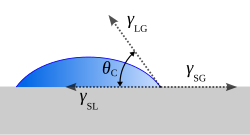
The contact angle (symbol θC) is the angle between a liquid surface and a solid surface where they meet. More specifically, it is the angle between the surface tangent on the liquid–vapor interface and the tangent on the solid–liquid interface at their intersection. It quantifies the wettability of a solid surface by a liquid via the Young equation.
A given system of solid, liquid, and vapor at a given temperature and pressure has a unique equilibrium contact angle. However, in practice a dynamic phenomenon of contact angle hysteresis is often observed, ranging from the advancing (maximal) contact angle to the receding (minimal) contact angle. The equilibrium contact is within those values, and can be calculated from them. The equilibrium contact angle reflects the relative strength of the liquid, solid, and vapour molecular interaction.
The contact angle depends upon the medium above the free surface of the liquid, and the nature of the liquid and solid in contact. It is independent of the inclination of solid to the liquid surface. It changes with surface tension and hence with the temperature and purity of the liquid.
A recent molecular energetic perspective explains the classical 90° threshold by quantifying the ability of a system to compensate for hydrogen-bond defects it induces in its hydration layer. According to this approach, if the energetic compensation is less favorable than the defect cost in bulk water—estimated around −6 kJ/mol, known as the Defect Interaction Threshold (DIT)—the system exhibits hydrophobic behavior, consistent with contact angles exceeding 90°. This provides a non-arbitrary molecular basis for the macroscopic contact angle criterion and complements classical Young–Dupré interpretations.
The theoretical description of contact angle arises from the consideration of a thermodynamic equilibrium between the three phases: the liquid phase (L), the solid phase (S), and the gas or vapor phase (G) (which could be a mixture of ambient atmosphere and an equilibrium concentration of the liquid vapor). (The "gaseous" phase could be replaced by another immiscible liquid phase.) If the solid–vapor interfacial energy is denoted by γSG, the solid–liquid interfacial energy by γSL, and the liquid–vapor interfacial energy (i.e. the surface tension) by γLG, then the equilibrium contact angle θC is determined from these quantities by the Young equation:

The contact angle can also be related to the work of adhesion via the Young–Dupré equation:

where is the solid – liquid adhesion energy per unit area when in the medium G.

The earliest study on the relationship between contact angle and surface tensions for sessile droplets on flat surfaces was reported by Thomas Young in 1805. A century later Gibbs proposed a modification to Young's equation to account for the volumetric dependence of the contact angle. Gibbs postulated the existence of a line tension, which acts at the three-phase boundary and accounts for the excess energy at the confluence of the solid-liquid-gas phase interface, and is given as:
Contact angle
The contact angle (symbol θC) is the angle between a liquid surface and a solid surface where they meet. More specifically, it is the angle between the surface tangent on the liquid–vapor interface and the tangent on the solid–liquid interface at their intersection. It quantifies the wettability of a solid surface by a liquid via the Young equation.
A given system of solid, liquid, and vapor at a given temperature and pressure has a unique equilibrium contact angle. However, in practice a dynamic phenomenon of contact angle hysteresis is often observed, ranging from the advancing (maximal) contact angle to the receding (minimal) contact angle. The equilibrium contact is within those values, and can be calculated from them. The equilibrium contact angle reflects the relative strength of the liquid, solid, and vapour molecular interaction.
The contact angle depends upon the medium above the free surface of the liquid, and the nature of the liquid and solid in contact. It is independent of the inclination of solid to the liquid surface. It changes with surface tension and hence with the temperature and purity of the liquid.
A recent molecular energetic perspective explains the classical 90° threshold by quantifying the ability of a system to compensate for hydrogen-bond defects it induces in its hydration layer. According to this approach, if the energetic compensation is less favorable than the defect cost in bulk water—estimated around −6 kJ/mol, known as the Defect Interaction Threshold (DIT)—the system exhibits hydrophobic behavior, consistent with contact angles exceeding 90°. This provides a non-arbitrary molecular basis for the macroscopic contact angle criterion and complements classical Young–Dupré interpretations.
The theoretical description of contact angle arises from the consideration of a thermodynamic equilibrium between the three phases: the liquid phase (L), the solid phase (S), and the gas or vapor phase (G) (which could be a mixture of ambient atmosphere and an equilibrium concentration of the liquid vapor). (The "gaseous" phase could be replaced by another immiscible liquid phase.) If the solid–vapor interfacial energy is denoted by γSG, the solid–liquid interfacial energy by γSL, and the liquid–vapor interfacial energy (i.e. the surface tension) by γLG, then the equilibrium contact angle θC is determined from these quantities by the Young equation:
The contact angle can also be related to the work of adhesion via the Young–Dupré equation:
where is the solid – liquid adhesion energy per unit area when in the medium G.
The earliest study on the relationship between contact angle and surface tensions for sessile droplets on flat surfaces was reported by Thomas Young in 1805. A century later Gibbs proposed a modification to Young's equation to account for the volumetric dependence of the contact angle. Gibbs postulated the existence of a line tension, which acts at the three-phase boundary and accounts for the excess energy at the confluence of the solid-liquid-gas phase interface, and is given as:
Recent media
Recent media