
Hubbry Logo
Converse relationConverse relationMain
Open search
Converse relation
Community hub
Converse relation
logo
7 pages, 0 posts
0 subscribers
Be the first to start a discussion here.
Converse relation
Converse relation
from Wikipedia

In mathematics, the converse of a binary relation is the relation that occurs when the order of the elements is switched in the relation. For example, the converse of the relation 'child of' is the relation 'parent of'. In formal terms, if and are sets and is a relation from to then is the relation defined so that if and only if In set-builder notation,

Since a relation may be represented by a logical matrix, and the logical matrix of the converse relation is the transpose of the original, the converse relation[1][2][3][4] is also called the transpose relation.[5] It has also been called the opposite or dual of the original relation,[6] the inverse of the original relation,[7][8][9][10] or the reciprocal of the relation [11]

Other notations for the converse relation include or [citation needed]
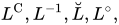
The notation is analogous with that for an inverse function. Although many functions do not have an inverse, every relation does have a unique converse. The unary operation that maps a relation to the converse relation is an involution, so it induces the structure of a semigroup with involution on the binary relations on a set, or, more generally, induces a dagger category on the category of relations as detailed below. As a unary operation, taking the converse (sometimes called conversion or transposition)[citation needed] commutes with the order-related operations of the calculus of relations, that is it commutes with union, intersection, and complement.

Examples

[edit]

For the usual (maybe strict or partial) order relations, the converse is the naively expected "opposite" order, for examples,

A relation may be represented by a logical matrix such as
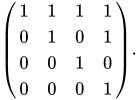
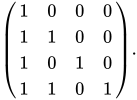
Then the converse relation is represented by its transpose matrix:
The converse of kinship relations are named: " is a child of " has converse " is a parent of ". " is a nephew or niece of " has converse " is an uncle or aunt of ". The relation " is a sibling of " is its own converse, since it is a symmetric relation.

Properties

[edit]

In the monoid of binary endorelations on a set (with the binary operation on relations being the composition of relations), the converse relation does not satisfy the definition of an inverse from group theory, that is, if is an arbitrary relation on then does not equal the identity relation on in general. The converse relation does satisfy the (weaker) axioms of a semigroup with involution: and [12]

Since one may generally consider relations between different sets (which form a category rather than a monoid, namely the category of relations Rel), in this context the converse relation conforms to the axioms of a dagger category (aka category with involution).[12] A relation equal to its converse is a symmetric relation; in the language of dagger categories, it is self-adjoint.

Furthermore, the semigroup of endorelations on a set is also a partially ordered structure (with inclusion of relations as sets), and actually an involutive quantale. Similarly, the category of heterogeneous relations, Rel is also an ordered category.[12]

In the calculus of relations, conversion (the unary operation of taking the converse relation) commutes with other binary operations of union and intersection. Conversion also commutes with unary operation of complementation as well as with taking suprema and infima. Conversion is also compatible with the ordering of relations by inclusion.[5]

If a relation is reflexive, irreflexive, symmetric, antisymmetric, asymmetric, transitive, connected, trichotomous, a partial order, total order, strict weak order, total preorder (weak order), or an equivalence relation, its converse is too.

Inverses

[edit]

If represents the identity relation, then a relation may have an inverse as follows: is called

right-invertible
if there exists a relation called a right inverse of that satisfies
left-invertible
if there exists a relation called a left inverse of that satisfies
invertible
if it is both right-invertible and left-invertible.

For an invertible homogeneous relation all right and left inverses coincide; this unique set is called its inverse and it is denoted by In this case, holds.[5]: 79 

Converse relation of a function

[edit]

A function is invertible if and only if its converse relation is a function, in which case the converse relation is the inverse function.

The converse relation of a function is the relation defined by the

This is not necessarily a function: One necessary condition is that be injective, since else is multi-valued. This condition is sufficient for being a partial function, and it is clear that then is a (total) function if and only if is surjective. In that case, meaning if is bijective, may be called the inverse function of

For example, the function has the inverse function

However, the function has the inverse relation which is not a function, being multi-valued.

Composition with relation

[edit]

Using composition of relations, a relation can be composed with its converse.

For the subset relation on the power set of a universe , both compositions with its converse are the universal relation on :

Indeed, for any ,

which holds by taking ; similarly,

which holds by taking .

Now consider the set membership relation and its converse . For sets ,

so is the "nonempty intersection" relation on . Conversely, for elements ,

which always holds (e.g. for ); hence is the universal relation on .

The compositions are used to classify relations according to type: for a relation Q, when the identity relation on the range of Q contains QTQ, then Q is called univalent. When the identity relation on the domain of Q is contained in QQT, then Q is called total. When Q is both univalent and total then it is a function. When QT is univalent, then Q is termed injective. When QT is total, Q is termed surjective.[13]

If Q is univalent, then QQT is an equivalence relation on the domain of Q, see Transitive relation#Related properties.

See also

[edit]

References

[edit]
Revisions and contributorsEdit on WikipediaRead on Wikipedia
from Grokipedia
In , the converse relation, also known as the inverse relation, of a binary relation RR from a set AA to a set BB is the relation R1R^{-1} from BB to AA defined by (b,a)R1(b, a) \in R^{-1} (a,b)R(a, b) \in R, effectively reversing the order of elements in each . This construction applies to any , regardless of whether it is a function, and the converse of the converse returns the original relation, making it an involution. A relation RR is symmetric if and only if it equals its converse, R=R1R = R^{-1}, as seen in examples like the "equals" relation on numbers. For asymmetric relations, such as the "less than" relation on real numbers where x<yx < y implies y>xy > x via the converse, it highlights directional properties essential in order theory. The converse also interacts with relation composition: if τ=ρσ\tau = \rho \circ \sigma, then τ1=σ1ρ1\tau^{-1} = \sigma^{-1} \circ \rho^{-1}, preserving structural analyses in relational algebra. Philosophically and logically, the converse relation underscores debates on relational directionality, as in distinguishing "before" from "after," and has been explored since at least the mid-20th century in works examining non-symmetric structures. In practical terms, it appears in for reversing associations and in as the transpose of a directed graph's adjacency relation.

Definition

Formal Definition

In , a RR on sets XX and YY is a of the X×YX \times Y, consisting of (x,y)(x, y) where xXx \in X and yYy \in Y. The converse relation of RR, also known as the inverse relation, is the set of all (y,x)Y×X(y, x) \in Y \times X such that (x,y)R(x, y) \in R. This reverses the order of the elements in each from RR, thereby swapping the roles of the domain and : if RR relates elements from XX to YY, its converse relates elements from YY to XX. This reversal preserves the membership condition of the original relation, meaning that the converse includes a pair precisely when the corresponding reversed pair is in RR, without adding or removing any associations beyond this transposition. Various notations exist for the converse, such as superscript TT or inverse symbol 1-1, as detailed in subsequent sections on representation.

Notation and Representation

The converse of a RR is commonly denoted using superscript notation to evoke analogies with matrix operations or inverses. One standard symbol is RTR^T, which highlights its correspondence to the in matrix representations, particularly useful in contexts involving over relations. Another frequent notation is R1R^{-1}, emphasizing the reversal of direction, though this must be distinguished from the inverse of a function, as general relations are not necessarily functional and R1R^{-1} simply denotes the converse set {(b,a)(a,b)R}\{(b, a) \mid (a, b) \in R\}. In and lattice studies, the opposite or converse relation is sometimes written as RopR^{\mathrm{op}}, reflecting its role in reversing the order of a . Binary relations can also be represented using logical matrices, providing a visual and computational tool for the converse. For a relation RA×BR \subseteq A \times B where A={a1,,am}A = \{a_1, \dots, a_m\} and B={b1,,bn}B = \{b_1, \dots, b_n\}, the MRM_R is an m×nm \times n matrix with entries M_R_{ij} = 1 if (ai,bj)R(a_i, b_j) \in R and 00 otherwise. The matrix for the converse relation RTR^T (or R1R^{-1}) is then the MRTM_R^T, an n×mn \times m matrix where (MRT)ji=1(M_R^T)_{ji} = 1 if (bj,ai)RT(b_j, a_i) \in R^T, effectively swapping rows and columns to reverse the relational direction. This transposition mirrors the geometric reflection of the relation's graph across the in the Cartesian plane. In the homogeneous case, where RX×XR \subseteq X \times X for a single finite set XX with X=k|X| = k, the matrix MRM_R is a square k×kk \times k logical matrix, and the converse is directly given by its transpose MRTM_R^T, preserving the square structure while inverting the off-diagonal entries symmetrically. This representation facilitates efficient computation of relational properties, such as symmetry (where R=RTR = R^T), using standard matrix operations.

Properties

Basic Algebraic Properties

The converse of a RR, denoted RTR^T, is an involution, satisfying (RT)T=R(R^T)^T = R; that is, applying the converse operation twice yields the original relation. This operation commutes with the standard operations on relations. Specifically, the converse of the union of two relations is the union of their converses: (RS)T=RTST(R \cup S)^T = R^T \cup S^T. Similarly, the converse of the is the of the converses: (RS)T=RTST(R \cap S)^T = R^T \cap S^T. The converse also commutes with the complement operation: (Rc)T=(RT)c(R^c)^T = (R^T)^c, where RcR^c denotes the complement of RR relative to the underlying . When considering typed relations, the converse preserves consistency under domain and restrictions. For a relation RX×YR \subseteq X \times Y and another SY×ZS \subseteq Y \times Z, the converse RTY×XR^T \subseteq Y \times X and STZ×YS^T \subseteq Z \times Y simply swap the roles of the sets, maintaining the relational across the chain without altering the inclusions. In the broader algebraic context, the collection of all binary relations on a fixed set forms a under relation composition, and the converse acts as an involution on this , reversing the order in compositions while preserving the overall .

Preservation of Structural Properties

The converse of a binary relation RR, denoted RTR^T, preserves reflexivity: RR is reflexive if and only if RTR^T is reflexive, as the pairs (a,a)(a, a) for all aa in the domain remain on the diagonal and are unaffected by transposition. This equivalence holds because reflexivity depends solely on self-pairs, which are invariant under the converse operation. Symmetry is characterized by self-converseness: a relation RR is R=RTR = R^T, meaning relations are unchanged by taking the converse. In this case, the converse operation yields the original relation, highlighting as the property where transposition has no effect. Transitivity is also preserved under the converse: RR is transitive RTR^T is transitive, since the operation maintains the composition structure required for the transitivity condition (if xRyx R y and yRzy R z, then zRTyz R^T y and yRTxy R^T x, implying zRTxz R^T x). This preservation follows from the duality in relational composition introduced in the basic algebraic properties. For antisymmetry, relevant to partial orders, the converse preserves the property: RR is antisymmetric if and only if RTR^T is antisymmetric, as the condition that aRba R b and bRab R a imply a=ba = b directly translates to bRTab R^T a and aRTba R^T b implying a=ba = b. Thus, if RR defines a partial order (reflexive, antisymmetric, and transitive), so does RTR^T, reversing the order while retaining its structural integrity. Equivalence relations, being reflexive, symmetric, and transitive, have converses that are identical to themselves due to , and the preservation of the other properties ensures the converse remains an . This self-duality underscores the robustness of equivalence relations under transposition.

Inverses and Special Cases

General Inverses of Relations

In the theory of binary relations, a relation RA×BR \subseteq A \times B is defined to be left-invertible if there exists another relation SB×AS \subseteq B \times A such that the composition SRS \circ R equals the identity relation IdA={(a,a)aA}\mathrm{Id}_A = \{ (a, a) \mid a \in A \}. Similarly, RR is right-invertible if there exists SB×AS \subseteq B \times A such that RS=IdBR \circ S = \mathrm{Id}_B. These definitions extend the notions of invertibility from functions to general relations, where composition SRS \circ R consists of pairs (a,b)(a, b) for which there exists some intermediate element linking them through RR and SS. A relation is invertible if it is both left- and right-invertible with the same SS, satisfying SR=IdAS \circ R = \mathrm{Id}_A and RS=IdBR \circ S = \mathrm{Id}_B. For homogeneous relations, which are binary relations RX×XR \subseteq X \times X on a single set XX, invertibility implies a close connection to the converse relation RT={(y,x)(x,y)R}R^T = \{ (y, x) \mid (x, y) \in R \}. Specifically, such an RR is invertible if and only if its converse serves as the two-sided inverse, meaning RTR=RRT=IdXR^T \circ R = R \circ R^T = \mathrm{Id}_X. This holds because invertible homogeneous relations correspond precisely to the graphs of s on XX, where the inverse relation is the graph of the corresponding inverse , coinciding with the converse. Most binary relations are not invertible, as the existence of a left or right inverse requires strong structural constraints, such as totality and uniqueness properties in the compositions. In contrast, the converse relation always exists for any and can be computed directly by swapping pairs, but it generally does not compose with the original to yield the identity unless the relation is invertible. In a modern abstract perspective, the category Rel of sets and s, equipped with relational composition as the categorical composition, forms a category where the dagger functor is precisely the converse operation. Here, invertible morphisms (isomorphisms in Rel) are the unitary morphisms, satisfying R=R1R^\dagger = R^{-1}, providing a categorical framework for understanding inverses beyond set-theoretic definitions.

Converse Relations for Functions

A function f:XYf: X \to Y can be viewed as a special type of , specifically a right-unique relation on X×YX \times Y, meaning that for each xXx \in X, there is at most one yYy \in Y such that (x,y)f(x, y) \in f. This right-uniqueness ensures that the relation defines a unique output for every input in the domain. The converse of such a function, denoted f1f^{-1}, is the relation {(y,x)(x,y)f}\{(y, x) \mid (x, y) \in f\}, which reverses the direction of the pairs. In general, f1f^{-1} is a left-total relation if ff is surjective (onto), meaning every yYy \in Y relates to at least one xXx \in X, but it is typically multi-valued unless ff is also injective (one-to-one). The converse f1f^{-1} qualifies as a function from YY to XX if and only if ff is bijective, that is, both injective and surjective. In this case, f1f^{-1} serves as the true , satisfying ff1=idYf \circ f^{-1} = \mathrm{id}_Y and f1f=idXf^{-1} \circ f = \mathrm{id}_X, where id\mathrm{id} denotes the . For non-bijective functions, the converse remains a relation but fails to be single-valued, as multiple inputs may map to the same output under ff, leading to multiple possible preimages for a given yy. This multi-valued nature highlights that the converse of a function is not necessarily a function itself, distinguishing it from the general inverse relations discussed earlier. Consider the example of f:RRf: \mathbb{R} \to \mathbb{R} defined by f(x)=2xf(x) = 2x. This function is bijective, and its converse is the single-valued function f1(y)=y/2f^{-1}(y) = y/2, which inverts the scaling. In contrast, for f:[0,)[0,)f: [0, \infty) \to [0, \infty) given by f(x)=x2f(x) = x^2, which is injective but not surjective on the reals (though surjective here by domain restriction), the converse is f1(y)=yf^{-1}(y) = \sqrt{y}
Add your contribution
Related Hubs
User Avatar
No comments yet.