


Community hub
Recent from talks
Contribute something
Nothing was collected or created yet.
Safety (gridiron football score)
View on Wikipedia

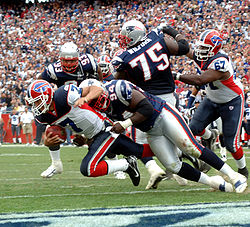
In gridiron football, the safety (American football) or safety touch (Canadian football) is a scoring play that results in two points being awarded to the scoring team. Safeties can be scored in a number of ways, such as when a ball carrier is tackled in his own end zone or when a foul is committed by the offense in its own end zone. After a safety is scored in American football, the ball is kicked off to the team that scored the safety from the 20-yard line; in Canadian football, the scoring team also has the options of taking control of the ball at its own 35-yard line or kicking off the ball, also at its own 35-yard line. The ability of the scoring team to receive the ball through a kickoff differs from the touchdown and field goal, which require the scoring team to kick the ball off to the scored-upon team.[1] Despite being of relatively low point value, safeties can have a significant impact on the result of games,[2] and Brian Burke of Advanced NFL Stats estimated that safeties have a greater abstract value than field goals, despite being worth a point less, due to the field position and reclaimed possession gained off the safety kick.[1]
Safeties are the least common method of scoring in American football[3] but are not rare occurrences[2]—a safety has occurred around once every 14 games in the history of the National Football League (NFL), or about once a week under current scheduling rules.[2] A much rarer occurrence is the one-point (or conversion) safety, which can be scored by the offense on an extra point or two-point conversion attempt: these have occurred at least twice in NCAA Division I football since 1996, most recently at the 2013 Fiesta Bowl, though no conversion safeties have occurred since 1940 in the NFL. A conversion safety by the defense is also possible, though highly unlikely. Although this has never occurred, it is the only possible way a team could finish with a single point in an American football game.[A]
Scoring a safety
[edit]American football
[edit]In American football, a safety is scored when any of the following conditions occur:[4][5][6]
- The ball carrier is tackled or forced out of bounds in his own end zone.
- The ball becomes dead in the end zone, with the exception of an incomplete forward pass, and the defending team is responsible for it being there.
- The offense commits a foul in its own end zone.
Canadian football
[edit]In Canadian football, a safety touch is scored when any of the following conditions occur:[7]
- The ball becomes dead in the goal area of the team in possession of the ball
- The ball touches or crosses the dead line or a sideline in goal after having been directed from the field of play into the Goal Area by the team scored against or as the direct result of a blocked scrimmage kick.
- The ball carrier is penalized for intentional grounding or an offside pass in his own goal area.
Resuming play after a safety
[edit]American football
[edit]After a safety is scored, the ball is put into play by a free kick. The team that was scored upon must kick the ball from its own 20-yard line and can punt, drop kick, or place kick the ball. Prior to 2024, a tee could not be used in the NFL; a tee has always been legal in high school or college football. Once the ball has been kicked, it can be caught and advanced by any member of the receiving team, and it can be recovered by the kicking team if the ball travels at least 10 yards or a player of the receiving team touches the ball.[8][9]
Canadian football
[edit]After scoring a safety touch, the scoring team has the option of taking control of the ball and beginning play from its own 35-yard line, kicking the ball off from its 35-yard line, or accepting a kickoff from the team that conceded the score.[10] When the scored-against team kicks off, it comes from the 35-yard line under amateur rules and from the 25-yard line under CFL rules. If a kickoff is chosen it must be a place kick, and the ball can be held, placed on the ground, or placed on a tee prior to the kick. As in American football, the ball must go at least ten yards before it can be recovered by the kicking team.[11]
Elective safeties
[edit]In American football, intentionally conceded safeties are an uncommon strategy. Teams have utilized elective safeties to gain field position for a punt when pinned deep in their own territory[12][13] and, when ahead near the end of a game, to run down the clock so as to deny the other team a chance to force a turnover or return a punt.[14][15][16][17] Teams have also taken intentional safeties by kicking a loose ball out the back of their end zone (which is an illegal kick), with the intent of preventing the defense from scoring a touchdown.[18][19]
In the NFL, starting with the 2023 season, a defense can decline a safety in favor of accepting a penalty committed in the end zone by the offense.[20] An example where a defense may choose to do this could be an illegal kick committed in the end zone by the offense (such as may occur following a bad snap on an attempted punt) on fourth down; rather than allowing the play to result in a safety, the defense could accept the penalty, which for an illegal kick is 10 yards (or no more than half the distance to the goal line) from the prior spot of the ball and a loss of down.[20] With the infraction committed on fourth down, this would result in a change of possession, with the team that was on defense now having possession of the ball close to their opponent's goal line.[20]
Elective safeties are more common in Canadian football, where they can result in better field position than a punt. The 2010 Edmonton Eskimos surrendered a Canadian Football League (CFL)-record 14 safeties, a factor that led CFL reporter Jim Mullin to suggest increasing the value of the safety touch from two to three points as a deterrent.[21]
Conversion safeties (one-point safeties)
[edit]Scored by the offense
[edit]In American football, if a team attempting an extra point or two-point conversion (officially known in the rulebooks as a try) scores what would normally be a safety, that attempting team is awarded one point.[22][23][24] This is commonly known as a conversion safety or one-point safety.[24][25] The first known occurrence of the conversion safety was in an NCAA University Division (now NCAA FBS) game on October 2, 1971, scored by Syracuse in a game at Indiana. On a failed extra point attempt, an Indiana player illegally batted the ball in the end zone (a spot foul defensive penalty).[26][27][28] There are two other known occurrences of the conversion safety in Division I FBS college football – a November 26, 2004, game in which Texas scored against Texas A&M, and the 2013 Fiesta Bowl in which Oregon scored against Kansas State.[29] In both games, the extra point attempt was blocked and recovered by the defense, which then fumbled or threw the ball back into its own end zone.[30] A conversion safety has occurred once in Division I-AA (now NCAA FCS) where Nevada scored a conversion safety against North Texas on September 21, 1991[31] and twice in Division II: once by Morningside College on November 9, 1996, against Northern Colorado,[32] and once by Emory and Henry College on October 8, 2022, against University of Virginia's College at Wise.[33] There are also at least four known NCAA Division III occurrences, the first being on October 20, 1990, scored by DePauw University against Anderson University;[34] the second on October 23, 1993, scored by Salisbury State against Wesley College;[35] the third on November 11, 2000, scored by Hamline University against St. Thomas-Minnesota,[36] and the most recent scored by Bluffton University against Franklin College (Indiana) on November 9, 2013.[37][38][39] One-point safeties have also occurred in an NAIA game and two junior college games.[40][41][42]
No conversion safeties have been scored in the NFL since 1940, although it is now slightly more likely after a rule change in 2015 allowed the defense to take possession and score on a conversion attempt which, like college football, awards the defense two points for returning a blocked PAT attempt, or intercepting, or returning a fumble on a 2-point conversion.
Before 2015, the only scenario in which a one-point safety could have been scored in the NFL would have involved, on a conversion attempt in which the ball was not kicked by the offense, the defense then kicking or batting a loose ball out of its own end zone without taking possession of the ball, giving the offense a one-point safety.[43][44][45][46]
Scored by the defense
[edit]A conversion safety can also be scored by the defense.[23][22] This scoring play has never occurred; to accomplish this, the team attempting the try must somehow be forced back to its own end zone. A possible scenario in the NFL and NCAA would involve a turnover while attempting a conversion, followed by the defending team's ball-carrier fumbling while en route to the attempting team's end zone, with the attempting team then recovering the ball and, after establishing possession outside the end zone, downing it in its own end zone (this scenario is not possible in high school football, as a turnover ends the conversion attempt; such a conversion safety could occur only if the offense maintains possession). While such a conversion safety has never been scored by the defense, it is the only possible way under current rules in which a team could finish with a single point in an American football game.[A][47]
See also
[edit]Notes
[edit]Footnotes
[edit]Citations
[edit]- ^ a b Burke, Brian (September 22, 2008). "What's a Safety Really Worth?". Advanced NFL Stats. Archived from the original on January 24, 2013. Retrieved March 10, 2013.
- ^ a b c Belson, Ken (December 8, 2011). "All That Work for 2 Points". The New York Times. Archived from the original on December 31, 2011. Retrieved November 5, 2012.
- ^ Romer, David (April 2006). "Do Firms Maximize? Evidence from Professional Football" (PDF). Journal of Political Economy. 114 (2): 340–365. doi:10.1086/501171. S2CID 9940053. Archived (PDF) from the original on October 18, 2012. Retrieved October 23, 2012.
- ^ NFL Rules 2018, Rule 11 Scoring, Section 5 Safety, p. 44.
- ^ NCAA Rules 2011–2012, pp. 80–81.
- ^ NFHS Rules 2012, pp. 66–67.
- ^ CFL Rules 2011, p. 27.
- ^ NFL Rules 2018, Rule 6 Free Kicks, pp. 23–25.
- ^ NFHS Rules 2012, pp. 15, 46, 52–53.
- ^ CFL Rules 2011, p. 29.
- ^ CFL Rules 2011, pp. 36–39.
- ^ "Belichick's gamble pays off for Patriots". ESPN.com. Archived from the original on November 4, 2012. Retrieved March 10, 2013.
- ^ Lewerenz, Dan (October 23, 2004). "No. 25 Iowa 6, Penn State 4". Archived from the original on September 23, 2022. Retrieved March 10, 2013.
- ^ Antonik, John (December 1, 2007). "Ouch!". West Virginia Mountaineers Sports. Archived from the original on May 26, 2011. Retrieved December 20, 2010.
- ^ "Oklahoma State Cowboys vs. Texas A&M Aggies". ESPN.com. Archived from the original on December 18, 2011. Retrieved December 25, 2011.
- ^ "UCLA Bruins vs. California Golden Bears". ESPN.com. Archived from the original on December 18, 2013. Retrieved December 25, 2011.
- ^ Craft, Kevin (February 4, 2013). "The Moral of Super Bowl XLVII: Pay Attention to Special Teams". The Atlantic. Archived from the original on March 13, 2013. Retrieved March 10, 2013.
- ^ "Warner, St. Louis Struggle Past Tampa Bay". The Washington Post. January 24, 2000. Archived from the original on April 11, 2014. Retrieved October 22, 2012.
- ^ Manfred, Tony (October 21, 2012). "Mark Sanchez Intentionally Kicks The Ball Out Of The Back Of The Endzone In The Saddest Play Of The Weekend". Business Insider. Archived from the original on May 13, 2013. Retrieved March 10, 2013.
- ^ a b c Austro, Ben (September 9, 2023). "Defenses can now decline a safety in some cases. Here's how this could be a literal gamechanger". Football Zebras. Retrieved December 21, 2023.
- ^ Mullin, Jim (January 29, 2011). "Mullin: Changing the Game - 3 point safety". CFL.ca. Archived from the original on June 24, 2012. Retrieved March 10, 2013.
- ^ a b NFL Rules 2018, Rule 11 Scoring, Section 3 Try, p. 42.
- ^ a b NCAA Rules 2011–2012, pp. 77–79.
- ^ a b NFHS Rules 2012, pp. 65–66.
- ^ Easterbrook, Greg (December 19, 2007). "TMQ Nation Fires Back". ESPN.com. Archived from the original on February 22, 2014. Retrieved November 5, 2012.
- ^ Hammel, Bob (October 3, 1971). "Hungry crowd finds a 'Darling' in defense". The Bedford Daily-Times Mail. Vol. 6, no. 5. Bedford, Indiana. p. 25. Archived from the original on January 27, 2020. Retrieved January 28, 2020 – via Newspapers.com.
Kicker George Bodine's effort was far short, and [Mike] Heizman, standing in front of the goal posts, reacted to the falling ball by swatting it away, mosquito-swatting style. Center Greg Aulk fell on the ball for Syracuse. ... 'It was just a reflex action,' Heizman said. 'I never even thought about the ball being live.'
- ^ "College Football Notes". The Vincennes Sun-Commercial. Vol. 41, no. 212. Vincennes, Indiana. October 6, 1971. p. 17. Archived from the original on January 26, 2020. Retrieved January 28, 2020 – via Newspapers.com.
Syracuse was trying to kick the extra point after taking a 6-0 lead. The ball was kicked almost straight up in the air and was coming down obviously short of the crossbar when an Indiana player [illegally] batted the ball down in the end zone and Syracuse recovered.
- ^ Nissenson, Herschel (October 5, 1971). "Grambling TV rating 'low'". The Shreveport Journal. Vol. 77. Shreveport, Louisiana. p. 10A. Archived from the original on January 14, 2020. Retrieved January 14, 2020.
- ^ Myerburg, Paul (January 4, 2013). "One-point safety adds spice to dull Fiesta Bowl". USA Today. Archived from the original on March 18, 2013. Retrieved March 10, 2013.
- ^ Greenburg, Chris (January 4, 2013). "Oregon 1-Point Safety: Kansas State Blocks Ducks' Extra Point Attempt But Gives Up Unlikely Point". The Huffington Post. Archived from the original on April 10, 2013. Retrieved March 10, 2013.
- ^ Trent, John (September 22, 1991). "Clafton sets Wolf Pack tackle record, hints freshman Milliken could break it". Reno Gazette-Journal. Reno, Nevada. p. 3D. Archived from the original on January 14, 2020. Retrieved January 14, 2020.
- ^ Hersom, Terry (November 10, 1996). "M'side suffers 17-7 loss". Sioux City Journal. Vol. 133, no. 75. Sioux City, Iowa. p. D1, D6. Archived from the original on January 14, 2020. Retrieved January 14, 2020.
- ^ "Emory & Henry Football Rolls Past UVA Wise, 34-14, In Southwest Virginia Bowl Saturday". GoWasps.com. 8 October 2022. Retrieved 2022-10-14.
The resulting PAT was blocked, but the Cavaliers attempt at a return failed to leave the end zone, resulting in the most elusive scoring play in football – a one-point safety.
- ^ "A one-pointer". Marshfield News-Herald. Vol. 71, no. 58. Marshfield, Wisconsin. May 9, 1991. p. 12. Archived from the original on January 14, 2020. Retrieved January 14, 2020.
- ^ Murphy, Ed (October 24, 1993). "Wesley gets revenge on Gulls 45-30". The News Journal. Vol. 19, no. 43. Wilmington, Delaware. p. D-10. Archived from the original on January 14, 2020. Retrieved January 14, 2020.
- ^ "UST football wins finale over Hamline, 19-13". University of St. Thomas. 2000-11-11. Archived from the original on 2018-07-09. Retrieved 2018-07-09.
- ^ FootballScoopVideos (2014-04-16). "1 Pt Safety". YouTube. Archived from the original on 2021-12-19. Retrieved 2018-05-02.
- ^ "Franklin College vs Bluffton University (11-09-13)". www.bluffton.edu. Archived from the original on 2014-07-13. Retrieved 2018-05-02.
- ^ Barnett, Zach (2014-04-16). "You might never see a play like this again in your lifetime - FootballScoop". FootballScoop. Archived from the original on 2018-05-02. Retrieved 2018-05-02.
- ^ "Cabrillo off to big start, 41-19". Santa Cruz Sentinel. Vol. 135, no. 251. Santa Cruz, California. September 11, 1992. p. D-1, D-4. Archived from the original on August 12, 2020. Retrieved January 17, 2020.
- ^ "One-point safety!". Standard-Speaker. Hazleton, Pennsylvania. September 8, 1996. p. B8. Archived from the original on September 22, 2021. Retrieved January 17, 2020.
- ^ "Results, College Football, Western States Conference". Los Angeles Times (Valley Edition). September 22, 1996. p. C11. Archived from the original on September 22, 2021. Retrieved January 17, 2020.
- ^ Bialik, Carl (January 3, 2013). "In Praise of the One-Point Safety". The Wall Street Journal. Archived from the original on February 12, 2013. Retrieved March 9, 2013.
- ^ Smith, Michael David (May 22, 2015). "NFL may see its first one-point safety". Profootballtalk.com. NBC Universal. Archived from the original on 2020-02-02. Retrieved 2020-01-15.
- ^ Nogle, Kevin (March 3, 2018). "Football 101: The one-point safety". The Phinsider. Vox Media. Archived from the original on 2020-11-05. Retrieved 2020-01-15.
- ^ Snyder, Jeremy (January 4, 2013). "One-point safety". Quirky Research. Archived from the original on 2020-01-14. Retrieved 2020-01-15.
- ^ Bois, Jon (December 7, 2016). "Chart Party: Scorigami, or the story of every NFL final score that has ever happened". SBNation. 18:15 in the video for the discussion of possibilities for a one-point defensive safety. Archived from the original on February 13, 2017. Retrieved February 12, 2017.
References
[edit]- "Canadian Football League Rule Book" (PDF). Canadian Football League. 2011. Archived from the original (PDF) on 2012-05-11.
- Redding, Rogers (2011–2012). Halpin, Ty (ed.). "NCAA Football Rules and Interpretations" (PDF). Ncaa Water Polo Rules. National Collegiate Athletic Association. ISSN 0736-5144. Archived (PDF) from the original on 2013-08-19. Retrieved 2012-11-14.
- Colgate, Bob, ed. (2011). "NFHS Football Rules Book" (PDF). Gardener, Robert B.. NFHS Publications. Archived from the original (PDF) on 2013-04-15.
- "2018 Official Playing Rules of the National Football League" (PDF). National Football League. 2018. Archived (PDF) from the original on 2018-12-14. Retrieved 2019-01-28.
External links
[edit]Safety (gridiron football score)
View on GrokipediaFundamentals
Definition
In gridiron football, a safety—also known as a safety touch in Canadian football—is a scoring play that awards two points to the defensive team when the ball becomes dead in or behind the offensive team's own end zone due to the offense's impetus or a foul committed there, typically as a result of the offense's actions that propel the ball there.[5][6] This occurs as a direct result of the offense's impetus, such as carrying, kicking, passing, or fumbling the ball into the end zone, where it is downed or goes out of bounds, or when the offense commits a foul such as intentional grounding in or behind the goal line.[5][7] Common scenarios include a ball carrier being tackled by the defense in the offensive team's end zone after advancing backward, an incomplete forward pass that lands out of bounds in the end zone (in Canadian football), or the recovery of a fumble in the end zone by the offense.[5][8] Additionally, a blocked kick from scrimmage that is recovered or downed in the kicking team's end zone can result in a safety, emphasizing the defensive team's control over the play.[5][6] Unlike a touchdown, which awards six points for advancing the ball into the opponent's end zone, or a field goal worth three points via a successful kick, a safety underscores the defense's success in pinning the offense in a scoring territory without allowing forward progress, often turning a potential scoring opportunity against the offense.[5][6]Point Value
In gridiron football, a safety is awarded 2 points to the defensive team in both American and Canadian variants of the game.[5][6] This scoring value applies uniformly regardless of the specific circumstances leading to the safety, such as a ball carrier being downed in their own end zone or an offensive foul committed behind the goal line.[5][9] Following a safety, possession effectively changes hands to the scoring team without any conversion attempt, distinguishing it from a touchdown where additional points can be pursued via kick or run.[5] In American football, the team that conceded the safety restarts play with a free kick from its own 20-yard line, allowing the scoring team to receive the ball in advantageous field position.[5] In Canadian football, the scoring team is given options for resumption, including scrimmaging from its own 35-yard line or receiving a kickoff from the opponent's 20-yard line, further enhancing the positional benefit.[6] Unlike post-touchdown scenarios, no extra-point or two-point conversion follows a safety in either code.[5][6]Scoring Conditions
American Football
In American football, a safety is awarded two points to the defense when the offense causes the ball to become dead in or behind their own goal line under specific conditions, primarily governed by Rule 11 of the NFL rulebook.[10] The primary ways a safety occurs include:- The ball carrier is tackled, forced out of bounds, or otherwise downed in their own end zone.
- The ball carrier's impetus carries the ball from the field of play into their own end zone, where it becomes dead (e.g., fumble recovery in end zone by offense).
- The offense commits a foul in their own end zone, such as intentional grounding by the quarterback, illegal forward pass, or other live-ball infractions enforced in the end zone.[11]
Canadian Football
In Canadian football, a safety touch awards two points to the defending team when the ball becomes dead in the offending team's goal area due to their own actions, as defined in the CFL Official Playing Rules and Football Canada guidelines.[6][14] Key conditions include:- The ball is carried, fumbled, passed, or kicked into the goal area by the offending team and becomes dead there (e.g., ball carrier tackled in goal area or ball goes out of bounds in goal area).
- A foul committed by the offense in their own goal area, such as holding or illegal procedure, enforced as a safety touch.
- Blocked kicks or deflected plays where the offending team's impetus sends the ball dead in their goal area.[6]