Hubbry Logo
Out of boundsOut of boundsMain
Open search
Out of bounds
Community hub
Out of bounds
logo
8 pages, 0 posts
0 subscribers
Be the first to start a discussion here.
Out of bounds
Out of bounds
from Wikipedia
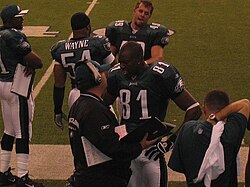
In gridiron football, a player who steps onto the sidelines during play is considered to be out of bounds. The horizontal white stripe near the bottom of this picture denotes the boundary, with legal play occurring above it.

In sports, out of bounds (or out-of-bounds) is the state of being outside the playing boundaries of the field. The legality of going out of bounds (intentionally or not), and the ease of prevention, vary by sport. Sports that use this term include American football, Canadian football, field lacrosse, basketball, rugby union, rugby league, and association football.

The boundary may be associated with the sidelines or touch-lines, lines which mark the outer boundaries of a sports field, running parallel to each other and perpendicular to the goal lines.[1] The foul lines in baseball and boundary lines in cricket are similar concepts.

Description

[edit]

The terms out of bounds or out-of-bounds refers to an active participant or component of a game (e.g., player or ball ) being outside the playing boundaries of the field of a sport. The legality of going out of bounds (intentionally or not), and the ease of prevention, vary by sport. Due to the chaotic nature of play, it is normal in many sports for players and/or the ball to go out of bounds frequently during a game. In some cases, players may intentionally go or send the ball out of bounds when it is to their advantage.

Sidelines

[edit]

The sidelines are the white or colored lines which mark the outer boundaries of a sports field, running parallel to each other and perpendicular to the goal lines.[1] The term is predominantly in use in American football, Canadian football, field lacrosse and basketball. In rugby union, rugby league and association football, they are known as touch-lines. The foul line is a similar concept in baseball. In cricket, the boundary lines can be marked by a rope.

Sidelines as an area of operations

[edit]
Players not actively participating in a game and coaches remain on the sidelines during play

The sidelines are also where the coaching staff and players out of play operate during a game. Sports in which the playing surface is bounded by walls, such as ice hockey, box lacrosse, and indoor football, do not use sidelines; in these sports, coaches and reserve players are positioned in recessed benches behind the walls.

Usage by sport

[edit]

Basketball

[edit]

Basketball differs from many other sports including tennis, volleyball, and association football in that a ball that touches any part of an endline or sideline (or is touched by a player who is standing on or touching any part of the line) is considered out of bounds. When the ball goes out of bounds, it is awarded to the team that did not last touch it, regardless of which team last possessed the ball. The team entitled to the ball is required to throw it into the court.[2]

Bat and ball games

[edit]

Baseball

[edit]

In baseball, there are two ways for a batted ball to be out-of-bounds. One is to exit the field of play between the foul lines (the foul lines themselves are fair territory). If this is achieved without touching the ground first, it is a home run, and the batter and teammates who are on base run to home plate and score a point for their team. If the ball bounced off the ground before exiting play, it is a ground rule double, and the batter and all runners not on third advance exactly two bases; runners only score if they were on second or third base. If the ball is hit outside the foul lines (such as to the side or behind the batter), it is a foul ball, and is equivalent to a strike, unless the batter has two strikes (in that instance, the strike count remains at two; the only exception to this is if the batter bunted the ball and it went foul, in which case the batter is called out). The foul ball bounds do not apply to fielders, who are allowed to try to catch a foul ball, which would put the batter out. While the rules of baseball define the angle of the foul lines, there are no set rules as to how large a field should be, and it varies from baseball field to baseball field.

Whether fielders can attempt to catch balls in dugouts or the stands varies. In major league baseball, it is possible in baseball for a dugout to be a factor in play. MLB rule 6.05(a) states that a fielder may reach into a dugout to catch a fly ball as long as one or both feet is on or over the playing field, and does not have a foot on the ground in the dugout when making the catch. MLB universal ground rules state that the player may subsequently enter the dugout after making the catch if his momentum is carrying him that way, but if he falls in the dugout as a result, the catch is allowed but baserunners advance in accordance with Rule 7.04(c).[3]

A live ball entering a dugout becomes dead and the batter-runner and any baserunners advance in accordance with Rule 7.04(c). However, a live ball bouncing off a dugout railing, if present, is still in play (unless a foul ball). Due to the dugouts' location in foul territory, live balls entering dugouts usually only occur after an errant throw by the defensive team.

Individual leagues at levels below MLB are free to set their own rules governing the dugouts as is appropriate for their league's ballparks and playing level. For example, the rule governing reaching into dugouts to catch fly balls would not apply in leagues where the dugouts are separated from the field by a chain-link fence that is taller than the players.

Cricket

[edit]

For the batting team, when the ball touches the ground outside of the field (or a fielder player who is in contact with the same), it is worth either four runs (points) if it bounced in the field first, or potentially up to six runs otherwise. In either case, the ball becomes dead. Any catches attempted by fielders also become invalidated if the fielder is touching the ball and steps outside of the field boundary before completing the catch.

Football

[edit]

Most football codes differ from sports such as basketball, volleyball, or table tennis where a player can "save" a ball by playing it while it is still in the air despite being over an out-of-bounds area; instead the ball is "out" if it fully crosses over a boundary line in the air.

Association football (soccer)

[edit]

In association football, the ball becomes out of play when it has entirely crossed a goal line or touch line (in Association Football, this is called "Into Touch" which means that the ball has passed over the touchline).[3] Play is restarted by a throw-in, goal kick or corner kick.

Australian rules

[edit]

In Australian rules football, the ball is considered out of bounds when the whole of the ball is outside the plane of boundary line; or, if any part of the ball touches the behind post.

Under most circumstances, play is restarted by means of a boundary throw-in after it has gone out of bounds: the boundary umpire throws the ball high in the air and backwards over his head to a neutral contest 15-20m in from the line.

Under the following circumstances, a free kick awarded against the team who put the ball out of bounds:

  • If the ball goes out of bounds on the full (without touching anything else first) from a kick
  • If the ball is kicked, handballed or forced out of bounds without sufficient intent to keep it in play (decided at the discretion of the field umpire)

Gridiron code

[edit]

In gridiron football, a play is considered to be dead if a ball or the player carrying the ball goes out of bounds. A forward pass thrown to a player who has one (in the NCAA) or both (in most other codes including the NFL) feet on the ground out of bounds is considered an incomplete pass regardless of whether it was caught or not.

In the NFL, the clock stops whenever a player carrying the ball steps out of bounds or fumbles the ball out of bounds. Within the last 2 minutes of the first half, the last 5 minutes of the game, or after a change of possession, the clock remains stopped until the next snap; at all other times, the clock restarts when the referee signals indicating that the ball has been placed for the next down.[4]

In arena football, the field is walled so that play can almost never go out of bounds. At all other times, the clock keeps ticking. In college football, the clock stops when the ballcarrier goes out of bounds. If there are more than two minutes left in either half, the clock resumes when the umpire marks the ball as ready for the next play. If there are less than two minutes left in the half, the clock resumes upon the next play.

If the player with the ball goes out of bounds in his own end zone, in most cases, it is considered to be a safety in favor of the other team. A ball kicked out of bounds through the end zone is a touchback; in Canadian football, this situation usually is awarded a single point.

A kickoff that goes out of bounds is a penalty. Up through 1986, this required the kicking team to rekick the ball from five yards behind the spot of the original kickoff, unless the penalty was declined by the receiving team. In 1987, the NFL instituted a new rule, where the ball would be awarded to the receiving team five yards ahead of the spot where it went out of bounds.[5]

In Canadian football, if a fumble goes out of bounds, the team of the last player to touch it gets possession.

Rugby league and rugby union

[edit]

In rugby league and rugby union, and their derivatives, the long parallel lines marking the lateral boundary of the field are called touch-lines. The continuation of the touch-line beyond the goal line ending at the dead ball line is called the "touch-in-goal line". Touch lines are considered outside the playing field. Following the ball going out of bounds, play is restarted in a variety of ways, depending on the circumstances and rules of the particular game.

In rugby union the two touch-lines may not be more than 70 metres (230 ft) apart.

  • The area beyond the touch-line is touch.
  • The officials who monitor the touch-lines are the touch judges.

Ice hockey

[edit]

In ice hockey, if the puck gets knocked out of play (such as into the player's benches, over the glass, or into the netting), a face-off shall be conducted at the nearest face-off dot to where the puck had gone out of play. However, if the puck is directly shot out of bounds over the glass deliberately by a player such as a goaltender or any defensive player within their own defensive zone, a delay of game minor penalty shall be assessed on the offending player.

Golf

[edit]

In golf, "Out of Bounds" is beyond the boundaries of the golf course or any part of the course so marked by the committee in charge of the competition or the golf course.

If a ball is out of bounds, the player must play a ball, under penalty of one stroke, as nearly as possible at the spot from which the original ball was last played.[6]

A golf ball is out of bounds when all of it lies out of bounds. A player may stand out of bounds to play a ball lying within bounds.[7]

Skiing

[edit]

In skiing, an out of bounds area is considered one that is outside of the area owned/serviced by a ski resort. Out of bounds areas can either be accessed by ducking under a rope or fence, or through marked gates. Usually, if one is caught 'cutting a rope', one will lose skiing privileges at the ski resort; depending on where one does so, they may also be arrested for trespassing. Out of bounds areas are not serviced by any type of lift, thus one must usually hike out of the area. Also, out of bounds areas are serviced by no ski patrol and are not checked for avalanche potential, thus one must be properly equipped for avalanche rescue and understand the dangers of a rescue.

Tennis

[edit]

In tennis, an out is an error in which the ball lands outside the playing area.[8]

Tag sports

[edit]

In various tag games, non-tagging players who step out of the field are generally eliminated from play.

Atya patya

[edit]

In atya patya, offensive players who step out of the field without keeping any part of their body grounded within the field are deemed out.[9]

Kabaddi

[edit]

In kabaddi, a player is declared "out" if they step out of bounds, with the opposing team scoring a point.[10]

Kho kho

[edit]

In kho kho, defensive players who step outside the field are automatically declared "out", with the offensive team scoring points as if they had tagged those defensive players.[11]

See also

[edit]

References

[edit]
[edit]
Revisions and contributorsEdit on WikipediaRead on Wikipedia
from Grokipedia
Out of bounds is a fundamental concept in numerous sports, denoting the region beyond the established boundaries of the playing area, where the ball or a player crossing into this space results in a stoppage of play and the application of specific rules for restarting, often with penalties such as loss of possession or additional strokes. This term ensures fair play by confining action to a defined field, preventing indefinite extension of the game area and maintaining competitive structure. In , a is out of bounds if it touches the floor, a player, or any object outside the boundary lines, leading to a from the sidelines by the opposing team. Similarly, in soccer, the becomes out of play when it has completely crossed the goal line or touchline, either on the ground or in the air, prompting a , , or depending on the circumstances. employs the term to describe a player or carrier touching the sideline or end line, which halts the play clock and awards possession to the opposing team via a new set of downs. In individual sports like , out of bounds occurs when a lies entirely outside the course's boundary edge, typically marked by white stakes, requiring the player to take stroke-and-distance relief by replaying from the previous spot with a one-stroke penalty. Tennis rules consider the out if it lands outside the court's lines or fails to bounce within them, awarding the point to the opponent. These variations highlight how out-of-bounds rules adapt to each sport's dynamics, balancing strategy, safety, and flow of play while universally serving to delineate legal boundaries.

Overview

Definition

Out of bounds in sports refers to the designated area beyond the limits or boundaries of the playing field, course, or rink, where the , puck, or similar object is considered legally out of play. When the or puck enters this zone, the game is temporarily stopped, and play resumes through a specific restart procedure dictated by the sport's rules, such as a , , or . This concept applies across various sports, including those involving a or puck, to maintain the integrity of the playing area. The origins of the out of bounds rule trace back to early codified sports in the , particularly variants of football developed in Britain. One of the earliest documented instances appears in the rules of the , which stipulated a when the ball went out of bounds to clearly define the limits of play and resolve potential disputes over possession. Similar provisions emerged in subsequent football codes, such as the laws, which introduced a when the ball passed out of bounds along the touchline, reflecting efforts to standardize gameplay amid growing popularity of organized matches. The fundamental principle of the out of bounds rule is to ensure safety, fairness, and containment of the action within a controlled environment. By establishing clear boundaries, it prevents play from extending into hazardous or uncontrolled spaces, thereby reducing risks to players, spectators, and officials. It also promotes equitable by eliminating advantages from exploiting undefined areas and minimizing arguments over where play legitimately occurs, fostering a structured and predictable contest.

Purpose in Sports

Out-of-bounds rules in sports serve a critical strategic function by preventing continuous, potentially endless play and instead imposing structured interruptions that allow teams to reposition and plan. In , for instance, when the ball crosses the touchline, play halts, enabling throw-ins or goal kicks that encourage tactical decisions around possession and territorial advantage, thereby defining clear zones of control within the field. This mechanism fosters strategic depth, as teams must balance aggressive advances with the risk of losing the ball to opponents upon boundary violations, ultimately enhancing the game's competitive balance and preventing stalemates from unchecked . Beyond strategy, these rules prioritize safety by confining action to designated areas, shielding players and spectators from hazards beyond the field. In early , prior to the 1926 rule change declaring balls dead upon going out of bounds, players often pursued live balls into crowds or over fences, resulting in injuries from collisions with obstacles or fans; the shift to dead-ball status explicitly addressed these risks by limiting pursuits. Similarly, modern evolutions, such as the NCAA's 2011 prohibition on out-of-bounds blocking during kickoffs, further underscore how boundaries mitigate physical dangers, evolving from 19th-century codes where unstructured chases amplified perils in rudimentary playing environments. Out-of-bounds provisions also enforce fairness by resolving ambiguities inherent in unstructured play, providing standardized procedures to adjudicate boundary crossings and maintain equitable restarts. In 19th-century rulebooks, such as the 1845 Knickerbocker Rules and 1860 NABBP codes, foul balls—those struck outside the range of first or third base—were defined to eliminate disputes over errant hits, ensuring consistent scoring opportunities and base advancements without reliance on subjective judgments. Likewise, the 1863 Football Association's laws stipulated a when the ball passed out of bounds, with the first player to touch it outside throwing the ball from the boundary point at right angles to the touchline, building on earlier rules like the to standardize play across varying fields and promote impartiality in emerging organized matches.

Boundary Markings

Sidelines

Sidelines, the lateral boundaries of a playing field or , extend along the full length of the playing area and demarcate its width in various . These lines serve as the primary markers for determining the edges of active play space, ensuring that participants remain within designated limits. Physically, sidelines are typically delineated by straight, uniform lines painted or drawn in a contrasting color to the playing surface, such as white on grass fields or colored tape on indoor courts. In outdoor settings, these markings are often applied using specialized field paints or for durability and visibility, while indoor venues employ tapes or embedded lines to prevent slippage. Flags or posts may supplement the lines at key points, such as corners, to enhance boundary recognition, and in some configurations, temporary barriers like cones or foam markers provide additional delineation during informal or youth play. All such markers must adhere to standardized widths, generally not exceeding 12 cm (5 inches) to maintain consistency and avoid altering the field's dimensions. The dimensions of sidelines vary across to accommodate differing field sizes, but they consistently run the entire length of the playing area; for instance, in football variants, they measure 100 to 120 yards long. This variability allows adaptation to venue constraints while preserving the rectangular shape essential for fair play. Operationally, sidelines define the precise width of the playable zone, with any portion of a or player crossing beyond them—except for the line itself, which is considered in bounds—activating out-of-bounds protocols. This enforcement helps maintain game flow, prevents unauthorized expansion of the field, and triggers immediate rule applications such as possession changes or stoppages.

End Lines and Goal Areas

End lines, also known as goal lines in many , serve as the transverse boundaries at each end of the playing field, typically shorter in length than the sidelines that define the field's width. These lines demarcate the endpoints of the playable area and often integrate directly with scoring , such as goalposts or nets, to facilitate the transition between general play and goal-scoring opportunities. In , the end lines, referred to as goal lines, measure between 45 meters and 90 meters in length for standard matches (64 to 75 meters for international games), with s centered along them that are 7.32 meters wide and equipped with nets. These lines are marked 5 to 10 centimeters wide and form the baseline for the goal area, a rectangular zone extending 5.5 meters into the field from each goalpost and 5.5 meters deep, totaling 18.32 meters wide, which helps regulate defensive positioning near the . Adjacent to this is the larger , extending 16.5 meters deep and 40.32 meters wide, where specific fouls can lead to penalty kicks; both areas extending from the goal line into the field, which helps regulate defensive positioning near the and influences out-of-bounds determinations when the crosses it without entering the . Goal areas in various extend perpendicularly from the end lines to create designated zones for scoring or restricted actions, altering how out-of-bounds calls are interpreted in proximity to these boundaries. For instance, in under rules, the end lines (also called baselines) span 15 meters across the court's width on a 28-meter-long playing surface, serving as the foundational line beneath the backboard, with the positioned 3.05 meters above the and the restricted area—a painted lane 5.8 meters long and 4.9 meters wide—projecting from the end line to limit charging fouls and define the key. In , the end lines mark the rear boundary of the 10-yard-deep end zones at each end of the 100-yard field of play, positioned 10 yards behind the goal lines that separate the field from these scoring areas; the end zones themselves measure 10 yards deep by 53 1/3 yards (160 feet) wide, with the goal line (8 inches wide) forming the critical plane that must be crossed for a . These configurations ensure that end lines not only bound the field but also frame the spatial rules for advancing into scoring territory, distinct from the sidelines that complement them along the lengths.

Rules and Consequences

Loss of Possession

In most sports governed by standardized rules, the or puck going out of bounds results in a loss of possession for the that last touched it, with play restarting via an inbound procedure awarded to the opponents. This last-contact principle ensures that errors in play do not confer an unfair advantage, promoting fair competition and quick resumption of action. For instance, in under FIFA's Laws of the Game, when the wholly crosses the touchline, a is awarded to the opposing from the point where it left the field. Similarly, in as per NBA rules, the whose player last touched the before it goes out-of-bounds forfeits possession, leading to a for the opponents at the nearest point on the boundary. Inbound procedures vary by sport but follow this uniformity to maintain game flow. Throw-ins are common in invasion sports like basketball and association football, requiring the inbounding player to release the ball within five seconds while keeping feet behind the boundary line, often from sidelines or end lines. In ice hockey, according to IIHF regulations, when the puck deflects or is shot out of bounds, play stops immediately, and a face-off is conducted at the nearest face-off spot to the point of exit, effectively giving the opposing team a neutral restart opportunity without direct possession award. Kick-ins, used in some futsal or indoor variants under FIFA, mirror throw-ins but involve kicking the ball back into play from the boundary. These mechanisms reference boundary markings such as sidelines and end lines to precisely locate the restart. Certain scenarios introduce neutral possession to balance restarts, avoiding strict alternation based solely on last touch. In basketball, the alternating possession rule—utilized after held balls, violations, or timeouts in leagues like NCAA—employs an arrow indicator to award throw-ins alternately between teams, ensuring equitable opportunities during dead-ball situations. This prevents prolonged disputes over possession and aligns with the broader goal of the last-contact principle in international standards.

Player Penalties

Player penalties for out of bounds violations primarily address infractions where athletes step beyond the boundary lines during active play, often resulting in fouls, loss of possession for their team, or more severe sanctions like ejections in cases of dangerous conduct. In , an offensive player who steps out of bounds without the ball commits a violation, leading to the ball being awarded to the opponents for a from the nearest sideline; this rule prevents strategic evasion of defenders and ensures fair play within the designated area. Similarly, under regulations, any body part touching the floor outside the boundary constitutes a player out-of-bounds violation, with the same penalty applied, distinct from ball possession outcomes. Enforcement of these penalties relies heavily on referee judgments regarding intent and context, such as whether a player voluntarily steps out to gain an advantage or is forced out by contact. In rugby, for instance, players must avoid physical contact with opponents before the ball is thrown into a lineout following an out-of-touch situation, with violations sanctioned by a penalty kick to the opposing team; referees assess intent to determine if the action disrupted fair play or posed unnecessary risk. American football rules similarly penalize players who go out of bounds voluntarily—such as members of the kicking team failing to return inbounds promptly—with a five-yard non-football act foul, emphasizing quick re-entry to maintain game flow and safety. Safety-driven rules have escalated penalties for dangerous plays involving out of bounds, particularly those forcing opponents beyond the lines, reflecting broader post-20th-century shifts toward in team sports. In , pushing an opponent out of bounds from behind or during transition is classified as an unsportsmanlike foul under guidelines, resulting in two free throws and possession for the offended team, with disqualification after two such infractions. Rugby laws prohibit actions like grasping and grounding an airborne opponent near the touchline, imposing a penalty and potential yellow or red cards based on severity, as part of welfare-focused evolutions since the that prioritize player protection over aggressive physicality. In , forcing a player out of bounds via unnecessary roughness incurs a 15-yard penalty and possible ejection. These measures, while related to loss of possession rules, specifically target athlete conduct to foster safer .

Usage in Invasion Sports

Association Football

In association football, when the ball fully crosses the touchline on the ground or in the air, play stops, and the opposing team is awarded a throw-in to restart the game, resulting in a loss of possession for the team that last touched the ball. The throw-in must be taken from the point on the touchline nearest to where the ball crossed the boundary, with the thrower facing the field of play, both feet on or behind the touchline, and delivering the ball using both hands from behind and over the head in a single movement. The ball is considered in play once it enters the field; if it enters the goal directly from a throw-in, a goal kick is awarded to the opponents, while entry into the thrower's own goal results in a corner kick. Opponents must remain at least 2 meters (2 yards) from the thrower until the ball is in play, and any infringement, such as the thrower touching the ball again before another player does, leads to an indirect free kick for the opposing team. For the goal line, the rules differ based on the last touch: if the entire ball crosses the goal line without a goal being scored and was last touched by an attacking player, the defending team restarts with a from within the goal area. The ball must be stationary and kicked by a defender, becoming in play once it clearly moves; opponents remain outside the until then, and a direct goal can be scored from the kick. Conversely, if the ball last touched a defending player before fully crossing the goal line, the attacking team receives a from the nearest corner arc. The kicker must ensure the ball is stationary and moves clearly upon contact, with opponents at least 9.15 meters (10 yards) from the arc; a direct goal is possible, but retaking occurs for procedural errors like the kicker playing the ball twice. Out-of-bounds events also interact with the , potentially resetting positions: a defending player who leaves the field without permission is deemed on their goal line for offside purposes until the next stoppage or until their team plays the ball beyond the halfway line. Similarly, an attacking player who steps off the field to evade active play is considered on the goal line if they re-enter and interfere before the next stoppage or defensive advance past the halfway line. These provisions maintain fairness in positioning after boundary crossings. In 2019, IFAB updated interpretations in Law 12 for greater clarity, including criteria for deliberate contact and body size enlargement, which apply near boundaries during restarts like throw-ins or kicks to prevent ambiguous rulings on edge-of-field incidents.

Basketball

In basketball, an out-of-bounds violation occurs when the ball touches a player who is out of bounds or the floor or any object outside the boundary lines, resulting in a turnover to the opposing team. The team that last touched the ball before it goes out of bounds loses possession, and this ruling applies whether the ball is deflected by an offensive or defensive player. Similarly, under rules, a player is considered out of bounds if any part of their body contacts the floor or an object outside the boundary, and the ball becomes out of bounds upon such contact, awarding possession to the opponents. These violations emphasize the importance of maintaining control within the court's confines to avoid frequent stoppages in play. Inbound passes in basketball are executed from the sidelines or baselines following an out-of-bounds violation, with the inbounder required to release the ball within five seconds after receiving it from the official. This time limit prevents stalling and applies in both NBA and competitions, where the inbounder must also ensure the pass enters the court directly without touching the out-of-bounds area first. Alternating possession rules further govern inbounds after certain stoppages, such as held balls or simultaneous violations; in , the arrow device alternates possession starting from the team that did not gain control in the initial , while the NBA uses a similar arrow system that resets after scores or timeouts. These mechanisms promote fairness and continuous action, distinguishing basketball's structured inbounds from more fluid boundary restarts in other sports. Defensive teams often exploit out-of-bounds situations through strategies, positioning players to the inbounder and potential receivers near the sidelines or baselines to force turnovers. Common tactics include double-teaming the inbounder while denying passing lanes, particularly on baseline inbounds where space is limited, which can disrupt offensive sets and lead to quick possessions. Fouls committed during these inbound plays, such as excessive contact on the inbounder, may result in free throws or technical penalties depending on the severity and timing.

American Football

In , the sidelines and end lines demarcate the boundaries of the field of play, with the sidelines running the length of the 100-yard field and the end lines capping each 10-yard . A player or the ball is considered out of bounds when any part touches the boundary line or anything beyond it, except for another player, official, or pylon. The forward progress spot for a runner going out of bounds along the sideline is determined by the point where the ball carrier's body or the ball first crosses the sideline plane, which can award yardage gained or a first down if it reaches the line to gain. Traditionally, this spot is measured using a 10-yard positioned along the sideline, with officials aligning the chains parallel to the sideline for accuracy during close calls; however, starting in the 2025 season, the has transitioned to camera-based electronic measurement systems to verify first downs from the out-of-bounds spot, reducing the need for physical chains. In the end zones, out of bounds carries distinct consequences based on possession and impetus. For punts or safety kicks that enter the end zone and are downed there without being advanced or go out of bounds in the end zone, it results in a , with the receiving team taking possession at their own 20-yard line. For kickoffs under the dynamic kickoff rules, if the ball enters the end zone and is downed there without being returned, or goes out of bounds in the end zone, it results in a at the receiving team's 35-yard line as of the 2025 season. Conversely, if the offensive team causes the ball to go out of bounds behind their own goal line, such as on a or , it awards a to the defense, worth two points and possession via . Blocking or targeting an opponent out of bounds is illegal, with penalties enforced to emphasize player , as updated in 2018 rules prohibiting unnecessary contact beyond the boundaries to prevent injuries. The clock's interaction with out-of-bounds plays significantly influences strategy, particularly in the game's closing moments. When a carrier goes out of bounds during a scrimmage play, the game clock stops immediately at the out-of-bounds spot and restarts on the referee's ready-for-play signal, allowing time for spotting and measurement. However, in the final two minutes of the first half or five minutes of the second half, the clock remains stopped until the next snap to prevent teams from hurrying the offense, enabling deliberate like spiking the or calling timeouts to preserve time for late-game drives. Replay reviews can also assess out-of-bounds status to ensure accurate clock and possession rulings.

Rugby Codes

In rugby union, when the ball or a ball-carrier crosses the touchline during general play, it is considered in touch, and the opposing team is awarded a lineout at the point where the ball went out, unless specific exceptions apply such as a quick throw-in. The lineout involves forwards from both teams forming parallel lines to the touchline, spaced one meter apart and between the 5-meter and 15-meter lines from touch, with the throwing team—typically the hooker—delivering the ball straight down the middle corridor to enable a contest for possession. Forwards play a central role in lineouts, where lifters support jumpers to catch the ball, a practice legalized in 1999 to enhance safety and competition while requiring players to lower teammates safely to the ground after the contest. This contested restart emphasizes physicality and strategy among the forwards, who aim to secure clean possession or disrupt the opposition. If the ball reaches the in-goal area and goes dead without a try being scored—such as when by the defense—a 22-meter dropout is required, taken as a from behind the defending team's 22-meter line to restart play. updated these laws in to include goal-line dropouts for situations like an attacking player carrying the ball into in-goal and it being , aiming to accelerate the game's pace by reducing stoppages and promoting quicker restarts. In , there are no lineouts; instead, when the ball or a player in possession enters touch during general play, the non-offending team restarts with a play-the-ball 10 meters infield from the point of exit, allowing for a rapid handover without contested set pieces. For restarts from the 20-meter line, such as after a kick-off or penalty, an optional kick must travel at least 10 meters or find touch, but if it goes out on the full, the opposition gains a play-the-ball 10 meters from touch; this mechanic avoids prolonged contests, prioritizing fluid play. If the ball goes dead over the goal line without a try, a dropout is taken from the 10-meter line, further streamlining restarts in league variants where forwards do not engage in lifting or aerial contests like in union.

Ice Hockey

In ice hockey, the rink's boundaries are defined by the boards and protective glass surrounding the playing surface, which serve to contain the puck and maintain continuous play. When the puck is shot, deflected, or otherwise propelled over the boards or glass and out of the playing area, play is immediately stopped, and a is conducted at the nearest spot in the zone from which the puck was played, unless otherwise specified by the rules. This procedure minimizes territorial advantages for the offending team and ensures prompt restarts. Deliberately shooting the puck over the boards or from the defensive zone results in a minor penalty for delay of game, assessed to the offending player, who must serve two minutes in the penalty box; however, no penalty is imposed if the puck deflects off a player, stick, , or the playing surface itself before leaving the rink. In scenarios involving icing—where a player shoots the puck from behind the center red line across the opponent's goal line without it being touched by another player—hybrid icing rules determine whether play continues or stops based on a race to the dots. Under hybrid icing, introduced by the NHL for the 2013-14 season to reduce stoppages and injuries from aggressive puck pursuits, the linesman allows play to continue if a defending player (other than the ) reaches the designated dots first; otherwise, icing is called, and the occurs in the offending team's defending zone at one of the end zone spots. For wrap-around attempts behind the , where an attacking player maneuvers the puck along the line to score, if the puck goes out of play—such as by crossing the boards or becoming unplayable—the ensuing takes place at the nearest spot in the defending zone, promoting defensive recovery without shifting territorial advantage. This rule applies specifically to situations where the puck exits the playing surface behind the , ensuring restarts favor the defending team in their zone. Additionally, players may incur penalties for boarding infractions, where a check pushes an opponent violently into the boards, potentially resulting in a or major penalty depending on the severity.

Usage in Striking and Fielding Sports

Baseball

In baseball, the boundaries of play are primarily defined by the foul lines, which extend from the point of home plate through the first- and third-base lines to the foul poles in left and right field. These lines, marked with chalk or other material, delineate fair territory—the playable area between them, including the lines and foul poles themselves—from foul territory outside. A that lands or is first touched in foul territory is ruled a , which counts as a strike against the batter unless they already have two strikes, in which case it results in a with no additional penalty; however, if caught by a fielder before touching the ground, the batter is out regardless of location. The standard dimensions of a Major League Baseball (MLB) field ensure consistent boundaries, with the infield forming a 90-foot square between bases and the extending variably but bounded by the foul lines to the outfield walls. The distance from home plate to first and third bases is 90 feet, while the pitcher's is 60 feet, 6 inches from home; outfield walls must be at least 325 feet from home plate along the foul lines and 400 feet to center field, though actual distances vary by . Fair territory encompasses this entire area up to the walls, with any ball passing over the wall in fair territory on a fly deemed a , allowing the batter and baserunners to score. Fan or spectator interference occurs when a spectator reaches into the field of play and affects a live ball, such as preventing a fielder from catching it, rendering the ball dead at the moment of interference. In such cases, umpires award baserunners the bases they would have reached without the interference, based on judgment; if the interference clearly prevents a catchable fly ball, the batter is ruled out. Balls hit directly into the stands without interference are dead upon entering spectator areas: a fair ball over the fence awards a home run, while one into foul territory or short of the fence results in a foul ball or ground-rule double (two bases), per umpire discretion under MLB guidelines.

Cricket

In cricket, the boundary defines the outer limit of the playing field and serves as a key element in scoring. The boundary is marked by a continuous white line or a laid on the ground, with the edge nearest the pitch considered the official boundary; flags, posts, or other objects beyond this marking serve only to highlight its position but do not constitute the boundary itself. If the ball struck by the reaches the boundary without first touching the ground inside the field, it scores six runs (Boundary 6); if it touches the ground inside the field before crossing or is not struck by the but crosses after deflection, it scores four runs (Boundary 4). For international matches on fields, the (ICC) mandates that no boundary exceeds 90 yards (82.29 meters) from the center and none is shorter than 65 yards (59.43 meters), ensuring consistent playability across venues. A is called when the bowler's front foot lands beyond the popping crease during delivery, effectively rendering the ball out of bounds and invalidating the delivery for most dismissal purposes. Under Law 21.5 of the (MCC) , for a delivery to be , some part of the bowler's front foot—whether grounded or raised—must land behind the popping crease and on the same side of the joining the middle stumps as the return crease. If this condition is violated, the bowler's end umpire immediately calls and signals , awarding the batting side one run and allowing the batter a on the next delivery in limited-overs formats, with the batter unable to be dismissed except by , obstructing the field, or hitting the ball twice. Fielding restrictions prohibit players from standing beyond the boundary during play, maintaining the integrity of the field of play. Law 19.4 states that no fielder, whether in contact with the ball or not, may be grounded at any time, and a fielder airborne over the boundary is considered grounded beyond it if their final contact with the ground before catching the ball occurs outside. The 2022 update to the MCC Code of Laws, effective from October 1, refined these rules for clarity in T20 formats by specifying that a fielder making airborne contact with the ball must land and remain within the field to complete a valid catch, closing ambiguities in boundary-line efforts. In T20 internationals, additional restrictions limit the number of fielders outside the inner circle during powerplays, but the boundary prohibition remains absolute to prevent unfair advantages.

Usage in Racket and Individual Sports

Tennis

In tennis, the is demarcated by lines that define the playing boundaries, ensuring fair play and clear delineation of in-bounds and out-of-bounds areas. The standard measures 78 feet (23.77 meters) in length and 27 feet (8.23 meters) in width for singles play, expanding to 36 feet (10.97 meters) in width for doubles due to additional sidelines. These boundaries are marked by lines of uniform color—typically white—that clearly contrast with the surface to enhance visibility, with all measurements taken to the outside of the lines. The is further divided by a net at the center, service lines parallel to the net 21 feet (6.40 meters) away, and a center service line that bisects the service courts. A is considered in play if it touches any part of these lines, but landing outside the relevant boundaries results in the being ruled out, awarding to the opponent unless it occurs during service. Service rules in tennis impose specific boundary requirements to maintain the integrity of play, with faults occurring when the served ball violates these limits. The server must deliver the ball from behind the baseline, within the extensions of the and sideline, and it must land in the diagonally opposite service court—bounded by the , sideline (or doubles sideline in doubles play), service line, and center service line—before touching the ground elsewhere. If the ball lands outside this service box, hits the or a permanent fixture before reaching the ground, or if the server commits a foot fault by touching the baseline or extensions during the serve, it constitutes a fault. According to (ITF) rules, a player is allowed one fault per point, permitting a second serve from the same side; however, a second consecutive fault results in a double fault, and the point is lost to the receiver. To ensure precise adjudication of boundary calls, electronic line-calling technology has become integral to professional since the mid-2000s. The system, developed by Hawk-Eye Innovations and approved by the ITF, uses multiple high-speed cameras to track the ball's trajectory in three dimensions, providing visualizations accurate to within 2.6 millimeters for line calls. First introduced for player challenges at the 2006 US Open, it allows players a limited number of reviews per set to contest line calls, significantly reducing disputes by overriding human error in close rulings and promoting greater confidence in officiating decisions. By 2025, has expanded to full electronic line calling on select surfaces, eliminating the need for line judges in some tournaments while maintaining the sport's emphasis on boundary precision.

Golf

In golf, out-of-bounds areas are typically marked by white stakes or lines, defining the boundaries of the course as established by the committee. These stakes indicate regions outside the playable course, such as adjacent property or roads, and a ball is considered out of bounds only if its entire circumference lies beyond the boundary edge. Under Rule 18 of the USGA Rules of Golf, if a player's ball comes to rest out of bounds, the player incurs a one-stroke penalty and must take stroke-and-distance relief by returning to the spot of the previous stroke to play again. Relief options for an out-of-bounds ball are limited to the stroke-and-distance procedure, with no allowance for dropping within bounds near the boundary or other lateral . However, effective January 1, 2019, the USGA introduced Model Local Rule E-5 as an optional alternative for general play, permitting players to drop a in the fairway (or general area) for a two-stroke penalty instead of replaying the previous shot, provided the original is not found within three minutes. This change aims to expedite play but is not permitted in professional or elite competitions and requires the ball to be dropped in a specific area not nearer the . White stakes themselves are immovable boundary objects, and players may not remove or obtain from them without penalty. Out-of-bounds markings are often placed along property lines, fences, or public roads to protect non-course areas, as recommended by the USGA for safety and reasons. On links-style courses, such as those in coastal regions with natural boundaries like railways or hedges, these out-of-bounds stakes significantly influence , encouraging players to favor safer lines of play to avoid the severe scoring penalty of stroke and distance.

Skiing

In alpine skiing, course boundaries are primarily defined by gates consisting of poles and panels, which competitors must pass through correctly to remain within bounds. A gate is considered passed when both ski tips and feet cross the imaginary gate line, the shortest line between the turning pole and any outside marker at snow level; failure to do so, such as by straddling a pole or exiting the course, results in disqualification unless the skier immediately hikes back to correct the fault. Flags may supplement gates in events like downhill for visibility, but gates remain the core markers enforcing bounds across disciplines including slalom, , and . In variants such as moguls and , out-of-bounds incurs specific penalties rather than automatic disqualification in all cases. For moguls, skiing outside course boundaries, including failing to cross the gate line or finish gate, constitutes a "" (DNF), while out-of-bounds landings on jumps lead to score deductions of up to 30% per fall or invalid maneuver; repeated boundary violations can escalate to full disqualification. In , competitors must remain within the defined walls and transition zones, with exits or landings outside the pipe resulting in unscored maneuvers, point deductions for poor control, or DNF if the run cannot be completed safely. These rules emphasize maintaining flow within designated areas to balance technical execution and . Safety considerations for out-of-bounds prevention in slalom events have evolved in the through FIS rule enhancements, including mandatory flex poles with bending devices that reduce risk upon collision and the addition of nets, fences, or padding around and course edges where hazards exist. These updates, alongside broader mandates for protective equipment like airbags in training and competition, aim to widen effective zones by ensuring are securely fixed yet forgiving, minimizing impacts during high-speed gate crossings that could otherwise lead to out-of-bounds incidents. In October 2025, the FIS Council approved additional measures to further strengthen athlete , including mandatory smart airbags in speed events from the 2025–26 season and cut-resistant undergarments across all disciplines.

Usage in Tag and Contact Games

In , the playing court is a rectangular measuring 13 meters in length by 10 meters in width for men's competitions, divided into two equal halves by a central line, with baulk lines positioned 3.75 meters from the central line in each half and bonus lines 1 meter from the baulk lines towards the end boundaries. The boundary lines—consisting of the sidelines and end lines—define the out-of-bounds area; any part of a player's body touching the ground outside these lines during play results in that player being declared out, except in cases where a defender crosses the boundary to engage the raider. This setup integrates directly with the game's core mechanics of raiding and tackling, where maintaining position within bounds is essential for scoring or defending. During a raid, the raider enters the opponent's half to tag defenders while staying within the court's boundaries; crossing the sidelines constitutes going out of bounds, rendering the raid unsuccessful and declaring the raider out, with no points awarded. To score touch points, the raider must tag at least one defender and return across the central line to their own half without being tackled or exiting the bounds; additionally, touching the bonus line during the raid earns an extra point if the raider successfully returns. In the , which adopted standardized international rules upon its inception in , these boundary constraints emphasize strategic positioning, as raiders often attempt deep penetrations toward the end boundary to access the bonus line while avoiding sideline exits. Tackle mechanics involving out-of-bounds plays hinge on whether defenders force the raider beyond the boundary: if a defender pushes or holds the raider out while remaining fully within the court, it counts as a successful tackle, declaring the raider out and awarding a point to the defending team. Conversely, if the defender crosses the boundary to effect the hold, the raider is deemed not out, and only the offending defender(s) are declared out, preserving the raid's validity under Pro Kabaddi League standards. Player penalties for illegal actions, such as deliberate shoving of opponents out of bounds without proper engagement, result in the offending player being warned or sent off temporarily. Breath control rules tie into out-of-bounds enforcement through the mandatory cant: the raider must continuously chant "" in a single breath from crossing the central line until fully returning to their own half, proving adherence to the no-breathing-in-opponent's-territory tradition adapted in modern play. If the chant ceases before the raider safely crosses back—such as during an out-of-bounds incident—the raid is invalidated, and the raider is out, ensuring the cant's continuity validates the entire sequence including boundary compliance. This rule, upheld in matches since 2014, underscores the physical and tactical demands of avoiding bounds violations while maintaining vocal discipline.

Kho Kho

Kho kho, a traditional Indian tag , features a rectangular field measuring approximately 27 to 29 meters in length and 16 meters in width for senior play, marked with lime powder on a leveled surface suitable for bare feet. Two wooden poles, each 120-125 cm high and 9-10 cm in diameter, are fixed at the center of each endline, serving as turning points for chases. A central , 30 cm wide and running the length of the field, divides it into two equal halves, while cross lanes intersect it at intervals to guide player positioning. The sidelines and endlines define the playing boundaries, with a free zone behind each pole allowing the active chaser to pivot without crossing into the opponent's half. In this setup, out-of-bounds occurs when players, particularly defenders (runners), step beyond the sidelines or endlines during play, resulting in an immediate out declaration. The rules enforce strict boundary adherence during chases, where eight chasers sit in alternating positions along the central lane, facing outward, and the active chaser pursues the three defenders running across the field. Defenders are ruled out if tagged by the active chaser while within bounds or if they cross beyond the sidelines or pole lines, effectively going out of field; this "boundary out" emphasizes the pole-based chase dynamics, as runners must dodge around the poles and lanes without exiting the perimeter. The active chaser, starting from one free zone, cannot cross the central lane midline to pursue into the opposite half, treating any such crossing as effectively out-of-bounds and resulting in a foul that may award points to the defending team. These midline restrictions maintain the chase's directional flow, preventing direct interception across halves and heightening the strategic use of boundaries. Originating from Maharashtra, India, these traditional rules date back centuries but saw international adaptations in the 2020s through leagues like Ultimate Kho Kho, which refined field dimensions to 22 x 16 meters for indoor play while retaining core boundary and midline principles. Scoring in kho kho revolves around tagging defenders out, with no ball involved, and boundaries play a key role in bonus opportunities. The chasing team earns one point for each defender tagged within the field, but an additional "boundary prey" or bonus point is awarded if a defender is tagged while crossing out of bounds or voluntarily steps beyond the lines. This incentivizes runners to stay within the pole-centered lanes during evasion, as out-of-bounds violations not only end their turn but amplify the opponent's score, typically aiming for all three defenders out to claim a full turn. In modern formats, such as Ultimate Kho Kho's 2020s rules, the bonus remains one point per out-of-field instance, aligning with traditional scoring to preserve the game's emphasis on boundary discipline.

Atya Patya

Atya Patya, a traditional Indian tag game originating from rural regions, utilizes a field marked with parallel trenches that create a grid-like structure of landing zones for players' jumps across the playing area. The standard court measures approximately 89 feet in length and 23 feet in width, featuring nine breadthwise trenches each 23 feet 1 inch long and 13 inches wide, intersected by a central lengthwise trench of 89 feet 1 inch long and 13 inches wide, dividing the field into defined sections for movement. Players are considered out if they land outside the court's side boundaries or fail to properly clear the trenches during jumps, ensuring all actions remain within the marked grid to avoid elimination. The game's dodge rules emphasize evasion of tags while navigating the grid, bearing similarities to through zoned positional play and elimination mechanics for boundary violations, though prioritizes agile jumps and feints over ball handling. Elimination occurs for out-of-bounds landings or hits beyond the lines, underscoring the sport's roots as a traditional Indian pursuit with limited standardized modern codification, often varying by regional practices. In team turns, the attacking side initiates from positions within the bounds near the trench, advancing by jumping across the grid; points are forfeited or players eliminated if crossings violate lines by improper landings or steps onto trenches reserved for defenders. This boundary adherence maintains the game's focus on precise, bounded movement during offensive sequences.

References

Add your contribution
Related Hubs
User Avatar
No comments yet.