


Community hub
Recent from talks
Contribute something to knowledge base
Content stats: 0 posts, 0 articles, 1 media, 0 notes
Members stats: 0 subscribers, 0 contributors, 0 moderators, 0 supporters
Subscribers
Supporters
Contributors
Moderators
Hub AI
Coral Harbour AI simulator
(@Coral Harbour_simulator)
Hub AI
Coral Harbour AI simulator
(@Coral Harbour_simulator)
Coral Harbour
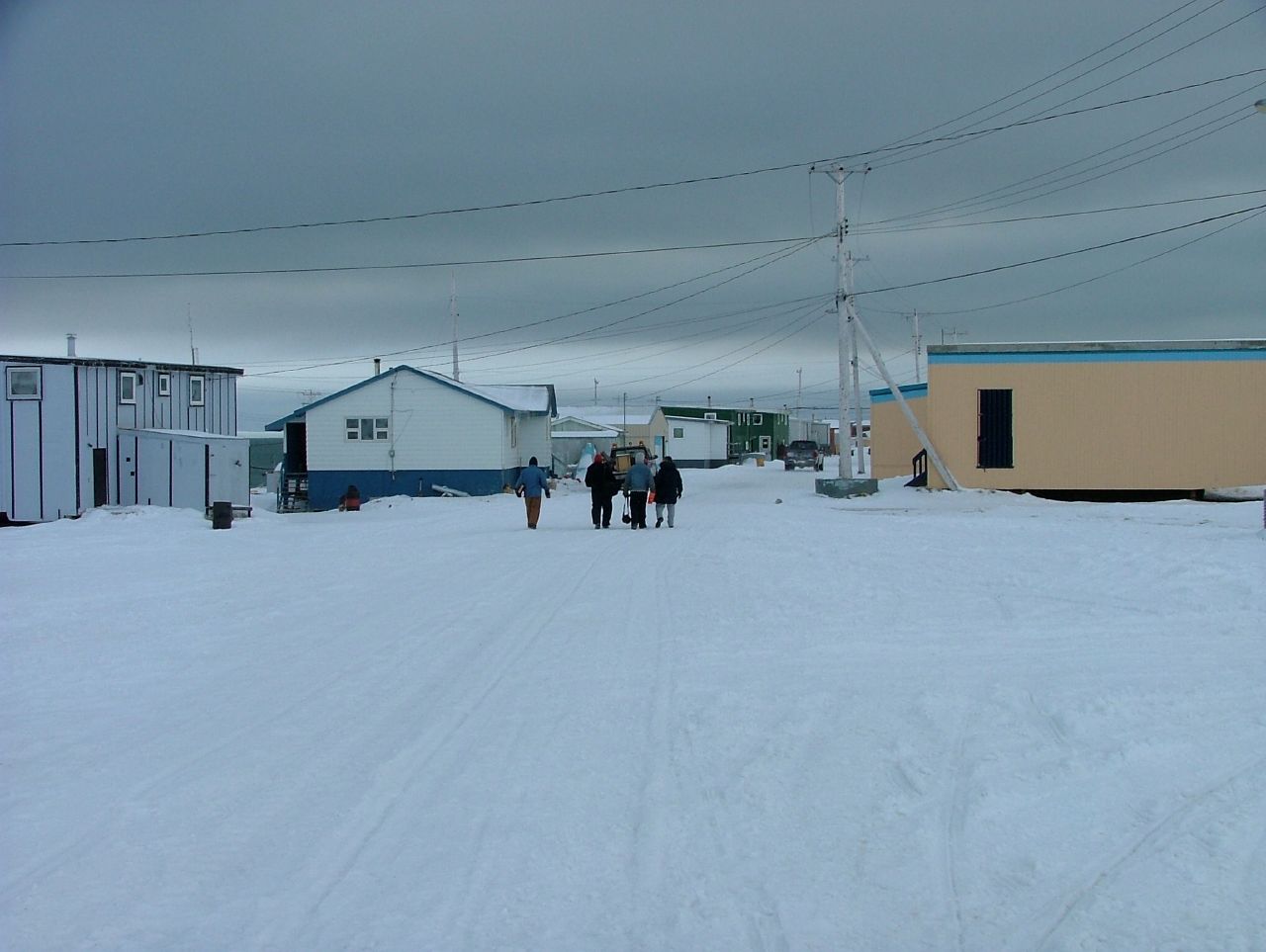
Coral Harbour (Inuktitut: Salliq / Salliit, Syllabics: ᓴᓪᓕᖅ / ᓴᓪᓖᑦ, formerly Southampton Island) is a small Inuit community that is located on Southampton Island, Kivalliq Region, in the Canadian territory of Nunavut. Its name is derived from the fossilized coral that can be found around the waters of the community which is situated at the head of South Bay. The name of the settlement in Inuktitut is Salliq, sometimes used to refer to all of Southampton Island. The plural Salliit, means large flat island(s) in front of the mainland.
The Sadlermiut ("inhabitants of Salliq") whose name is derived from Salliq previously occupied the area. The Tuniit, a pre-Inuit culture, officially went ethnically and culturally extinct in 1902–03 when an illness killed all of the Sadlermiut in a matter of weeks. However, others believe that the Sadlermiut were descendants of the Thule, whose geographically isolated culture would have developed idiosyncratically from the mainland Thule culture.
At the beginning of the 20th century, the area was repopulated by Aivilingmiut, whose name was to be later adapted for the Aivilik electoral district, from the Naujaat and Chesterfield Inlet areas, influenced to do so by whaler Captain George Comer and others. Baffin Islanders arrived 25 years later. John Ell, who as a young child travelled with his mother Shoofly on Comer's schooners, eventually became the most famous of Southampton Island's re-settled population.
In the 2021 Canadian census conducted by Statistics Canada, Coral Harbour had a population of 1,035 living in 225 of its 303 total private dwellings, a change of 16.2% from its 2016 population of 891. With a land area of 126.39 km2 (48.80 sq mi), it had a population density of 8.2/km2 (21.2/sq mi) in 2021.
Coral Harbour is the only Nunavut community that does not observe daylight saving time, remaining on Eastern Standard Time year-round.
The only way to reach this community is by aircraft at Coral Harbour Airport or by water (such as the resupply barges, which do not carry passengers, that come from Churchill, Manitoba and the East coast and St. Lawrence area, every summer) and the main transportation on the island itself (nearly the same size as Switzerland) is by snowmobile and dog sled in the winter and all-terrain vehicle in the summer. Despite the harsh climate there is plentiful wildlife around the island. Among some of the species found there are walruses, polar bears, barren-ground caribou, ringed seals, gyrfalcons, and (rarely) peregrine falcons.
The community has been served by the Qiniq network since 2005. Qiniq is a fixed wireless service to homes and businesses, connecting to the outside world via a satellite backbone. The Qiniq network is designed and operated by SSI Micro. In 2017, the network was upgraded to 4G LTE technology, and 2G-GSM for mobile voice.
Coral Harbour has a severe subarctic climate (Köppen Dfc), for which it just qualifies due to its 10 °C (50 °F) July means. It is a borderline polar climate, which results in barren vegetation. Coral Harbour has never gone above freezing in February or March (although the latter has recorded 0.0 °C (32.0 °F)). Due to the frozen nature of Hudson Bay, there is a severe seasonal lag until June despite much sunshine and perpetual twilight at night. Due to the drop of solar strength and the absence of warm water even in summer, temperatures still drop off very fast as September approaches, with only July and August having ever recorded temperatures above 24 °C (75 °F). Cold extremes are severe, but in line with many areas even farther south in Canada's interior. Unlike those areas, Coral Harbour remains beneath −25 °C (−13 °F) in terms of average high in the midst of winter.
Coral Harbour
Coral Harbour (Inuktitut: Salliq / Salliit, Syllabics: ᓴᓪᓕᖅ / ᓴᓪᓖᑦ, formerly Southampton Island) is a small Inuit community that is located on Southampton Island, Kivalliq Region, in the Canadian territory of Nunavut. Its name is derived from the fossilized coral that can be found around the waters of the community which is situated at the head of South Bay. The name of the settlement in Inuktitut is Salliq, sometimes used to refer to all of Southampton Island. The plural Salliit, means large flat island(s) in front of the mainland.
The Sadlermiut ("inhabitants of Salliq") whose name is derived from Salliq previously occupied the area. The Tuniit, a pre-Inuit culture, officially went ethnically and culturally extinct in 1902–03 when an illness killed all of the Sadlermiut in a matter of weeks. However, others believe that the Sadlermiut were descendants of the Thule, whose geographically isolated culture would have developed idiosyncratically from the mainland Thule culture.
At the beginning of the 20th century, the area was repopulated by Aivilingmiut, whose name was to be later adapted for the Aivilik electoral district, from the Naujaat and Chesterfield Inlet areas, influenced to do so by whaler Captain George Comer and others. Baffin Islanders arrived 25 years later. John Ell, who as a young child travelled with his mother Shoofly on Comer's schooners, eventually became the most famous of Southampton Island's re-settled population.
In the 2021 Canadian census conducted by Statistics Canada, Coral Harbour had a population of 1,035 living in 225 of its 303 total private dwellings, a change of 16.2% from its 2016 population of 891. With a land area of 126.39 km2 (48.80 sq mi), it had a population density of 8.2/km2 (21.2/sq mi) in 2021.
Coral Harbour is the only Nunavut community that does not observe daylight saving time, remaining on Eastern Standard Time year-round.
The only way to reach this community is by aircraft at Coral Harbour Airport or by water (such as the resupply barges, which do not carry passengers, that come from Churchill, Manitoba and the East coast and St. Lawrence area, every summer) and the main transportation on the island itself (nearly the same size as Switzerland) is by snowmobile and dog sled in the winter and all-terrain vehicle in the summer. Despite the harsh climate there is plentiful wildlife around the island. Among some of the species found there are walruses, polar bears, barren-ground caribou, ringed seals, gyrfalcons, and (rarely) peregrine falcons.
The community has been served by the Qiniq network since 2005. Qiniq is a fixed wireless service to homes and businesses, connecting to the outside world via a satellite backbone. The Qiniq network is designed and operated by SSI Micro. In 2017, the network was upgraded to 4G LTE technology, and 2G-GSM for mobile voice.
Coral Harbour has a severe subarctic climate (Köppen Dfc), for which it just qualifies due to its 10 °C (50 °F) July means. It is a borderline polar climate, which results in barren vegetation. Coral Harbour has never gone above freezing in February or March (although the latter has recorded 0.0 °C (32.0 °F)). Due to the frozen nature of Hudson Bay, there is a severe seasonal lag until June despite much sunshine and perpetual twilight at night. Due to the drop of solar strength and the absence of warm water even in summer, temperatures still drop off very fast as September approaches, with only July and August having ever recorded temperatures above 24 °C (75 °F). Cold extremes are severe, but in line with many areas even farther south in Canada's interior. Unlike those areas, Coral Harbour remains beneath −25 °C (−13 °F) in terms of average high in the midst of winter.
Recent media
Recent media