
Recent from talks
Coraopolis, Pennsylvania
Knowledge base stats:
Talk channels stats:
Members stats:
Coraopolis, Pennsylvania
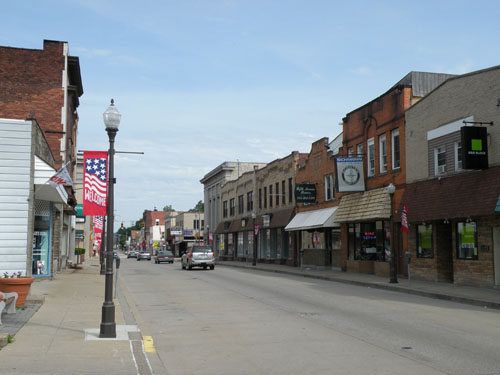
Coraopolis (/ˌkoʊriˈɒpəlɪs/) is a borough in Allegheny County, Pennsylvania, United States, along the Ohio River. The population was 5,559 at the 2020 census.
Coraopolis is located west of Pittsburgh along the Ohio River and to the east of the Pittsburgh International Airport. The borough has steep topography, numerous brick streets and many large, old houses. The American Bridge Company is headquartered in Coraopolis.
On April 3, 1769, Andrew Montour, an Indian interpreter who had provided service to English settlers during the French and Indian War, was granted a land patent for approximately 350 acres (1.4 km2) of what would later become the borough of Coraopolis and Neville Island. However, there is no evidence that Montour ever lived on this tract. The first permanent white settler in Coraopolis was Capt. Robert Vance, who settled in the vicinity of Montour's tract around 1773, just prior to the beginning of the American Revolution. Vance, a Virginian, had been a member of the regiment commanded by George Washington at the Braddock expedition during the French and Indian War. For the protection of himself and his neighbors, of whom several arrived within a few years, Vance had a log stockade built with a stone blockhouse to protect the area against Indian raids. This was known as Vance Fort (or Fort Vance). The site of the fort was around present-day Broadway and Chestnut streets, near Second Avenue. Over time the community grew and developed, and it became known as Middletown in the 1800s, either because it was situated midway between Pittsburgh and Beaver, Pennsylvania, or perhaps after an early settler named Alexander Middleton who supposedly ran "Middleton's Tavern" in the area.
One of the most important early industries in the area was begun by the Watson family, English immigrants who arrived in America in 1830. The Watsons built a sawmill on the site of the former municipal building on Fifth Avenue. Later, they operated a much larger grist mill on the river bank at Mill Street, until 1887.[citation needed]
The borough was incorporated on June 7, 1886. It was previously known as a village under the name of Middletown, while the post office name was Vancefort. It was established in August 1861, and changed to Coraopolis in March 1886. Legend has it that the borough was named for a member of the Watson family, Cora Watson, who was born on February 2, 1870. However, an old newspaper uncovered by longtime resident and local historian Dr. Frank Braden, Jr. suggests it more likely took the appellation from a Greek word for "maiden city". According to page 7 of the book Coraopolis, by Gia Tatone, Coraopolis Historical Society (2007), "The newspaper [Dr. Frank Braden, Jr. uncovered] was simply called the News and was published in Coraopolis, Pennsylvania, on June 5, 1897. The newspaper discusses the confusion that was occurring with the post offices in regard to the name Middletown, because several other areas in the state of Pennsylvania shared the same name. With a borough now being established, the Reverend Josiah Dillon, a pioneer clergyman, suggested the name to be changed to Coraopolis. Dillon knew Greek and was also the first burgess (mayor) at the time. So he suggested combining Kore meaning 'maiden' and opolis meaning 'city' ('maiden city') to achieve Koreopolis. However, when Greek letters and pronunciation were turned to English, it is said the spelling therefore accidentally got changed." The borough was built on land then owned by James Harvey McCabe and when the borough charter was granted, he was elected first burgess. "and, under his careful and interested administration the departments of the new government and were, in an astonishing short time, working with great lubricity and resulting high efficiency. As he took the lead in the matter of establishing the new form of government, so it was his energetic championing of the projected laying of the tracks of the Pittsburg [sic] and Lake Erie through the borough that made that enterprise possible, his active assistance in securing rights of way being an important factor in its success."
Community development in Coraopolis moved along gradually with the building of the Pittsburgh and Lake Erie Railroad in 1877. Several Coraopolis residents were stockholders in this enterprise. Eventually the P&LE spun off the Montour Railroad as a subsidiary to bring coal in from the many mines south of town. Its headquarters and main yard remained in Coraopolis. The Montour at its peak ran 50 miles to Clairton with mines all along the way. The railroad ran until the 1980s, when the coal ran out and it was closed.[citation needed] Its old right of way is now part of the Montour Trail.
In 1892, community development took off with the construction of the first high-speed electric street railway in the United States. The railway ran from downtown Pittsburgh through McKees Rocks, Neville Island and Coraopolis to Sewickley. Streetcars ran until 1955. Along with the railway came Consolidated Lamp and Glass Company to Coraopolis, moving from its location in Fostoria, Ohio. Consolidated Glass employed up to 350 people, and was located in Coraopolis from 1895 until 1963. Other Coraopolis residents worked for the new industries established on Neville Island. Shafer Bus Line was headquartered in Coraopolis and served the western part of Allegheny County south of the Ohio River until 1960, when it was bought out by PennDOT, which continues to run buses between Coraopolis, the Pittsburgh International Airport and downtown Pittsburgh. Standard Steel Spring Company, which was bought out by North American Rockwell Steel Corporation, operated from 1900 until 1960, when it moved to Mishewaka, Indiana. The plant made springs, bumpers and frames for vehicles. It employed 10,000 men working three shifts a day seven days a week.
Coraopolis' first municipal building was built in 1897 on State Avenue and was used until 1929, when next building was constructed on Fifth Ave. Coraopolis dedicated a new municipal complex on Fourth Ave in 2017 that houses all municipal departments, including the police and fire stations.
Hub AI
Coraopolis, Pennsylvania AI simulator
(@Coraopolis, Pennsylvania_simulator)
Coraopolis, Pennsylvania
Coraopolis (/ˌkoʊriˈɒpəlɪs/) is a borough in Allegheny County, Pennsylvania, United States, along the Ohio River. The population was 5,559 at the 2020 census.
Coraopolis is located west of Pittsburgh along the Ohio River and to the east of the Pittsburgh International Airport. The borough has steep topography, numerous brick streets and many large, old houses. The American Bridge Company is headquartered in Coraopolis.
On April 3, 1769, Andrew Montour, an Indian interpreter who had provided service to English settlers during the French and Indian War, was granted a land patent for approximately 350 acres (1.4 km2) of what would later become the borough of Coraopolis and Neville Island. However, there is no evidence that Montour ever lived on this tract. The first permanent white settler in Coraopolis was Capt. Robert Vance, who settled in the vicinity of Montour's tract around 1773, just prior to the beginning of the American Revolution. Vance, a Virginian, had been a member of the regiment commanded by George Washington at the Braddock expedition during the French and Indian War. For the protection of himself and his neighbors, of whom several arrived within a few years, Vance had a log stockade built with a stone blockhouse to protect the area against Indian raids. This was known as Vance Fort (or Fort Vance). The site of the fort was around present-day Broadway and Chestnut streets, near Second Avenue. Over time the community grew and developed, and it became known as Middletown in the 1800s, either because it was situated midway between Pittsburgh and Beaver, Pennsylvania, or perhaps after an early settler named Alexander Middleton who supposedly ran "Middleton's Tavern" in the area.
One of the most important early industries in the area was begun by the Watson family, English immigrants who arrived in America in 1830. The Watsons built a sawmill on the site of the former municipal building on Fifth Avenue. Later, they operated a much larger grist mill on the river bank at Mill Street, until 1887.[citation needed]
The borough was incorporated on June 7, 1886. It was previously known as a village under the name of Middletown, while the post office name was Vancefort. It was established in August 1861, and changed to Coraopolis in March 1886. Legend has it that the borough was named for a member of the Watson family, Cora Watson, who was born on February 2, 1870. However, an old newspaper uncovered by longtime resident and local historian Dr. Frank Braden, Jr. suggests it more likely took the appellation from a Greek word for "maiden city". According to page 7 of the book Coraopolis, by Gia Tatone, Coraopolis Historical Society (2007), "The newspaper [Dr. Frank Braden, Jr. uncovered] was simply called the News and was published in Coraopolis, Pennsylvania, on June 5, 1897. The newspaper discusses the confusion that was occurring with the post offices in regard to the name Middletown, because several other areas in the state of Pennsylvania shared the same name. With a borough now being established, the Reverend Josiah Dillon, a pioneer clergyman, suggested the name to be changed to Coraopolis. Dillon knew Greek and was also the first burgess (mayor) at the time. So he suggested combining Kore meaning 'maiden' and opolis meaning 'city' ('maiden city') to achieve Koreopolis. However, when Greek letters and pronunciation were turned to English, it is said the spelling therefore accidentally got changed." The borough was built on land then owned by James Harvey McCabe and when the borough charter was granted, he was elected first burgess. "and, under his careful and interested administration the departments of the new government and were, in an astonishing short time, working with great lubricity and resulting high efficiency. As he took the lead in the matter of establishing the new form of government, so it was his energetic championing of the projected laying of the tracks of the Pittsburg [sic] and Lake Erie through the borough that made that enterprise possible, his active assistance in securing rights of way being an important factor in its success."
Community development in Coraopolis moved along gradually with the building of the Pittsburgh and Lake Erie Railroad in 1877. Several Coraopolis residents were stockholders in this enterprise. Eventually the P&LE spun off the Montour Railroad as a subsidiary to bring coal in from the many mines south of town. Its headquarters and main yard remained in Coraopolis. The Montour at its peak ran 50 miles to Clairton with mines all along the way. The railroad ran until the 1980s, when the coal ran out and it was closed.[citation needed] Its old right of way is now part of the Montour Trail.
In 1892, community development took off with the construction of the first high-speed electric street railway in the United States. The railway ran from downtown Pittsburgh through McKees Rocks, Neville Island and Coraopolis to Sewickley. Streetcars ran until 1955. Along with the railway came Consolidated Lamp and Glass Company to Coraopolis, moving from its location in Fostoria, Ohio. Consolidated Glass employed up to 350 people, and was located in Coraopolis from 1895 until 1963. Other Coraopolis residents worked for the new industries established on Neville Island. Shafer Bus Line was headquartered in Coraopolis and served the western part of Allegheny County south of the Ohio River until 1960, when it was bought out by PennDOT, which continues to run buses between Coraopolis, the Pittsburgh International Airport and downtown Pittsburgh. Standard Steel Spring Company, which was bought out by North American Rockwell Steel Corporation, operated from 1900 until 1960, when it moved to Mishewaka, Indiana. The plant made springs, bumpers and frames for vehicles. It employed 10,000 men working three shifts a day seven days a week.
Coraopolis' first municipal building was built in 1897 on State Avenue and was used until 1929, when next building was constructed on Fifth Ave. Coraopolis dedicated a new municipal complex on Fourth Ave in 2017 that houses all municipal departments, including the police and fire stations.
Recent media