
Recent from talks
Corn tortilla
Knowledge base stats:
Talk channels stats:
Members stats:
Corn tortilla
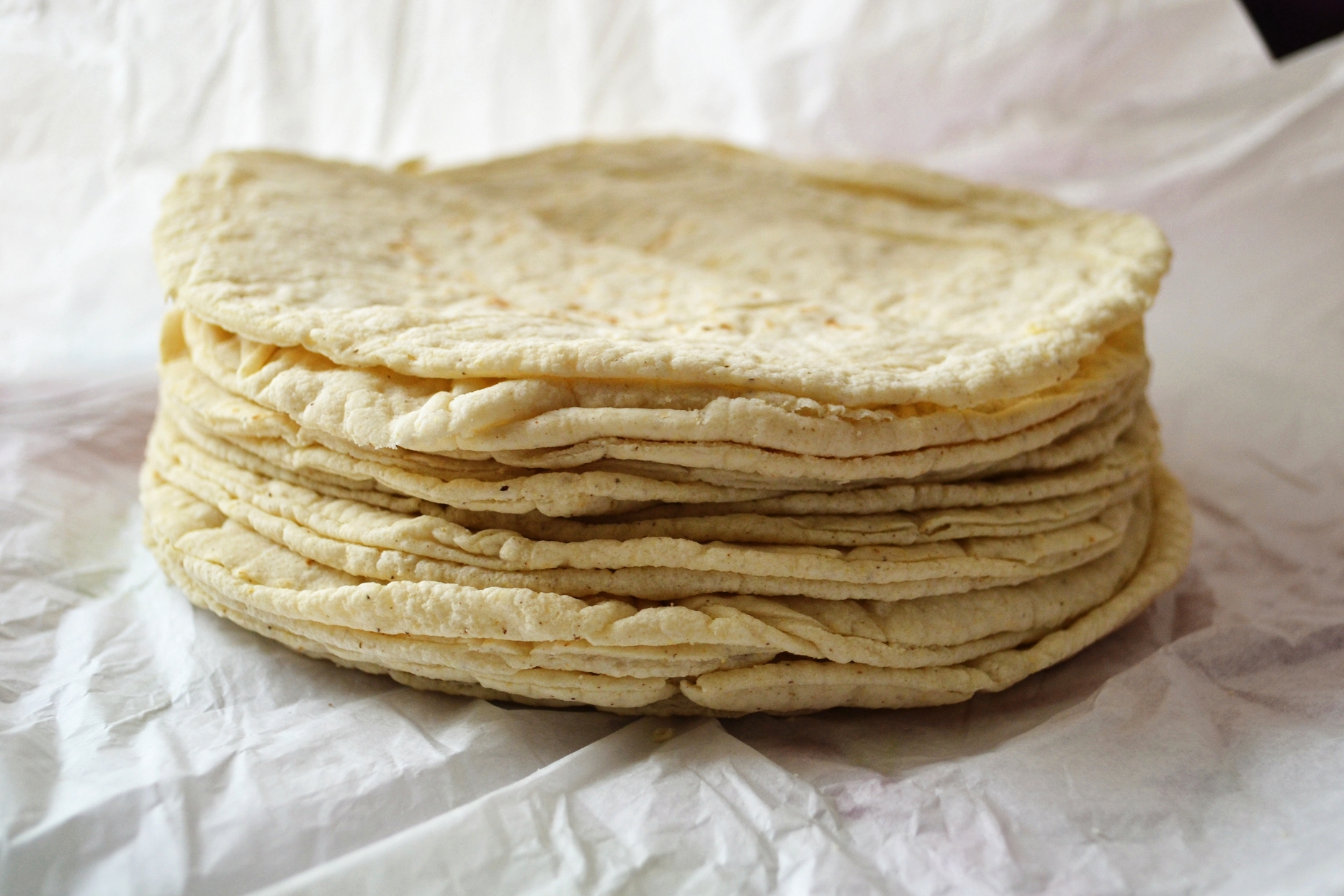
In Mexico and Central America, a corn tortilla or just tortilla (/tɔːrˈtiːə/, Spanish: [toɾˈtiʝa]) is a type of thin, unleavened flatbread, made from hominy, that is the whole kernels of maize treated with alkali to improve their nutrition in a process called nixtamalization. A simple dough made of ground hominy, salt and water is then formed into flat discs and cooked on a very hot surface, generally an iron griddle called a comal.
A similar flatbread from South America, called an arepa (made with ground maize, not hominy, and typically much thicker than tortillas), predates the arrival of Europeans to America, and was called tortilla by the Spanish from its resemblance to traditional Spanish round, unleavened cakes and omelettes. The Aztecs and other Nahuatl-speakers call tortillas tlaxcalli ([t͡ɬaʃˈkalli]). The successful conquest of the Aztec empire by the Spanish and the subsequent colonial empire ruled from the former Aztec capital have ensured that this variation become the prototypical tortilla for much of the Spanish-speaking world.
Maize kernels naturally occur in many colors, depending on cultivar: from pale white, to yellow, to red and bluish purple. Likewise, corn meal and the tortillas made from it may be similarly colored. White and yellow tortillas are by far the most common, however. In Mexico, there are three colors of maize dough for making tortillas: white maize, yellow maize and blue maize (also referred to as black maize). Tortilla is a common food in Mexico, Guatemala, Belize, El Salvador, Honduras, Nicaragua and Costa Rica.
Tortilla, from Spanish torta, cake, plus the diminutive -illa, literally means "little cake". Nahuatl tlaxcalli is derived from the verb (i)xca "to bake" with the help of the prefix tla- and two common suffixes -l- and -li (<-tli), that is "something baked".
Tortilla in Iberian Spanish also means omelette. As such, this corn flour flatbread tortilla is not to be confused with the Spanish omelette or any other egg-based one.
The corn tortilla was first developed in Mexico, during prehistoric times. It has since become a staple carbohydrate in North American and Mesoamerican cultures. It predates its derivative, the wheat flour tortilla (tortilla de harina or tortilla de trigo), in all such cultures. This is because old world wheat was neither known nor grown in the Americas prior to European colonization.
In Aztec times two or three corn tortillas would be eaten with each meal, either plain or dipped in mole or a chili pepper and water sauce. Tortillas were also sold at Aztec marketplaces filled with turkey meat, turkey eggs, beans, honey, squash, prickly pears and various preparations of chili pepper.
Analogous staple carbohydrates in New World cultures, all made from hominy and serving a similar nutritional function, include the sope, the totopo, the gordita, the tlacoyo of Mexico, and the pupusa of Central America. The arepa of northern South America, though similar, is made with ground maize, not hominy, and does not offer the same nutrition profile as foods whose maize has been processed with alkali[citation needed].
Hub AI
Corn tortilla AI simulator
(@Corn tortilla_simulator)
Corn tortilla
In Mexico and Central America, a corn tortilla or just tortilla (/tɔːrˈtiːə/, Spanish: [toɾˈtiʝa]) is a type of thin, unleavened flatbread, made from hominy, that is the whole kernels of maize treated with alkali to improve their nutrition in a process called nixtamalization. A simple dough made of ground hominy, salt and water is then formed into flat discs and cooked on a very hot surface, generally an iron griddle called a comal.
A similar flatbread from South America, called an arepa (made with ground maize, not hominy, and typically much thicker than tortillas), predates the arrival of Europeans to America, and was called tortilla by the Spanish from its resemblance to traditional Spanish round, unleavened cakes and omelettes. The Aztecs and other Nahuatl-speakers call tortillas tlaxcalli ([t͡ɬaʃˈkalli]). The successful conquest of the Aztec empire by the Spanish and the subsequent colonial empire ruled from the former Aztec capital have ensured that this variation become the prototypical tortilla for much of the Spanish-speaking world.
Maize kernels naturally occur in many colors, depending on cultivar: from pale white, to yellow, to red and bluish purple. Likewise, corn meal and the tortillas made from it may be similarly colored. White and yellow tortillas are by far the most common, however. In Mexico, there are three colors of maize dough for making tortillas: white maize, yellow maize and blue maize (also referred to as black maize). Tortilla is a common food in Mexico, Guatemala, Belize, El Salvador, Honduras, Nicaragua and Costa Rica.
Tortilla, from Spanish torta, cake, plus the diminutive -illa, literally means "little cake". Nahuatl tlaxcalli is derived from the verb (i)xca "to bake" with the help of the prefix tla- and two common suffixes -l- and -li (<-tli), that is "something baked".
Tortilla in Iberian Spanish also means omelette. As such, this corn flour flatbread tortilla is not to be confused with the Spanish omelette or any other egg-based one.
The corn tortilla was first developed in Mexico, during prehistoric times. It has since become a staple carbohydrate in North American and Mesoamerican cultures. It predates its derivative, the wheat flour tortilla (tortilla de harina or tortilla de trigo), in all such cultures. This is because old world wheat was neither known nor grown in the Americas prior to European colonization.
In Aztec times two or three corn tortillas would be eaten with each meal, either plain or dipped in mole or a chili pepper and water sauce. Tortillas were also sold at Aztec marketplaces filled with turkey meat, turkey eggs, beans, honey, squash, prickly pears and various preparations of chili pepper.
Analogous staple carbohydrates in New World cultures, all made from hominy and serving a similar nutritional function, include the sope, the totopo, the gordita, the tlacoyo of Mexico, and the pupusa of Central America. The arepa of northern South America, though similar, is made with ground maize, not hominy, and does not offer the same nutrition profile as foods whose maize has been processed with alkali[citation needed].
Recent media