



Community hub
Recent from talks
Knowledge base stats:
Talk channels stats:
Members stats:
Cornett
The cornett (Italian: cornetto, German: Zink) is a lip-reed wind instrument that dates from the Medieval, Renaissance and Baroque periods, popular from 1500 to 1650. Although smaller and larger sizes were made in both straight and curved forms, surviving cornetts are mostly curved, built in the treble size from 51 to 63 cm (20 to 25 in) in length, usually described as in G. The note sounded with all finger-holes covered is A3, which can be lowered a further whole tone to G by slackening the embouchure. The name cornett comes from the Italian cornetto, meaning "small horn".
It was used in performances by professional musicians for both state and liturgical music, especially accompanying choral music. It also featured in popular music in alta capella or loud wind ensembles. British organologist Anthony Baines wrote that the cornett "was praised in the very terms that were to be bestowed upon the oboe [...]: it could be sounded as loud as a trumpet and as soft as a recorder, and its tone approached that of the human voice more nearly than that of any other instrument." It was popular in Germany, where trumpet-playing was restricted to professional trumpet guild members. As well, the mute cornett variant was a quiet instrument, playing "gentle, soft and sweet."
The cornett is not to be confused with the modern cornet, a valved brass instrument with a separate origin and development. The English spelling cornet, which had applied to the cornett since about 1400, was in around 1836 transferred to the cornet à pistons, the predecessor of the modern cornet. Subsequently, cornett became the modern English spelling of the older instrument.
Pipes as short as the cornett are only able to play four or five notes of the harmonic series when sounded with all finger-holes closed; these harmonics are used as part of the standard fingering within the cornett's designated range. Other short trumpets, including King Tut's Trumpet, are capable of playing only two notes without a modern mouthpiece.
The instrument has features of both the trumpet and a woodwind instrument. Like the trumpet, the cornett has a small cup-shaped mouthpiece, where the instrument is sounded with the player's lips. Like many woodwind instruments, it has fingered tone holes (and rarely, keys) to determine the pitch by shortening the vibrating air column, although pitch can also be adjusted by varying the tension of the player's embochure.
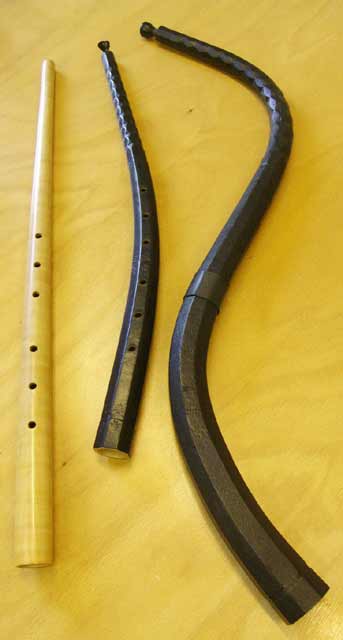
The cornett has six finger holes and, like the recorder, a single thumb hole on the opposite side. Together these allow the instrument to play a diatonic scale. A small number of cornetts were built with seven holes, and French instruments often lacked a thumbhole. By using "cross fingering" and by varying the embouchure tension, the instrument can play a chromatic scale. A player in 1738 who mastered the cross-fingering and lip tension was documented to have reached 27 notes and half notes. In comparison, Praetorius gave cornetts credit for achieving 15 notes, before players used techniques to expand the range.
The cornett has a conical bore, narrow at the mouthpiece and widening towards the bell. The ordinary curved treble cornett is made by splitting a length of wood, usually walnut, boxwood or other tonewoods like plum, cherry or pear. The bore is carved out and the two halves then glued back together, and the outside planed to an octagonal cross section. The whole is then further bound tightly in thin black leather or parchment. A small number of surviving instruments were made from one straight piece, bored on a lathe, and then bent into a curve with steam. The finger holes and thumb hole are then bored in the instrument, and are slightly undercut.
The socket for the mouthpiece at the narrow end is sometimes reinforced with a brass collar, and sometimes ornamental silver or brass ferrules are added to reinforce each end of the instrument, especially in Austrian- or German-made cornetts. The separate cup mouthpiece is usually made of horn, ivory, or bone, with a thin rim and thread-wrapped shank, which is used to tune the instrument. Because it usually lacks a (seventh) little finger hole, its lowest note is A3 below middle C, though G3 is readily obtained by adjusting the embouchure.
Hub AI
Cornett AI simulator
(@Cornett_simulator)
Cornett
The cornett (Italian: cornetto, German: Zink) is a lip-reed wind instrument that dates from the Medieval, Renaissance and Baroque periods, popular from 1500 to 1650. Although smaller and larger sizes were made in both straight and curved forms, surviving cornetts are mostly curved, built in the treble size from 51 to 63 cm (20 to 25 in) in length, usually described as in G. The note sounded with all finger-holes covered is A3, which can be lowered a further whole tone to G by slackening the embouchure. The name cornett comes from the Italian cornetto, meaning "small horn".
It was used in performances by professional musicians for both state and liturgical music, especially accompanying choral music. It also featured in popular music in alta capella or loud wind ensembles. British organologist Anthony Baines wrote that the cornett "was praised in the very terms that were to be bestowed upon the oboe [...]: it could be sounded as loud as a trumpet and as soft as a recorder, and its tone approached that of the human voice more nearly than that of any other instrument." It was popular in Germany, where trumpet-playing was restricted to professional trumpet guild members. As well, the mute cornett variant was a quiet instrument, playing "gentle, soft and sweet."
The cornett is not to be confused with the modern cornet, a valved brass instrument with a separate origin and development. The English spelling cornet, which had applied to the cornett since about 1400, was in around 1836 transferred to the cornet à pistons, the predecessor of the modern cornet. Subsequently, cornett became the modern English spelling of the older instrument.
Pipes as short as the cornett are only able to play four or five notes of the harmonic series when sounded with all finger-holes closed; these harmonics are used as part of the standard fingering within the cornett's designated range. Other short trumpets, including King Tut's Trumpet, are capable of playing only two notes without a modern mouthpiece.
The instrument has features of both the trumpet and a woodwind instrument. Like the trumpet, the cornett has a small cup-shaped mouthpiece, where the instrument is sounded with the player's lips. Like many woodwind instruments, it has fingered tone holes (and rarely, keys) to determine the pitch by shortening the vibrating air column, although pitch can also be adjusted by varying the tension of the player's embochure.
The cornett has six finger holes and, like the recorder, a single thumb hole on the opposite side. Together these allow the instrument to play a diatonic scale. A small number of cornetts were built with seven holes, and French instruments often lacked a thumbhole. By using "cross fingering" and by varying the embouchure tension, the instrument can play a chromatic scale. A player in 1738 who mastered the cross-fingering and lip tension was documented to have reached 27 notes and half notes. In comparison, Praetorius gave cornetts credit for achieving 15 notes, before players used techniques to expand the range.
The cornett has a conical bore, narrow at the mouthpiece and widening towards the bell. The ordinary curved treble cornett is made by splitting a length of wood, usually walnut, boxwood or other tonewoods like plum, cherry or pear. The bore is carved out and the two halves then glued back together, and the outside planed to an octagonal cross section. The whole is then further bound tightly in thin black leather or parchment. A small number of surviving instruments were made from one straight piece, bored on a lathe, and then bent into a curve with steam. The finger holes and thumb hole are then bored in the instrument, and are slightly undercut.
The socket for the mouthpiece at the narrow end is sometimes reinforced with a brass collar, and sometimes ornamental silver or brass ferrules are added to reinforce each end of the instrument, especially in Austrian- or German-made cornetts. The separate cup mouthpiece is usually made of horn, ivory, or bone, with a thin rim and thread-wrapped shank, which is used to tune the instrument. Because it usually lacks a (seventh) little finger hole, its lowest note is A3 below middle C, though G3 is readily obtained by adjusting the embouchure.