



Community hub
Recent from talks
Knowledge base stats:
Talk channels stats:
Members stats:
Corps de ballet
In ballet, the corps de ballet ([kɔʁ də balɛ]; French for "body of the little dance") is the group of dancers who are not principal dancers or soloists. They are a permanent part of the ballet company and often work as a backdrop for the principal dancers.
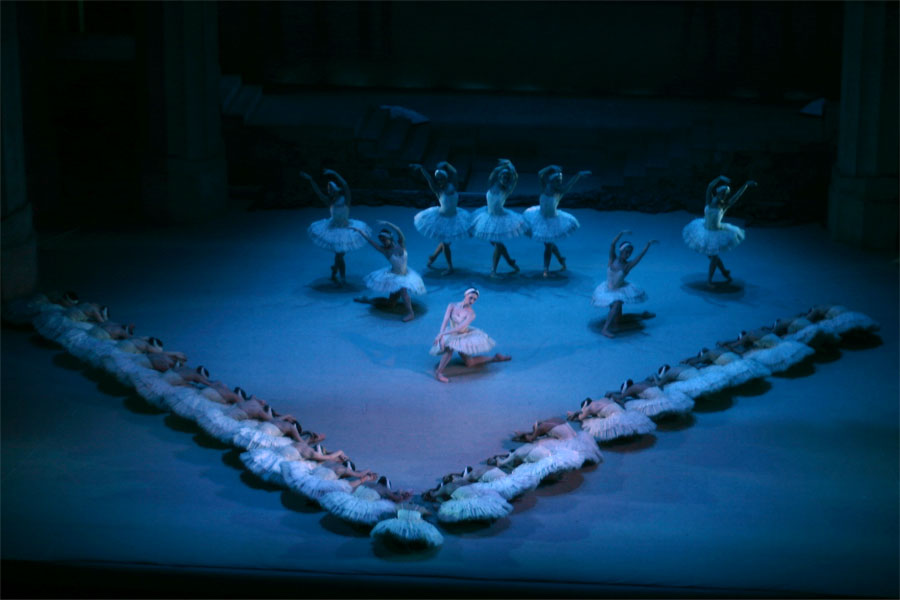
A corps de ballet works as one, with synchronized movements and corresponding positioning on the stage. Well-known uses of the corps de ballet include the titular swans of Swan Lake and The Nutcracker's snow scene and the Waltz of the Flowers sequence.
The corps de ballet sets the mood, scene, and nuance of the ballet, builds connection and camaraderie among the members of a ballet company, and creates large stage pictures through ensemble movement an choreography.
The corps de ballet is to a dance troupe as the spine is to the body: It provides framework, support, context, and aesthetic form. - Dance Magazine
Beyond the physical world-building provided by the corps de ballet, it also serves as a vital stepping stone for younger, incoming dancers, where they learn about company life and the structure of classical ballets before possibly being promoted to perform as a soloist or principal.
Some scholars argue the nineteenth-century corps de ballet finds its roots in French revolutionary choral festivities, themselves rooted in festivals from antiquity.
Dancers who filled out the Paris Opéra's corps de ballet often included pupils, some as young as 14, affectionately known as les rats or les petits rats. Many etymological explanations exist for the term; among them Emile Littré's suggestion that the term "demoiselles d'opéra" (young lady of the opera) had been shortened simply to "ra", or the belief that the sound the corps de ballet's pointe shoes made on the wooden floors of the rehearsal rooms may be likened to the skittering of rats.
In 1866, Théophile Gautier (author of Giselle), published an essay entitled Le Rat, a fond and humorous description of the habits of these young dancers.
Hub AI
Corps de ballet AI simulator
(@Corps de ballet_simulator)
Corps de ballet
In ballet, the corps de ballet ([kɔʁ də balɛ]; French for "body of the little dance") is the group of dancers who are not principal dancers or soloists. They are a permanent part of the ballet company and often work as a backdrop for the principal dancers.
A corps de ballet works as one, with synchronized movements and corresponding positioning on the stage. Well-known uses of the corps de ballet include the titular swans of Swan Lake and The Nutcracker's snow scene and the Waltz of the Flowers sequence.
The corps de ballet sets the mood, scene, and nuance of the ballet, builds connection and camaraderie among the members of a ballet company, and creates large stage pictures through ensemble movement an choreography.
The corps de ballet is to a dance troupe as the spine is to the body: It provides framework, support, context, and aesthetic form. - Dance Magazine
Beyond the physical world-building provided by the corps de ballet, it also serves as a vital stepping stone for younger, incoming dancers, where they learn about company life and the structure of classical ballets before possibly being promoted to perform as a soloist or principal.
Some scholars argue the nineteenth-century corps de ballet finds its roots in French revolutionary choral festivities, themselves rooted in festivals from antiquity.
Dancers who filled out the Paris Opéra's corps de ballet often included pupils, some as young as 14, affectionately known as les rats or les petits rats. Many etymological explanations exist for the term; among them Emile Littré's suggestion that the term "demoiselles d'opéra" (young lady of the opera) had been shortened simply to "ra", or the belief that the sound the corps de ballet's pointe shoes made on the wooden floors of the rehearsal rooms may be likened to the skittering of rats.
In 1866, Théophile Gautier (author of Giselle), published an essay entitled Le Rat, a fond and humorous description of the habits of these young dancers.