



Community hub
Recent from talks
Contribute something
Nothing was collected or created yet.
Scale factor (cosmology)
View on WikipediaThe expansion of the universe is parametrized by a dimensionless scale factor . Also known as the cosmic scale factor or sometimes the Robertson–Walker scale factor,[1] this is a key parameter of the Friedmann equations.

In the early stages of the Big Bang, most of the energy was in the form of radiation, and that radiation was the dominant influence on the expansion of the universe. Later, with cooling from the expansion the roles of matter and radiation changed and the universe entered a matter-dominated era. Recent results suggest that we have already entered an era dominated by dark energy, but examination of the roles of matter and radiation are most important for understanding the early universe.
Using the dimensionless scale factor to characterize the expansion of the universe, the effective energy densities of radiation and matter scale differently. This leads to a radiation-dominated era in the very early universe but a transition to a matter-dominated era at a later time and, since about 4 billion years ago, a subsequent dark-energy–dominated era.[2][notes 1]
Concept
[edit]
By itself the scale factor in cosmology is a geometrical scaling factor conventionally set to be 1.0 at the present time ("now" or ). At earlier times the factor is less than one. For three galaxies, their relative positions, , over time are related through the scale factor : Models of the universe specify the value of the scale factor as a function of cosmic time. The scale factor is independent of location and direction.[3]: 43


Detail
[edit]Some insight into the expansion can be obtained from a Newtonian expansion model which leads to a simplified version of the Friedmann equation. It relates the proper distance (which can change over time, unlike the comoving distance which is constant and set to today's distance) between a pair of objects, e.g. two galaxy clusters, moving with the Hubble flow in an expanding or contracting FLRW universe at any arbitrary time to their distance at some reference time . The formula for this is: where is the proper distance at epoch , is the distance at the reference time , usually also referred to as comoving distance, and is the scale factor.[4] Thus, by definition, and .


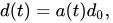


The scale factor is dimensionless, with counted from the birth of the universe and set to the present age of the universe: 13.799±0.021 Gyr[5] giving the current value of as or .


The evolution of the scale factor is a dynamical question, determined by the equations of general relativity, which are presented in the case of a locally isotropic, locally homogeneous universe by the Friedmann equations.
The Hubble parameter is defined as:

where the dot represents a time derivative. The Hubble parameter varies with time, not with space, with the Hubble constant being its current value.

From the previous equation one can see that , and also that , so combining these gives , and substituting the above definition of the Hubble parameter gives which is just Hubble's law.
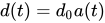
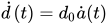

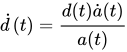

Current evidence suggests that the expansion of the universe is accelerating, which means that the second derivative of the scale factor is positive, or equivalently that the first derivative is increasing over time.[6] This also implies that any given galaxy recedes from us with increasing speed over time, i.e. for that galaxy is increasing with time. In contrast, the Hubble parameter seems to be decreasing with time, meaning that if we were to look at some fixed distance d and watch a series of different galaxies pass that distance, later galaxies would pass that distance at a smaller velocity than earlier ones.[7]


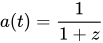
According to the Friedmann–Lemaître–Robertson–Walker metric which is used to model the expanding universe, if at present time we receive light from a distant object with a redshift of z, then the scale factor at the time the object originally emitted that light is .[8][9]
Chronology
[edit]Radiation-dominated era
[edit]After Inflation, and until about 47,000 years after the Big Bang, the dynamics of the early universe were set by radiation (referring generally to the constituents of the universe which moved relativistically, principally photons and neutrinos).[10]
For a radiation-dominated universe the evolution of the scale factor in the Friedmann–Lemaître–Robertson–Walker metric is obtained solving the Friedmann equations:[11]

Matter-dominated era
[edit]Between about 47,000 years and 9.8 billion years after the Big Bang,[12] the energy density of matter exceeded both the energy density of radiation and the vacuum energy density.[13]
When the early universe was about 47,000 years old (redshift 3600), mass–energy density surpassed the radiation energy, although the universe remained optically thick to radiation until the universe was about 378,000 years old (redshift 1100). This second moment in time (close to the time of recombination), at which the photons which compose the cosmic microwave background radiation were last scattered, is often mistaken[neutrality is disputed] as marking the end of the radiation era.
For a matter-dominated universe the evolution of the scale factor in the Friedmann–Lemaître–Robertson–Walker metric is easily obtained solving the Friedmann equations:

Dark-energy–dominated era
[edit]In physical cosmology, the dark-energy–dominated era is proposed as the last of the three phases of the known universe, beginning when the Universe was about 9.8 billion years old.[14] In the era of cosmic inflation, the Hubble parameter is also thought to be constant, so the expansion law of the dark-energy–dominated era also holds for the inflationary prequel of the big bang.
The cosmological constant is given the symbol Λ, and, considered as a source term in the Einstein field equation, can be viewed as equivalent to a "mass" of empty space, or dark energy. Since this increases with the volume of the universe, the expansion pressure is effectively constant, independent of the scale of the universe, while the other terms decrease with time. Thus, as the density of other forms of matter – dust and radiation – drops to very low concentrations, the cosmological constant (or "dark energy") term will eventually dominate the energy density of the Universe. Recent measurements of the change in Hubble constant with time, based on observations of distant supernovae, show this acceleration in expansion rate,[15] indicating the presence of such dark energy.
For a dark-energy–dominated universe, the evolution of the scale factor in the Friedmann–Lemaître–Robertson–Walker metric is easily obtained solving the Friedmann equations: Here, the coefficient in the exponential, the Hubble constant, is This exponential dependence on time makes the spacetime geometry identical to the de Sitter universe, and only holds for a positive sign of the cosmological constant, which is the case according to the currently accepted value of the cosmological constant, Λ, that is approximately 2×10⁻³⁵ s−2. The current density of the observable universe is of the order of 9.44×10⁻²⁷ kg/m3 and the age of the universe is of the order of 13.8 billion years, or 4.358×10¹⁷ s. The Hubble constant, , is ≈70.88 km/s/Mpc (The Hubble time is 13.79 billion years).


See also
[edit]Notes
[edit]- ^ [2] p. 6: "The Universe has gone through three distinct eras: radiation-dominated, z ≳ 3000; matter-dominated, 3000 ≳ z ≳ 0.5; and dark-energy–dominated, z ≲ 0.5. The evolution of the scale factor is controlled by the dominant energy form: a(t) ∝ t2/3(1+w) (for constant w). During the radiation-dominated era, a(t) ∝ t1/2; during the matter-dominated era, a(t) ∝ t2/3; and for the dark-energy–dominated era, assuming w = −1, asymptotically a(t) ∝ exp(Ht)."
p. 44: "Taken together, all the current data provide strong evidence for the existence of dark energy; they constrain the fraction of critical density contributed by dark energy, 0.76 ± 0.02, and the equation-of-state parameter, w ≈ −1 ± 0.1 (stat) ±0.1 (sys), assuming that w is constant. This implies that the Universe began accelerating at redshift z ∼ 0.4 and age t ∼ 10 Gyr. These results are robust – data from any one method can be removed without compromising the constraints – and they are not substantially weakened by dropping the assumption of spatial flatness."
References
[edit]- ^ Steven Weinberg (2008). Cosmology. Oxford University Press. p. 3. ISBN 978-0-19-852682-7.
- ^ a b Frieman, Joshua A.; Turner, Michael S.; Huterer, Dragan (2008-01-01). "Dark Energy and the Accelerating Universe". Annual Review of Astronomy and Astrophysics. 46 (1): 385–432. arXiv:0803.0982. Bibcode:2008ARA&A..46..385F. doi:10.1146/annurev.astro.46.060407.145243. S2CID 15117520.
- ^ Ryden, Barbara (2016-11-17). Introduction to Cosmology (2 ed.). Cambridge University Press. doi:10.1017/9781316651087. ISBN 978-1-107-15483-4.
- ^ Schutz, Bernard (2003). Gravity from the Ground Up: An Introductory Guide to Gravity and General Relativity. Cambridge University Press. p. 363. ISBN 978-0-521-45506-0.
- ^ Planck Collaboration (2016). "Planck 2015 results. XIII. Cosmological parameters (See Table 4 on page 31 of pdf)". Astronomy & Astrophysics. 594: A13. arXiv:1502.01589. Bibcode:2016A&A...594A..13P. doi:10.1051/0004-6361/201525830. S2CID 119262962.
- ^ Jones, Mark H.; Robert J. Lambourne (2004). An Introduction to Galaxies and Cosmology. Cambridge University Press. p. 244. ISBN 978-0-521-83738-5.
- ^ Is the universe expanding faster than the speed of light? (see final paragraph) Archived November 28, 2010, at the Wayback Machine
- ^ Davies, Paul (1992), The New Physics, p. 187.
- ^ Mukhanov, V. F. (2005), Physical Foundations of Cosmology, p. 58.
- ^ Ryden, Barbara, "Introduction to Cosmology", 2006, eqn. 5.25, 6.41
- ^ Padmanabhan (1993, p. 64)
- ^ Ryden, Barbara, "Introduction to Cosmology", 2006, eqn. 6.33, 6.41
- ^ Zelik, M and Gregory, S: "Introductory Astronomy & Astrophysics", page 497. Thompson Learning, Inc. 1998
- ^ Ryden, Barbara, "Introduction to Cosmology", 2006, eqn. 6.33
- ^ The Nobel Prize in Physics 2011. Retrieved 18 May 2017.
- Padmanabhan, Thanu (1993). Structure formation in the universe. Cambridge: Cambridge University Press. ISBN 978-0-521-42486-8.
- Spergel, D. N.; et al. (2003). "First-Year Wilkinson Microwave Anisotropy Probe (WMAP) Observations: Determination of Cosmological Parameters". Astrophysical Journal Supplement. 148 (1): 175–194. arXiv:astro-ph/0302209. Bibcode:2003ApJS..148..175S. CiteSeerX 10.1.1.985.6441. doi:10.1086/377226. S2CID 10794058.


