



Community hub
Recent from talks
Contribute something
Nothing was collected or created yet.
Cosmic time
View on WikipediaCosmic time, or cosmological time, is the time coordinate used in the Big Bang models of physical cosmology.[1]: 315 This concept of time avoids some issues related to relativity by being defined within a solution to the equations of general relativity widely used in cosmology.
Problems with absolute time
[edit]Albert Einstein's theory of special relativity showed that simultaneity is not absolute. An observer at rest may believe that two events separated in space (say, two lightning strikes 10 meters apart) occurred at the same time, while another observer in (relative) motion claims that one occurred after the other. This coupling of space and time, Minkowski spacetime, complicates scientific time comparisons: neither observer is an obvious candidate for the time reference.[2]: 202
Einstein's theory of general relativity in an isotropic, homogeneous expanding universe provides a way to define a unique time reference.[2]: 205 All coordinate points in such a universe are equivalent. Hermann Weyl postulated that "galaxies" in such a universe define geodesics, generalizations of straight lines in spacetime. Each galaxy represents an area of co-moving masses and gets its own local clock. All of these clocks synchronized at the single point in the past where the geodesics intersect. Hypersurfaces perpendicular to the geodesics become surfaces of constant cosmic time.[3]
Cosmic time provides a universal time only as long as the assumptions used to define it hold. There are solutions to general relativity that do not support cosmic time.[2]: 207 However, the standard cosmological theory based on the concepts required for cosmic time has been very successful.[4]
Definition
[edit]Cosmic time [5][6]: 142 is a measure of time by a physical clock with zero peculiar velocity in the absence of matter over-/under-densities (to prevent time dilation due to relativistic effects or confusions caused by expansion of the universe). Unlike other measures of time such as temperature, redshift, particle horizon, or Hubble horizon, the cosmic time (similar and complementary to the co-moving coordinates) is blind to the expansion of the universe.

Cosmic time is the standard time coordinate for specifying the Friedmann–Lemaître–Robertson–Walker solutions of Einstein field equations of general relativity.[2]: 205 Such time coordinate may be defined for a homogeneous, expanding universe so that the universe has the same density everywhere at each moment in time (the fact that this is possible means that the universe is, by definition, homogeneous). The clocks measuring cosmic time should move along the Hubble flow.
The doesn't necessarily have to correspond to a physical event (such as the cosmological singularity) but rather it refers to the point at which the scale factor would vanish for a standard cosmological model such as ΛCDM. For technical purposes, concepts such as the average temperature of the universe (in units of eV) or the particle horizon are used when the early universe is the objective of a study since understanding the interaction among particles is more relevant than their time coordinate or age.

Cosmic time relies on physical concepts like mass that may not be valid for times before approximately 10−11 seconds.[7]
Reference point
[edit]A value of cosmic time at a distant location can be given relative to the current time at our location, called lookback time, or relative the start of the big bang, called the "age of the universe" for that location.
Lookback time
[edit]The lookback time, , is an age difference: the age of the universe now, , minus the age of the universe when a photon was emitted at a distant location, The lookback time depends upon the cosmological model: where and means the present day density parameters for mass and is the cosmological constant.[8] The lookback time at infinite z is the age of the universe at our location and time. This can be described in terms of the time light has taken to arrive here from a distance object.[9]


Age of the universe
[edit]Alternatively, the Big Bang may be taken as reference to define as the age of the universe, also known as time since the big bang, at the location of the clock. For an object observed at redshift z, the age of the universe when the observed photons were emitted is:

For every value of redshift, the sum equals the age at the universe at our location, . The current physical cosmology estimates the present age as 13.8 billion years.[10]


Relation to redshift
[edit]Astronomical observations and theoretical models may use redshift as a time-like parameter. Cosmic time and redshift z are related. In case of flat universe without dark energy the cosmic time can expressed as:[11] Here is the Hubble constant and is the density parameter ratio of density of the universe, to the critical density for the Friedmann equation for a flat universe:[12]: 47 Uncertainties in the value of these parameters make the time values derived from redshift measurements model dependent.



See also
[edit]References
[edit]- ^ D'Inverno, Ray (1992). Introducing Einstein's Relativity. Oxford University Press. pp. 312–315. ISBN 0-19-859686-3.
- ^ a b c d Smeenk, Chris (2013-02-15). "Time in Cosmology". In Dyke, Heather; Bardon, Adrian (eds.). A Companion to the Philosophy of Time (1 ed.). Wiley. pp. 201–219. doi:10.1002/9781118522097.ch13. ISBN 978-0-470-65881-9.
- ^ Roos, Matts (2003). Introduction to cosmology (3 ed.). Chichester: Wiley. p. 37. ISBN 978-0-470-84910-1.
- ^ Abdalla, Elcio; Abellán, Guillermo Franco; Aboubrahim, Amin; Agnello, Adriano; Akarsu, Özgür; Akrami, Yashar; Alestas, George; Aloni, Daniel; Amendola, Luca; Anchordoqui, Luis A.; Anderson, Richard I.; Arendse, Nikki; Asgari, Marika; Ballardini, Mario; Barger, Vernon (2022-06-01). "Cosmology intertwined: A review of the particle physics, astrophysics, and cosmology associated with the cosmological tensions and anomalies". Journal of High Energy Astrophysics. 34: 49–211. arXiv:2203.06142. Bibcode:2022JHEAp..34...49A. doi:10.1016/j.jheap.2022.04.002. ISSN 2214-4048.
- ^ Dodelson, Scott (2003). Modern cosmology. Internet Archive. San Diego, Calif. : Academic Press. ISBN 978-0-12-219141-1.
- ^ Bonometto, Silvio (2002). Modern Cosmology. Bristol and Philadelphia: Institute of Physics Publishing. p. 142. ISBN 9780750308106.
- ^ Rugh, S. E.; Zinkernagel, H. (2009-01-01). "On the physical basis of cosmic time". Studies in History and Philosophy of Science Part B: Studies in History and Philosophy of Modern Physics. 40 (1): 1–19. arXiv:0805.1947. Bibcode:2009SHPMP..40....1R. doi:10.1016/j.shpsb.2008.06.001. ISSN 1355-2198.
- ^ Hogg, David W. (2000-12-16). "Distance measures in cosmology". arXiv:astro-ph/9905116.
- ^ "lookback time". Oxford Reference. Retrieved 2024-06-07.
- ^ How Old is the Universe?
- ^ Longair, M. S. (1998). Galaxy Formation. Springer. p. 161. ISBN 978-3-540-63785-1.
- ^ Liddle, Andrew R. (2003). An introduction to modern cosmology (2nd ed.). Chichester ; Hoboken, NJ: Wiley. ISBN 978-0-470-84834-0.


Cosmic time
View on GrokipediaConceptual Foundations
Challenges to Absolute Time
In Newtonian mechanics, time is defined as absolute, true, and mathematical, flowing equably and uniformly in itself without relation to anything external, and independent of the motion or position of observers. This concept posits time as a universal backdrop, unaffected by physical processes or observers, serving as a fixed measure for all events. Isaac Newton articulated this view in the Scholium to the Definitions in his Philosophiæ Naturalis Principia Mathematica (1687), where he distinguished it from relative, apparent, and common time, which varies with human perception or motion.[5] Critiques of absolute time emerged from philosophical perspectives emphasizing relationalism. Gottfried Wilhelm Leibniz, in his correspondence with Samuel Clarke (a defender of Newtonian ideas) from 1715 to 1716, argued that time is not an independent substance but a relational order of successive events among coexisting things, lacking meaning without reference to changes in the world. Similarly, Ernst Mach, in The Science of Mechanics (1883), rejected Newton's absolute time as metaphysical and unobservable, proposing instead that time be understood relationally through the measurable changes and dependencies among physical phenomena in the universe. These relational views challenged the substantival nature of time, suggesting it derives its reality from interactions rather than existing in isolation.[6][7] A key issue with absolute time arose from problems of simultaneity in moving reference frames, illustrated by thought experiments considering events like lightning strikes observed from both a stationary platform and a passing train. Such scenarios demonstrate that what appears simultaneous to one observer may not to another in relative motion, undermining the universality of Newtonian time. This relativity of simultaneity, along with time dilation effects where moving clocks tick slower relative to stationary ones, was rigorously established by Albert Einstein in his seminal 1905 paper "On the Electrodynamics of Moving Bodies," which replaced absolute time with a framework where time is intertwined with space and observer motion in special relativity. These developments were later extended in general relativity to account for gravitational influences on time.[8]Proper Time in General Relativity
In general relativity, proper time represents the duration measured by an idealized clock following a timelike worldline, which is the path of a massive particle or observer through spacetime. This invariant quantity is the integral along the worldline, where each infinitesimal element quantifies the "experienced" time independent of the coordinate system. The spacetime geometry is described by the metric tensor , with the line element . For timelike paths where , the proper time interval is derived as or equivalently, , where encompasses the spatial separation orthogonal to the time direction. This formulation arises from the requirement that proper time maximizes the interval along geodesics, the shortest paths in spacetime for massive objects, contrasting with the absolute time in Newtonian mechanics where simultaneity is universal across all observers.[9][10] Coordinate time , such as the time parameter in a chosen chart like Schwarzschild coordinates, labels events but does not correspond to the physical ticking of clocks; it varies with the observer's frame and gravitational field. In curved spacetime, proper time differs from due to both velocity and gravitational effects, leading to time dilation where clocks in stronger fields or relative motion elapse more slowly relative to distant standards. This distinction is fundamental, as proper time is a scalar invariant under general coordinate transformations, while coordinate time is frame-dependent.[11] A key example occurs in the Schwarzschild metric, describing spacetime around a non-rotating black hole, where for a stationary observer at radial coordinate (with the Schwarzschild radius), the proper time relates to coordinate time by . This gravitational redshift effect causes clocks near the black hole to tick slower compared to those at infinity, as verified in observations like atomic clocks on Earth versus GPS satellites. Another illustration is uniform acceleration in flat spacetime using Rindler coordinates , where the metric is ; here, the proper time for an observer at fixed with constant proper acceleration satisfies , demonstrating how acceleration mimics gravitational time dilation in an inertial frame.[12]Definition in Cosmological Models
Formal Definition
In the standard cosmological model, cosmic time is defined as the proper time measured by fundamental observers who are comoving with the Hubble flow, meaning they remain at fixed spatial coordinates in the expanding universe. These observers experience no peculiar velocity relative to the overall expansion, and their clocks tick according to the time coordinate in the Friedmann-Lemaître-Robertson-Walker (FLRW) metric, which describes a homogeneous and isotropic universe.[13][14] The FLRW line element formalizes this as where denotes cosmic time, is the dimensionless scale factor that encodes the expansion history, is the spatial curvature parameter (), is the comoving radial coordinate, and spans the angular part. For comoving observers at rest (), the line element simplifies to , confirming that directly measures their proper time. This setup ensures cosmic time serves as a synchronous parameter labeling uniform hypersurfaces across the universe, facilitating the description of its global evolution.[13][15] The validity of cosmic time relies on the hypersurface orthogonality of the comoving observers' worldlines, as postulated by Weyl, which guarantees that these geodesics are everywhere orthogonal to spacelike hypersurfaces of simultaneity without vorticity or acceleration relative to the expansion. In homogeneous and isotropic universes governed by the cosmological principle, this choice of time coordinate is unique up to the overall normalization of the metric, providing a canonical framework for modeling the universe from the Big Bang singularity at , where .[13][16]Comoving Frame and Coordinates
In the Friedmann–Lemaître–Robertson–Walker (FLRW) models of cosmology, comoving coordinates provide a reference frame where the spatial positions of galaxies remain fixed despite the universe's expansion. These coordinates, typically denoted as (r, θ, φ) in spherical form, label points that are carried along with the overall expansion, such that galaxies occupy constant values of these coordinates over time. The physical distances between such points increase proportionally to the scale factor a(t), a dimensionless function of cosmic time t that quantifies the relative expansion of the universe at different epochs. Fundamental observers are defined as those at rest within this comoving frame, meaning they have no peculiar velocity relative to the average matter distribution and are thus aligned with the cosmic microwave background (CMB) rest frame. These observers follow geodesic worldlines with zero acceleration in the FLRW spacetime, serving as the standard reference for measuring the homogeneity and isotropy of the universe. Their four-velocity is aligned with the coordinate time direction , normalized such that . In practice, most cosmological analyses identify fundamental observers with the CMB frame, where the CMB appears isotropic to within small perturbations of order . The spatial geometry in the comoving frame is characterized by the curvature parameter k, a dimensionless constant that takes discrete values of -1, 0, or +1. For k = +1, the universe has positive spatial curvature, resulting in a closed geometry analogous to the surface of a three-sphere, which is finite but unbounded. When k = 0, the spatial sections are flat with Euclidean geometry, extending infinitely without curvature. A value of k = -1 corresponds to negative curvature, yielding an open hyperbolic geometry that is also infinite in extent. This parameter influences the overall topology and the relation between comoving distances and physical observables, though current measurements from the CMB indicate a nearly flat universe with |k| approaching zero. Physically, the expansion of the universe in this framework is understood as the growing separation between fixed comoving points due to the time evolution of a(t), rather than the bulk motion of galaxies through pre-existing space. Galaxies are effectively stationary in comoving coordinates, with any observed recession velocities arising from the metric's scale factor rather than local dynamical effects. This interpretation avoids superluminal motion issues for distant objects, as the expansion rate is a global property of spacetime itself. Cosmic time corresponds to the proper time elapsed along the worldlines of these fundamental observers.Cosmological Time Scales
Age of the Universe
In the standard ΛCDM cosmological model, the age of the universe, denoted as , represents the proper time elapsed since the Big Bang for an observer at rest in the comoving frame. This scalar quantity is computed by integrating the inverse of the expansion rate over the scale factor , from the initial singularity () to the present (): where is the present-day Hubble constant, and the normalized Hubble parameter is given by Here, is the present matter density parameter (including baryons and cold dark matter), is the dark energy density parameter, and accounts for curvature ( in a flat universe). This integral encapsulates the cumulative effect of gravitational slowing in the early matter-dominated era and acceleration from dark energy in later epochs.[17] Measurements from the Planck satellite's 2018 analysis of cosmic microwave background anisotropies provide the benchmark estimate for , yielding billion years under the base ΛCDM model assuming flatness. This has been confirmed by the Atacama Cosmological Telescope's 2025 analysis, yielding 13.8 billion years with 0.1% uncertainty. This result relies on parameters such as km s⁻¹ Mpc⁻¹, , and , derived from temperature and polarization power spectra combined with baryon acoustic oscillation data. These values reflect a universe transitioning from radiation- and matter-dominated phases to dark energy dominance around redshift .[18] The computed age depends sensitively on the density parameters: higher shortens by enhancing early deceleration, while greater lengthens it through late-time acceleration; non-zero curvature () further modulates the integral, with positive curvature implying a younger universe. In the historical Einstein–de Sitter model—a flat, matter-only universe with and —the age simplifies analytically to , or approximately 9.2 billion years using modern values, underscoring how dark energy extends the timeline beyond matter-dominated predictions. This model, proposed in 1932, served as a reference for early cosmological interpretations before observations favored ΛCDM. Uncertainties in arise primarily from the Hubble tension, a discrepancy between CMB-inferred (e.g., Planck's 67.4 km s⁻¹ Mpc⁻¹) and local measurements like those from the SH0ES team using Cepheid-calibrated supernovae, which yield –73 km s⁻¹ Mpc⁻¹ as of 2024 JWST observations. Adopting the higher SH0ES value would reduce the age to about 12.9 billion years, highlighting a potential inconsistency in expansion history that challenges ΛCDM consistency at the 4–5σ level. As of 2025, the tension remains unresolved, increasingly referred to as a crisis, with ongoing JWST efforts refining distance ladders.[17][20]Lookback Time
Lookback time, denoted as , represents the duration of cosmic time that has elapsed since light was emitted from a source at redshift and received by an observer at the present epoch (). It quantifies the light-travel time across an expanding universe, providing a measure of when distant events occurred in the cosmic timeline. Unlike proper distance, which describes the physical separation between emitter and observer at a given epoch, lookback time emphasizes the temporal interval affected by the universe's expansion history. In the standard CDM model, lookback time is computed via the integral where is the Hubble parameter at redshift , is the present-day Hubble constant, is the present matter density parameter, is the present dark energy density parameter, and accounts for total density including curvature . For a flat universe (, ), the expression simplifies by omitting the curvature term. This formulation arises from the Friedmann-Lemaître-Robertson-Walker metric, integrating the scale factor's evolution along null geodesics for photons. A representative example illustrates its scale: in a flat CDM cosmology with km s Mpc, , and , the lookback time to (approximately halfway to the particle horizon) is about 7.7 billion years. This places the emission event roughly halfway through the universe's current age of approximately 13.8 billion years. Lookback time enables precise timing of key cosmic events, such as the formation of early galaxies by combining it with stellar age estimates from spectroscopy. It also supports analyses of supernova explosions, particularly Type Ia events, by mapping their delay-time distributions relative to star formation epochs to probe nucleosynthesis and dark energy evolution.[21]Observational Connections
Relation to Redshift
In cosmology, the redshift observed for light emitted at cosmic time and received at the present cosmic time is directly tied to the evolution of the scale factor , which parametrizes the expansion of the universe over cosmic time. Specifically, the redshift is defined as , where and are the observed and emitted wavelengths, respectively.[22] This relation establishes a one-to-one correspondence between the redshift and the ratio of scale factors at emission and observation, reflecting how the universe's expansion history, governed by cosmic time, stretches the light's wavelength.[22] The origin of this cosmological redshift lies in the expansion of space itself, rather than relative motion through space. As photons propagate from distant sources, the intervening space expands, causing the photon's wavelength to increase proportionally to the scale factor: . This geometric effect accumulates over the light's travel from emission at to observation at , resulting in the observed stretching without energy loss to Doppler-like motion of the source.[22] In the framework of the Friedmann-Lemaître-Robertson-Walker metric, this follows from the null geodesic equation for light in an expanding universe, where the proper distance between comoving points grows with .[22] A kinematic interpretation provides an intuitive understanding, particularly at low redshifts, by viewing the redshift as the cumulative effect of infinitesimal recession velocities along the photon's path. In this picture, each small segment contributes a Doppler shift , where is the Hubble parameter at time and is the proper distance element. Integrating along the path yields , which approximates to for small .[22] This equivalence holds because the scale factor evolution satisfies , linking the kinematic sum directly to the geometric stretching.[22] Observational evidence strongly confirms this time-redshift connection through the cosmic microwave background (CMB), the relic radiation from the early universe. The CMB temperature scales inversely with the scale factor, , implying that photons emitted when the universe was smaller appear hotter in the past. Measurements show the CMB at a redshift , corresponding to the epoch of recombination around 380,000 years after the Big Bang, when the universe cooled sufficiently for neutral hydrogen to form and decouple photons.[23] This high-redshift signature validates the expansion's impact on cosmic time scales.[23]Integration with Expansion History
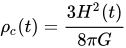
Cosmic time serves as the fundamental parameter in the Friedmann equations, which govern the dynamical evolution of the universe's scale factor in a homogeneous and isotropic cosmology. The first Friedmann equation relates the Hubble parameter to the energy density , spatial curvature , and cosmological constant as follows: where is the gravitational constant and is the speed of light. This equation, derived from Einstein's field equations applied to the Friedmann-Lemaître-Robertson-Walker metric, describes how the expansion rate changes over cosmic time , with encompassing contributions from radiation, matter, and dark energy.[17] The universe's expansion history divides into distinct epochs defined by the dominant energy component, each spanning specific intervals of cosmic time. In the radiation-dominated era, from the Big Bang until matter-radiation equality at approximately 52,000 years (redshift z ≈ 3400), relativistic particles and photons drive the expansion with , leading to . This transitions to the matter-dominated epoch around that time, persisting until matter-dark energy equality at z ≈ 0.3 (about 10.3 billion years after the Big Bang, corresponding to a lookback time of approximately 3.5 billion years), where non-relativistic matter dominates with and . Currently, the universe is in the dark energy-dominated phase (since z ≈ 0.3), where or a similar component causes accelerated expansion with nearly constant, yielding asymptotically.[17] Cosmic time integrates into distance measures that quantify the expansion's spatial extent. The comoving distance to a source emitting at time (observed at ) is given by , which can be recast in terms of redshift as , remaining fixed in the comoving frame as the universe expands.[24] For a flat universe (), the luminosity distance relates to by , enabling inferences about expansion history from supernova observations. The particle horizon, representing the maximum comoving distance light has traveled since , thus defines the observable universe's boundary at Gpc, corresponding to a proper radius of approximately 46.5 billion light-years today.[17]References
- https://phys.org/news/2025-03-clearest-images-year-universe-reveal.html