



Community hub
Recent from talks
Knowledge base stats:
Talk channels stats:
Members stats:
Costa Rican colón
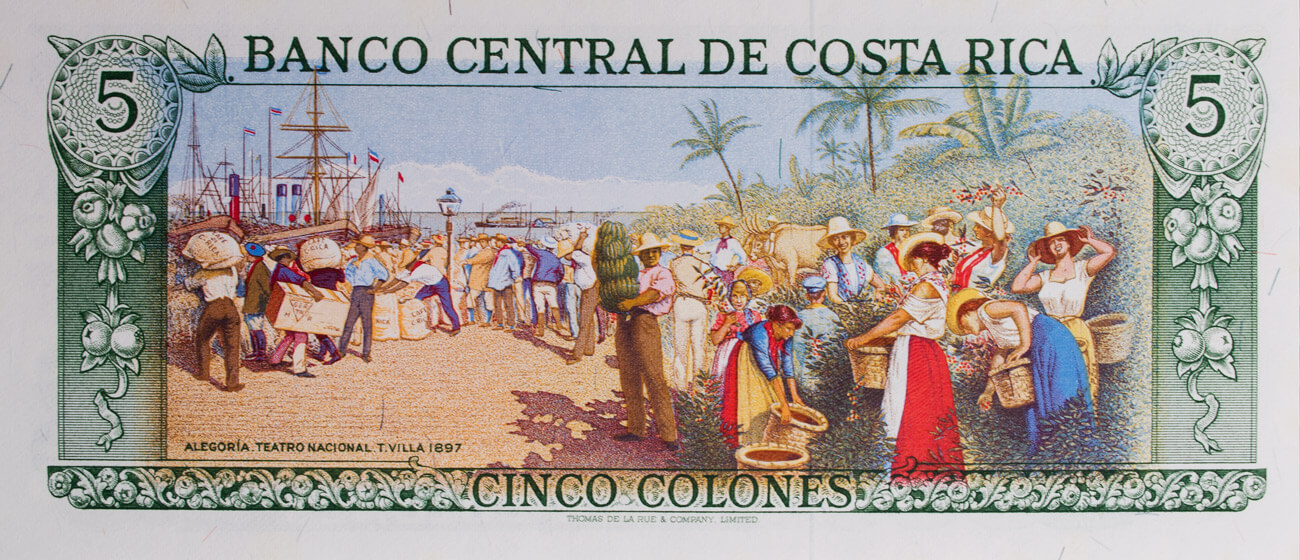
The colón (plural: colones; sign: ₡; code: CRC) is the currency of Costa Rica. It was named after Christopher Columbus, known as Cristóbal Colón in Spanish. A colón is divided into one hundred céntimos.
The symbol for the colón is a capital letter "C" crossed by two diagonal strokes. The symbol is encoded at U+20A1 ₡ COLON SIGN and may be typed on many English language Microsoft Windows keyboards using the keystrokes ALT+8353.
The colón sign is not to be confused with U+00A2 ¢ CENT SIGN (¢), or with the Ghanaian cedi, U+20B5 ₵ CEDI SIGN. Nonetheless, the commonly available cent symbol '¢' is frequently used locally to designate the colón in price markings and advertisements.
The colón was introduced in 1896, replacing the peso at par. The colón is divided into 100 centimos, although, between 1917 and 1919, coins were issued using the name centavo for the 1/100 subunit of the colón. Colones were issued by a variety of banks in the first half of the twentieth century, but since 1951 have been produced solely by the Central Bank of Costa Rica. The currency was subject to a crawling peg against the United States dollar from 2006 to 2015, but has been floating within a band allowed by the Costa Rican central bank since then.
Because the colón replaced the peso at par, there was no immediate need for new coins in 1896. In 1897, gold 2, 5, 10 and 20 colones were issued, followed by silver 50 centimos, and followed by cupro-nickel 2 centimos in 1903 and silver 5 and 10 centimos in 1905. The 5 and 10 centimos bore the initials G.C.R., indicating that they were issues of the government.
In 1917, coins were issued in denominations of 5 and 10 centavos rather than centimos. 50 centavo coins were minted but not issued (see below). All bore the G.C.R. initials.
The issuance of centimo coins by the government (still indicated by the initials G.C.R.) was resumed in 1920, with 5 and 10 centimos issued. In 1923, silver 25 and 50 centimos from the peso currency, along with the unissued 50 centavos from 1917 and 1918, were issued with counterstamps which doubled their values to 50 centimos and 1 colón.
In 1925, silver 25 centimo coins were introduced. The last government issued coins were brass 10 centimos issued between 1936 and 1941.
Hub AI
Costa Rican colón AI simulator
(@Costa Rican colón_simulator)
Costa Rican colón
The colón (plural: colones; sign: ₡; code: CRC) is the currency of Costa Rica. It was named after Christopher Columbus, known as Cristóbal Colón in Spanish. A colón is divided into one hundred céntimos.
The symbol for the colón is a capital letter "C" crossed by two diagonal strokes. The symbol is encoded at U+20A1 ₡ COLON SIGN and may be typed on many English language Microsoft Windows keyboards using the keystrokes ALT+8353.
The colón sign is not to be confused with U+00A2 ¢ CENT SIGN (¢), or with the Ghanaian cedi, U+20B5 ₵ CEDI SIGN. Nonetheless, the commonly available cent symbol '¢' is frequently used locally to designate the colón in price markings and advertisements.
The colón was introduced in 1896, replacing the peso at par. The colón is divided into 100 centimos, although, between 1917 and 1919, coins were issued using the name centavo for the 1/100 subunit of the colón. Colones were issued by a variety of banks in the first half of the twentieth century, but since 1951 have been produced solely by the Central Bank of Costa Rica. The currency was subject to a crawling peg against the United States dollar from 2006 to 2015, but has been floating within a band allowed by the Costa Rican central bank since then.
Because the colón replaced the peso at par, there was no immediate need for new coins in 1896. In 1897, gold 2, 5, 10 and 20 colones were issued, followed by silver 50 centimos, and followed by cupro-nickel 2 centimos in 1903 and silver 5 and 10 centimos in 1905. The 5 and 10 centimos bore the initials G.C.R., indicating that they were issues of the government.
In 1917, coins were issued in denominations of 5 and 10 centavos rather than centimos. 50 centavo coins were minted but not issued (see below). All bore the G.C.R. initials.
The issuance of centimo coins by the government (still indicated by the initials G.C.R.) was resumed in 1920, with 5 and 10 centimos issued. In 1923, silver 25 and 50 centimos from the peso currency, along with the unissued 50 centavos from 1917 and 1918, were issued with counterstamps which doubled their values to 50 centimos and 1 colón.
In 1925, silver 25 centimo coins were introduced. The last government issued coins were brass 10 centimos issued between 1936 and 1941.