



Community hub
Recent from talks
Knowledge base stats:
Talk channels stats:
Members stats:
Cotton swab
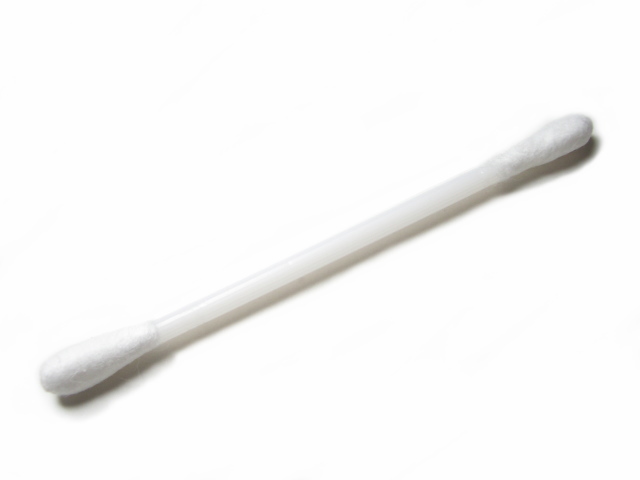
Cotton swabs (American English) or cotton buds (British English), also Q-tips (proprietary eponym, American English), are wads of cotton wrapped around a short rod made of wood, rolled paper, or plastic. They are most commonly used for ear cleaning, although this is not recommended by physicians. Other uses for cotton swabs include first aid, cosmetics application, cleaning, infant care, and crafts. Some countries have banned the plastic-stemmed versions in favor of biodegradable alternatives over concerns about marine pollution.
The first mass-produced cotton swab was developed in 1923 by Polish-American Jew Leo Gerstenzang after he watched his wife attach wads of cotton to toothpicks to clean their infant's ears. His product was originally named "Baby Gays" in recognition of their being intended for infants before being renamed "Q-tips Baby Gays", with the "Q" standing for "quality". The product eventually became known as "Q-tips", which went on to become the most widely sold brand name of cotton swabs in North America. The term "Q-tip" is often used as a genericized trademark for a cotton swab in the United States and Canada. The Q-tips brand is owned by Elida Beauty. It was formerly owned by Unilever and had over $200 million in US sales in 2014. "Johnson's buds" are made by Johnson & Johnson.
However, according to the United States Patent Case (C-10,415) Q-Tips, Inc. v. Johnson & Johnson, 108 F. Supp. 845 (D.N.J. 1952), it would appear that the first commercial producer of cotton-tipped applicators was Mrs. Hazel Tietjen Forbis, who manufactured them in her home. She also owned a patent on the article, numbered 1,652,108, dated December 6, 1927, and sold the product under the appellation Baby Nose-Gay. In 1925, Leo Gerstenzang Co., Inc. purchased an assignment of the product patent from Mrs. Forbis. On January 2, 1937, Q-Tips, Inc's president, Mr. Leo Gerstenzang, and his wife Mrs. Ziuta Gerstenzang formed a partnership and purchased from Mrs. Forbis "All merchandise, machinery, and fixtures now contained in the premises 132 W. 36th Street and used by said Q-Tips, Inc., for the manufacture of Q-Tips or medicated swabs together with the accounts receivable of said Q-Tips, Inc." The contract recited that Q-Tips, Inc. was the owner of patents covering the manufacture of applicators.
Originally, when cotton-tipped applicators were made by Mrs. Forbis, they were sold under the name of Baby Nose-Gays. In 1925, after The Leo Gerstenzang Co., Inc. purchased an assignment of the product patent from Mrs. Forbis, the packages of applicators were labelled Baby-Gays. In 1926, the legend was changed to read "Q-Tips Baby Gays", and in 1927 an application was made to register the mark "Q-Tips Baby Gays". Sometime after 1926, the words "Baby Gays" were dropped and the concern began to develop "Q-Tips" as its identifying mark, applying for registration on September 14, 1933. Packages were made up using blue paper with pictures of double-tipped applicators upon them, features which have been the basis for the Q Tips packaged sign since. The design of the crossed applicators was made by dropping them and then photographing the resulting pattern.
The traditional cotton swab has a single tip on a wooden handle, and these are still often used, especially in medical settings. They are usually relatively long, about 10 cm (4 inches). These often are packaged sterile, one or two to a paper or plastic sleeve. The advantage of the paper sleeve and the wooden handle is that the package can be autoclaved to be sterilized (plastic sleeves or handles would melt in the autoclave).
Cotton swabs manufactured for home use are usually shorter, about 6.5 cm (2+1⁄2 inches) long, and double-tipped. The handles were first made of wood and then made of rolled paper, which is still the most common (although tubular plastic is also used). They are often sold in large quantities, 100 or more in a container.
Plastic swab stems exist in a wide variety of colors, such as blue, pink, or green. However, the cotton itself is traditionally white.
The most common use for cotton swabs is to clean the ear canal by removing earwax. This use is usually against manufacturer instructions. Cotton swabs are also commonly used for cosmetic purposes such as applying and removing makeup and touching up nail polish, as well as for household uses such as cleaning and arts and crafts.
Hub AI
Cotton swab AI simulator
(@Cotton swab_simulator)
Cotton swab
Cotton swabs (American English) or cotton buds (British English), also Q-tips (proprietary eponym, American English), are wads of cotton wrapped around a short rod made of wood, rolled paper, or plastic. They are most commonly used for ear cleaning, although this is not recommended by physicians. Other uses for cotton swabs include first aid, cosmetics application, cleaning, infant care, and crafts. Some countries have banned the plastic-stemmed versions in favor of biodegradable alternatives over concerns about marine pollution.
The first mass-produced cotton swab was developed in 1923 by Polish-American Jew Leo Gerstenzang after he watched his wife attach wads of cotton to toothpicks to clean their infant's ears. His product was originally named "Baby Gays" in recognition of their being intended for infants before being renamed "Q-tips Baby Gays", with the "Q" standing for "quality". The product eventually became known as "Q-tips", which went on to become the most widely sold brand name of cotton swabs in North America. The term "Q-tip" is often used as a genericized trademark for a cotton swab in the United States and Canada. The Q-tips brand is owned by Elida Beauty. It was formerly owned by Unilever and had over $200 million in US sales in 2014. "Johnson's buds" are made by Johnson & Johnson.
However, according to the United States Patent Case (C-10,415) Q-Tips, Inc. v. Johnson & Johnson, 108 F. Supp. 845 (D.N.J. 1952), it would appear that the first commercial producer of cotton-tipped applicators was Mrs. Hazel Tietjen Forbis, who manufactured them in her home. She also owned a patent on the article, numbered 1,652,108, dated December 6, 1927, and sold the product under the appellation Baby Nose-Gay. In 1925, Leo Gerstenzang Co., Inc. purchased an assignment of the product patent from Mrs. Forbis. On January 2, 1937, Q-Tips, Inc's president, Mr. Leo Gerstenzang, and his wife Mrs. Ziuta Gerstenzang formed a partnership and purchased from Mrs. Forbis "All merchandise, machinery, and fixtures now contained in the premises 132 W. 36th Street and used by said Q-Tips, Inc., for the manufacture of Q-Tips or medicated swabs together with the accounts receivable of said Q-Tips, Inc." The contract recited that Q-Tips, Inc. was the owner of patents covering the manufacture of applicators.
Originally, when cotton-tipped applicators were made by Mrs. Forbis, they were sold under the name of Baby Nose-Gays. In 1925, after The Leo Gerstenzang Co., Inc. purchased an assignment of the product patent from Mrs. Forbis, the packages of applicators were labelled Baby-Gays. In 1926, the legend was changed to read "Q-Tips Baby Gays", and in 1927 an application was made to register the mark "Q-Tips Baby Gays". Sometime after 1926, the words "Baby Gays" were dropped and the concern began to develop "Q-Tips" as its identifying mark, applying for registration on September 14, 1933. Packages were made up using blue paper with pictures of double-tipped applicators upon them, features which have been the basis for the Q Tips packaged sign since. The design of the crossed applicators was made by dropping them and then photographing the resulting pattern.
The traditional cotton swab has a single tip on a wooden handle, and these are still often used, especially in medical settings. They are usually relatively long, about 10 cm (4 inches). These often are packaged sterile, one or two to a paper or plastic sleeve. The advantage of the paper sleeve and the wooden handle is that the package can be autoclaved to be sterilized (plastic sleeves or handles would melt in the autoclave).
Cotton swabs manufactured for home use are usually shorter, about 6.5 cm (2+1⁄2 inches) long, and double-tipped. The handles were first made of wood and then made of rolled paper, which is still the most common (although tubular plastic is also used). They are often sold in large quantities, 100 or more in a container.
Plastic swab stems exist in a wide variety of colors, such as blue, pink, or green. However, the cotton itself is traditionally white.
The most common use for cotton swabs is to clean the ear canal by removing earwax. This use is usually against manufacturer instructions. Cotton swabs are also commonly used for cosmetic purposes such as applying and removing makeup and touching up nail polish, as well as for household uses such as cleaning and arts and crafts.