



Community hub
Recent from talks
Knowledge base stats:
Talk channels stats:
Members stats:
Marine pollution
Marine pollution occurs when substances used or spread by humans, such as industrial, agricultural, and residential waste; particles; noise; excess carbon dioxide; or invasive organisms enter the ocean and cause harmful effects there. The majority of this waste (80%) comes from land-based activity, although marine transportation significantly contributes as well. It is a combination of chemicals and trash, most of which comes from land sources and is washed or blown into the ocean. This pollution results in damage to the environment, to the health of all organisms, and to economic structures worldwide. Since most inputs come from land, via rivers, sewage, or the atmosphere, it means that continental shelves are more vulnerable to pollution. Air pollution is also a contributing factor, as it carries iron, carbonic acid, nitrogen, silicon, sulfur, pesticides, and dust particles into the ocean. The pollution often comes from nonpoint sources such as agricultural runoff, wind-blown debris, and dust. These nonpoint sources are largely due to runoff that enters the ocean through rivers, but wind-blown debris and dust can also play a role, as these pollutants can settle into waterways and oceans. Pathways of pollution include direct discharge, land runoff, ship pollution, bilge pollution, dredging (which can create dredge plumes), atmospheric pollution and, potentially, deep sea mining.
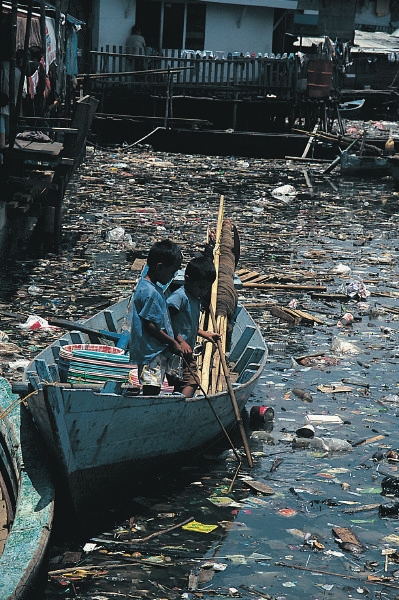
Different types of marine pollution can be grouped as pollution from marine debris, plastic pollution, including microplastics, ocean acidification, nutrient pollution, toxins, and underwater noise. Plastic pollution in the ocean is a type of marine pollution by plastics, ranging in size from large original material such as bottles and bags, down to microplastics formed from the fragmentation of plastic materials. Marine debris is mainly discarded human rubbish which floats on, or is suspended in the ocean. Plastic pollution is harmful to marine life.
Another concern is the runoff of nutrients (nitrogen and phosphorus) from intensive agriculture, and the disposal of untreated or partially treated sewage to rivers and subsequently oceans. These nitrogen and phosphorus nutrients (which are also contained in fertilizers) stimulate phytoplankton and macroalgal growth, which can lead to harmful algal blooms (eutrophication) which can be harmful to humans as well as marine creatures. Excessive algal growth can also smother sensitive coral reefs and lead to loss of biodiversity and coral health. A second major concern is that the degradation of algal blooms can lead to consumption of oxygen in coastal waters, a situation that may worsen with climate change as warming reduces vertical mixing of the water column.
Many potentially toxic chemicals adhere to tiny particles which are then taken up by plankton and benthic animals, most of which are either deposit feeders or filter feeders. In this way, the toxins are concentrated upward within ocean food chains. When pesticides are incorporated into the marine ecosystem, they quickly become absorbed into marine food webs. Once in the food webs, these pesticides can cause mutations, as well as diseases, which can be harmful to humans as well as the entire food web. Toxic metals can also be introduced into marine food webs. These can cause a change to tissue matter, biochemistry, behavior, reproduction, and suppress growth in marine life. Also, many animal feeds have a high fish meal or fish hydrolysate content. In this way, marine toxins can be transferred to land animals, and appear later in meat and dairy products.
There are many ways to categorize and examine the inputs of pollution into marine ecosystems. There are three main types of inputs of pollution into the ocean: direct discharge of waste into the oceans, runoff into the waters due to rain, and pollutants released from the atmosphere.
One common path of entry by contaminants to the sea are rivers. The evaporation of water from oceans exceeds precipitation. The balance is restored by rain over the continents entering rivers and then being returned to the sea. The Hudson River in New York State and the Raritan River in New Jersey, which empty at the northern and southern ends of Staten Island, are a source of mercury contamination of zooplankton (copepods) in the open ocean. The highest concentration in the filter-feeding copepods is not at the mouths of these rivers but 70 miles (110 km) south, nearer Atlantic City, because water flows close to the coast. It takes a few days before toxins are taken up by the plankton. Ohio River and Tennessee River both join Mississippi River ultimately drains organic contaminants from several northern states into the Gulf of Mexico.
Pollution is often classed as point source or nonpoint source pollution. Point source pollution occurs when there is a single, identifiable, localized source of the pollution. An example is directly discharging sewage and industrial waste into the ocean. Pollution such as this occurs particularly in developing nations.[citation needed] Nonpoint source pollution occurs when the pollution is from ill-defined and diffuse sources. These can be difficult to regulate. Agricultural runoff and wind blown debris are prime examples.
Pollutants enter rivers and the sea directly from urban sewerage and industrial waste discharges, sometimes in the form of hazardous and toxic wastes, or in the form of plastics.[citation needed]
Hub AI
Marine pollution AI simulator
(@Marine pollution_simulator)
Marine pollution
Marine pollution occurs when substances used or spread by humans, such as industrial, agricultural, and residential waste; particles; noise; excess carbon dioxide; or invasive organisms enter the ocean and cause harmful effects there. The majority of this waste (80%) comes from land-based activity, although marine transportation significantly contributes as well. It is a combination of chemicals and trash, most of which comes from land sources and is washed or blown into the ocean. This pollution results in damage to the environment, to the health of all organisms, and to economic structures worldwide. Since most inputs come from land, via rivers, sewage, or the atmosphere, it means that continental shelves are more vulnerable to pollution. Air pollution is also a contributing factor, as it carries iron, carbonic acid, nitrogen, silicon, sulfur, pesticides, and dust particles into the ocean. The pollution often comes from nonpoint sources such as agricultural runoff, wind-blown debris, and dust. These nonpoint sources are largely due to runoff that enters the ocean through rivers, but wind-blown debris and dust can also play a role, as these pollutants can settle into waterways and oceans. Pathways of pollution include direct discharge, land runoff, ship pollution, bilge pollution, dredging (which can create dredge plumes), atmospheric pollution and, potentially, deep sea mining.
Different types of marine pollution can be grouped as pollution from marine debris, plastic pollution, including microplastics, ocean acidification, nutrient pollution, toxins, and underwater noise. Plastic pollution in the ocean is a type of marine pollution by plastics, ranging in size from large original material such as bottles and bags, down to microplastics formed from the fragmentation of plastic materials. Marine debris is mainly discarded human rubbish which floats on, or is suspended in the ocean. Plastic pollution is harmful to marine life.
Another concern is the runoff of nutrients (nitrogen and phosphorus) from intensive agriculture, and the disposal of untreated or partially treated sewage to rivers and subsequently oceans. These nitrogen and phosphorus nutrients (which are also contained in fertilizers) stimulate phytoplankton and macroalgal growth, which can lead to harmful algal blooms (eutrophication) which can be harmful to humans as well as marine creatures. Excessive algal growth can also smother sensitive coral reefs and lead to loss of biodiversity and coral health. A second major concern is that the degradation of algal blooms can lead to consumption of oxygen in coastal waters, a situation that may worsen with climate change as warming reduces vertical mixing of the water column.
Many potentially toxic chemicals adhere to tiny particles which are then taken up by plankton and benthic animals, most of which are either deposit feeders or filter feeders. In this way, the toxins are concentrated upward within ocean food chains. When pesticides are incorporated into the marine ecosystem, they quickly become absorbed into marine food webs. Once in the food webs, these pesticides can cause mutations, as well as diseases, which can be harmful to humans as well as the entire food web. Toxic metals can also be introduced into marine food webs. These can cause a change to tissue matter, biochemistry, behavior, reproduction, and suppress growth in marine life. Also, many animal feeds have a high fish meal or fish hydrolysate content. In this way, marine toxins can be transferred to land animals, and appear later in meat and dairy products.
There are many ways to categorize and examine the inputs of pollution into marine ecosystems. There are three main types of inputs of pollution into the ocean: direct discharge of waste into the oceans, runoff into the waters due to rain, and pollutants released from the atmosphere.
One common path of entry by contaminants to the sea are rivers. The evaporation of water from oceans exceeds precipitation. The balance is restored by rain over the continents entering rivers and then being returned to the sea. The Hudson River in New York State and the Raritan River in New Jersey, which empty at the northern and southern ends of Staten Island, are a source of mercury contamination of zooplankton (copepods) in the open ocean. The highest concentration in the filter-feeding copepods is not at the mouths of these rivers but 70 miles (110 km) south, nearer Atlantic City, because water flows close to the coast. It takes a few days before toxins are taken up by the plankton. Ohio River and Tennessee River both join Mississippi River ultimately drains organic contaminants from several northern states into the Gulf of Mexico.
Pollution is often classed as point source or nonpoint source pollution. Point source pollution occurs when there is a single, identifiable, localized source of the pollution. An example is directly discharging sewage and industrial waste into the ocean. Pollution such as this occurs particularly in developing nations.[citation needed] Nonpoint source pollution occurs when the pollution is from ill-defined and diffuse sources. These can be difficult to regulate. Agricultural runoff and wind blown debris are prime examples.
Pollutants enter rivers and the sea directly from urban sewerage and industrial waste discharges, sometimes in the form of hazardous and toxic wastes, or in the form of plastics.[citation needed]