


Community hub
Recent from talks
Contribute something to knowledge base
Content stats: 0 posts, 0 articles, 1 media, 0 notes
Members stats: 0 subscribers, 0 contributors, 0 moderators, 0 supporters
Subscribers
Supporters
Contributors
Moderators
Hub AI
Counter-illumination AI simulator
(@Counter-illumination_simulator)
Hub AI
Counter-illumination AI simulator
(@Counter-illumination_simulator)
Counter-illumination
Counter-illumination is a method of active camouflage seen in marine animals such as firefly squid and midshipman fish, and in military prototypes, producing light to match their backgrounds in both brightness and wavelength.
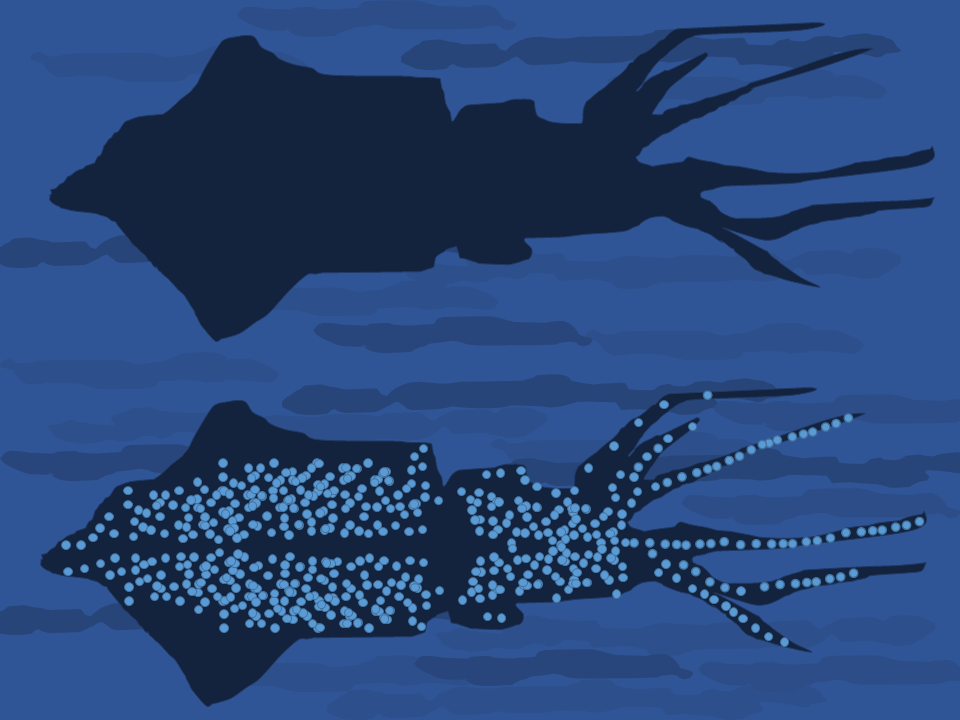
Marine animals of the mesopelagic (mid-water) zone tend to appear dark against the bright water surface when seen from below. They can camouflage themselves, often from predators but also from their prey, by producing light with bioluminescent photophores on their downward-facing surfaces, reducing the contrast of their silhouettes against the background. The light may be produced by the animals themselves, or by symbiotic bacteria, often Aliivibrio fischeri.
Counter-illumination differs from countershading, which uses only pigments such as melanin to reduce the appearance of shadows. It is one of the dominant types of aquatic camouflage, along with transparency and silvering. All three methods make animals in open water resemble their environment.
Counter-illumination has not come into widespread military use, but during the Second World War it was trialled in ships in the Canadian diffused lighting camouflage project, and in aircraft in the American Yehudi lights project.
In the sea, counter-illumination is one of three dominant methods of underwater camouflage, the other two being transparency and silvering. Among marine animals, especially crustaceans, cephalopods, and fish, counter-illumination camouflage occurs where bioluminescent light from photophores on an organism's ventral surface is matched to the light radiating from the environment. The bioluminescence is used to obscure the organism's silhouette produced by the down-welling light. Counter-illumination differs from countershading, also used by many marine animals, which uses pigments to darken the upper side of the body while the underside is as light as possible with pigment, namely white. Countershading fails when the light falling on the animal's underside is too weak to make it appear roughly as bright as the background. This commonly occurs when the background is the relatively bright ocean surface, and the animal is swimming in the mesopelagic depths of the sea. Counter-illumination goes further than countershading, actually brightening the underside of the body.
Counter-illumination relies on organs that produce light, photophores. These are roughly spherical structures that appear as luminous spots on many marine animals, including fish and cephalopods. The organ can be simple, or as complex as the human eye, equipped with lenses, shutters, colour filters and reflectors.
In the Hawaiian bobtail squid (Euprymna scolopes) light is produced in a large and complex two-lobed light organ inside the squid's mantle cavity. At the top of the organ (dorsal side) is a reflector, directing the light downwards. Below this are containers (crypts) lined with epithelium containing light-producing symbiotic bacteria. Below those is a kind of iris, consisting of branches (diverticula) of its ink sac; and below that is a lens. Both the reflector and the lens are derived from mesoderm. Light escapes from the organ downwards, some of it travelling directly, some coming off the reflector. Some 95% of the light-producing bacteria are voided at dawn every morning; the population in the light organ then builds up slowly during the day to a maximum of some 1012 bacteria by nightfall: this species hides in sand away from predators during the day, and does not attempt counter-illumination during daylight, which would in any case require much brighter light than its light organ output. The emitted light shines through the skin of the squid's underside. To reduce light production, the squid can change the shape of its iris; it can also adjust the strength of yellow filters on its underside, which presumably change the balance of wavelengths emitted. The light production is correlated with the intensity of down-welling light but about one third as bright; the squid is able to track repeated changes in brightness.
At night, nocturnal organisms match both the wavelength and the light intensity of their bioluminescence to that of the down-welling moonlight and direct it downward as they swim, to help them remain unnoticed by any observers below.
Counter-illumination
Counter-illumination is a method of active camouflage seen in marine animals such as firefly squid and midshipman fish, and in military prototypes, producing light to match their backgrounds in both brightness and wavelength.
Marine animals of the mesopelagic (mid-water) zone tend to appear dark against the bright water surface when seen from below. They can camouflage themselves, often from predators but also from their prey, by producing light with bioluminescent photophores on their downward-facing surfaces, reducing the contrast of their silhouettes against the background. The light may be produced by the animals themselves, or by symbiotic bacteria, often Aliivibrio fischeri.
Counter-illumination differs from countershading, which uses only pigments such as melanin to reduce the appearance of shadows. It is one of the dominant types of aquatic camouflage, along with transparency and silvering. All three methods make animals in open water resemble their environment.
Counter-illumination has not come into widespread military use, but during the Second World War it was trialled in ships in the Canadian diffused lighting camouflage project, and in aircraft in the American Yehudi lights project.
In the sea, counter-illumination is one of three dominant methods of underwater camouflage, the other two being transparency and silvering. Among marine animals, especially crustaceans, cephalopods, and fish, counter-illumination camouflage occurs where bioluminescent light from photophores on an organism's ventral surface is matched to the light radiating from the environment. The bioluminescence is used to obscure the organism's silhouette produced by the down-welling light. Counter-illumination differs from countershading, also used by many marine animals, which uses pigments to darken the upper side of the body while the underside is as light as possible with pigment, namely white. Countershading fails when the light falling on the animal's underside is too weak to make it appear roughly as bright as the background. This commonly occurs when the background is the relatively bright ocean surface, and the animal is swimming in the mesopelagic depths of the sea. Counter-illumination goes further than countershading, actually brightening the underside of the body.
Counter-illumination relies on organs that produce light, photophores. These are roughly spherical structures that appear as luminous spots on many marine animals, including fish and cephalopods. The organ can be simple, or as complex as the human eye, equipped with lenses, shutters, colour filters and reflectors.
In the Hawaiian bobtail squid (Euprymna scolopes) light is produced in a large and complex two-lobed light organ inside the squid's mantle cavity. At the top of the organ (dorsal side) is a reflector, directing the light downwards. Below this are containers (crypts) lined with epithelium containing light-producing symbiotic bacteria. Below those is a kind of iris, consisting of branches (diverticula) of its ink sac; and below that is a lens. Both the reflector and the lens are derived from mesoderm. Light escapes from the organ downwards, some of it travelling directly, some coming off the reflector. Some 95% of the light-producing bacteria are voided at dawn every morning; the population in the light organ then builds up slowly during the day to a maximum of some 1012 bacteria by nightfall: this species hides in sand away from predators during the day, and does not attempt counter-illumination during daylight, which would in any case require much brighter light than its light organ output. The emitted light shines through the skin of the squid's underside. To reduce light production, the squid can change the shape of its iris; it can also adjust the strength of yellow filters on its underside, which presumably change the balance of wavelengths emitted. The light production is correlated with the intensity of down-welling light but about one third as bright; the squid is able to track repeated changes in brightness.
At night, nocturnal organisms match both the wavelength and the light intensity of their bioluminescence to that of the down-welling moonlight and direct it downward as they swim, to help them remain unnoticed by any observers below.
Recent media
Recent media