Hubbry Logo
search
logo
885022

Counter-illumination

logo
Community Hub0 Subscribers
Read side by side
from Wikipedia

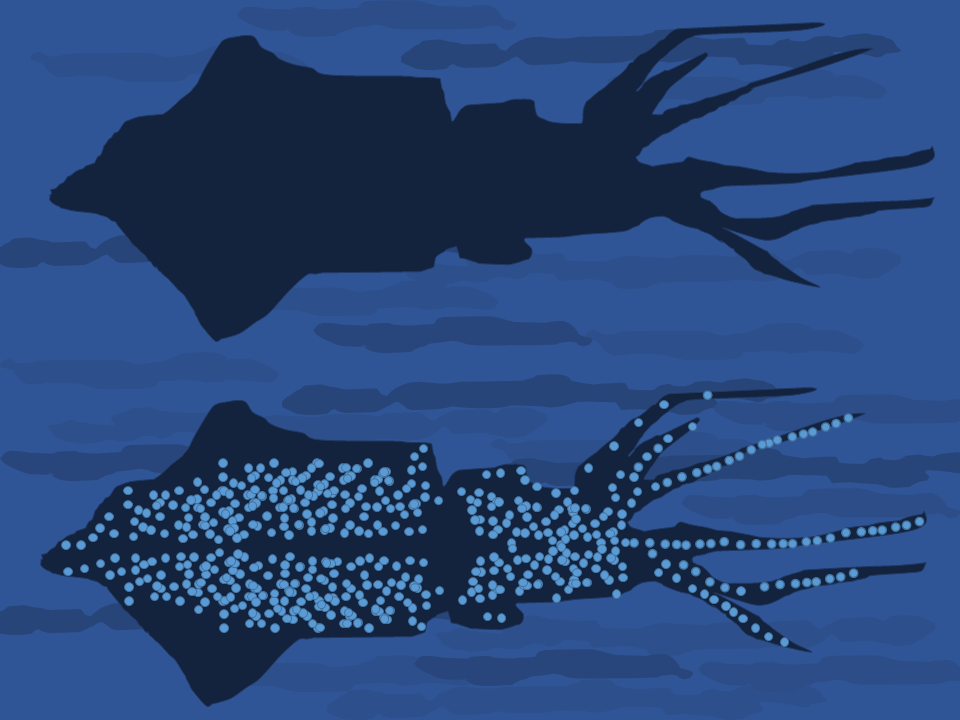
Principle of the counter-illumination camouflage of the firefly squid, Watasenia scintillans. When seen from below by a predator, the animal's light helps to match its brightness and colour to the sea surface above.

Counter-illumination is a method of active camouflage seen in marine animals such as firefly squid and midshipman fish, and in military prototypes, producing light to match their backgrounds in both brightness and wavelength.

Marine animals of the mesopelagic (mid-water) zone tend to appear dark against the bright water surface when seen from below. They can camouflage themselves, often from predators but also from their prey, by producing light with bioluminescent photophores on their downward-facing surfaces, reducing the contrast of their silhouettes against the background. The light may be produced by the animals themselves, or by symbiotic bacteria, often Aliivibrio fischeri.

Counter-illumination differs from countershading, which uses only pigments such as melanin to reduce the appearance of shadows. It is one of the dominant types of aquatic camouflage, along with transparency and silvering. All three methods make animals in open water resemble their environment.

Counter-illumination has not come into widespread military use, but during the Second World War it was trialled in ships in the Canadian diffused lighting camouflage project, and in aircraft in the American Yehudi lights project.

In marine animals

[edit]

Mechanism

[edit]

Counter-illumination and countershading

[edit]
Counter-illuminating photophores illuminating the underside of the hatchetfish Argyropelecus olfersii

In the sea, counter-illumination is one of three dominant methods of underwater camouflage, the other two being transparency and silvering.[1] Among marine animals, especially crustaceans, cephalopods, and fish, counter-illumination camouflage occurs where bioluminescent light from photophores on an organism's ventral surface is matched to the light radiating from the environment.[2] The bioluminescence is used to obscure the organism's silhouette produced by the down-welling light. Counter-illumination differs from countershading, also used by many marine animals, which uses pigments to darken the upper side of the body while the underside is as light as possible with pigment, namely white. Countershading fails when the light falling on the animal's underside is too weak to make it appear roughly as bright as the background. This commonly occurs when the background is the relatively bright ocean surface, and the animal is swimming in the mesopelagic depths of the sea. Counter-illumination goes further than countershading, actually brightening the underside of the body.[3][4]

Photophores

[edit]
Photophores on a lanternfish, the most common deep sea fish worldwide

Counter-illumination relies on organs that produce light, photophores. These are roughly spherical structures that appear as luminous spots on many marine animals, including fish and cephalopods. The organ can be simple, or as complex as the human eye, equipped with lenses, shutters, colour filters and reflectors.[5]

Sagittal section of the large eye-like light-producing organ of Hawaiian bobtail squid, Euprymna scolopes. The organ houses symbiotic Aliivibrio fischeri bacteria.

In the Hawaiian bobtail squid (Euprymna scolopes) light is produced in a large and complex two-lobed light organ inside the squid's mantle cavity. At the top of the organ (dorsal side) is a reflector, directing the light downwards. Below this are containers (crypts) lined with epithelium containing light-producing symbiotic bacteria. Below those is a kind of iris, consisting of branches (diverticula) of its ink sac; and below that is a lens. Both the reflector and the lens are derived from mesoderm. Light escapes from the organ downwards, some of it travelling directly, some coming off the reflector. Some 95% of the light-producing bacteria are voided at dawn every morning; the population in the light organ then builds up slowly during the day to a maximum of some 1012 bacteria by nightfall: this species hides in sand away from predators during the day, and does not attempt counter-illumination during daylight, which would in any case require much brighter light than its light organ output. The emitted light shines through the skin of the squid's underside. To reduce light production, the squid can change the shape of its iris; it can also adjust the strength of yellow filters on its underside, which presumably change the balance of wavelengths emitted. The light production is correlated with the intensity of down-welling light but about one third as bright; the squid is able to track repeated changes in brightness.[6]

Matching light intensity and wavelength

[edit]

At night, nocturnal organisms match both the wavelength and the light intensity of their bioluminescence to that of the down-welling moonlight and direct it downward as they swim, to help them remain unnoticed by any observers below.[6][7]

Spectrum of visible light showing colours at different wavelengths, in nanometres

In the eyeflash squid (Abralia veranyi) a species which daily migrates between the surface and deep waters, a study showed that the light produced is bluer in cold waters and greener in warmer waters, temperature serving as a guide to the required emission spectrum. The animal has more than 550 photophores on its underside, consisting of rows of four to six large photophores running across the body, and many smaller photophores scattered over the surface. In cold water at 11 Celsius, the squid's photophores produced a simple (unimodal) spectrum with its peak at 490 nanometres (blue-green). In warmer water at 24 Celsius, the squid added a weaker emission (forming a shoulder on the side of the main peak) at around 440 nanometres (blue), from the same group of photophores. Other groups remained unilluminated: other species, and perhaps A. veranyi from its other groups of photophores, can produce a third spectral component when needed. Another squid, Abralia trigonura, is able to produce three spectral components: at 440 and at 536 nanometres (green), appearing at 25 Celsius, apparently from the same photophores; and at 470–480 nanometres (blue-green), easily the strongest component at 6 Celsius, apparently from a different group of photophores. Many species can in addition vary the light they emit by passing it through a choice of colour filters.[8]

Counterillumination camouflage halved predation among individuals employing it compared to those not employing it in the midshipman fish Porichthys notatus.[6][9]

Diagram of a small type of photophore in the skin of a cephalopod, Abralia trigonura, in vertical section

Autogenic or bacteriogenic bioluminescence

[edit]

The bioluminescence used for counter-illumination can be either autogenic (produced by the animal itself, as in pelagic cephalopods such as Vampyroteuthis, Stauroteuthis, and pelagic octopuses in the Bolitaenidae[10]) or bacteriogenic (produced by bacterial symbionts). The luminescent bacterium is often Aliivibrio fischeri, as for example in the Hawaiian bobtail squid.[6]

Purpose

[edit]
Photophores on a nocturnal midshipman fish, whose bioluminescence halves its rate of predation[6]

Hiding from predators

[edit]

Reducing the silhouette is primarily an anti-predator defence for mesopelagic (mid-water) organisms. The reduction of the silhouette from highly directional down-welling light is important, since there is no refuge in the open water, and predation occurs from below.[3][11][12] Many mesopelagic cephalopods such as the firefly squid (Watasenia scintillans), decapod crustaceans, and deep ocean fishes use counter-illumination; it works best for them when ambient light levels are low, leaving the diffuse down-welling light from above as the only light source.[6][3] Some deep water sharks, including Dalatias licha, Etmopterus lucifer, and Etmopterus granulosus, are bioluminescent, most likely for camouflage from predators that attack from beneath.[13]

Hiding from prey

[edit]

Besides its effectiveness as a predator avoidance mechanism, counter-illumination also serves as an essential tool to predators themselves. Some shark species, such as the deepwater velvet belly lanternshark (Etmopterus spinax), use counter-illumination to remain hidden from their prey.[14] Other well-studied examples include the cookiecutter shark (Isistius brasiliensis), the marine hatchetfish, and the Hawaiian bobtail squid.[6] More than 10% of shark species may be bioluminescent, though some such as lantern sharks may use the light for signalling as well as for camouflage.[15]

Defeating counter-illumination camouflage

[edit]

An animal camouflaged by counter-illumination is not completely invisible. A predator could resolve individual photophores on a camouflaged prey's underside, given sufficiently acute vision, or it could detect the remaining difference in brightness between the prey and the background. Predators with a visual acuity of 0.11 degrees (of arc) would be able to detect individual photophores of the Madeira lanternfish Ceratoscopelus maderensis at up to 2 metres (2.2 yd), and they would be able to see the general layout of the photophore clusters with poorer visual acuity. Much the same applies also to Abralia veranyi, but it was largely given away by its unlit fins and tentacles, which appear dark against the background from as far away as 8 metres (8.7 yd). All the same, the counter-illumination camouflage of these species is extremely effective, radically reducing their detectability.[2][a]

Military prototypes

[edit]

Active camouflage in the form of counter-illumination has rarely been used for military purposes, but it has been prototyped in ship and aircraft camouflage from the Second World War onwards.[16][17][18]

For ships

[edit]
Diffused lighting camouflage prototype, not quite complete and set to maximum brightness, installed on HMS Largs in 1942

Diffused lighting camouflage, in which visible light is projected on to the sides of ships to match the faint glow of the night sky, was trialled by Canada's National Research Council from 1941 onwards, and then by the Royal Navy, during the Second World War. Some 60 light projectors were mounted all around the hull and on the ships' superstructure such as the bridge and funnels. On average, the system reduced the distance at which a ship could be seen from a surfaced submarine by 25% using binoculars, or by 33% using the naked eye. The camouflage worked best on clear moonless nights: on such a night in January 1942, HMS Largs was not seen until it closed to 2,250 yards (2,060 m) when counter-illuminated, but was visible at 5,250 yards (4,800 m) unlighted, a 57% reduction in range.[16][19]

For aircraft

[edit]
Mary Taylor Brush's 1917 patent application for camouflaging a Morane-Borel monoplane using light bulbs

In 1916 the American artist Mary Taylor Brush experimented with camouflage on a Morane-Borel monoplane using light bulbs around the aircraft, and filed a 1917 patent that claimed she was "able to produce a machine which is practically invisible when in the air". The concept was not developed further during the First World War.[20]

Forward-pointing Yehudi lights on Grumman TBM Avenger raised the average brightness of the plane from a dark shape to the same as the sky.[b]

The Canadian ship concept was trialled in American aircraft including B-24 Liberators and TBM Avengers in the Yehudi lights project, starting in 1943, using forward-pointing lamps automatically adjusted to match the brightness of the sky. The goal was to enable a radar-equipped, sea-search aircraft to approach a surfaced submarine to within 30 seconds from arrival before being seen, to enable the aircraft to drop its depth charges before the submarine could dive. There was insufficient electrical power available to illuminate the entire surface of the aircraft, and outboard lamps in the manner of diffused lighting camouflage would have interfered with the airflow over the aircraft's surface, so a system of forward-pointing lamps was chosen. These had a beam with a radius of 3 degrees, so pilots had to fly with the aircraft's nose pointed directly at the enemy. In a crosswind, this required a curving approach path, rather than a straight-line path with the nose pointed upwind. In trials in 1945, a counter-illuminated Avenger was not seen until 3,000 yards (2.7 km) from its target, compared to 12 miles (19 km) for an uncamouflaged aircraft.[17]

The idea was revisited in 1973 when an F-4 Phantom was fitted with camouflaging lights in the "Compass Ghost" project.[18]

Notes

[edit]

References

[edit]
[edit]
Revisions and contributorsEdit on WikipediaRead on Wikipedia
from Grokipedia
Counter-illumination is a form of active camouflage used by numerous marine animals, primarily deep-sea fish, cephalopods, and crustaceans, in which specialized bioluminescent organs known as photophores on the ventral surface emit light that matches the intensity, spectrum, and angular distribution of downwelling light from the surface, thereby erasing the animal's silhouette and rendering it nearly invisible to predators viewing from below.[1][2] This adaptation is particularly prevalent in the open ocean's dimly lit midwater zone, where hiding places are scarce and predation pressure is high.[3] The mechanism relies on precise regulation of photophore output, often involving bacterial or chemical bioluminescence to produce blue-green light that mimics the faint sunlight penetrating deep waters.[4] In many species, such as stomiiform fishes, eye-facing photophores provide a reference signal to the animal's visual system, allowing real-time adjustment of ventral light intensity via an accessory retina pathway.[1] For instance, the hatchetfish (Argyropelecus aculeatus) and the squid Abralia veranyi employ dense arrays of ventral photophores to achieve this match, with light directed downward through lenses and reflective tissues.[2][4] Recent studies on rare species like Vinciguerria mabahiss reveal consistent photophore structures, including pigment layers and lenses, that facilitate downward-directed emission for effective camouflage in the Red Sea's depths.[5] Counter-illumination has evolved independently in multiple lineages, including myctophiform and stomiiform fishes, as well as cephalopods, underscoring its adaptive value in pelagic environments.[1] Phylogenetic analyses indicate a dependent co-evolution between ventral and regulatory photophores, with over 90% of counter-illumination-capable stomiiform species possessing eye-facing structures.[1] It is primarily used for defense against silhouette detection.[2] This strategy highlights the sophisticated interplay of bioluminescence and vision in marine ecology, enabling survival in one of Earth's most challenging habitats.[3]

Overview

Definition and Principles

Counter-illumination is an active camouflage strategy utilized by certain marine organisms, wherein bioluminescence is emitted from the ventral surface to match the intensity, spectrum, and angular distribution of downwelling ambient light from above. This emission effectively eliminates the dark silhouette that would otherwise form against the brighter background when viewed from below, rendering the organism less detectable to predators.[6][7][8] At its core, counter-illumination relies on bioluminescence, the enzymatic production of light through chemical reactions within living organisms, to achieve this match. Unlike passive camouflage methods, such as countershading—which uses pigmentation gradients to mimic natural shadows and highlights—counter-illumination actively generates light to counteract visibility cues in low-light conditions. This distinction is crucial in environments where passive strategies alone fail to provide sufficient concealment due to the absence of complex structures or varied lighting.[6][3] The optical principles underlying counter-illumination address the inherent light dynamics of aquatic habitats. In water, sunlight undergoes exponential attenuation with increasing depth, primarily through absorption—where photons are captured by water molecules and dissolved substances—and scattering, where photons are redirected by suspended particles, leading to a pronounced vertical gradient with maximum intensity from downwelling directions. By producing ventral light that replicates this downwelling illumination, counter-illumination disrupts the contrast between the organism and its background, preventing silhouette formation without requiring precise angular control in all cases. This strategy is most effective in the open ocean's pelagic zones, characterized by uniform, featureless water columns, and extends to the twilight zone (approximately 200–1,000 meters depth), where residual blue light penetrates but overall illumination remains dim.[6][7][9] Such light emission is facilitated by specialized organs known as photophores located on the ventral side.[6]

Historical Context

Early observations of glowing marine animals date back to the 19th century, when explorers documented bioluminescent phenomena during voyages. Charles Darwin, aboard the H.M.S. Beagle in the 1830s, reported instances of highly luminous seas, such as off the coast of South America where the water sparkled with light trails left by swimming penguins, attributing this to phosphorescent organisms. These sightings were initially grouped under general bioluminescence without distinguishing specialized functions like camouflage.[10] Key milestones in understanding counter-illumination emerged in the 20th century through targeted studies on deep-sea organisms. In 1963, William D. Clarke conducted pioneering research on mesopelagic organisms, demonstrating that ventral bioluminescence in mesopelagic animals matches the intensity and spectrum of downwelling sunlight to eliminate silhouettes against the surface, thereby confirming its role in camouflage. Clarke's work built on earlier examinations of photophores in squid, highlighting how these light organs enable precise light emission for concealment. Interest in counter-illumination shifted toward military applications during World War II, as Allied forces recognized its potential for reducing visibility of vessels at sea. The U.S. Navy experimented with diffused lighting systems on ships like the USS Hamul in the 1940s, employing adjustable lights to mimic sky backgrounds and counter enemy detection, with declassified reports detailing tests inspired by marine biology. These efforts paralleled British and Canadian developments in active camouflage for aircraft and ships.[11] The terminology "counter-illumination" evolved in mid-20th-century scientific literature to describe this specific bioluminescent strategy, with Clarke's 1963 publication marking an early formal usage in the context of adaptive camouflage. Prior descriptions often referred to it more broadly as "ventral lighting" or "countershading with bioluminescence," reflecting growing recognition of its ecological significance.

Biological Mechanisms

Countershading and Counter-illumination

Countershading is a passive form of camouflage characterized by a gradient of darkening from the dorsal to the ventral surface of an animal, designed to counteract the natural falloff of light intensity in environments with overhead illumination, such as shallow waters or terrestrial settings.[12] This coloration pattern minimizes self-shadowing, making the animal appear more uniformly lit and less conspicuous against its background when viewed from above or below.[13] It is particularly effective in uniform or shallow light conditions where the contrast between the animal and its surroundings is primarily due to ambient lighting gradients.[14] In contrast, counter-illumination represents an active camouflage strategy employed by many marine organisms, involving the emission of bioluminescent light from ventral surfaces to mimic the downwelling light from the water's surface, thereby erasing the dark silhouette that forms against brighter backgrounds.[3] This approach is essential in deeper or clearer waters where passive pigmentation alone cannot compensate for the uniform illumination penetrating from above, rendering the animal fully visible as a shadowed outline to upward-viewing predators. Unlike countershading, which relies on static pigmentation, counter-illumination dynamically adjusts light output to match varying environmental conditions.[15] Countershading becomes ineffective in open, clear aquatic environments, particularly against observers below, as the lack of background contrast allows the dorsal-ventral gradient to fail in concealing the overall form without supplementary light emission.[3] Many marine species address this limitation by integrating both mechanisms, combining dorsal darkening with ventral bioluminescence—often produced via photophores—for comprehensive camouflage across diverse light regimes.[16] For instance, cephalopods such as the midwater squid Abralia veranyi exhibit countershading pigmentation alongside counter-illumination capabilities, enhancing concealment in the pelagic zone.[15] This synergistic strategy provides a more robust defense in variable oceanic habitats compared to either method in isolation.[13]

Photophores

Photophores are specialized light-emitting organs found predominantly in marine organisms such as fishes, cephalopods, and crustaceans, consisting of clusters of photogenic cells known as photocytes that generate bioluminescence. These organs typically house the biochemical machinery for light production, including luciferin-luciferase reactions in most fish and squid or symbiotic bioluminescent bacteria in certain species, and are strategically positioned on the ventral surface to align with the organism's body silhouette.[17][18] The photocytes are often embedded in a glandular tissue surrounded by supportive structures like pigment cells and musculature for intensity control, with the entire organ covered by a translucent dermal layer.[19] Photophores vary in complexity, with simple reflector types relying on iridescent tissues, such as guanine platelet layers, to diffuse and direct light broadly from the photocytes. In contrast, complex lens-equipped photophores incorporate transparent lenses or scale-like coverings to focus emission directionally, enhancing precision in light projection; for instance, euphausiids like krill possess eyestalk photophores functioning as "headlights" with lens structures for targeted output.[20][21] These variations allow adaptation to specific anatomical needs, with reflectors common in diffuse ventral arrays and lenses in more focal organs.[22] In many counter-illuminating species, photophores are distributed in dense ventral clusters to uniformly cover the underside, as observed in hatchetfishes (e.g., Argyropelecus spp.), where they form rows along the belly, and in squid (e.g., Abralia spp.), which have embedded photophores across the mantle and arms.[23][24] This patterning ensures comprehensive coverage of the body outline from below. Evolutionary adaptations include variations in photophore size and density correlated with habitat depth; shallower-water species tend to have larger, sparser photophores, while deeper-dwelling forms exhibit smaller, denser arrays to optimize light emission in dimmer environments with reduced ambient illumination.[25] For example, in lanternfishes (Myctophidae), photophore size decreases progressively with increasing depth, reflecting selective pressures for efficiency in low-light zones.[19]

Light Intensity and Spectrum Matching

Organisms employing counter-illumination precisely regulate the intensity of their emitted light to match the diminishing downwelling light in the ocean, which follows Lambert's cosine law whereby the apparent brightness of the light source remains consistent regardless of the observer's angle from directly below. This matching is achieved through behavioral adjustments, such as diel vertical migration, where bioluminescent sharks like those in the Dalatiidae family maintain a constant luminescent output and adjust depth to remain at iso-luminance levels, ensuring their ventral glow cloaks the silhouette against brighter surface waters. In addition, muscular modulation via melanophore pigment movement over photocytes allows rapid intensity adjustments, as observed in the pygmy shark (Squaliolus aliae), where hormonal signals like melatonin induce light emission by retracting pigments to expose photogenic tissues.[26][27] Spectrum matching is equally critical, with emissions typically tuned to the blue-green wavelengths (450-550 nm) that dominate oceanic light penetration due to minimal absorption by seawater. Photophores achieve this tuning through integrated filters containing pigments that selectively transmit these wavelengths while absorbing others, as detailed in studies of deep-sea fishes where such filters optimize the glow to mimic the residual downwelling spectrum. For instance, bioluminescent sharks exhibit emission peaks at 455-486 nm, closely aligning with the bluish downwelling light at depth.[28][26] Feedback mechanisms enable real-time adjustments to fluctuating conditions, such as dawn and dusk transitions, potentially via photoreceptor integration or eye-facing photophores that provide a reference for comparing emitted and ambient light. In Arctic krill (Thysanoessa inermis), circadian rhythms entrained by weak twilight modulate visual sensitivity, allowing photophore output to track downwelling intensity changes with a periodicity of approximately 20.4 hours. These eye-facing structures, pigmented on the anterior side in species like myctophid fishes, facilitate self-monitoring for precise counter-illumination.[29][30] Challenges in matching arise from variability in water clarity, which alters light attenuation and required output levels; in clearer oceanic waters, mismatches become detectable at greater distances due to reduced scattering, potentially compromising camouflage despite perfect spectral alignment. Such environmental heterogeneity demands adaptive strategies, though visual acuity limits of predators often mitigate detection risks at typical sighting ranges.[7]

Bioluminescence Sources

Bioluminescence in counter-illumination primarily arises from two distinct sources: autogenic, where the organism produces light internally through its own biochemical pathways, and bacteriogenic, involving symbiotic luminous bacteria housed within specialized organs. Autogenic bioluminescence is generated via the oxidation of a substrate called luciferin, catalyzed by the enzyme luciferase, which triggers a chemiluminescent reaction producing visible light.[18] This mechanism is prevalent in many cephalopods, such as oegopsid squids like Dosidicus gigas, where photophores—specialized light-emitting structures—enable the production and precise emission of light.[18] In certain deep-sea fishes, including myctophids, autogenic systems similarly facilitate counter-illumination by allowing the animal to synthesize and release luciferin-luciferase complexes on demand.[31] In contrast, bacteriogenic bioluminescence relies on symbiotic relationships with bioluminescent bacteria, typically species of the genus Vibrio, such as Vibrio fischeri, which colonize light organs and produce light through their own luciferin-luciferase reactions.[32] These bacteria are cultivated in dedicated compartments within the host's photophores, and the light output is modulated by the host through mechanisms like bacterial density regulation and periodic venting to refresh the population.[18] A representative example is the flashlight fish (Anomalops katoptron), where subocular light organs harbor these symbionts, and the fish controls emission via shutters or expulsion of bacteria-laden fluid.[33] Efficiency differences between these sources influence their utility in counter-illumination: autogenic systems permit greater precision and rapid modulation of light intensity and duration through neural or hormonal control of the enzymatic reaction, allowing quick on-off responses suited to dynamic environments.[18] Bacteriogenic systems, however, provide a more consistent, low-level glow due to the continuous activity of bacterial colonies, though modulation is limited to broader host interventions like venting, which can reduce fine-tuned control but ensures reliability over extended periods.[18] The evolutionary origins of these bioluminescence sources reflect multiple independent acquisitions within marine lineages, with at least 27 separate evolutions documented in ray-finned fishes alone, often converging on similar luciferin-based chemistries for counter-illumination adaptations.[31] In cephalopods, bioluminescence has arisen independently several times, with autogenic forms dominating pelagic species and bacteriogenic ones emerging in coastal groups like sepiolids, underscoring the adaptive pressures of deep-sea camouflage.[18]

Natural Applications

Antipredator Functions

Counter-illumination serves as a primary antipredator mechanism in marine animals by eliminating the dark silhouette created when an organism is backlit by downwelling light from the surface, thereby blending the ventral surface with the brighter water column above. This active camouflage fools visual predators, such as larger fish or squid, that hunt from below by reducing the contrast that would otherwise outline the prey against the illuminated background.[7] In species like the plainfin midshipman fish (Porichthys notatus), ventral photophores produce a glow that matches the intensity and pattern of overhead light, disrupting the silhouette and aiding evasion in open water. Similarly, the firefly squid (Watasenia scintillans) employs numerous small photophores across its ventral surface to generate a uniform glow, concealing its form from predators in the water column.[34][35] Experimental evidence demonstrates the effectiveness of this strategy, with luminous juvenile midshipman experiencing predation rates approximately half those of non-luminous individuals when exposed to predatory conspecifics under dim illumination simulating natural conditions. This provides the first direct support for counter-illumination's role in reducing attack success.[34] The technique is most effective in low-turbidity waters, where clear conditions enhance the visibility of silhouettes due to stronger downwelling light penetration and higher contrast, making precise light matching essential for concealment.[7]

Counterprey Functions

Counter-illumination serves a counterprey function by allowing marine predators to approach their targets undetected, preventing the formation of a dark silhouette against the brighter downwelling light from above. This stealthy mechanism enables hunters to close distances without alerting prey that rely on upward visual scans for threats. In deep-sea environments, where light gradients create stark contrasts, such camouflage is particularly effective for slow-swimming predators navigating toward larger, visually oriented quarry.[36] A prominent example is the cookiecutter shark (Isistius brasiliensis), which deploys ventral photophores to emit light matching the ambient intensity and spectrum, effectively erasing its outline from below as it positions for ambush. This bioluminescent matching, produced by specialized light organs, permits the shark to drift or maneuver silently toward prey up to ten times its size, such as dolphins or large fish, without casting shadows or silhouettes. The strategy culminates in a rapid suction-based bite that removes circular plugs of flesh, exploiting the prey's failure to detect the approaching threat.[36] Tactically, counter-illumination facilitates surprise attacks in visually dominated habitats, providing an offensive edge over more conspicuous bioluminescent tactics like active lures or signaling flashes used by other deep-sea hunters. Unlike those methods, which draw prey through attraction, counter-illumination emphasizes passive concealment, conserving motion and enhancing strike precision in low-visibility conditions. In the cookiecutter shark, this is augmented by a non-luminescent dark band around the throat that mimics a small fish silhouette against the glowing underside, further deceiving prey into approaching.[36] Counterprey applications of counter-illumination are less widespread than antipredator uses, as the continuous energy expenditure for light production limits its feasibility for agile or frequent hunting.

Evasion from Detection

Predators in marine environments have evolved several adaptations to overcome counter-illumination camouflage, primarily by exploiting mismatches in light intensity, spectrum, or pattern. Enhanced upward vision allows certain predators, such as swordfish, to detect subtle silhouettes of counter-illuminated prey at depths where downwelling light is faint; their retinas, warmed by specialized vascular structures, achieve superior temporal resolution for spotting rapid movements or inconsistencies in ventral light emission—for example, models using swordfish vision indicate that at depths around 775 m in clear water, the maximum detection distance for silhouettes approximates the target size itself, making counter-illumination crucial for evasion deeper in the water column.[26] Polarization sensitivity in pelagic predators like cuttlefish and some fish further aids detection by enhancing contrast against polarized background light, revealing otherwise transparent or light-matched prey through scattered polarization cues that bioluminescent emissions fail to replicate perfectly. Technological methods in fisheries and research bypass visual camouflage by targeting non-optical signatures. Sonar systems, particularly imaging sonars operating at frequencies like 0.75–3 MHz, effectively identify schools of counter-illuminated fish that blend optically with their surroundings, as acoustic reflections from swim bladders or body structures remain detectable regardless of light matching; these tools have shown higher detection rates for camouflaged, site-attached species compared to optical cameras in turbid or low-light conditions.[37] Blue-light filters can isolate bioluminescent signals from downwelling illumination, highlighting ventral photophores in species where emission spectra do not fully match the blue-dominant background, though this is more common in laboratory assessments than routine fisheries use. Studies on squid demonstrate how spectral mismatches enable detection via targeted imaging. Similar vulnerabilities occur in other cephalopods, where imperfect spectral tuning—such as shorter wavelengths in some shark-like species—reduces camouflage efficacy below 1000 meters, increasing visibility to visually acute predators.[26] This dynamic fosters an evolutionary arms race, where imperfect counter-illumination drives selection for refined systems in prey while pressuring predators to evolve sharper mismatch detection. In bioluminescent sharks, for example, deviations from ideal iso-luminance (matching downwelling light intensity) limit vertical range and expose individuals to predation, favoring lineages with better spectral alignment over geological time; such pressures have radiated diverse photophore arrangements, but persistent mismatches ensure ongoing coevolutionary escalation between counter-illuminators and their hunters.[26]

Human Applications

The development of counter-illumination systems for naval vessels originated during World War II, drawing brief inspiration from the photophore-based camouflage observed in marine animals like cephalopods, which emit light to blend with overhead illumination. The U.S. Navy conducted early experiments with diffused lighting camouflage, a counter-illumination technique designed to reduce a ship's silhouette against the night sky by projecting adjustable low-intensity light onto the hull undersides. This approach aimed to counter moonlight and starlight visibility, making vessels harder to detect from aircraft or other ships.[38] A key prototype was tested on the destroyer tender USS Hamul in January 1942, where General Electric installed a system of dimmable lamps powered by a 3 kW alternator, adding approximately 5,000 pounds of equipment weight. The setup used diffused blue-grey lighting to eliminate shadows and match the background luminance, achieving up to 70% reduction in visibility during controlled trials under clear conditions. Similar installations were prototyped on other Allied vessels, such as the Royal Canadian Navy's corvettes, demonstrating effective stealth approaches in exercises, though real-world applications were limited.[38][11] Prototypes encountered persistent challenges, such as vulnerability to saltwater corrosion requiring frequent maintenance, excessive energy consumption that strained onboard generators, and incomplete coverage from side angles where light diffusion was uneven. Visibility from oblique perspectives often compromised the effect, particularly in rough seas or variable weather. By the late 1940s, the rise of radar rendered these optical systems obsolete for widespread adoption, leading to their abandonment in favor of electronic countermeasures.[38]

Aerial Prototypes

Counter-illumination for aircraft, inspired by biological adaptations in marine organisms that match ambient light to evade detection, was first explored in the 1940s through trials by the Royal Air Force using ventral lights installed on bombers. These early experiments aimed to illuminate the undersides of aircraft to blend with the low levels of starlight or moonlight, thereby reducing their silhouette against the night sky during anti-submarine patrols and bombing missions. The concept, proposed by British scientists in 1942, involved mounting adjustable lamps on the leading edges of wings and the fuselage to counter the darker appearance of aircraft undersurfaces relative to the brighter sky background.[39] During the Vietnam War, the United States revived and refined these ideas in the "Yehudi lights" system, tested on F-4 Phantom aircraft as part of night camouflage efforts. These setups used modulated incandescent lamps for low-power emission, to dynamically adjust illumination and indirectly minimize detection by blending with the horizon, which could complicate radar lock-on in visual environments. The system was deployed on select fighters for air-to-ground operations, focusing on reducing visual acquisition ranges in low-light conditions over Southeast Asia. Technical implementations featured directional emitters, such as sealed-beam lamps filtered with blue lacquer to emit in the 500-600 nm range, mimicking the scattering of skylight for optimal atmospheric blending. Intensity was automatically modulated via photocells sensitive to ambient conditions, maintaining output below 500 watts while achieving up to 2,000 foot-lamberts to match varying backgrounds without over-illumination. These components were positioned on ventral surfaces and leading edges to project light forward and downward, ensuring coverage from typical observer angles during approach.[39] Despite promising lab results—such as reducing detection distances from 12 miles to about 3,000 yards in clear conditions—the systems saw limited operational success due to high aircraft speeds causing rapid changes in viewing geometry and the challenges of multi-angle illumination. Rapid advancements in radar and infrared detection further diminished their utility, leading to their phase-out by the 1980s in favor of passive stealth technologies like radar-absorbent materials.[39]

Contemporary Research

In the 2010s and 2020s, biomimicry efforts have focused on replicating the photophores of marine organisms, such as hatchetfish, to develop artificial counter-illumination systems using advanced materials. Researchers have mimicked the counterillumination strategy of hatchetfish, which emit downward light to blend with downwelling sunlight, by designing metamaterial-based devices that control light emission and reflection for camouflage. These bio-inspired approaches draw from cephalopod photophores, adapting flexible light-emitting structures for dynamic environmental matching. Multispectral extensions in the 2020s have advanced counter-illumination into infrared (IR) domains for thermal camouflage, integrating emission control across visible and IR spectra. Recent research has developed active devices using light-emitting diodes (LEDs) with photothermal-scattering hybrids to emit IR radiation matching background temperatures, enabling adaptive camouflage against thermal sensors. For instance, a 2025 study proposed a VIS-IR adaptive camouflage device using thermochromic and electrochromic layers, achieving a radiative temperature difference of 67.7°C for concealment across visible and IR spectra.[40] These systems extend traditional visible counter-illumination to counter thermal imaging, vital for nocturnal operations. Applications target unmanned aerial vehicles (UAVs) and wearable gear for special forces, where counter-illumination enhances stealth against visual and thermal detection. For UAVs, bio-inspired active camouflage prototypes using modulated lighting have been tested to render small drones nearly invisible against sky backgrounds, building on e-ink and LED arrays for real-time adjustment.[41] Wearables, such as multispectral suits and ponchos, incorporate IR-emitting fabrics to mask human heat signatures from drone-mounted sensors, as seen in field trials for infantry evasion. Challenges like high energy consumption are being addressed through luminescent nanomaterials, such as quantum dots and perovskite nanocrystals, which improve emission efficiency in low-power displays by up to 20% compared to conventional LEDs.[42][43] As of November 2025, prototypes remain in laboratory and field testing phases, with no widespread military deployment due to scalability issues. European Union-funded initiatives, such as those under Horizon Europe, support dynamic lighting research for adaptive systems, including bioluminescent-inspired emitters for energy-efficient camouflage. High-impact studies emphasize interdisciplinary integration of photonics and nanomaterials, but practical hurdles like durability in harsh environments persist. Potential non-military applications include civilian aviation lighting for reduced bird strikes and scientific drones for wildlife observation without disturbance.[44]

References

User Avatar
No comments yet.