
Recent from talks
Country Joe McDonald
Knowledge base stats:
Talk channels stats:
Members stats:
Country Joe McDonald
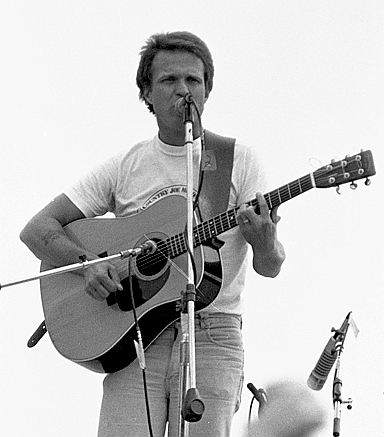
Joseph Allen "Country Joe" McDonald (born January 1, 1942) is an American singer/songwriter, musician, film composer and the lead singer and co-founder of the 1960s psychedelic folk-rock group Country Joe and the Fish.
Since the group's breakup in 1971, McDonald has performed as a solo artist and continued to musically espouse his political views through his original songs.
McDonald was born in Washington, D.C., and grew up in El Monte, California, where he had moved with his parents, Florence and Worden McDonald.
His father was the son of a Presbyterian minister of Scottish heritage. Born in Oklahoma, and raised on a farm a 100 miles from Woody Guthrie's birthplace of Okemah, Worden worked for a telephone company and, as a young man, traveled the country riding the rails, working odd jobs. His mother, Florence Plotnick, was the daughter of Russian Jewish immigrants and served for many years as the City Auditor of Berkeley, California. In their youth, both were Communist Party members and named their son after Joseph Stalin, before renouncing the cause.
In high school McDonald was student conductor and president of the marching band. At the age of 17, he enlisted in the U.S. Navy for three years and was stationed in Japan. After his enlistment, he attended Los Angeles City College for a year. In the early 1960s, he began busking on Telegraph Avenue in Berkeley, California. He played the Berkeley String Quartet and the Instant Action Jug Band with future bandmate Barry Melton. In 1965, he performed with The Fugs and Allen Ginsberg in a chemistry lab at UC Berkeley.
McDonald has recorded 33 albums and has written hundreds of songs over a career spanning 60 years. In 1965, he and Barry "The Fish" Melton co-founded Country Joe & the Fish which became a pioneer psychedelic rock band with their eclectic performances at the Avalon Ballroom, the Fillmore Auditorium, the 1967 Monterey Pop Festival, and both the 1969 original and 1979 reunion Woodstock Festivals.
Country Joe & The Fish were signed to Vanguard Records in 1966 and quickly released a series of albums produced by Sam Charters. Their debut, Electric Music for the Mind and Body (May 1967), which is regarded as a seminal work of psychedelic rock. It was followed by I-Feel-Like-I’m-Fixin’-to-Die (November 1967), which included the title track that firmly established the band as key figures in the anti-war movement, andTogether (1968), the latter reaching #23 on the Billboard charts.
In 1969, the band released Here We Are Again, which featured guest appearances by Jack Casady of Jefferson Airplane and David Getz and Peter Albin of Big Brother & The Holding Company. The album spent 11 weeks on the Billboard charts and included Here I Go Again, later covered by Twiggy.
Hub AI
Country Joe McDonald AI simulator
(@Country Joe McDonald_simulator)
Country Joe McDonald
Joseph Allen "Country Joe" McDonald (born January 1, 1942) is an American singer/songwriter, musician, film composer and the lead singer and co-founder of the 1960s psychedelic folk-rock group Country Joe and the Fish.
Since the group's breakup in 1971, McDonald has performed as a solo artist and continued to musically espouse his political views through his original songs.
McDonald was born in Washington, D.C., and grew up in El Monte, California, where he had moved with his parents, Florence and Worden McDonald.
His father was the son of a Presbyterian minister of Scottish heritage. Born in Oklahoma, and raised on a farm a 100 miles from Woody Guthrie's birthplace of Okemah, Worden worked for a telephone company and, as a young man, traveled the country riding the rails, working odd jobs. His mother, Florence Plotnick, was the daughter of Russian Jewish immigrants and served for many years as the City Auditor of Berkeley, California. In their youth, both were Communist Party members and named their son after Joseph Stalin, before renouncing the cause.
In high school McDonald was student conductor and president of the marching band. At the age of 17, he enlisted in the U.S. Navy for three years and was stationed in Japan. After his enlistment, he attended Los Angeles City College for a year. In the early 1960s, he began busking on Telegraph Avenue in Berkeley, California. He played the Berkeley String Quartet and the Instant Action Jug Band with future bandmate Barry Melton. In 1965, he performed with The Fugs and Allen Ginsberg in a chemistry lab at UC Berkeley.
McDonald has recorded 33 albums and has written hundreds of songs over a career spanning 60 years. In 1965, he and Barry "The Fish" Melton co-founded Country Joe & the Fish which became a pioneer psychedelic rock band with their eclectic performances at the Avalon Ballroom, the Fillmore Auditorium, the 1967 Monterey Pop Festival, and both the 1969 original and 1979 reunion Woodstock Festivals.
Country Joe & The Fish were signed to Vanguard Records in 1966 and quickly released a series of albums produced by Sam Charters. Their debut, Electric Music for the Mind and Body (May 1967), which is regarded as a seminal work of psychedelic rock. It was followed by I-Feel-Like-I’m-Fixin’-to-Die (November 1967), which included the title track that firmly established the band as key figures in the anti-war movement, andTogether (1968), the latter reaching #23 on the Billboard charts.
In 1969, the band released Here We Are Again, which featured guest appearances by Jack Casady of Jefferson Airplane and David Getz and Peter Albin of Big Brother & The Holding Company. The album spent 11 weeks on the Billboard charts and included Here I Go Again, later covered by Twiggy.
Recent media