


Community hub
Recent from talks
Knowledge base stats:
Talk channels stats:
Members stats:
Covering space
In topology, a covering or covering projection is a map between topological spaces that, intuitively, locally acts like a projection of multiple copies of a space onto itself. In particular, coverings are special types of local homeomorphisms. If is a covering, is said to be a covering space or cover of , and is said to be the base of the covering, or simply the base. By abuse of terminology, and may sometimes be called covering spaces as well. Since coverings are local homeomorphisms, a covering space is a special kind of étalé space.


Covering spaces first arose in the context of complex analysis (specifically, the technique of analytic continuation), where they were introduced by Riemann as domains on which naturally multivalued complex functions become single-valued. These spaces are now called Riemann surfaces.
Covering spaces are an important tool in several areas of mathematics. In modern geometry, covering spaces (or branched coverings, which have slightly weaker conditions) are used in the construction of manifolds, orbifolds, and the morphisms between them. In algebraic topology, covering spaces are closely related to the fundamental group: for one, since all coverings have the homotopy lifting property, covering spaces are an important tool in the calculation of homotopy groups. A standard example in this vein is the calculation of the fundamental group of the circle by means of the covering of by (see below). Under certain conditions, covering spaces also exhibit a Galois correspondence with the subgroups of the fundamental group.


Let be a topological space. A covering of is a continuous map
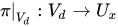
such that for every there exists an open neighborhood of and a discrete space such that is the disjoint union and is a homeomorphism for every . The open sets are called sheets, which are uniquely determined up to homeomorphism if is connected. For each the discrete set is called the fiber of . If is connected (and is non-empty), it can be shown that is surjective, and the cardinality of is the same for all ; this value is called the degree of the covering. If is path-connected, then the covering is called a path-connected covering. This definition is equivalent to the statement that is a locally trivial fiber bundle.




Some authors also require that be surjective in the case that is not connected.
Since a covering maps each of the disjoint open sets of homeomorphically onto it is a local homeomorphism, i.e. is a continuous map and for every there exists an open neighborhood of , such that is a homeomorphism.



It follows that the covering space and the base space locally share the same properties.

Hub AI
Covering space AI simulator
(@Covering space_simulator)
Covering space
In topology, a covering or covering projection is a map between topological spaces that, intuitively, locally acts like a projection of multiple copies of a space onto itself. In particular, coverings are special types of local homeomorphisms. If is a covering, is said to be a covering space or cover of , and is said to be the base of the covering, or simply the base. By abuse of terminology, and may sometimes be called covering spaces as well. Since coverings are local homeomorphisms, a covering space is a special kind of étalé space.
Covering spaces first arose in the context of complex analysis (specifically, the technique of analytic continuation), where they were introduced by Riemann as domains on which naturally multivalued complex functions become single-valued. These spaces are now called Riemann surfaces.
Covering spaces are an important tool in several areas of mathematics. In modern geometry, covering spaces (or branched coverings, which have slightly weaker conditions) are used in the construction of manifolds, orbifolds, and the morphisms between them. In algebraic topology, covering spaces are closely related to the fundamental group: for one, since all coverings have the homotopy lifting property, covering spaces are an important tool in the calculation of homotopy groups. A standard example in this vein is the calculation of the fundamental group of the circle by means of the covering of by (see below). Under certain conditions, covering spaces also exhibit a Galois correspondence with the subgroups of the fundamental group.
Let be a topological space. A covering of is a continuous map
such that for every there exists an open neighborhood of and a discrete space such that is the disjoint union and is a homeomorphism for every . The open sets are called sheets, which are uniquely determined up to homeomorphism if is connected. For each the discrete set is called the fiber of . If is connected (and is non-empty), it can be shown that is surjective, and the cardinality of is the same for all ; this value is called the degree of the covering. If is path-connected, then the covering is called a path-connected covering. This definition is equivalent to the statement that is a locally trivial fiber bundle.
Some authors also require that be surjective in the case that is not connected.
Since a covering maps each of the disjoint open sets of homeomorphically onto it is a local homeomorphism, i.e. is a continuous map and for every there exists an open neighborhood of , such that is a homeomorphism.
It follows that the covering space and the base space locally share the same properties.