Covering space
Covering space
Main page
2239289

Covering space

logo
Community Hub0 subscribers
Read side by side
from Wikipedia
Intuitively, a covering locally projects a "stack of pancakes" above an open neighborhood onto

In topology, a covering or covering projection is a map between topological spaces that, intuitively, locally acts like a projection of multiple copies of a space onto itself. In particular, coverings are special types of local homeomorphisms. If is a covering, is said to be a covering space or cover of , and is said to be the base of the covering, or simply the base. By abuse of terminology, and may sometimes be called covering spaces as well. Since coverings are local homeomorphisms, a covering space is a special kind of étalé space.

Covering spaces first arose in the context of complex analysis (specifically, the technique of analytic continuation), where they were introduced by Riemann as domains on which naturally multivalued complex functions become single-valued. These spaces are now called Riemann surfaces.[1]: 10 

Covering spaces are an important tool in several areas of mathematics. In modern geometry, covering spaces (or branched coverings, which have slightly weaker conditions) are used in the construction of manifolds, orbifolds, and the morphisms between them. In algebraic topology, covering spaces are closely related to the fundamental group: for one, since all coverings have the homotopy lifting property, covering spaces are an important tool in the calculation of homotopy groups. A standard example in this vein is the calculation of the fundamental group of the circle by means of the covering of by (see below).[2]: 29  Under certain conditions, covering spaces also exhibit a Galois correspondence with the subgroups of the fundamental group.

Definition

[edit]

Let be a topological space. A covering of is a continuous map

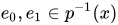
such that for every there exists an open neighborhood of and a discrete space such that is the disjoint union and is a homeomorphism for every . The open sets are called sheets, which are uniquely determined up to homeomorphism if is connected.[2]: 56  For each the discrete set is called the fiber of . If is connected (and is non-empty), it can be shown that is surjective, and the cardinality of is the same for all ; this value is called the degree of the covering. If is path-connected, then the covering is called a path-connected covering. This definition is equivalent to the statement that is a locally trivial fiber bundle.

Some authors also require that be surjective in the case that is not connected.[3]

Examples

[edit]
  • For every topological space , the identity map is a covering. Likewise for any discrete space the projection taking is a covering. Coverings of this type are called trivial coverings; if has finitely many (say ) elements, the covering is called the trivial -sheeted covering of .
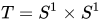
The space is a covering space of . The disjoint open sets are mapped homeomorphically onto . The fiber of consists of the points .
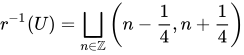
  • The map with is a covering of the unit circle . The base of the covering is and the covering space is . For any point such that , the set is an open neighborhood of . The preimage of under is
and the sheets of the covering are for The fiber of is

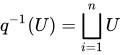
  • Another covering of the unit circle is the map with for some positive For an open neighborhood of an , one has:
.
  • A map which is a local homeomorphism but not a covering of the unit circle is with . There is a sheet of an open neighborhood of , which is not mapped homeomorphically onto .
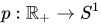
  • Let be odd. The map defined by is a homomorphic double covering.

Properties

[edit]

Local homeomorphism

[edit]

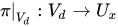
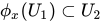
Since a covering maps each of the disjoint open sets of homeomorphically onto it is a local homeomorphism, i.e. is a continuous map and for every there exists an open neighborhood of , such that is a homeomorphism.

It follows that the covering space and the base space locally share the same properties.

  • If is a connected and non-orientable manifold, then there is a covering of degree , whereby is a connected and orientable manifold.[2]: 234 
  • If is a connected Lie group, then there is a covering which is also a Lie group homomorphism and is a Lie group.[4]: 174 
  • If is a graph, then it follows for a covering that is also a graph.[2]: 85 
  • If is a connected manifold, then there is a covering , whereby is a connected and simply connected manifold.[5]: 32 
  • If is a connected Riemann surface, then there is a covering which is also a holomorphic map[5]: 22  and is a connected and simply connected Riemann surface.[5]: 32 

Factorisation

[edit]

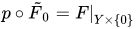
Let and be path-connected, locally path-connected spaces, and and be continuous maps, such that the diagram

commutes.

  • If and are coverings, so is .
  • If and are coverings, so is .[6]: 485 

Product of coverings

[edit]

Let and be topological spaces and and be coverings, then with is a covering.[6]: 339  However, coverings of are not all of this form in general.

Equivalence of coverings

[edit]

Let be a topological space and and be coverings. Both coverings are called equivalent, if there exists a homeomorphism , such that the diagram

commutes. If such a homeomorphism exists, then one calls the covering spaces and isomorphic.

Lifting property

[edit]

All coverings satisfy the lifting property, i.e.:

Let be the unit interval and be a covering. Let be a continuous map and be a lift of , i.e. a continuous map such that . Then there is a uniquely determined, continuous map for which and which is a lift of , i.e. .[2]: 60 

If is a path-connected space, then for it follows that the map is a lift of a path in and for it is a lift of a homotopy of paths in .

As a consequence, one can show that the fundamental group of the unit circle is an infinite cyclic group, which is generated by the homotopy classes of the loop with .[2]: 29 

Let be a path-connected space and be a connected covering. Let be any two points, which are connected by a path , i.e. and . Let be the unique lift of , then the map

with

is bijective.[2]: 69 

If is a path-connected space and a connected covering, then the induced group homomorphism

with ,

is injective and the subgroup of consists of the homotopy classes of loops in , whose lifts are loops in .[2]: 61 

Branched covering

[edit]

Definitions

[edit]

Holomorphic maps between Riemann surfaces

[edit]

Let and be Riemann surfaces, i.e. one dimensional complex manifolds, and let be a continuous map. is holomorphic in a point , if for any charts of and of , with , the map is holomorphic.

If is holomorphic at all , we say is holomorphic.

The map is called the local expression of in .

If is a non-constant, holomorphic map between compact Riemann surfaces, then is surjective and an open map,[5]: 11  i.e. for every open set the image is also open.

Ramification point and branch point

[edit]

Let be a non-constant, holomorphic map between compact Riemann surfaces. For every there exist charts for and and there exists a uniquely determined , such that the local expression of in is of the form .[5]: 10  The number is called the ramification index of in and the point is called a ramification point if . If for an , then is unramified. The image point of a ramification point is called a branch point.

Degree of a holomorphic map

[edit]

Let be a non-constant, holomorphic map between compact Riemann surfaces. The degree of is the cardinality of the fiber of an unramified point , i.e. .

This number is well-defined, since for every the fiber is discrete[5]: 20  and for any two unramified points , it is:

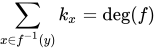
It can be calculated by:

[5]: 29 

Branched covering

[edit]

Definition

[edit]

A continuous map is called a branched covering, if there exists a closed set with dense complement , such that is a covering.

Examples

[edit]
  • Let and , then with is a branched covering of degree , where by is a branch point.
  • Every non-constant, holomorphic map between compact Riemann surfaces of degree is a branched covering of degree .

Universal covering

[edit]

Definition

[edit]

Let be a simply connected covering. If is another simply connected covering, then there exists a uniquely determined homeomorphism , such that the diagram

commutes.[6]: 482 

This means that is, up to equivalence, uniquely determined and because of that universal property denoted as the universal covering of the space .

Existence

[edit]

A universal covering does not always exist. The following theorem guarantees its existence for a certain class of base spaces.

Let be a connected, locally simply connected topological space. Then, there exists a universal covering

The set is defined as where is any chosen base point. The map is defined by [2]: 64 

The topology on is constructed as follows: Let be a path with Let be a simply connected neighborhood of the endpoint Then, for every there is a path inside from to that is unique up to homotopy. Now consider the set The restriction with is a bijection and can be equipped with the final topology of [further explanation needed]

The fundamental group acts freely on by and the orbit space is homeomorphic to through the map

Examples

[edit]
The Hawaiian earring. Only the ten largest circles are shown.
  • with is the universal covering of the unit circle .
  • with is the universal covering of the projective space for .
  • with is the universal covering of the unitary group .
  • Since , it follows that the quotient map is the universal covering of .
  • A topological space which has no universal covering is the Hawaiian earring: One can show that no neighborhood of the origin is simply connected.[6]: 487, Example 1 

G-coverings

[edit]

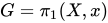
Let G be a discrete group acting on the topological space X. This means that each element g of G is associated to a homeomorphism Hg of X onto itself, in such a way that Hg h is always equal to Hg Hh for any two elements g and h of G. (Or in other words, a group action of the group G on the space X is just a group homomorphism of the group G into the group Homeo(X) of self-homeomorphisms of X.) It is natural to ask under what conditions the projection from X to the orbit space X/G is a covering map. This is not always true since the action may have fixed points. An example for this is the cyclic group of order 2 acting on a product X × X by the twist action where the non-identity element acts by (x, y) ↦ (y, x). Thus the study of the relation between the fundamental groups of X and X/G is not so straightforward.

However the group G does act on the fundamental groupoid of X, and so the study is best handled by considering groups acting on groupoids, and the corresponding orbit groupoids. The theory for this is set down in Chapter 11 of the book Topology and groupoids referred to below. The main result is that for discontinuous actions of a group G on a Hausdorff space X which admits a universal cover, then the fundamental groupoid of the orbit space X/G is isomorphic to the orbit groupoid of the fundamental groupoid of X, i.e. the quotient of that groupoid by the action of the group G. This leads to explicit computations, for example of the fundamental group of the symmetric square of a space.

Smooth coverings

[edit]

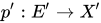
Let E and M be smooth manifolds with or without boundary. A covering is called a smooth covering if it is a smooth map and the sheets are mapped diffeomorphically onto the corresponding open subset of M. (This is in contrast to the definition of a covering, which merely requires that the sheets are mapped homeomorphically onto the corresponding open subset.)

Deck transformation

[edit]

Definition

[edit]

Let be a covering. A deck transformation is a homeomorphism , such that the diagram of continuous maps

commutes. Together with the composition of maps, the set of deck transformation forms a group , which is the same as .

Now suppose is a covering map and (and therefore also ) is connected and locally path connected. The action of on each fiber is free. If this action is transitive on some fiber, then it is transitive on all fibers, and we call the cover regular (or normal or Galois). Every such regular cover is a principal -bundle, where is considered as a discrete topological group.

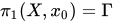
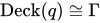
Every universal cover is regular, with deck transformation group being isomorphic to the fundamental group .

Examples

[edit]
  • Let be the covering for some , then the map for is a deck transformation and .
  • Let be the covering , then the map for is a deck transformation and .
  • As another important example, consider the complex plane and the complex plane minus the origin. Then the map with is a regular cover. The deck transformations are multiplications with -th roots of unity and the deck transformation group is therefore isomorphic to the cyclic group . Likewise, the map with is the universal cover.

Properties

[edit]

Let be a path-connected space and be a connected covering. Since a deck transformation is bijective, it permutes the elements of a fiber with and is uniquely determined by where it sends a single point. In particular, only the identity map fixes a point in the fiber.[2]: 70  Because of this property every deck transformation defines a group action on , i.e. let be an open neighborhood of a and an open neighborhood of an , then is a group action.

Normal coverings

[edit]

Definition

[edit]

A covering is called normal, if . This means, that for every and any two there exists a deck transformation , such that .

Properties

[edit]

Let be a path-connected space and be a connected covering. Let be a subgroup of , then is a normal covering iff is a normal subgroup of .

If is a normal covering and , then .

If is a path-connected covering and , then , whereby is the normaliser of .[2]: 71 

Let be a topological space. A group acts discontinuously on , if every has an open neighborhood with , such that for every with one has .

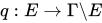
If a group acts discontinuously on a topological space , then the quotient map with is a normal covering.[2]: 72  Hereby is the quotient space and is the orbit of the group action.
Examples

[edit]
  • The covering with is a normal coverings for every .
  • Every simply connected covering is a normal covering.

Calculation

[edit]

Let be a group, which acts discontinuously on a topological space and let be the normal covering.

  • If is path-connected, then .[2]: 72 
  • If is simply connected, then .[2]: 71 

Examples

[edit]
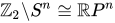
  • Let . The antipodal map with generates, together with the composition of maps, a group and induces a group action , which acts discontinuously on . Because of it follows, that the quotient map is a normal covering and for a universal covering, hence for .
  • Let be the special orthogonal group, then the map is a normal covering and because of , it is the universal covering, hence .
  • With the group action of on , whereby is the semidirect product , one gets the universal covering of the klein bottle , hence .
  • Let be the torus which is embedded in the . Then one gets a homeomorphism , which induces a discontinuous group action , whereby . It follows, that the map is a normal covering of the klein bottle, hence .
  • Let be embedded in the . Since the group action is discontinuously, whereby are coprime, the map is the universal covering of the lens space , hence .

Galois correspondence

[edit]

Let be a connected and locally simply connected space, then for every subgroup there exists a path-connected covering with .[2]: 66 

Let and be two path-connected coverings, then they are equivalent iff the subgroups and are conjugate to each other.[6]: 482 

Let be a connected and locally simply connected space, then, up to equivalence between coverings, there is a bijection:

For a sequence of subgroups one gets a sequence of coverings . For a subgroup with index , the covering has degree .


Classification

[edit]

Definitions

[edit]

Category of coverings

[edit]

Let be a topological space. The objects of the category are the coverings of and the morphisms between two coverings and are continuous maps , such that the diagram

commutes.

G-Set

[edit]

Let be a topological group. The category is the category of sets which are G-sets. The morphisms are G-maps between G-sets. They satisfy the condition for every .

Equivalence

[edit]

Let be a connected and locally simply connected space, and be the fundamental group of . Since defines, by lifting of paths and evaluating at the endpoint of the lift, a group action on the fiber of a covering, the functor is an equivalence of categories.[2]: 68–70 
Applications

[edit]
Gimbal lock occurs because any map T3RP3 is not a covering map. In particular, the relevant map carries any element of T3, that is, an ordered triple (a,b,c) of angles (real numbers mod 2π), to the composition of the three coordinate axis rotations Rx(a)Ry(b)Rz(c) by those angles, respectively. Each of these rotations, and their composition, is an element of the rotation group SO(3), which is topologically RP3. This animation shows a set of three gimbals mounted together to allow three degrees of freedom. When all three gimbals are lined up (in the same plane), the system can only move in two dimensions from this configuration, not three, and is in gimbal lock. In this case it can pitch or yaw, but not roll (rotate in the plane that the axes all lie in).

An important practical application of covering spaces occurs in charts on SO(3), the rotation group. This group occurs widely in engineering, due to 3-dimensional rotations being heavily used in navigation, nautical engineering, and aerospace engineering, among many other uses. Topologically, SO(3) is the real projective space RP3, with fundamental group Z/2, and only (non-trivial) covering space the hypersphere S3, which is the group Spin(3), and represented by the unit quaternions. Thus quaternions are a preferred method for representing spatial rotations – see quaternions and spatial rotation.

However, it is often desirable to represent rotations by a set of three numbers, known as Euler angles (in numerous variants), both because this is conceptually simpler for someone familiar with planar rotation, and because one can build a combination of three gimbals to produce rotations in three dimensions. Topologically this corresponds to a map from the 3-torus T3 of three angles to the real projective space RP3 of rotations, and the resulting map has imperfections due to this map being unable to be a covering map. Specifically, the failure of the map to be a local homeomorphism at certain points is referred to as gimbal lock, and is demonstrated in the animation at the right – at some points (when the axes are coplanar) the rank of the map is 2, rather than 3, meaning that only 2 dimensions of rotations can be realized from that point by changing the angles. This causes problems in applications, and is formalized by the notion of a covering space.

See also

[edit]

Literature

[edit]
  • Hatcher, Allen (2002). Algebraic topology. Cambridge: Cambridge University Press. ISBN 0-521-79160-X. OCLC 45420394.
  • Forster, Otto (1981). Lectures on Riemann surfaces. New York. ISBN 0-387-90617-7. OCLC 7596520.{{cite book}}: CS1 maint: location missing publisher (link)
  • Munkres, James R. (2018). Topology. New York, NY. ISBN 978-0-13-468951-7. OCLC 964502066.{{cite book}}: CS1 maint: location missing publisher (link)
  • Kühnel, Wolfgang (2011). Matrizen und Lie-Gruppen Eine geometrische Einführung (in German). Wiesbaden: Vieweg+Teubner Verlag. doi:10.1007/978-3-8348-9905-7. ISBN 978-3-8348-9905-7. OCLC 706962685.

References

[edit]
Revisions and contributorsEdit on WikipediaRead on Wikipedia
from Grokipedia
In algebraic topology, a covering space (or cover) of a topological space XX is a topological space X~\tilde{X} equipped with a continuous surjective map p:X~Xp: \tilde{X} \to X, called the covering map, such that for every point xXx \in X, there exists an open neighborhood UU of xx that is evenly covered by pp; this means p1(U)p^{-1}(U) is a disjoint union of open sets in X~\tilde{X}, each of which pp maps homeomorphically onto UU.[1] The preimage p1(x)p^{-1}(x) under pp is called the fiber over xx, and if XX is connected, all fibers have the same cardinality, known as the number of sheets of the covering.[1] Covering spaces provide a powerful framework for studying the global topology of XX through local homeomorphisms to simpler spaces X~\tilde{X}, often simply connected ones.[1] A fundamental property is the unique lifting of paths and homotopies: given a path in XX starting at x0x_0 and a choice of lift x~0p1(x0)\tilde{x}_0 \in p^{-1}(x_0), there exists a unique path in X~\tilde{X} starting at x~0\tilde{x}_0 that projects to the original path under pp; similarly, homotopies lift uniquely.[1] This lifting criterion enables the computation of the fundamental group π1(X)\pi_1(X), as the covering map induces an injective homomorphism p:π1(X~)π1(X)p_*: \pi_1(\tilde{X}) \to \pi_1(X), and for the universal covering space—a simply connected cover unique up to isomorphismpp_* is the trivial homomorphism since π1(X~)\pi_1(\tilde{X}) is trivial.[1] The universal covering space exists for any path-connected, locally path-connected, and semilocally simply-connected space XX, and it plays a central role in the Galois correspondence, which establishes a bijection between the basepoint-preserving isomorphism classes of path-connected covering spaces of XX and the subgroups of π1(X,x0)\pi_1(X, x_0).[1] Deck transformations—autohomeomorphisms of X~\tilde{X} that commute with pp—form a group acting freely and properly discontinuously on X~\tilde{X}, isomorphic to π1(X)\pi_1(X) for the universal cover, linking topological and algebraic structures.[1] Classic examples include the infinite-sheeted universal cover RS1\mathbb{R} \to S^1 via the exponential map and the nn-sheeted cover S1S1S^1 \to S^1 given by zznz \mapsto z^n.[1] Covering spaces extend to applications in homology and higher homotopy groups, where the covering map induces isomorphisms on πn\pi_n for n2n \geq 2, and they underpin theorems like the Fundamental Theorem of Algebra and the Brouwer fixed-point theorem through degree computations and lifting arguments.[1] In more advanced contexts, such as fibrations and spectral sequences, covering spaces inform the study of aspherical manifolds and orbifolds, maintaining relevance in modern geometric and algebraic topology.[1]

Fundamentals

Definition

A universal covering space of a topological space XX is a simply connected covering space X~X\tilde{X} \to X such that every path-connected covering space of XX admits a covering map from X~\tilde{X}. It is unique up to isomorphism of covering spaces over XX. For such a universal covering p:X~Xp: \tilde{X} \to X where XX is path-connected, locally path-connected, and semi-locally simply connected—where a space is locally path-connected if every point has a basis of path-connected open neighborhoods, and semi-locally simply connected if every point has a neighborhood UU such that every loop in UU is nullhomotopic in XX (i.e., the induced map on fundamental groups π1(U)π1(X)\pi_1(U) \to \pi_1(X) is trivial)—the deck group Deck(p)\mathrm{Deck}(p) is isomorphic to the fundamental group π1(X,x0)\pi_1(X, x_0).[1] In contrast, if the base space XX is simply connected, its universal cover is XX itself, and the deck group is trivial, consisting only of the identity transformation.[1]

Examples

A basic example is the trivial covering X×DXX \times D \to X, where DD is a discrete space with nn points (for finite-sheeted) or countably infinite; the projection is pr1\mathrm{pr}_1, with fibers homeomorphic to DD. This illustrates disconnected total space and constant fiber cardinality.[1] The nn-sheeted covering of the circle S1S^1 by itself is given by p:S1S1p: S^1 \to S^1, zznz \mapsto z^n (for n1n \geq 1), where S1={zC:z=1}S^1 = \{ z \in \mathbb{C} : |z|=1 \}. This wraps the domain circle nn times around the base, with fibers consisting of the nnth roots of points in the base. It is a finite regular covering, connected total space, and demonstrates how coverings can detect the fundamental group order.[1] For instance, when n=3n=3, the map p(z)=z3p(z) = z^3 is a 3-fold covering. Equivalently, it arises as the quotient map S1S1/Z3S^1 \to S^1 / \mathbb{Z}_3, where Z3\mathbb{Z}_3 acts on S1S^1 by rotations through angles of 120120^\circ and 240240^\circ (multiplication by the non-trivial cube roots of unity). Every point zz is identified with its images under these rotations. A fundamental domain is the arc from θ=0\theta = 0 to θ=2π/3\theta = 2\pi/3. The endpoints at 00 and 2π/32\pi/3 are identified in the quotient because they lie in the same orbit under the group action. Gluing these endpoints together yields a circle, showing that the quotient space S1/Z3S^1 / \mathbb{Z}_3 is homeomorphic to S1S^1. The covering map wraps the original circle three times around this quotient circle, which has an effective angular parameterization of length 2π/32\pi/3 (one-third the original) but retains the topology of a simple closed loop.[1] Another example is the orientation double cover of a non-orientable manifold, such as the real projective plane RP2\mathbb{RP}^2, covered by S2S^2 via the antipodal map p:S2RP2p: S^2 \to \mathbb{RP}^2, [x]={x,x}[x] = \{x, -x\}. Fibers have two points, and lifts distinguish orientations, showing how coverings resolve local ambiguities.[1]

Basic Properties

Local homeomorphism

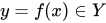
A covering map $ p: Y \to X $ is a local homeomorphism, meaning that for every point $ y \in Y $, there exists an open neighborhood $ V $ of $ y $ in $ Y $ such that the restriction $ p|_V: V \to p(V) $ is a homeomorphism onto its image, where $ p(V) $ is open in $ X $.[1] To see this, consider any $ y \in Y $ and let $ x = p(y) $. By the definition of a covering map, there exists an evenly covered open neighborhood $ U $ of $ x $ in $ X $ such that $ p^{-1}(U) $ is a disjoint union of open sets $ {V_\alpha} $ in $ Y $, with each $ p|{V\alpha}: V_\alpha \to U $ a homeomorphism. Since $ y $ lies in one such $ V_\alpha $, an open neighborhood $ V \subseteq V_\alpha $ of $ y $ maps homeomorphically via $ p $ onto an open subset of $ U $, hence of $ X $. The inverse map is given by the homeomorphism on $ V_\alpha $, confirming the local homeomorphism property.[1] This local homeomorphism implies that covering spaces preserve the local topological structure of the base space: if $ X $ is locally Euclidean (or satisfies any local topological property preserved under homeomorphisms), then so is $ Y $. For instance, the existence of local charts in $ X $ lifts directly to charts in $ Y $, facilitating the study of global features through local analysis.[1] Additionally, the fibers $ p^{-1}(x) $ over each $ x \in X $ are discrete topological spaces. In any evenly covered neighborhood $ U $ of $ x $, the points of the fiber over $ x $ reside in distinct components $ V_\alpha $, each separated by open sets, ensuring no limit points within the fiber.[1]

Connectedness of Covering Spaces

Let $ p: E \to X $ be a covering map with monodromy action $ l: \pi_1(X, x_0) \times p^{-1}(x_0) \to p^{-1}(x_0) $ for some $ x_0 \in X $. Suppose $ X $ is path-connected. Then $ E $ is path-connected if and only if the monodromy action is transitive.[1] To prove this, first assume $ E $ is path-connected. Let $ x, y \in p^{-1}(x_0) $. Since $ E $ is path-connected, there exists a path $ \tilde{\gamma} $ in $ E $ from $ x $ to $ y $. The projection $ \gamma = p \circ \tilde{\gamma} $ is then a path in $ X $ from $ x_0 $ to $ x_0 $, i.e., a loop based at $ x_0 $. The homotopy class $ [\gamma] \in \pi_1(X, x_0) $ acts via monodromy to send $ x $ to $ y $, showing transitivity.[1] Conversely, assume the monodromy action is transitive. Fix $ y_0 \in p^{-1}(x_0) $. For any $ y \in E $, let $ x = p(y) $. Since $ X $ is path-connected, there exists a path $ \delta $ in $ X $ from $ x $ to $ x_0 $. By the path lifting property, this lifts to a unique path $ \tilde{\delta} $ in $ E $ from $ y $ to some $ y_1 \in p^{-1}(x_0) $. By transitivity, there exists a loop $ \alpha $ based at $ x_0 $ such that $ [\alpha] \cdot y_1 = y_0 $. This loop lifts to a unique path $ \tilde{\alpha} $ in $ E $ from $ y_1 $ to $ y_0 $. Concatenating $ \tilde{\delta} $ followed by $ \tilde{\alpha} $ (reparameterized) yields a path in $ E $ from $ y $ to $ y_0 $, showing $ E $ is path-connected.[1]

Lifting property

One of the defining characteristics of a covering space $ p: Y \to X $ is its lifting property, which ensures that continuous maps into the base space $ X $ can be uniquely lifted to the total space $ Y $ under appropriate conditions. This property stems from the local homeomorphism structure of the covering map, where each point in $ X $ has an evenly covered neighborhood, allowing local lifts that can be glued together globally.[1] The path lifting theorem states that for any path $ \gamma: [0,1] \to X $ starting at $ x_0 = \gamma(0) $ and any point $ y_0 \in p^{-1}(x_0) $, there exists a unique path $ \tilde{\gamma}: [0,1] \to Y $ such that $ \tilde{\gamma}(0) = y_0 $ and $ p \circ \tilde{\gamma} = \gamma $. This theorem guarantees that paths in the base lift uniquely when the starting point in the fiber is specified.[1] The proof proceeds by exploiting the local homeomorphism property: the path $ \gamma $ is covered by evenly covered neighborhoods, and the lift is constructed incrementally over a subdivision of $ [0,1] $, using the compactness of the interval to ensure continuity and the discrete nature of the fibers for uniqueness.[1] Building on path lifting, the homotopy lifting theorem asserts that if two paths $ \gamma_0, \gamma_1: [0,1] \to X $ are homotopic relative to their endpoints and each has a lift starting at a fixed $ y_0 \in p^{-1}(\gamma_0(0)) = p^{-1}(\gamma_1(0)) $, then their lifts $ \tilde{\gamma}_0 $ and $ \tilde{\gamma}_1 $ are homotopic relative to endpoints. More generally, given a homotopy $ H: [0,1] \times [0,1] \to X $ with an initial lift $ \tilde{H}_0 $ of $ H(-,0) $, there exists a unique homotopy lift $ \tilde{H}: [0,1] \times [0,1] \to Y $ such that $ \tilde{H}(-,0) = \tilde{H}_0 $ and $ p \circ \tilde{H} = H $, with the lift unique relative to the initial slice.[1] The proof extends the path lifting argument by treating the homotopy as a family of paths parameterized by the second interval, applying path lifts over a fine subdivision and invoking compactness of the square $ [0,1] \times [0,1] $ to obtain a continuous global lift.[1] The lifting properties induce a monodromy action on the fibers of the covering map. Specifically, for a path $ \gamma $ from $ x_0 $ to $ x_1 $ in $ X $, the unique lifts starting at each point in the fiber $ p^{-1}(x_0) $ end at points in $ p^{-1}(x_1) $, defining a bijection between these fibers. This permutation of fiber points, arising directly from path lifting, captures how paths in the base "twist" the structure of the total space.[1]

Composition of covering maps

The composition of two covering maps is not necessarily a covering map. For instance, counterexamples exist where the base space lacks sufficient local connectedness, such as the shrinking wedge of circles, where a two-sheeted covering composed with another map fails to satisfy the evenly covered condition. This is demonstrated in Hatcher's Algebraic Topology, Section 1.3, Exercise 6.[1] However, if the second map in the composition is finite-sheeted, then the composition is a covering map. Specifically, if g:XZg: X \to Z is a covering map and h:ZBh: Z \to B is a finite-sheeted covering map, then the composition hg:XBh \circ g: X \to B is a covering map.[2] To see this, let bBb \in B and choose a distinguished neighbourhood UU of bb with respect to hh. That is, h1(U)=V1⨿⨿Vkh^{-1}(U) = V_1 \amalg \cdots \amalg V_k and h:ViUh: V_i \to U is a homeomorphism for each i=1,,ki = 1, \dots, k, where kk is finite. Let {y1,,yk}=h1(b)\{y_1, \dots, y_k\} = h^{-1}(b) with yiViy_i \in V_i. For each ii, pick a distinguished neighbourhood WiW_i of yiy_i with respect to gg such that WiViW_i \subseteq V_i, so that g1(Wi)=jAijg^{-1}(W_i) = \coprod_j A_{ij} and g:AijWig: A_{ij} \to W_i is a homeomorphism for each jj. Note that hh restricted to WiW_i is a homeomorphism onto its image, and h(Wi)h(W_i) is open in BB. Let U=i=1kh(Wi)U' = \bigcap_{i=1}^k h(W_i). Then UU' is an open neighbourhood of bb with respect to hgh \circ g. Let Wi=Wih1(U)W_i' = W_i \cap h^{-1}(U') and Aij=g1(Wi)A_{ij}' = g^{-1}(W_i'). Then (hg)1(U)=g1(h1(U))=g1(i=1kWi)=i=1kjAij(h \circ g)^{-1}(U') = g^{-1}(h^{-1}(U')) = g^{-1}\left( \bigsqcup_{i=1}^k W_i' \right) = \bigsqcup_{i=1}^k \bigsqcup_j A_{ij}', and each hg:AijUh \circ g: A_{ij}' \to U' is a homeomorphism.

Advanced Properties

Equivalence of coverings

In algebraic topology, two covering spaces p:YXp: Y \to X and p:YXp': Y' \to X of the same base space XX are equivalent if there exists a homeomorphism h:YYh: Y \to Y' such that the diagram commutes, meaning ph=pp' \circ h = p.[1] This definition ensures that the coverings are indistinguishable up to relabeling of the total spaces while preserving the projection structure.[3] The homeomorphism hh in this equivalence is necessarily fiber-preserving, meaning it maps each fiber p1(x)p^{-1}(x) bijectively onto the corresponding fiber (p)1(x)(p')^{-1}(x) for every xXx \in X.[1] This property maintains the local triviality of the coverings and ensures that the deck transformation groups act compatibly under the equivalence, although the explicit group structure is determined by the topology of YY and YY'.[4] Equivalent coverings have homeomorphic total spaces, as the defining homeomorphism hh directly establishes this isomorphism.[1] Moreover, if XX is connected, the fibers of equivalent coverings have the same cardinality, reflecting the uniform number of sheets in the covering.[3] For a path-connected and locally path-connected base XX, this cardinality is constant across all points and equals the index of the image of the fundamental group of the total space in that of the base, but equivalence guarantees matching indices over corresponding components even if XX is disconnected.[1] The pullback construction provides a mechanism to realize equivalence between coverings by transporting structure across maps to the base. Specifically, given a covering p:YXp: Y \to X and the identity map idX:XX\mathrm{id}_X: X \to X, the pullback Y×XXY \times_X X is canonically homeomorphic to YY via the projection, and two coverings p:YXp: Y \to X and p:YXp': Y' \to X are equivalent if YY' is homeomorphic to the pullback of YY along a suitable fiber-preserving map, confirming their structural identity.[4] This construction is particularly useful for verifying equivalence when total spaces arise from different constructions but project identically to XX.[1]

Product of coverings

In algebraic topology, given covering maps pi:YiXip_i: Y_i \to X_i for i=1,,ni = 1, \dots, n, the product map pi:YiXi\prod p_i: \prod Y_i \to \prod X_i, defined coordinatewise, is itself a covering map.[1] This construction preserves the local homeomorphism property, as each pip_i is a local homeomorphism, and the product of open sets in the bases lifts evenly to the product of the total spaces. The fiber over a point (x1,,xn)Xi(x_1, \dots, x_n) \in \prod X_i is the product of the individual fibers pi1(xi)\prod p_i^{-1}(x_i), which is discrete since each component fiber is discrete.[1] For finite-sheeted coverings, where each pip_i has degree did_i (the cardinality of the fiber), the degree of the product covering pi\prod p_i is the product di\prod d_i. This follows from the fact that the number of sheets equals the index of the image of the induced homomorphism on fundamental groups, and for path-connected bases, π1(Xi)π1(Xi)\pi_1(\prod X_i) \cong \prod \pi_1(X_i), with the corresponding subgroup being the product of the images.[1] A related construction is the base change, or pullback, of a covering p:YXp: Y \to X along a continuous map f:ZXf: Z \to X, yielding a new covering fp:fYZf^* p: f^* Y \to Z. Here, fY={(z,y)Z×Yf(z)=p(y)}f^* Y = \{(z, y) \in Z \times Y \mid f(z) = p(y)\}, and the projection fp(z,y)=zf^* p(z, y) = z is a covering map with fiber over zZz \in Z homeomorphic to p1(f(z))p^{-1}(f(z)). This operation is functorial and allows transferring coverings to different bases while preserving the covering structure.[1] Finally, if multiple coverings pi:YiXp_i: Y_i \to X share the same base XX, their disjoint union pi:YiX\coprod p_i: \coprod Y_i \to X forms a covering map, where the map is defined componentwise. The fiber over any xXx \in X is the disjoint union pi1(x)\coprod p_i^{-1}(x), which remains discrete. This yields possibly disconnected total spaces, useful for combining coverings over a common base.[1]

Branched Coverings

Definitions

In topology, branched coverings generalize the notion of covering spaces by allowing the map to fail to be a local homeomorphism at a finite (or discrete) set of points, rather than requiring it everywhere as in the standard definition of an unbranched covering.[5] A branched covering is a continuous surjective map $ p: Y \to X $ between topological spaces (often path-connected manifolds or surfaces) such that there exist finite subsets $ S \subset Y $ and $ T \subset X $ with $ p(S) = T $, and the restriction $ p|_{Y \setminus S}: Y \setminus S \to X \setminus T $ is a covering map.[5][6] The points in $ S $ are called ramification points, and those in $ T $ are the branch points.[7] The ramification index $ e_y $ at a ramification point $ y \in S $ is the positive integer representing the local multiplicity of the map near $ y $, such that in suitable local coordinates around $ y $ and $ p(y) $, the map $ p $ behaves like the model map $ z \mapsto z^{e_y} $ from a disk to itself.[6][7] This index $ e_y > 1 $ indicates how the preimage fibers "merge" at $ y $, reducing the effective number of distinct preimages compared to the generic case.[7] A branch point is the image under $ p $ of a ramification point, i.e., an element of $ T \subset X $, where the cardinality of the fiber $ p^{-1}(t) $ is strictly less than that over generic points in $ X $.[5][6] The degree $ d $ of a branched covering $ p: Y \to X $ is the constant positive integer equal to the sum of the ramification indices over the fiber above any point in $ X $, i.e., $ d = \sum_{y \in p^{-1}(x)} e_y $ for any $ x \in X $ (with $ e_y = 1 $ at non-ramification points).[8] This degree coincides with the cardinality of the generic fiber $ |p^{-1}(x)| $ for $ x \notin T $ and remains invariant across the space by the properties of proper maps between compact manifolds.[8][7]

Examples

A classic example is the squaring map $ p: \mathbb{C} \to \mathbb{C} $, $ z \mapsto z^2 $, which is a 2-sheeted branched covering with ramification at the origin (where the two sheets merge). Compactifying to the Riemann sphere gives the map $ [\mathbb{CP}^1 \to \mathbb{CP}^1] $, $ [z : w] \mapsto [z^2 : w^2] $, branched at 0 and \infty.[9] The 2-torus $ T^2 $ is a branched double covering of the 2-sphere $ S^2 $, with the covering map branched along four points on $ S^2 $. This construction arises from identifying an annulus in $ T^2 $ mapping to a disk in $ S^2 $ containing two branch points.[10] In the context of Riemann surfaces, every compact connected Riemann surface is a branched covering of the Riemann sphere $ \mathbb{CP}^1 $ via a non-constant holomorphic function, by the Riemann existence theorem.[9]

Universal Covering Spaces

Definition

A universal covering space of a topological space XX is a simply connected covering space X~X\tilde{X} \to X such that every path-connected covering space of XX admits a covering map from X~\tilde{X}. It is unique up to isomorphism of covering spaces over XX. For such a universal covering p:X~Xp: \tilde{X} \to X where XX is path-connected, locally path-connected, and semi-locally simply connected, the deck group Deck(p)\mathrm{Deck}(p) is isomorphic to the fundamental group π1(X,x0)\pi_1(X, x_0).[1] In contrast, if the base space XX is simply connected, its universal cover is XX itself, and the deck group is trivial, consisting only of the identity transformation.[1]

Existence

The existence of a universal covering space for a topological space XX requires specific conditions on XX. These conditions are that XX is path-connected, locally path-connected, and semi-locally simply connected. A space XX is path-connected if any two points can be joined by a continuous path, locally path-connected if every point has a local basis of path-connected open neighborhoods, and semi-locally simply connected if every point has a neighborhood UU such that the inclusion-induced map π1(U)π1(X)\pi_1(U) \to \pi_1(X) is trivial.[1] These assumptions ensure that loops in small neighborhoods are nullhomotopic in XX, allowing for the construction of a simply connected cover that "unwinds" the fundamental group action. Under these assumptions, XX admits a universal covering space X~\tilde{X}, which is a simply connected covering space of XX such that every other path-connected covering space of XX is covered by X~\tilde{X}. The space X~\tilde{X} is path-connected and simply connected, meaning its fundamental group is trivial. This result is a fundamental theorem in algebraic topology, guaranteeing the existence and uniqueness (up to covering space isomorphism) of the universal cover.[1] One standard construction of X~\tilde{X} proceeds by considering the set of homotopy classes of paths in XX starting at a fixed basepoint x0Xx_0 \in X. Formally, let X~={[γ]γ:[0,1]X a path with γ(0)=x0}\tilde{X} = \{ [\gamma] \mid \gamma: [0,1] \to X \text{ a path with } \gamma(0) = x_0 \}, where [γ][\gamma] denotes the homotopy class of γ\gamma rel endpoints. The topology on X~\tilde{X} is defined using a basis consisting of sets U[γ]U[\gamma], where UU is an evenly covered open neighborhood of γ(1)\gamma(1) in XX with π1(U)π1(X)\pi_1(U) \to \pi_1(X) trivial, and U[γ]U[\gamma] comprises classes of paths δ\delta such that γ1δ\gamma^{-1} \cdot \delta lifts to a path in UU starting at x0x_0. The projection p:X~Xp: \tilde{X} \to X sends [γ]γ(1)[\gamma] \mapsto \gamma(1), forming a covering map. This X~\tilde{X} is simply connected because any loop in X~\tilde{X} projects to a loop in XX that lifts uniquely, and the semi-local simple connectivity ensures the lift closes only if the original loop is nullhomotopic.[1] An alternative construction uses Zorn's lemma on the partially ordered set of connected covering spaces of XX ordered by covering space morphisms (or inclusion). The poset is nonempty since XX covers itself, and chains have upper bounds via fiber products. A maximal element in this poset yields a simply connected covering space, as any non-trivial loop would allow extension to a larger cover, contradicting maximality. The local path-connectedness ensures the cover is path-connected.[1] Without the semi-local simple connectivity assumption, a universal covering space may not exist. A classic counterexample is the Hawaiian earring, the shrinking wedge sum of circles in the plane converging to the origin. This space is path-connected and locally path-connected but not semi-locally simply connected at the origin, as neighborhoods there contain infinitely many non-trivial loops that generate the uncountable fundamental group, preventing a simply connected cover.[1]

Examples

The universal covering space of the circle S1S^1 is the real line R\mathbb{R}, with the covering map given by the exponential function p:RS1p: \mathbb{R} \to S^1, te2πitt \mapsto e^{2\pi i t}. This map winds the line infinitely many times around the circle, unwinding loops in S1S^1 to straight paths in R\mathbb{R}, thereby simplifying the topology by making the fundamental group trivial in the cover.[11] For the 2-sphere S2S^2, which is simply connected, the universal covering space is S2S^2 itself, with the identity map as the covering projection. This reflects the absence of non-trivial loops, as π1(S2)=0\pi_1(S^2) = 0, so no unwinding is needed.[12] The torus T2=S1×S1T^2 = S^1 \times S^1 has universal covering space R2\mathbb{R}^2, projected via p:R2T2p: \mathbb{R}^2 \to T^2, (s,t)(e2πis,e2πit)(s, t) \mapsto (e^{2\pi i s}, e^{2\pi i t}). This covering quotients R2\mathbb{R}^2 by the integer lattice Z2\mathbb{Z}^2, straightening the two generating loops of the torus into parallel lines, which aids in computing homology and understanding abelian fundamental groups.[13] The Klein bottle, a non-orientable surface, also has R2\mathbb{R}^2 as its universal covering space, but with a twisted quotient identification: the projection identifies points via translations and reflections, such as (x,y)(x+1,1y)(x, y) \sim (x + 1, 1 - y) and (x,y)(x,y+1)(x, y) \sim (x, y + 1), reflecting its fundamental group structure with a non-abelian extension. This cover resolves the self-intersection in immersions of the Klein bottle, providing a simply connected model for its topology.[14] For closed orientable surfaces of genus g>1g > 1, the universal covering space is the hyperbolic plane H2\mathbb{H}^2, with the covering map induced by the action of the surface group on H2\mathbb{H}^2 via Fuchsian representations. This hyperbolic structure simplifies the topology by tiling H2\mathbb{H}^2 with infinitely many copies of the surface, highlighting negative curvature and enabling computations of Euler characteristics and moduli spaces.[15]

Deck Transformations

Definition

Deck transformations, also called covering transformations, are defined for any covering map p:AXp: A \to X. They act on AA by homeomorphisms which preserve the projection pp. In the context of a covering space p:YXp: Y \to X, a deck transformation is a homeomorphism f:YYf: Y \to Y such that pf=pp \circ f = p, meaning it is a fiber-preserving automorphism of the total space YY over the base space XX.[1] These transformations permute the points within each fiber p1(x)p^{-1}(x) bijectively while preserving the covering structure.[16] The deck group, denoted Deck(p)\mathrm{Deck}(p), consists of all deck transformations of the covering pp, forming a group under function composition. This group acts on YY in a way that respects the fibers, providing an algebraic structure that encodes symmetries of the covering.[1] For a universal covering space X~X\tilde{X} \to X where XX is path-connected, locally path-connected, and semi-locally simply connected, the deck group Deck(p)\mathrm{Deck}(p) is isomorphic to the fundamental group π1(X,x0)\pi_1(X, x_0).[1] In contrast, if the base space XX is simply connected, its universal cover is XX itself, and the deck group is trivial, consisting only of the identity transformation.[1]

Properties

The group of deck transformations of a covering space $ p: Y \to X $ acts on the total space $ Y $ by homeomorphisms that commute with the covering projection, preserving the structure of the covering. This action is properly discontinuous, meaning that for every compact subset $ K \subset Y $, the set $ { g \in G \mid g(K) \cap K \neq \emptyset } $ is finite, where $ G $ is the deck transformation group.[1] For connected $ Y $, the action is free—i.e., only the identity transformation fixes any point. This property is a direct consequence of the unique lifting property of deck transformations, which implies that a deck transformation is entirely determined by its action on a single point. The covering is regular (also called normal) if the action is transitive on each fiber, in which case every pair of points in a fiber can be mapped to each other by some deck transformation, and the orbits under $ G $ are precisely the fibers of $ p $.[1] By the orbit-stabilizer theorem applied to this group action, the size of each fiber equals the index of the stabilizer of a point in $ Y $, which is trivial in the free case, confirming that fibers are the orbits $ G \cdot y $ for $ y \in p^{-1}(x) $.[1][17] Deck transformations commute with all path liftings: if $ \tilde{\gamma} $ is a lift of a path $ \gamma: I \to X $ starting at $ \tilde{x} \in Y $, then for any deck transformation $ \sigma \in G $, the composition $ \sigma \circ \tilde{\gamma} $ is a lift starting at $ \sigma(\tilde{x}) $, known as the centralizer property of the deck group with respect to the monodromy action.[1] This commuting ensures that $ G $ preserves the homotopy classes of lifted paths and integrates seamlessly with the fundamental group action on the fiber. This implies that the deck transformation group is the centralizer of the monodromy group, which acts as a subgroup of the symmetric group on the fiber.[18] For a finite-sheeted covering—where each fiber has finitely many points—the deck transformation group $ G $ is finite, as the number of sheets equals the index of the image of $ \pi_1(Y) $ in $ \pi_1(X) $, making $ G $ isomorphic to the quotient of the normalizer by this image, which must be finite.[1][19]

Normal coverings

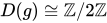
A covering space $ p: Y \to X $ is called normal, or regular, if the group of deck transformations Deck(p)\mathrm{Deck}(p) acts transitively on each fiber $ p^{-1}(x) $ for $ x \in X $.[1] This transitive action means that for any two points $ y_1, y_2 \in p^{-1}(x) $, there exists a deck transformation $ \tau \in \mathrm{Deck}(p) $ such that $ \tau(y_1) = y_2 $.[1] Equivalently, $ p $ is normal if and only if the image subgroup $ p_(\pi_1(Y, y_0)) $ is a normal subgroup of $ \pi_1(X, x_0) $, where $ x_0 = p(y_0) $, making $ Y $ the quotient of the universal cover $ \tilde{X} $ of $ X $ by the action of this normal subgroup.[1] To see why transitivity implies normality, consider that for any $ g \in \pi_1(X, x_0) $ and $ h \in p_(\pi_1(Y, y_0)) $, we must show $ g h g^{-1} \in p_(\pi_1(Y, y_0)) $. Let $ [\gamma] = g $ and $ [\alpha] = h $. Lift the path $ \gamma $ starting at $ y_0 $ to obtain its endpoint $ y_1 $. By transitivity, there exists a deck transformation $ \Delta $ such that $ \Delta(y_0) = y_1 $. Since $ p \circ \Delta = p $, this implies $ p_ \circ \Delta_* = p_* $, so deck transformations preserve the fundamental group image. Thus, the lift of $ \alpha $ starting at $ y_1 $ closes at $ y_1 $, so the lift of the conjugate loop $ \gamma \alpha \gamma^{-1} $ starting at $ y_0 $ proceeds from $ y_0 $ to $ y_1 $ via the lift of $ \gamma $, loops at $ y_1 $ via the lift of $ \alpha $ (which closes due to the deck transformation), and returns to $ y_0 $ via the lift of $ \gamma^{-1} $. This implies the conjugate is in the subgroup, so $ H = g H g^{-1} $ for all $ g $, hence $ H $ is normal.[1] In a normal covering, the deck group $ \mathrm{Deck}(p) $ is isomorphic to the quotient group $ \pi_1(X, x_0) / p_(\pi_1(Y, y_0)) $, and the action of $ \mathrm{Deck}(p) $ on $ Y $ is free and properly discontinuous.[1] Intermediate coverings between $ p: Y \to X $ and the universal cover $ \tilde{X} \to X $ correspond precisely to subgroups of $ \pi_1(X, x_0) $ that properly contain the normal subgroup $ p_(\pi_1(Y, y_0)) $, forming a lattice structure under inclusion.[1] A fundamental theorem states that regular coverings of a path-connected, locally path-connected space $ X $ are in one-to-one correspondence with normal subgroups of $ \pi_1(X, x_0) $, where the deck group acts freely and transitively on the fibers.[1] The universal covering $ \tilde{X} \to X $ is always normal, as the trivial subgroup of $ \pi_1(X, x_0) $ is normal, and $ \mathrm{Deck}(\tilde{X} \to X) \cong \pi_1(X, x_0) $ acts transitively on fibers.[1] Furthermore, if $ X $ is connected, locally path-connected, and semilocally simply connected with $ \pi_1(X) $ infinite, then the universal cover $ \tilde{X} $ is not compact.[20] Under these conditions, the universal cover $ p: \tilde{X} \to X $ exists and the group of deck transformations $ \mathrm{Aut}(\tilde{X}/X) \cong \pi_1(X) $. For any point $ x \in X $, the fiber $ p^{-1}(x) $ is in one-to-one correspondence with the elements of $ \pi_1(X) $, and thus contains infinitely many points since $ \pi_1(X) $ is infinite. The action of the fundamental group on the universal cover is properly discontinuous.[1] To see this, suppose for contradiction that the action is not properly discontinuous. Then there exists a compact set $ K \subset \tilde{X} $ such that for some $ k \in K $, infinitely many distinct deck transformations $ g_i $ satisfy $ g_i(k) \in K $. Take a neighborhood $ U $ of $ k $ such that $ \bigsqcup_{g \in \mathrm{Deck}(p)} gU $ is the even covering of $ p(U) $ (this can be done, for instance, by taking an evenly covered neighborhood around $ p(k) $ whose preimage consists of one component around each point in the orbit $ \mathrm{Deck}(p) \cdot k $). By the construction, there are infinitely many $ k_i \in U $ with $ g_i k_i \in K $, implying $ g_i k_i \in g_i U \cap K $ for infinitely many $ g_i $. Then the set $ { g_i k_i } \cap K $ is discrete (as the $ g_i U $ are disjoint), infinite, and compact (since it is closed in the compact set $ K $), which is a contradiction.[1] This implies that the fiber $ p^{-1}(x) $ is a discrete subset of $ \tilde{X} $. In a compact Hausdorff space, every infinite subset has a limit point by the Bolzano-Weierstrass property, but a discrete infinite subset has no limit points. This contradiction implies that $ \tilde{X} $ cannot be compact.[1][20] Another example is the double covering of the circle $ S^1 $ by itself given by $ p: S^1 \to S^1 $, $ p(z) = z^2 $, where $ p_*(\pi_1(S^1)) = 2\mathbb{Z} $ is normal in $ \pi_1(S^1) \cong \mathbb{Z} $, and $ \mathrm{Deck}(p) \cong \mathbb{Z}/2\mathbb{Z} $ acts transitively on each pair of antipodal points in the fibers.[1]

Classification of Coverings

Connected coverings

In algebraic topology, for a path-connected and locally path-connected topological space XX, there is a bijective correspondence between the isomorphism classes of connected covering spaces of XX (up to isomorphism not necessarily preserving basepoints) and the conjugacy classes of subgroups of the fundamental group π1(X)\pi_1(X).[1] This classification theorem provides a complete algebraic description of the connected coverings, assuming XX admits a universal covering space, which holds if XX is also semilocally simply connected.[1] The correspondence associates to each connected covering p:X~Xp: \tilde{X} \to X the conjugacy class of the subgroup p(π1(X~,x~0))p_*(\pi_1(\tilde{X}, \tilde{x}_0)) of π1(X,x0)\pi_1(X, x_0) for some choice of basepoints x~0p1(x0)\tilde{x}_0 \in p^{-1}(x_0); different choices of x~0\tilde{x}_0 yield conjugate subgroups.[1] Conversely, every conjugacy class of subgroups arises in this way from a unique connected covering up to isomorphism.[1] This bijection relies on the lifting properties of covering maps and the action of π1(X)\pi_1(X) on the universal cover of XX.[1] Given a subgroup Hπ1(X,x0)H \leq \pi_1(X, x_0), the corresponding connected covering space is constructed as the quotient X~/HX\tilde{X}/H \to X, where X~\tilde{X} is the universal covering space of XX and HH acts on X~\tilde{X} via the monodromy action induced by deck transformations.[1] This action is free and properly discontinuous, ensuring that the quotient map is a covering map with the desired subgroup image under the induced homomorphism on fundamental groups.[1] For a concrete illustration, consider the space X=S1S1X = S^1 \vee S^1, whose fundamental group is the free group F2=a,bF_2 = \langle a, b \rangle. Using Schreier's lemma, one can find a generating set for a specific subgroup HF2H \leq F_2: H=b,a2,abaH = \langle b, a^2, aba \rangle, which is free of rank 3 and has index 2 in F2F_2. This rank can be verified using the Schreier index formula, which states that for a free group of rank rr and a subgroup of finite index nn, the rank of the subgroup is n(r1)+1n(r-1) + 1. Here, with r=2r=2 and n=2n=2, the rank is 2(21)+1=32(2-1) + 1 = 3.[21][22] Since subgroups of index 2 are normal, the corresponding connected covering space X~/HX\tilde{X}/H \to X, where X~\tilde{X} is the universal covering space of XX, is a normal covering with deck group isomorphic to F2/HZ/2ZF_2/H \cong \mathbb{Z}/2\mathbb{Z}.[1] Two such coverings X~/HX\tilde{X}/H \to X and X~/KX\tilde{X}/K \to X are isomorphic if and only if the subgroups HH and KK are conjugate in π1(X)\pi_1(X).[1] The cardinality of the fiber over any point in XX equals the index [π1(X):H][\pi_1(X) : H], which is finite if HH has finite index and infinite otherwise, yielding coverings with infinitely many sheets in the latter case.[1]

Galois correspondence

In the context of a normal covering p:YXp: Y \to X, where the deck transformation group G=Deck(p)G = \mathrm{Deck}(p) acts freely and transitively on the fibers, there exists a Galois correspondence establishing a lattice isomorphism between the normal subgroups of GG and the intermediate normal coverings between YY and XX.[1] Specifically, this correspondence assigns to each normal subgroup KGK \trianglelefteq G the intermediate covering space Y/KXY/K \to X, obtained as the quotient of YY by the action of KK, which is itself a normal covering with deck group G/KG/K.[1] Conversely, every intermediate normal covering q:ZXq: Z \to X with YZY \to Z factors through the deck group of qq, yielding the corresponding normal subgroup as the kernel of the induced action.[1] This bijection preserves the lattice structure of inclusions but acts as an anti-isomorphism: if K1K2K_1 \subset K_2 are normal subgroups of GG, then the intermediate covering corresponding to K2K_2, namely Y/K2Y/K_2, is a subcover of Y/K1Y/K_1, meaning larger subgroups produce smaller intermediate spaces.[1] The analogy to Galois theory is direct, where subgroups of the Galois group correspond to fixed fields; here, each normal subgroup KK "fixes" the subcover YK={yYky=y kK}Y^K = \{ y \in Y \mid k \cdot y = y \ \forall k \in K \}, which coincides with the quotient Y/KY/K under the free action, yielding the intermediate space as the fixed locus of the subgroup action.[1] To establish this theorem, consider the universal cover Y~Y\tilde{Y} \to Y of YY, which is also a covering of XX since pp is normal, with deck group G~\tilde{G} containing GG as a normal subgroup isomorphic to π1(X)/p(π1(Y))\pi_1(X)/p_*(\pi_1(Y)).[1] For a normal subgroup KGK \trianglelefteq G, the quotient action of G/KG/K on Y~\tilde{Y} descends to define the intermediate space Z=Y~/(G~/K)XZ = \tilde{Y}/( \tilde{G}/K ) \to X, but restricting to the action on YY yields Z=Y/KZ = Y/K as the fixed subcover, ensuring normality via the transitive action of the quotient deck group.[1] The inverse map sends an intermediate normal covering YZXY \to Z \to X to the subgroup K={gGg(Z)=Z}K = \{ g \in G \mid g(Z) = Z \}, which is normal because the covering is normal, and the quotient G/KG/K acts as the deck group of ZXZ \to X.[1] This construction relies on the proper discontinuity of the group actions and the unique lifting property of coverings to ensure the quotients are indeed covering spaces.[1]

Equivalence to the category of G-sets

Let XX be a path-connected and locally path-connected topological space with basepoint xXx \in X, and let G=π1(X,x)G = \pi_1(X, x). Then there is an equivalence of categories
Cov(X)GSet, \operatorname{Cov}(X) \xrightarrow{\sim} \operatorname{GSet},
where Cov(X)\operatorname{Cov}(X) denotes the category of covering spaces of XX (with objects covering maps p:EXp: E \to X and morphisms covering maps over the identity on XX), and GSet\operatorname{GSet} denotes the category of (left) GG-sets. This equivalence is induced by the fiber functor, which sends a covering space p:EXp: E \to X to the fiber p1(x)p^{-1}(x) equipped with the monodromy action of GG (arising from lifting based paths at xx to the fiber). The inverse functor constructs a covering space from a GG-set via the associated bundle construction using the universal cover of XX. This categorical equivalence generalizes the correspondence for connected coverings, which arise precisely from the transitive GG-sets (with conjugacy classes of subgroups corresponding to stabilizers of transitive actions); arbitrary coverings, including disconnected ones, correspond to general GG-sets as coproducts of connected coverings.[1]

Equivalence with Locally Constant Sheaves

The category of covering spaces over a topological space XX is equivalent to the category of locally constant sheaves on XX, especially when XX is locally connected.[23][24] A locally constant sheaf on XX can be understood as the sheaf of sections of a covering space of XX. Specifically, given a covering space p:EXp: E \to X, the associated sheaf F\mathcal{F} is defined by F(U)\mathcal{F}(U) as the set of continuous sections s:UEs: U \to E such that ps=idUp \circ s = \mathrm{id}_U, with restriction maps by restriction of sections. This sheaf is locally constant because over suitable neighborhoods, it is isomorphic to a constant sheaf with value the fiber.[23][24] Conversely, from a locally constant sheaf F\mathcal{F} on XX, the corresponding covering space is constructed by taking EE as the disjoint union of the stalks Fx\mathcal{F}_x over xXx \in X, equipped with the coarsest topology making the maps from sections to germs continuous, and the projection p:EXp: E \to X sending a germ to its base point. This pp is a covering map, as locally the stalks are constant.[23][24] These functors are inverses, establishing the equivalence of categories. The equivalence holds for general topological spaces, but additional assumptions like path-connectedness and semilocal simple connectedness may be needed for connections to the fundamental group.[23][24]

Applications

Topological applications

Covering spaces provide a powerful tool for computing the fundamental group of a topological space. For a path-connected, locally path-connected space XX with universal covering space X~X\tilde{X} \to X, the fundamental group π1(X,x0)\pi_1(X, x_0) is isomorphic to the group of deck transformations Deck(X~X)\mathrm{Deck}(\tilde{X} \to X).[1] This isomorphism arises from the monodromy action, where elements of π1(X,x0)\pi_1(X, x_0) act on the fiber over the basepoint by lifting loops to paths in the cover, corresponding precisely to the free and transitive action of the deck group on the fibers.[1] In homology theory, covering space projections induce maps that preserve significant algebraic structure. For a finite-sheeted covering p:X~Xp: \tilde{X} \to X and coefficients in a field F\mathbb{F} whose characteristic does not divide the number of sheets, the induced map p:Hk(X;F)Hk(X~;F)p^*: H_k(X; \mathbb{F}) \to H_k(\tilde{X}; \mathbb{F}) is injective.[1] In the case of the universal cover, where the number of sheets is infinite, this injectivity holds over the rationals Q\mathbb{Q}, allowing homology groups of the base space to be understood as quotients of those of the cover under the deck group action.[1] The Seifert-van Kampen theorem, which computes the fundamental group of a space as a union of path-connected open sets via the free product amalgamated by the intersection, can be reformulated and proved using regular covering spaces. Specifically, for spaces that are semi-locally simply connected, one constructs the universal cover of the union by gluing the universal covers of the components along the cover of their intersection, yielding the desired group presentation as a consequence of the classification of coverings. This approach decomposes complex spaces using their universal covers to simplify fundamental group calculations. Covering spaces also aid in classifying manifolds up to homeomorphism by identifying them as quotients of simply connected manifolds by deck group actions. A prominent example is the lens spaces L(m;q1,,qk)L(m; q_1, \dots, q_k), which are quotients of the odd-dimensional sphere S2k+1S^{2k+1} by a free action of the cyclic group Z/mZ\mathbb{Z}/m\mathbb{Z}, realized as an mm-sheeted covering space S2k+1L(m;q1,,qk)S^{2k+1} \to L(m; q_1, \dots, q_k).[1] Distinct lens spaces with the same mm but different parameters qiq_i (coprime to mm) often have isomorphic fundamental groups Z/mZ\mathbb{Z}/m\mathbb{Z} but differ in higher homotopy or homology, illustrating how deck groups distinguish manifold topology.[1]

Geometric applications

In differential geometry, covering spaces of Riemannian manifolds inherit a natural metric structure via the pullback of the base metric along the covering map. For a Riemannian manifold (M,g)(M, g), the universal covering space M~\tilde{M} is equipped with the pulled-back metric g~=pg\tilde{g} = p^* g, where p:M~Mp: \tilde{M} \to M is the covering projection; this ensures that deck transformations act as isometries on (M~,g~)(\tilde{M}, \tilde{g}).[25] For compact surfaces of genus g2g \geq 2, the uniformization theorem implies that the universal cover is the hyperbolic plane H2\mathbb{H}^2 with its constant curvature 1-1 metric dx2+dy2y2\frac{dx^2 + dy^2}{y^2}, making the surface a quotient H2/Γ\mathbb{H}^2 / \Gamma by a Fuchsian group Γπ1(M)\Gamma \cong \pi_1(M) acting freely by isometries.[25] This geometric inheritance allows the study of global properties, such as geodesic flows and curvature, to be lifted to the simply connected cover where explicit computations are feasible.[26] For a p-sheeted covering projection p:MNp: M \to N between connected closed orientable manifolds, the topological degree deg(p)\deg(p) is ±p\pm p. The sign is positive if pp preserves orientation globally and negative if it reverses orientation. By choosing an orientation for NN and lifting it to an orientation for MM, the local degree of pp at each point in p1(y)p^{-1}(y) can be made +1, resulting in deg(p)=p\deg(p) = p. By definition, the degree is the signed sum of the local degrees over the preimages p1(y)p^{-1}(y) for a regular value yNy \in N. Since pp is a local homeomorphism between orientable manifolds, each local degree is ±1\pm 1, and connectedness of MM ensures all local degrees have the same sign. As there are exactly pp points in each fiber, deg(p)=±p\deg(p) = \pm p.[1] A key application in complex analysis arises with branched holomorphic coverings between compact Riemann surfaces, quantified by the Riemann-Hurwitz formula. For a non-constant holomorphic map f:RSf: R \to S of degree dd between compact Riemann surfaces RR and SS, the formula states
χ(R)=dχ(S)pR(vf(p)1), \chi(R) = d \cdot \chi(S) - \sum_{p \in R} (v_f(p) - 1),
where χ\chi denotes the Euler characteristic and vf(p)1v_f(p) \geq 1 is the ramification index at pp (with vf(p)>1v_f(p) > 1 at branch points); the sum (vf(p)1)\sum (v_f(p) - 1) measures the total branching.[27] Equivalently, in terms of genera gRg_R and gSg_S,
2gR2=d(2gS2)+pR(vf(p)1). 2g_R - 2 = d(2g_S - 2) + \sum_{p \in R} (v_f(p) - 1).
This relation constrains possible degrees and branching for maps between surfaces, enabling classification of low-genus covers and computations of moduli spaces.[27] Deck transformations of hyperbolic covers generate symmetries central to the theory of automorphic forms. On the universal cover H2\mathbb{H}^2 of a hyperbolic Riemann surface X=H2/ΓX = \mathbb{H}^2 / \Gamma, the deck group Γ\Gamma consists of orientation-preserving isometries, and automorphic forms are holomorphic functions f:H2Cf: \mathbb{H}^2 \to \mathbb{C} invariant under Γ\Gamma, i.e., f(γz)=f(z)f(\gamma z) = f(z) (or with automorphy factors) for γΓ\gamma \in \Gamma.[28] These forms descend to well-defined meromorphic functions on XX, facilitating the spectral analysis of the Laplacian and connections to number theory via Fuchsian groups.[28] Covering spaces extend to orbifolds, which generalize Riemann surfaces to singular quotients by finite group actions. An orbifold cover f:XYf: \mathcal{X} \to \mathcal{Y} between one-dimensional complex orbifolds (orbifold curves) is a ramified Galois map with deck group G=AutY(X)G = \mathrm{Aut}_\mathcal{Y}(\mathcal{X}), where singularities arise as cone points with cyclic stabilizers of orders pjp_j; the orbifold Euler characteristic incorporates these as χ(Y)=22gY(11/pj)\chi(\mathcal{Y}) = 2 - 2g_Y - \sum (1 - 1/p_j).[29] This framework applies to modular curves and Fermat varieties, where branched covers account for stabilizers, enabling formulas like the orbifold Chevalley-Weil theorem for decomposing representations of differential forms.[29]

References

User Avatar
No comments yet.