



Community hub
Recent from talks
Knowledge base stats:
Talk channels stats:
Members stats:
Crash test dummy
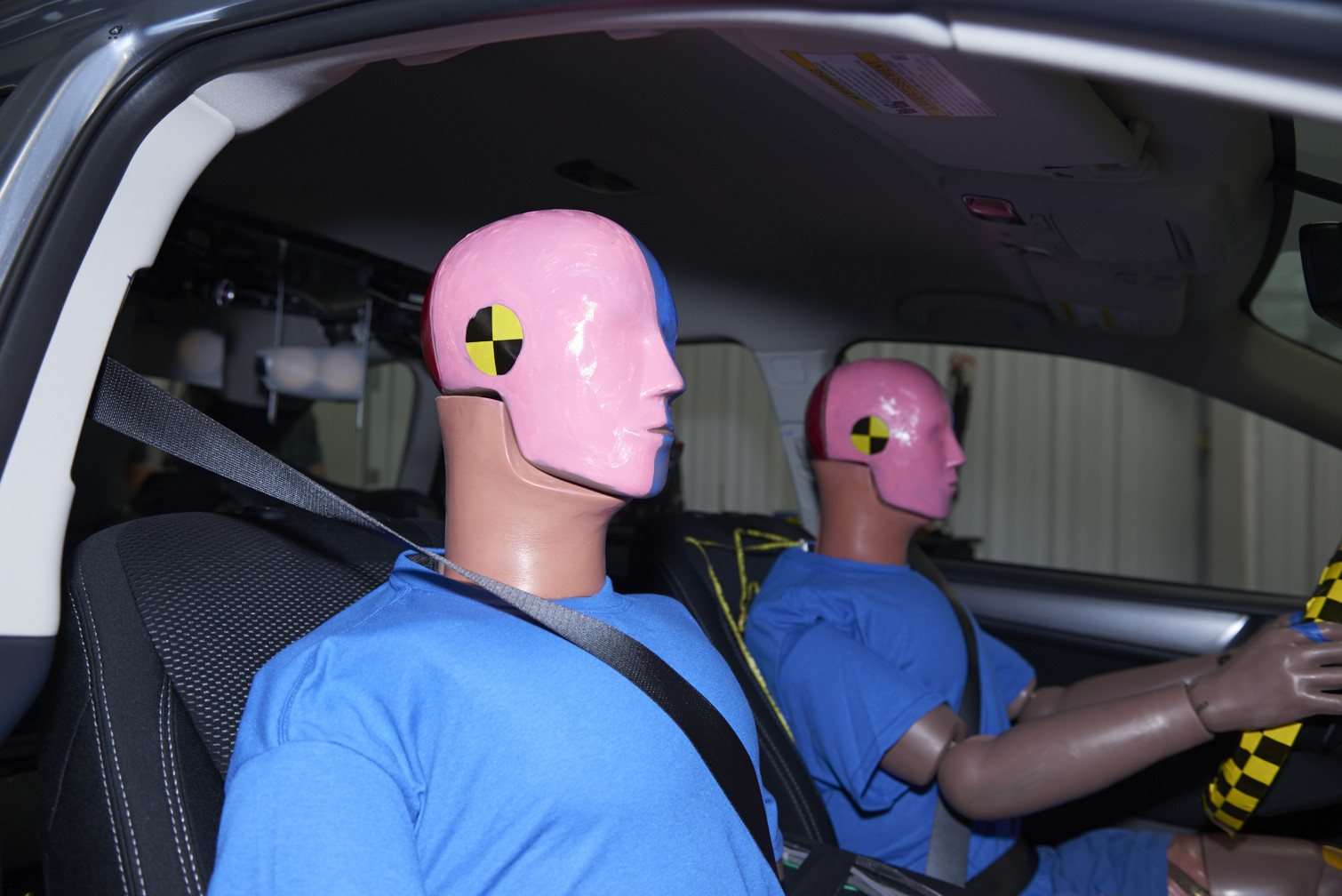
A crash test dummy, or simply dummy, is a full-scale anthropomorphic test device (ATD) that simulates the dimensions, weight proportions and articulation of the human body during a traffic collision. Dummies are used by researchers, automobile and aircraft manufacturers to predict the injuries a person might sustain in a crash. Modern dummies are usually instrumented to record data such as velocity of impact, crushing force, bending, folding, or torque of the body, and deceleration rates during a collision.
Prior to the development of crash test dummies, automobile companies tested using human cadavers, animals and live volunteers. Cadavers have been used to modify different parts of a car, such as the seatbelt. This type of testing may provide more realistic test results than using a dummy, but it raises ethical dilemmas because human cadavers and animals are not able to consent to research studies. Animal testing is not prevalent today. Computational models of the human body are increasingly being used in the industry and research to complement the use of dummies as virtual tools.
There is a constant need for new testing because each new vehicle has a different design, and as technology changes ATDs must be developed to accurately test safety and efficacy.
On August 31, 1869, Mary Ward became the first recorded victim of an automobile accident; the car involved was steam-powered (Karl Benz did not invent the gasoline-powered automobile until 1886). Ward, of Parsonstown, Ireland, was thrown out of a motor vehicle and killed. Thirty years later, on September 13, 1899, Henry Bliss became North America's first motor vehicle fatality when hit while stepping off a New York City trolley. The need for a means of analyzing and mitigating the effects of motor vehicle accidents on humans was felt soon after commercial production of automobiles began in the late 1890s, and by the 1930s, when the automobile became a common part of daily life and the number of motor vehicle deaths were rising. Death rates had surpassed 15.6 fatalities per 100 million vehicle-miles continue to climb. (Currently, according to the CDC, each year approximately 1.35 million people are killed on roadways around the world.).
In 1930 cars had dashboards of rigid metal, non-collapsible steering columns, and protruding knobs, buttons, and levers. Without seat belts, passengers in a frontal collision could be hurled against the interior of the automobile or through the windshield. The vehicle body itself was rigid, and impact forces were transmitted directly to the vehicle occupants. As late as the 1950s, car manufacturers were on public record as saying that vehicle accidents simply could not be made survivable because the forces in a crash were too great.
Detroit's Wayne State University was the first to begin serious work on collecting data on the effects of high-speed collisions on the human body. In the late 1930s there was no reliable data on how the human body responds to the sudden, violent forces acting on it in an automobile accident. Furthermore, no effective tools existed to measure such responses. Biomechanics was a field barely in its infancy. It was therefore necessary to employ two types of test subjects in order to develop initial data sets.
The first test subjects were human cadavers. They were used to obtain fundamental information about the human body's ability to withstand the crushing and tearing forces typically experienced in a high-speed accident. To such an end, steel ball bearings were dropped on skulls, and bodies were dumped down unused elevator shafts onto steel plates. Cadavers fitted with crude accelerometers were strapped into automobiles and subjected to head-on collisions and vehicle rollovers.
Albert King's 1995 Journal of Trauma article, "Humanitarian Benefits of Cadaver Research on Injury Prevention", clearly states the value in human lives saved as a result of cadaver research. King's calculations indicate that as a result of design changes implemented up to 1987, cadaver research since saved 8,500 lives annually. He notes that for every cadaver used, each year 61 people survive due to wearing seat belts, 147 live due to air bags, and 68 survive windshield impact.
Hub AI
Crash test dummy AI simulator
(@Crash test dummy_simulator)
Crash test dummy
A crash test dummy, or simply dummy, is a full-scale anthropomorphic test device (ATD) that simulates the dimensions, weight proportions and articulation of the human body during a traffic collision. Dummies are used by researchers, automobile and aircraft manufacturers to predict the injuries a person might sustain in a crash. Modern dummies are usually instrumented to record data such as velocity of impact, crushing force, bending, folding, or torque of the body, and deceleration rates during a collision.
Prior to the development of crash test dummies, automobile companies tested using human cadavers, animals and live volunteers. Cadavers have been used to modify different parts of a car, such as the seatbelt. This type of testing may provide more realistic test results than using a dummy, but it raises ethical dilemmas because human cadavers and animals are not able to consent to research studies. Animal testing is not prevalent today. Computational models of the human body are increasingly being used in the industry and research to complement the use of dummies as virtual tools.
There is a constant need for new testing because each new vehicle has a different design, and as technology changes ATDs must be developed to accurately test safety and efficacy.
On August 31, 1869, Mary Ward became the first recorded victim of an automobile accident; the car involved was steam-powered (Karl Benz did not invent the gasoline-powered automobile until 1886). Ward, of Parsonstown, Ireland, was thrown out of a motor vehicle and killed. Thirty years later, on September 13, 1899, Henry Bliss became North America's first motor vehicle fatality when hit while stepping off a New York City trolley. The need for a means of analyzing and mitigating the effects of motor vehicle accidents on humans was felt soon after commercial production of automobiles began in the late 1890s, and by the 1930s, when the automobile became a common part of daily life and the number of motor vehicle deaths were rising. Death rates had surpassed 15.6 fatalities per 100 million vehicle-miles continue to climb. (Currently, according to the CDC, each year approximately 1.35 million people are killed on roadways around the world.).
In 1930 cars had dashboards of rigid metal, non-collapsible steering columns, and protruding knobs, buttons, and levers. Without seat belts, passengers in a frontal collision could be hurled against the interior of the automobile or through the windshield. The vehicle body itself was rigid, and impact forces were transmitted directly to the vehicle occupants. As late as the 1950s, car manufacturers were on public record as saying that vehicle accidents simply could not be made survivable because the forces in a crash were too great.
Detroit's Wayne State University was the first to begin serious work on collecting data on the effects of high-speed collisions on the human body. In the late 1930s there was no reliable data on how the human body responds to the sudden, violent forces acting on it in an automobile accident. Furthermore, no effective tools existed to measure such responses. Biomechanics was a field barely in its infancy. It was therefore necessary to employ two types of test subjects in order to develop initial data sets.
The first test subjects were human cadavers. They were used to obtain fundamental information about the human body's ability to withstand the crushing and tearing forces typically experienced in a high-speed accident. To such an end, steel ball bearings were dropped on skulls, and bodies were dumped down unused elevator shafts onto steel plates. Cadavers fitted with crude accelerometers were strapped into automobiles and subjected to head-on collisions and vehicle rollovers.
Albert King's 1995 Journal of Trauma article, "Humanitarian Benefits of Cadaver Research on Injury Prevention", clearly states the value in human lives saved as a result of cadaver research. King's calculations indicate that as a result of design changes implemented up to 1987, cadaver research since saved 8,500 lives annually. He notes that for every cadaver used, each year 61 people survive due to wearing seat belts, 147 live due to air bags, and 68 survive windshield impact.