
Recent from talks
Crinoline
Knowledge base stats:
Talk channels stats:
Members stats:
Crinoline
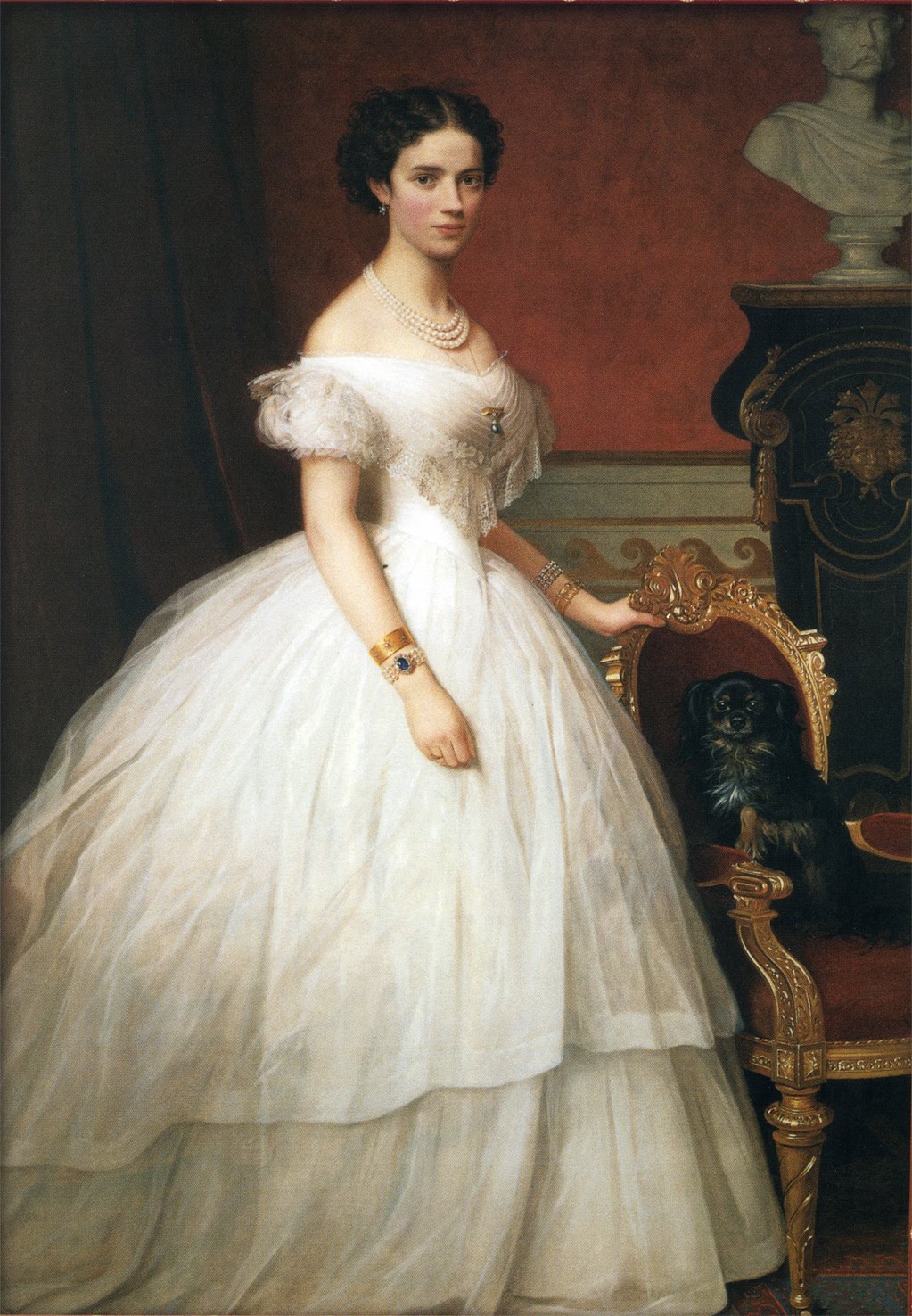
A crinoline /ˈkrɪn.əl.ɪn/ is a stiff or structured petticoat designed to hold out a skirt, popular at various times since the mid-19th century. Originally, crinoline described a stiff fabric made of horsehair ("crin") and cotton or linen which was used to make underskirts and as a dress lining. The term crin or crinoline continues to be applied to a nylon stiffening tape used for interfacing and lining hemlines in the 21st century.
By the 1850s the term crinoline was more usually applied to the fashionable silhouette provided by horsehair petticoats, and to the hoop skirts that replaced them in the mid-1850s. In form and function these hoop skirts were similar to the 16th- and 17th-century farthingale and to 18th-century panniers, in that they too enabled skirts to spread even wider and more fully.
The steel-hooped cage crinoline, first patented in April 1856 by R.C. Milliet in Paris, and by their agent in Britain a few months later, became extremely popular. Steel cage crinolines were mass-produced in huge quantity, with factories across the Western world producing tens of thousands in a year. Alternative materials, such as whalebone, cane, gutta-percha, and even inflatable caoutchouc (natural rubber) were all used for hoops, although steel was the most popular. At its widest point, the crinoline could reach a circumference of up to six yards, although by the late 1860s, crinolines were beginning to reduce in size. By the early 1870s, the smaller crinolette and the bustle had largely replaced the crinoline.
The crinoline silhouette was revived several times in the 20th century, particularly in the late 1940s as a result of Christian Dior's "New Look" of 1947. The flounced nylon and net petticoats worn in the 1950s, 1960s, and early 1970s to poof out skirts also became known as crinolines even when there were no hoops in their construction. In the mid-1980s Vivienne Westwood designed the mini-crini, a mini-length crinoline which was highly influential on 1980s fashion. Late 20th and early 21st century designers such as John Galliano and Alexander McQueen have become famous for their updated crinoline designs. Since the 1980s and well into the 21st century the crinoline has remained a popular option for formal evening dresses, wedding dresses, and ball gowns.
The name crinoline is often described as a combination of the Latin word crinis ("hair") and/or the French word crin ("horsehair"); with the Latin word linum ("thread" or "flax," which was used to make linen), describing the materials used in the original textile.
In the 21st century, the term crin is still used to describe a type of woven nylon flat braid, available in various widths and used for stiffening and providing bulk-free body to hemlines, serving the same purpose as the original crin/crinoline. Crin tape/trim is typically transparent, though it also comes in black, white, and cream colors. It is also described as horsehair braid or crinoline tape.
The crinoline was not the first garment designed to support the wearer's skirts in a fashionable shape. Whilst the bell-shaped skirts seen on statuettes from the ancient Minoan civilization are often compared to crinolines, particularly under the assumption that hoops were required to retain their shape, there is no evidence to confirm this and the theory is usually dismissed.
The crinoline's ancestors are more typically recognised as the Spanish verdugada, later known as the farthingale, widely worn in Europe from the late 15th century to the early 17th century, and the side-hoops and panniers worn throughout the 18th century.
Hub AI
Crinoline AI simulator
(@Crinoline_simulator)
Crinoline
A crinoline /ˈkrɪn.əl.ɪn/ is a stiff or structured petticoat designed to hold out a skirt, popular at various times since the mid-19th century. Originally, crinoline described a stiff fabric made of horsehair ("crin") and cotton or linen which was used to make underskirts and as a dress lining. The term crin or crinoline continues to be applied to a nylon stiffening tape used for interfacing and lining hemlines in the 21st century.
By the 1850s the term crinoline was more usually applied to the fashionable silhouette provided by horsehair petticoats, and to the hoop skirts that replaced them in the mid-1850s. In form and function these hoop skirts were similar to the 16th- and 17th-century farthingale and to 18th-century panniers, in that they too enabled skirts to spread even wider and more fully.
The steel-hooped cage crinoline, first patented in April 1856 by R.C. Milliet in Paris, and by their agent in Britain a few months later, became extremely popular. Steel cage crinolines were mass-produced in huge quantity, with factories across the Western world producing tens of thousands in a year. Alternative materials, such as whalebone, cane, gutta-percha, and even inflatable caoutchouc (natural rubber) were all used for hoops, although steel was the most popular. At its widest point, the crinoline could reach a circumference of up to six yards, although by the late 1860s, crinolines were beginning to reduce in size. By the early 1870s, the smaller crinolette and the bustle had largely replaced the crinoline.
The crinoline silhouette was revived several times in the 20th century, particularly in the late 1940s as a result of Christian Dior's "New Look" of 1947. The flounced nylon and net petticoats worn in the 1950s, 1960s, and early 1970s to poof out skirts also became known as crinolines even when there were no hoops in their construction. In the mid-1980s Vivienne Westwood designed the mini-crini, a mini-length crinoline which was highly influential on 1980s fashion. Late 20th and early 21st century designers such as John Galliano and Alexander McQueen have become famous for their updated crinoline designs. Since the 1980s and well into the 21st century the crinoline has remained a popular option for formal evening dresses, wedding dresses, and ball gowns.
The name crinoline is often described as a combination of the Latin word crinis ("hair") and/or the French word crin ("horsehair"); with the Latin word linum ("thread" or "flax," which was used to make linen), describing the materials used in the original textile.
In the 21st century, the term crin is still used to describe a type of woven nylon flat braid, available in various widths and used for stiffening and providing bulk-free body to hemlines, serving the same purpose as the original crin/crinoline. Crin tape/trim is typically transparent, though it also comes in black, white, and cream colors. It is also described as horsehair braid or crinoline tape.
The crinoline was not the first garment designed to support the wearer's skirts in a fashionable shape. Whilst the bell-shaped skirts seen on statuettes from the ancient Minoan civilization are often compared to crinolines, particularly under the assumption that hoops were required to retain their shape, there is no evidence to confirm this and the theory is usually dismissed.
The crinoline's ancestors are more typically recognised as the Spanish verdugada, later known as the farthingale, widely worn in Europe from the late 15th century to the early 17th century, and the side-hoops and panniers worn throughout the 18th century.
Recent media