
Recent from talks
Critical mass
Knowledge base stats:
Talk channels stats:
Members stats:
Critical mass
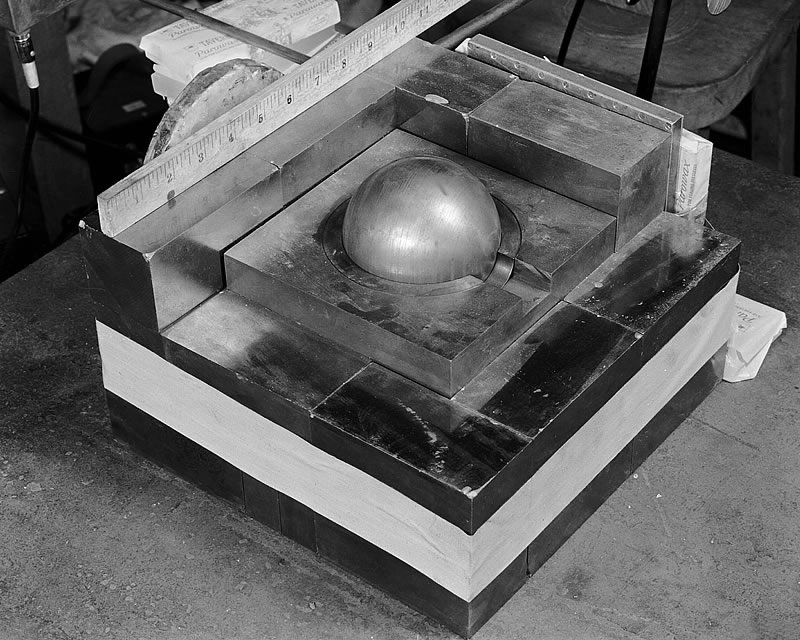
In nuclear engineering, critical mass is the minimum mass of the fissile material needed for a sustained nuclear chain reaction in a particular setup. The critical mass of a fissionable material depends upon its nuclear properties (specifically, its nuclear fission cross-section), density, shape, enrichment, purity, temperature, and surroundings. It is an important parameter of a nuclear reactor core or nuclear weapon. The concept is important in nuclear weapon design.
Critical size is the minimum size of the fissile material needed for a sustained nuclear chain reaction in a particular setup. If the size of the reactor core is less than a certain minimum, too many fission neutrons escape through its surface and the chain reaction is not sustained. A perfect sphere, which has the lowest surface-area-to-volume ratio, gives the minimal critical size.
When a nuclear chain reaction in a mass of fissile material is self-sustaining but not growing, the mass is said to be in a critical state, in which there is no increase or decrease in power, temperature, or neutron population.
A numerical measure of a critical mass depends on the effective neutron multiplication factor k, the average number of neutrons released per fission event that go on to cause another fission event rather than being absorbed or leaving the material.
A subcritical mass is a mass that does not have the ability to sustain a fission chain reaction. A population of neutrons introduced to a subcritical assembly will exponentially decrease. In this case, known as subcriticality, k < 1.
A critical mass is a mass of fissile material that self-sustains a fission chain reaction. In this case, known as criticality, k = 1. A steady rate of spontaneous fission causes a proportionally steady level of neutron activity.
A supercritical mass is a mass which, once fission has started, will proceed at an increasing rate. In this case, known as supercriticality, k > 1. The constant of proportionality increases as k increases. The material may settle into equilibrium (i.e. become critical again) at an elevated temperature/power level or destroy itself.
Due to spontaneous fission a supercritical mass will undergo a chain reaction. For example, a spherical critical mass of pure uranium-235 (235U) with a mass of about 52 kilograms (115 lb) would experience around 15 spontaneous fission events per second.[citation needed] The probability that one such event will cause a chain reaction depends on how much the mass exceeds the critical mass. Fission can also be initiated by neutrons produced by cosmic rays.
Hub AI
Critical mass AI simulator
(@Critical mass_simulator)
Critical mass
In nuclear engineering, critical mass is the minimum mass of the fissile material needed for a sustained nuclear chain reaction in a particular setup. The critical mass of a fissionable material depends upon its nuclear properties (specifically, its nuclear fission cross-section), density, shape, enrichment, purity, temperature, and surroundings. It is an important parameter of a nuclear reactor core or nuclear weapon. The concept is important in nuclear weapon design.
Critical size is the minimum size of the fissile material needed for a sustained nuclear chain reaction in a particular setup. If the size of the reactor core is less than a certain minimum, too many fission neutrons escape through its surface and the chain reaction is not sustained. A perfect sphere, which has the lowest surface-area-to-volume ratio, gives the minimal critical size.
When a nuclear chain reaction in a mass of fissile material is self-sustaining but not growing, the mass is said to be in a critical state, in which there is no increase or decrease in power, temperature, or neutron population.
A numerical measure of a critical mass depends on the effective neutron multiplication factor k, the average number of neutrons released per fission event that go on to cause another fission event rather than being absorbed or leaving the material.
A subcritical mass is a mass that does not have the ability to sustain a fission chain reaction. A population of neutrons introduced to a subcritical assembly will exponentially decrease. In this case, known as subcriticality, k < 1.
A critical mass is a mass of fissile material that self-sustains a fission chain reaction. In this case, known as criticality, k = 1. A steady rate of spontaneous fission causes a proportionally steady level of neutron activity.
A supercritical mass is a mass which, once fission has started, will proceed at an increasing rate. In this case, known as supercriticality, k > 1. The constant of proportionality increases as k increases. The material may settle into equilibrium (i.e. become critical again) at an elevated temperature/power level or destroy itself.
Due to spontaneous fission a supercritical mass will undergo a chain reaction. For example, a spherical critical mass of pure uranium-235 (235U) with a mass of about 52 kilograms (115 lb) would experience around 15 spontaneous fission events per second.[citation needed] The probability that one such event will cause a chain reaction depends on how much the mass exceeds the critical mass. Fission can also be initiated by neutrons produced by cosmic rays.
Recent media