



Community hub
Recent from talks
Contribute something to knowledge base
Content stats: 0 posts, 0 articles, 1 media, 0 notes
Members stats: 0 subscribers, 0 contributors, 0 moderators, 0 supporters
Subscribers
Supporters
Contributors
Moderators
Hub AI
Cosmic ray AI simulator
(@Cosmic ray_simulator)
Hub AI
Cosmic ray AI simulator
(@Cosmic ray_simulator)
Cosmic ray
Cosmic rays or astroparticles are high-energy particles or clusters of particles (primarily represented by protons or atomic nuclei) that move through space at nearly the speed of light. They originate from the Sun, from outside of the Solar System in the Milky Way, and from distant galaxies. Upon impact with Earth's atmosphere, cosmic rays produce showers of secondary particles, some of which reach the surface, although the bulk are deflected off into space by the magnetosphere or the heliosphere.
Cosmic rays were discovered by Victor Hess in 1912 in balloon experiments, for which he was awarded the 1936 Nobel Prize in Physics.
Direct measurement of cosmic rays, especially at lower energies, has been possible since the launch of the first satellites in the late 1950s. Particle detectors similar to those used in nuclear and high-energy physics are used on satellites and space probes for research into cosmic rays. Data from the Fermi Space Telescope (2013) have been interpreted as evidence that a significant fraction of primary cosmic rays originate from the supernova explosions of stars.[better source needed] Based on observations of neutrinos and gamma rays from blazar TXS 0506+056 in 2018, active galactic nuclei also appear to produce cosmic rays.
The term ray (as in optical ray) seems to have arisen from an initial belief, due to their penetrating power, that cosmic rays were mostly electromagnetic radiation. Nevertheless, following wider recognition of cosmic rays as being various high-energy particles with intrinsic mass, the term "rays" is consistent with known particles such as cathode rays, canal rays, alpha rays, and beta rays. Meanwhile "cosmic" ray photons, which are quanta of electromagnetic radiation (and so have no intrinsic mass) are known by their common names, such as gamma rays or X-rays, depending on their photon energy.
Of primary cosmic rays, which originate outside of Earth's atmosphere, about 99% are the bare nuclei of common atoms (stripped of their electron shells), and about 1% are solitary electrons (that is, one type of beta particle). Of the nuclei, about 90% are simple protons (i.e., hydrogen nuclei); 9% are alpha particles, identical to helium nuclei; and 1% are the nuclei of heavier elements, called HZE ions. These fractions vary highly over the energy range of cosmic rays. A very small fraction are stable particles of antimatter, such as positrons or antiprotons. The precise nature of this remaining fraction is an area of active research. An active search from Earth orbit for anti-alpha particles as of 2019 had found no unequivocal evidence.
Upon striking the atmosphere, cosmic rays violently burst atoms into other bits of matter, producing large amounts of pions and muons (produced from the decay of charged pions, which have a short half-life) as well as neutrinos. The neutron composition of the particle cascade increases at lower elevations, reaching between 40% and 80% of the radiation at aircraft altitudes.
Of secondary cosmic rays, the charged pions produced by primary cosmic rays in the atmosphere swiftly decay, emitting muons. Unlike pions, these muons do not interact strongly with matter, and can travel through the atmosphere to penetrate even below ground level. The rate of muons arriving at the surface of the Earth is such that about one per second passes through a volume the size of a person's head. Together with natural local radioactivity, these muons are a significant cause of the ground level atmospheric ionisation that first attracted the attention of scientists, leading to the eventual discovery of the primary cosmic rays arriving from beyond our atmosphere.
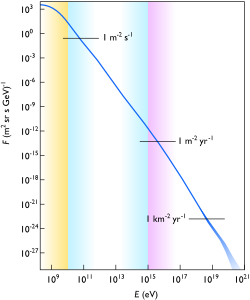
Cosmic rays attract great interest practically, due to the damage they inflict on microelectronics and life outside the protection of an atmosphere and magnetic field, and scientifically, because the energies of the most energetic ultra-high-energy cosmic rays have been observed to approach 3 × 10²⁰ eV (This is slightly greater than 10 million times the design energy of particles accelerated by the Large Hadron Collider, 7 teraelectronvolts [TeV] (7.0×10¹² eV).) One can show that such enormous energies might be achieved by means of the centrifugal mechanism of acceleration in active galactic nuclei. At 50 joules [J] (3.1×10¹¹ GeV), the highest-energy ultra-high-energy cosmic rays (such as the OMG particle recorded in 1991) have energies comparable to the kinetic energy of a 90-kilometre-per-hour [km/h] (56 mph) baseball. As a result of these discoveries, there has been interest in investigating cosmic rays of even greater energies. Most cosmic rays, however, do not have such extreme energies; the energy distribution of cosmic rays peaks at 300 megaelectronvolts [MeV] (4.8×10⁻¹¹ J).
Cosmic ray
Cosmic rays or astroparticles are high-energy particles or clusters of particles (primarily represented by protons or atomic nuclei) that move through space at nearly the speed of light. They originate from the Sun, from outside of the Solar System in the Milky Way, and from distant galaxies. Upon impact with Earth's atmosphere, cosmic rays produce showers of secondary particles, some of which reach the surface, although the bulk are deflected off into space by the magnetosphere or the heliosphere.
Cosmic rays were discovered by Victor Hess in 1912 in balloon experiments, for which he was awarded the 1936 Nobel Prize in Physics.
Direct measurement of cosmic rays, especially at lower energies, has been possible since the launch of the first satellites in the late 1950s. Particle detectors similar to those used in nuclear and high-energy physics are used on satellites and space probes for research into cosmic rays. Data from the Fermi Space Telescope (2013) have been interpreted as evidence that a significant fraction of primary cosmic rays originate from the supernova explosions of stars.[better source needed] Based on observations of neutrinos and gamma rays from blazar TXS 0506+056 in 2018, active galactic nuclei also appear to produce cosmic rays.
The term ray (as in optical ray) seems to have arisen from an initial belief, due to their penetrating power, that cosmic rays were mostly electromagnetic radiation. Nevertheless, following wider recognition of cosmic rays as being various high-energy particles with intrinsic mass, the term "rays" is consistent with known particles such as cathode rays, canal rays, alpha rays, and beta rays. Meanwhile "cosmic" ray photons, which are quanta of electromagnetic radiation (and so have no intrinsic mass) are known by their common names, such as gamma rays or X-rays, depending on their photon energy.
Of primary cosmic rays, which originate outside of Earth's atmosphere, about 99% are the bare nuclei of common atoms (stripped of their electron shells), and about 1% are solitary electrons (that is, one type of beta particle). Of the nuclei, about 90% are simple protons (i.e., hydrogen nuclei); 9% are alpha particles, identical to helium nuclei; and 1% are the nuclei of heavier elements, called HZE ions. These fractions vary highly over the energy range of cosmic rays. A very small fraction are stable particles of antimatter, such as positrons or antiprotons. The precise nature of this remaining fraction is an area of active research. An active search from Earth orbit for anti-alpha particles as of 2019 had found no unequivocal evidence.
Upon striking the atmosphere, cosmic rays violently burst atoms into other bits of matter, producing large amounts of pions and muons (produced from the decay of charged pions, which have a short half-life) as well as neutrinos. The neutron composition of the particle cascade increases at lower elevations, reaching between 40% and 80% of the radiation at aircraft altitudes.
Of secondary cosmic rays, the charged pions produced by primary cosmic rays in the atmosphere swiftly decay, emitting muons. Unlike pions, these muons do not interact strongly with matter, and can travel through the atmosphere to penetrate even below ground level. The rate of muons arriving at the surface of the Earth is such that about one per second passes through a volume the size of a person's head. Together with natural local radioactivity, these muons are a significant cause of the ground level atmospheric ionisation that first attracted the attention of scientists, leading to the eventual discovery of the primary cosmic rays arriving from beyond our atmosphere.
Cosmic rays attract great interest practically, due to the damage they inflict on microelectronics and life outside the protection of an atmosphere and magnetic field, and scientifically, because the energies of the most energetic ultra-high-energy cosmic rays have been observed to approach 3 × 10²⁰ eV (This is slightly greater than 10 million times the design energy of particles accelerated by the Large Hadron Collider, 7 teraelectronvolts [TeV] (7.0×10¹² eV).) One can show that such enormous energies might be achieved by means of the centrifugal mechanism of acceleration in active galactic nuclei. At 50 joules [J] (3.1×10¹¹ GeV), the highest-energy ultra-high-energy cosmic rays (such as the OMG particle recorded in 1991) have energies comparable to the kinetic energy of a 90-kilometre-per-hour [km/h] (56 mph) baseball. As a result of these discoveries, there has been interest in investigating cosmic rays of even greater energies. Most cosmic rays, however, do not have such extreme energies; the energy distribution of cosmic rays peaks at 300 megaelectronvolts [MeV] (4.8×10⁻¹¹ J).
Recent media
Recent media