


Community hub
Recent from talks
Contribute something
Nothing was collected or created yet.
Cro-Mags
View on Wikipedia
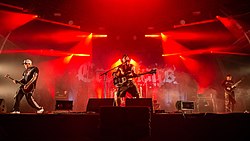
The Cro-Mags are an American hardcore punk band from New York City. They have released six studio albums. They were among the first bands to fuse hardcore punk with thrash metal. They were also a prototypical band for Krishnacore, a sub-sect of hardcore bands that adopt Krishna consciousness.[3]
Key Information


Harley Flanagan, who co-founded the Cro-Mags, reached a settlement in April 2019 with former singer John Joseph and former drummer Mackie Jayson. Under the terms of the agreement, Flanagan retained exclusive rights to the Cro-Mags name, while Joseph and Jayson would continue performing under the name Cro-Mags"JM".[4][5] Despite not being a constant member of the band, having left and rejoined on a few occasions, Flanagan is the only musician from The Age of Quarrel lineup to appear on every Cro-Mags album.
History
[edit]Early years (1980–1985)
[edit]How the Cro-Mags were formed is disputed by the band's founding members. In Tony Rettman's 2014 book NYHC: New York Hardcore 1980–1990, guitarist Parris Mayhew states that the band formed after he had put up a number of posters around New York in search of band members, to which Flanagan responded.[6] In the same book, other people involved in the New York hardcore scene suggest that the band formed under the name Mode of Ignorance, with an original lineup consisting of Dave Hahn on drums, Mayhew and Dave Stein on guitar, John Joseph on lead vocals and Flanagan on bass. During its early existence, the band went through frequent lineup changes. Mayhew explains that this was because "Harley would see some kid with a shaved head and think 'This kid is hard... let's bring him into the band.' Then I would end up tolerating some horrible, talentless person for however long it took Harley to realise that the guy had no talent". Joseph left the band soon after to live in Puerto Rico and then Hawaii,[7] and was replaced by Eric Casanova. One Cro-Mags lineup from this time consisted of Flanagan on drums, Mayhew on guitar, Todd Youth on bass and Casanova on vocals. By the time the band played their first live performance, Youth had been replaced by Roger Miret. Soon after, Casanova was kicked out of the band due to the birth of his son interfering with scheduling.[8] By this time, Joseph had returned to New York and rejoined as the band's vocalist.[7] Youth briefly rejoined the band after Miret's departure, at the same time Robb "Nunzio" Ortiz joined as an additional guitarist. A few months later, the band changed their name to the Cro-Mags.[6]
However, Flanagan claims in his 2016 autobiography Hard-Core: Life of My Own that he and Mayhew met in 1980 after being introduced by Paul Dordal, and they began writing music together soon after and formed the band with vocalist Eric Casanova, who had only performed with the band twice.[9] Following this, they would go on hiatus as Flanagan went to California then Canada, during which time he wrote and recorded demos for the songs "Everybody's Gonna Die", "Don't Tread On Me", "By Myself" and "Do Unto Others". After returning to New York in 1983, he regrouped the band and he, Mayhew and Casanova began writing again, using his demo tracks as a basis.[10]
In 2018, Flanagan claimed that he formed the Cro-Mags in 1980 with guitarist Dave Stein, drummer Dave Hahn and vocalist John Berry and that the band's first performance was at the Peppermint Lounge opening for the Stimulators the same year. He thought the band was not ready to debut using their real name, so instead performed as Disco Smoothy. After this performance, the group disbanded and in 1982–1983, Flanagan recorded four tracks in Songshop Studios in New York City with Denise Mercedes of the Stimulators, the tracks set to be released by Rat Cage Records but issues regarding management prevented the project to come to fruition. He then recruited Eric Casanova on vocals, before meeting Parris Mayhew in 1983, who then joined as guitarist, along with drummer Mackie Jayson.[1] This final story by Flanagan is mainly supported by John Joseph in his 2007 autobiography The Evolution of a Cro-Magnon, but Joseph states the band formed in 1981 and that he was the band's vocalist prior to Berry, but left prior to the Peppermint Lounge performance because he thought the name they were performing under was not serious enough.[2]
Rising popularity, lineup changes and breakup (1986–2002)
[edit]The Cro-Mags' debut album The Age of Quarrel was released in 1986, which was mostly written by Parris Mayhew and Flanagan,[11][12] some songs being based on a four track demo that Flanagan had recorded solo in 1982 while on the West Coast.[7] Joseph parted ways with the band again after The Age of Quarrel, leaving Flanagan to sing on the second Cro-Mags album, Best Wishes (1989), which had a more heavy metal-influenced sound. The next album, Alpha Omega (1992), saw the return of Joseph singing along with Flanagan. According to co-founder Parris Mayhew, he wrote most of the album with guitarist Rob Buckley. However, neither Mayhew or Buckley played on the actual recording, and the writing has been disputed by Flanagan and others[citation needed]. The Cro-Mags disbanded but later recorded the album with the return of Doug Holland and a new rhythm guitarist, Gabby Abularach.[13]
The album, Near Death Experience was released in 1993, after which the group disbanded for several years. They began touring again in the late 1990s with Flanagan on vocals and bass and Mayhew returning to the fold. Eventually, the band released Revenge in 2000. For many fans, this album signified a return to the Cro-Mags' early hardcore roots. Many songs were comparable to those on The Age of Quarrel, although some featured a more melodic/punk rock style. The release of Revenge and its subsequent tour resulted in yet another break up, which caused lasting resentment between Mayhew and Flanagan. In 2001 Flanagan asked Joseph to join him once again, but the short-lived reunion ended in 2002.
Reunion and legal battle over name ownership (2008–2019)
[edit]
In 2008, John Joseph and Jayson began playing shows under the Cro-Mags name with other established hardcore musicians such as Craig Setari from Sick of It All on bass and A.J. Novello from Leeway on guitar. In an October 2010 interview, Joseph revealed that they were planning to release a new album in 2011. This album never happened, as Joseph did not have the legal right to release music using the trademarked name Cro-Mags.
In 2018, Flanagan filed a federal trademark infringement suit against John Joseph and Mackie Jayson in the Southern District of New York. In April 2019, Flanagan announced a settlement wherein he would own exclusive rights to the name Cro-Mags; simultaneously, Joseph announced his recognition of the settlement, and that he and his band would perform as the Cro-Mags JM, having been granted a limited license to use the name in this manner, beginning in August 2019.[14][15] Later infringement by Joseph in 2022 resulted in a permanent injunction granted by the Federal District Court of the Southern District of New York. The rights to the Cro-Mags name now belong exclusively to Flanagan.
Cro-Mags today (2019–present)
[edit]On June 28, 2019, the Cro-Mags released their first new music in nineteen years, before a five-show string of performances opening for the Misfits,[16] sharing three new songs "Don't Give In", "Drag You Under", and "No One's Victim",[17] and toured in North America and Europe. The line-up consisted of Flanagan on bass and vocals, Abulurach on guitar, Rocky George on lead guitar and long time drummer Garry "G-Man" Sullivan on drums.
At the end of 2019, they released "From the Grave" featuring former Motörhead guitarist Phil Campbell on lead and slide guitar.[18] A three-song 7-inch EP of the same name was released on December 6, 2019, in various colors and have the tracks "PTSD" and "Between Wars" included. The band was set to perform with Body Count in New York City on March 15 at Webster Hall. The show was postponed due to the COVID-19 virus. The band decided to live stream a free performance from SIR studios,[19] one of the first bands to do so during the pandemic.[20] On March 31, 2020, the band offered a free download of the track, "The Final Test" and announced the June 19 release date of their first studio album in twenty years, In the Beginning.[21][22]
In July 2022, Flanagan announced that the Cro-Mags were working on new material for their next album.[23]
On September 10, 2025, Flanagan announced that drummer Pete Hines had rejoined the Cro-Mags,[24] and in the same month, the band embarked on their first East Coast U.S. tour with him in more than 35 years.[25] The band also plans to release a new album in 2026.[26] On January 14, 2026, the Cro-Mags announced that they had signed a deal with BLKIIBLK Records.[27]
Band members
[edit]Current
- Harley Flanagan – bass (1981[b]–1982, 1984–1996, 1999–2003, 2019–present), vocals (1982, 1987–1991, 1999–2002, 2019–present), drums (1982–1984), guitars (1982)
- Pete Hines – drums (1986–1989, 2025–present)
- Dom DiBenedetto – rhythm guitar (2022–present)
- Dave Sharpe – lead guitar (2023–present)
Former
- Dave Hahn – drums (1981[b])
- Dave Stein – lead guitar (1981[b]), died 2014
- John Joseph – vocals (1981,[c] 1984–1987, 1991–1999, 2002–2003, 2008–2019)
- John Berry – vocals (1981[d]), died 2016
- Parris Mayhew – rhythm guitar (1983[e]–1991, 1999–2001); lead guitar (1982–1984)
- Eric Casanova – vocals (1983[f]–1984)
- Todd Youth – bass (1982–1983, 1984), died 2018
- Roger Miret – bass (1983–1984)
- Robb "Nunzio" Ortiz – lead guitar (1984)
- Mackie Jayson – drums (1983–1986, 1996–1999, 2008–2019)
- Doug Holland – lead guitar (1985–1989, 1991–1999, 2001); rhythm guitar (1995–1999, 2001)
- Dave di Censo – drums (1989–1995)
- Rob Buckley – lead guitar (1989–1991, 1993–1995, 2001); rhythm guitar (1993–1995, 2001)
- Gabby Abularach – rhythm guitar (1991–1995, 2019–2020)
- A.J. Novello – guitars (1993–1994, 2001–2002, 2008–2019)
- Rocky George – lead guitar (1999–2001, 2002–2003, 2019–2022); rhythm guitar (2002–2003)
- Craig Setari – bass (2008–2019)
- Joe Affe – rhythm guitar (2020–2022; touring 2019, 2025)
- Garry "G-Man" Sullivan – drums (1999–2001, 2002–2003, 2019–2023)
- Hector Guzman – lead guitar (2022–2023)
- Christian Lawrence – drums (2023–2025)
At various times during the 1990s and 2000s, Flanagan and Joseph simultaneously led separate versions of the Cro-Mags with completely different lineups. The groups billed themselves as Cro-Mag Jam, Street Justice, Age of Quarrel, FVK (Fearless Vampire Killers) or Cholo-Mags.[citation needed]
Timeline

Discography
[edit]- The Age of Quarrel (1986)
- Best Wishes (1989)
- Alpha Omega (1992)
- Near Death Experience (1993)
- Revenge (2000)
- In the Beginning (2020)
See also
[edit]References
[edit]Footnotes
- ^ Flanagan states in a 2018 interview with Blabbermouth.net that the name was Disco Smoothy,[1] however John Joseph states in his 2007 autobiography that the name was the Disco Smoothies.[2]
- ^ a b c d Flanagan states in a 2018 interview with Blabbermouth.net that the band was formed in 1980,[1] however John Joseph states in his 2007 autobiography that the band was formed in 1981.[2]
- ^ Joseph states in his 2007 autobiography that he was the band's founding vocalist in 1981 prior to John Berry.[2] This is disputed by Flanagan, who claims Berry was the band's founding vocalist in 1980.[1]
- ^ Flanagan states in a 2018 interview with Blabbermouth.net that Berry was the band's founding vocalist in 1980,[1] however John Joseph states in his 2007 autobiography that Berry was the band's second vocalist in 1981.[2] Berry being a part of the band was disputed by Parris Mayhew in NYHC: New York Hardcore 1980–1990.[7]
- ^ Flanagan states in his 2016 autobiography that Mayhew was a founding member of the band in 1980.[9] However, he states in a 2018 interview with Blabbermouth.net that Mayhew did not join until 1983.[1]
- ^ Flanagan states in his 2016 autobiography that Casanova joined 1980.[9] However, he states in a 2018 interview with Blabbermouth.net that he joined in 1983.[1]
Citations
- ^ a b c d e f g "Harley Flanagan To Release 'Cro-Mag Demos' And 'Hard Core Dr. Know' EP". Blabbermouth.net. May 10, 2018.
- ^ a b c d e Joseph, John (July 2008). The Evolution of a Cro-Magnon. Punkhouse Pub Co. p. 266.
Late in the summer of '81 I started hanging out with Harley again. He spent a lot of time at 171A because he was good friends with the Bad Brains, since he shared the stage with them playing in the Stimulators. I remember Harley and Darryl would wrestle around in the studio for hours like big brothers. Darryl was an amazing bass player and Harley learned to attack his instrument the same way - with a vengeance. Right around that time is when Harley put together the first Cro-Mags line-up at 171 with him on bass, the late Dave Hahn (Bad Brains manager and former production coordinator) on drums, Dave Stein (who played in a band Even Worse) on guitar, and me on vocals. We started writing songs and we used some of Harley's solo stuff, but the project was doomed to fail since a few months later Dave H. announced he was going into drug rehab and Dave S. said he was off to college. Harley wanted to play this show at the Peppermint Lounge as a goof under the name "The Disco Smoothies," but I was way too serious about my shit and turned down his offer. Harley doesn't like to mention the actual facts because he loves to claim that I wasn't the first singer. Instead, he got this dude John Berry (who was in the Beastie Boys when they were a NYC hardcore band and prior to the addition of Adam Horovitz to the line up) to sing and they did their Disco Smoothies show. It seemed the REAL Cro-Mag line-up would be put on the back burner for a while.
- ^ "Hare Krishnacore - An introduction to the most improbable punk subculture ever". The Vinyl Factory. June 26, 2015. Retrieved November 23, 2025.
- ^ Grow, Kory (April 23, 2019). "Cro-Mags Lawsuit: Harley Flanagan Wins Band Name". Rolling Stone. Retrieved December 1, 2020.
- ^ Russell, Josh (May 30, 2018). "New York Punk Rockers Take Dispute to Court". Retrieved December 1, 2020.
- ^ a b Rettman, Tony (2015). NYHC: New York Hardcore 1980-1990. Brooklyn, NY. p. 213. ISBN 9781935950127.
{{cite book}}: CS1 maint: location missing publisher (link) - ^ a b c d Rettman, Tony (2015). NYHC : New York Hardcore 1980-1990. Brooklyn, NY. p. 211. ISBN 9781935950127.
{{cite book}}: CS1 maint: location missing publisher (link) - ^ Rettman, Tony (2015). NYHC : New York Hardcore 1980-1990. Brooklyn, NY. p. 212. ISBN 9781935950127.
{{cite book}}: CS1 maint: location missing publisher (link) - ^ a b c Flanagan, Harley; Blush, Steven (October 20, 2016). Hard-Core: Life of My Own. Feral House. p. 131. ISBN 978-1627310338.
I met Parris Mitchell Mayhew around that time, through my crazy-ass Skinhead friend Paul Dordal, back in like 1980. Paul introduced him to me as "Kevin," and that's how we all knew him when we started playing together...
As it turned out, Parris used to go to Max's and he was a huge Stimulators fan, as well as of the Bad Brains, Motörhead, Sex Pistols, and other stuff I was into. I think he was pretty excited about playing with me, 'cause he'd seen the Stimulators many times. We became friends and started talking about jamming, and planning to do a band together...
Eric Casanova joined the band. We did our first two shows with him. Eric was only like 15 when he got his girlfriend pregnant and left to try and do the right thing. That's when John Joseph joined. Those early days were the best, that's all I can say-crazy but fun. - ^ Flanagan, Harley; Blush, Steven (October 20, 2016). Hard-Core: Life of My Own. Feral House. p. 132. ISBN 978-1627310338.
When we finally started playing and writing together, there was instant chemistry. But we were having no luck finding other players. And before anything really happened with the band, I wound up heading out to Cali and then to Canada. When I came back to New York after all that madness, I really wanted to get a band going...
It was around that time I did solo recordings of "Don't Tread On Me," "Wake Up," "Dead End Kids," and "Why Don't You," which Denise helped produce...
Parris and me finally picked up where we had left off. So there we were, it was 1983. I was in full-on Skinhead mode. But this time I was serious about starting the Cro-Mags. When we started jamming, I'd already written "Do Unto Others," "Don't Tread On Me," "Everybody's Gonna Die," and "By Myself," as well as the songs that wound up on my solo recordings like "Why Don't U" "Wake Up" and "Dead End Kids." That became the template for the sound and the direction we were heading. Parris had a lot of riffs for the songs. Eric Casanova co-wrote a lot of the words that ended up on The Age of Quarrel. - ^ "Cro-Mags – The Age Of Quarrel on Discogs". Discogs. November 27, 1986. Retrieved January 24, 2022.
- ^ "This Is Hardcore Podcast Episode 30 - Parris Mayhew.. The Age of Chaos Magic". YouTube. March 19, 2021. Retrieved January 24, 2022.
- ^ "The Official Cro-Mags Website". Cro-mags.com. Archived from the original on July 8, 2011. Retrieved November 13, 2019.
- ^ "Harley Flanagan and John Joseph settle Cro-Mags lawsuit". Punknews.org. April 22, 2019. Retrieved April 23, 2019.
- ^ Kory Grow (April 23, 2019). "Cro-Mags Lawsuit: Harley Flanagan Wins Band Name". rollingstone.com. Retrieved June 12, 2020.
- ^ "The Original Misfits add shows with The Distillers, The Damned & Cro-Mags". brooklynvegan.com. May 14, 2019. Retrieved April 14, 2023.
- ^ "Hear Hardcore Heroes Cro-Mags Return With First New Songs in 20 Years". Rollingstone.com. June 28, 2019. Retrieved July 28, 2019.
- ^ "Listen To New CRO-MAGS Single 'From The Grave' Feat. MOTÖRHEAD Guitarist PHIL CAMPBELL". Blabbermouth.net. October 11, 2019. Retrieved October 11, 2019.
- ^ "Cro-Mags Corona Virus Quarantine Show - Live Stream Sunday night". Facebook. Retrieved March 13, 2020.
- ^ "musicians-reach-out-amid-coronavirus.cnn". cnn.com. March 23, 2020. Retrieved March 23, 2020.
- ^ "CRO-MAGS To Release 'In The Beginning' Album In June; New Song Available For Free Download". Blabbermouth.net. March 31, 2020. Retrieved March 31, 2020.
- ^ "CRO-MAGS – New Album In The Beginning Streaming In Full". Bravewords.com. June 19, 2020. Retrieved June 24, 2020.
- ^ "Cro-Mags - Tracking New Tunes". Metal Storm. July 27, 2022. Retrieved July 22, 2022.
- ^ "Cro-Mags Announce Return Of Drummer Pete Hines". Blabbermouth. September 10, 2025. Retrieved September 10, 2025.
- ^ "Cro-Mags - East Coast Tour Dates Confirmed". Metal Storm. August 9, 2025. Retrieved September 11, 2025.
- ^ "Cro-Mags - Reunite With Drummer Pete Hines". Metal Storm. September 11, 2025. Retrieved September 11, 2025.
- ^ "FORBIDDEN Signs Worldwide Deal With BLKIIBLK Records; CRO-MAGS, UNTO OTHERS, NUNSLAUGHTER Join Label Roster". Brave Words & Bloody Knuckles. January 14, 2026. Retrieved January 16, 2026.
External links
[edit]
- Official website
- Cro-Mags at AllMusic
- Parris Mayhew's Cro-Mags website
- Interview with Quarter-Life Crisis
- Artist: Cro-Mags – MusicBrainz

| International | |
|---|---|
| National | |
| Artists | |
Cro-Mags
View on GrokipediaHistory
Formation and early years (1980–1985)
The Cro-Mags were founded in New York City by bassist and songwriter Harley Flanagan, a teenage prodigy who had previously drummed for the punk band the Stimulators starting at age 12, an experience that heavily influenced his approach to hardcore music.[8] The band's formation date remains disputed, with some accounts placing it in 1980 and others in 1981, amid Flanagan's efforts to assemble a group drawing from the raw energy of the local punk scene.[8] Initially known as Disco Smoothy, the band held its first rehearsals in Flanagan's basement, reflecting the DIY ethos of the era's underground music community.[8] The group underwent frequent lineup changes in its nascent phase, with Flanagan as the constant member; early participants included various guitarists and vocalists as the band sought stability.[8] They made their live debut at the iconic CBGB venue in 1981, performing under the Cro-Mags name for the first time and marking their entry into Manhattan's hardcore circuit.[8] By 1983, the lineup stabilized with the addition of vocalist John Joseph, whose powerful delivery helped solidify the band's sound.[8] Flanagan's songwriting during this period was deeply shaped by his juvenile experiences in New York City's Lower East Side, including involvement in gangs, survival amid crime and poverty, and the harsh realities of urban street life, which infused the band's early material with themes of resilience and rebellion.[8]Breakthrough albums and lineup shifts (1986–1995)
The Cro-Mags marked their breakthrough with the release of their debut full-length album, The Age of Quarrel, on Profile Records in September 1986. Recorded at Eastside Studios in New York City, the album captured the band's raw energy through tracks like "We Gotta Know," "Show You No Mercy," and "We All Bleed Red," blending hardcore punk aggression with emerging crossover thrash influences that helped solidify the New York hardcore (NYHC) sound as a distinct, high-impact subgenre.[9][10][11] Following the album's success, internal tensions within the band led to the departure of vocalist John Joseph in 1987, prompting bassist Harley Flanagan to take over lead vocals while retaining his instrument duties. The group, now featuring guitarist Parris Mayhew prominently in the songwriting, signed with Profile Records for their follow-up, Best Wishes, released in April 1989. This sophomore effort incorporated faster tempos, intricate metal riffs, and a more polished production, as heard in songs like "Days of Confusion" and "Crush the Demoniac," evolving their sound toward crossover thrash while maintaining NYHC roots; the lineup included Flanagan on bass and vocals, Mayhew on rhythm guitar, Doug Holland on lead guitar, and Pete Hines on drums.[12][13][14] The release of Best Wishes coincided with key events in the band's trajectory, including a 1989 tour supporting the album and ongoing involvement in the volatile NYHC scene, where rivalries with contemporaries like Agnostic Front contributed to the era's intense interpersonal and territorial conflicts. These dynamics, emblematic of broader regional tensions in the hardcore community, underscored the Cro-Mags' position as central figures in New York's punk underbelly.[15][16][17] Joseph's return in 1991 helped stabilize the band for their third album, Alpha Omega, issued on Century Media Records in 1992, which featured a more thrash-oriented production with heavier guitar tones and solos, as evident in tracks like "See the Signs" and "Bloodline." However, escalating conflicts resulted in Mayhew's exit prior to recording, shifting the creative dynamic; the album's lineup comprised Joseph on vocals, Flanagan on bass, Gabby Abularach and Doug Holland on guitars, and Dave DiCenso on drums.[18][19][20] Lineup instability persisted into the mid-1990s, culminating in the addition of guitarist Rocky George—formerly of Suicidal Tendencies—for the band's 1993 album Near Death Experience on Century Media, marking their final release before a hiatus and reflecting further experimentation with metallic hardcore elements amid ongoing member flux.[21][22]Hiatus, reunions, and dissolution (1996–2007)
Following the release of their fourth studio album, Near Death Experience, in 1993, the Cro-Mags entered an extended hiatus marked by inactivity and internal challenges. The band, plagued by lineup instability and personal issues among key members, ceased full-group operations for much of the mid-1990s. Founding bassist and vocalist Harley Flanagan, in particular, grappled with severe substance abuse problems during this period, including heroin addiction and heavy use of methamphetamine, which exacerbated the group's fragmentation.[23] During the hiatus, band members turned to side projects and solo endeavors, reflecting the waning momentum of the New York hardcore (NYHC) scene in the 1990s, which had peaked in the previous decade but faced declining venue support and rising violence that deterred promoters.[24] Flanagan remained active in the punk world through his longstanding involvement with Murphy's Law, the hardcore band he co-founded in 1983, releasing albums like The Best of Times in 1991 and maintaining sporadic performances.[25] Other former members, such as vocalist John Joseph, pursued fitness ventures and guest appearances, while the collective relevance of NYHC bands like the Cro-Mags diminished as the genre evolved and splintered into substyles. Efforts to revive the Cro-Mags began in the late 1990s, culminating in a reformation around 1999-2000 with a lineup featuring Flanagan, guitarist Parris Mayhew, drummer Mackie Jayson, and others. This reunion produced the band's fifth studio album, Revenge, released independently on Cro-Mag Recordings in 2000, which returned to their raw crossover thrash sound with tracks emphasizing aggression and street-level themes.[26] The group toured sporadically in 2000-2001 to support the album, but persistent creative and personal disputes—stemming from earlier tensions over songwriting credits and band direction—led to another dissolution by 2002.[5] The period closed with further fragmentation, as members dispersed once more amid the NYHC scene's reduced visibility. Flanagan's ongoing personal struggles, including a 2005 arrest related to a nightclub altercation, further stalled any immediate reunion prospects and underscored the band's turbulent dynamics.[27] By 2007, the Cro-Mags had effectively dissolved again, with no full-band activity, allowing individuals to focus on separate paths while the group's legacy endured through reissues and cult following.Legal disputes and band reformation (2008–2019)
In the late 2000s, tensions between Cro-Mags co-founder Harley Flanagan and former vocalist John Joseph intensified as both sought to revive the band under the Cro-Mags name. Flanagan, who had left the group in 2000, began assembling his own lineup around 2009, registering the "Cro-Mag" trademark for merchandise that year and for recordings the following year. This move marked the start of Flanagan's efforts to reassert control, leading to competing versions of the band touring separately throughout the 2010s.[28][29] The feud escalated dramatically on July 6, 2012, when Flanagan was arrested for assaulting two members of Joseph's lineup—bassist Michael Couls and drummer William Berardo—backstage at Webster Hall in New York City during the CBGB Festival. Flanagan allegedly entered the dressing room with a hunting knife, stabbing Couls in the abdomen and biting Berardo during the altercation, which stemmed from years of bitterness over band ownership, stolen tour revenues from the 1980s, and Joseph's claim that Flanagan had reported him to the U.S. Navy in 1995. Although Couls and Berardo initially pursued civil action, criminal charges were dropped in December 2012 after the victims declined to cooperate with prosecutors. Joseph described the incident as the culmination of Flanagan's disruptive behavior, while Flanagan portrayed it as a confrontation over unauthorized use of the band's legacy.[30][31][32] Throughout the 2010s, Flanagan's iteration of the Cro-Mags featured multiple lineup changes, including collaborations with guitarist Parris Mayhew early on and later additions like drummer Max Crook and guitarist Rocky George, enabling European and U.S. tours that emphasized Flanagan's role as the band's founder and primary songwriter. These performances, such as the 2019 "Best Wishes" 30th anniversary European tour, drew strong crowds and highlighted the group's enduring influence in hardcore punk, despite the ongoing schism. Meanwhile, Joseph's version continued touring under the Cro-Mags banner, further fueling the rivalry over intellectual property and performance rights.[29][33] The disputes reached a legal climax in May 2018 when Flanagan filed a lawsuit against Joseph and other members, alleging trademark infringement and unauthorized use of the Cro-Mags name since around 2002, when Flanagan had paused touring for personal reasons. The suit claimed Joseph's group had profited without permission, violating Flanagan's trademarks. In April 2019, the parties reached a settlement, granting Flanagan exclusive rights to the Cro-Mags name effective August 1, 2019, after a three-month transition period to avoid confusion at shows. Joseph and drummer Mackie Jayson subsequently formed Cro-Mags JM (for John/Mackie), allowing them to perform select material but barring use of the original moniker. This resolution affirmed Flanagan's leadership, enabling his version to continue without competition over the band's identity.[29][34][28][35] Amid these battles, Flanagan's Cro-Mags released new material in 2019, including the single "Don't Give In," signaling a creative resurgence under his direction. The period underscored the band's fractured history but solidified Flanagan's position as the enduring steward of its legacy.[35]Recent releases and activities (2020–present)
Following the resolution of long-standing legal disputes in 2019, the Cro-Mags achieved greater stability and returned to recording with In the Beginning, their sixth studio album released on June 19, 2020. This marked the band's first full-length original material in 20 years, since Revenge in 2000, and was produced by Arthur Rizk at The Ranch in Las Vegas. The 13-track effort blended the group's signature New York hardcore aggression with metallic riffs and themes of resilience, receiving praise for revitalizing their sound.[36] The band maintained momentum through extensive touring, including a 13-date U.S. run in December 2022 that kicked off in Manchester, New Hampshire, and spanned venues across the East Coast and Midwest. In 2023, they performed over 50 shows worldwide, highlighted by festival appearances such as the Beta venue in Copenhagen, Denmark, and the Cobra Lounge in Chicago, Illinois. During this period, frontman Harley Flanagan announced that the group was actively developing new material, signaling ongoing creative activity.[37][38][39] In 2025, the Cro-Mags continued their touring schedule with support slots on Danzig's West Coast U.S. run in March, alongside Down and Abbath, covering dates from Las Vegas to Phoenix. A European summer tour was announced on July 10, featuring headline shows and festivals like Tolminator in Slovenia and DLB Festival in Italy. Later that year, on September 10, drummer Pete Hines—known for his work on the 1989 album Best Wishes—returned to the lineup, joining ahead of an East Coast U.S. tour starting September 12 in New Bedford, Massachusetts.[40][41][42][43] By May 2025, the band entered the studio to record their seventh studio album, slated for release in 2026 and again produced by Arthur Rizk. This project builds on the momentum from In the Beginning and reflects Flanagan's commitment to evolving the Cro-Mags' legacy. However, the group continues to navigate challenges in sustaining lineup consistency and engaging fans within the shifting dynamics of the punk and hardcore scenes.[44][45]Musical style and influences
Roots in New York hardcore punk
The Cro-Mags emerged from the vibrant and gritty New York hardcore punk scene of the early 1980s, particularly the Lower East Side, where urban decay and DIY ethos fueled a tight-knit community of musicians and fans. Formed in 1980 by bassist Harley Flanagan and vocalist John Joseph, the band quickly became a fixture in this environment, drawing from the raw energy of street life and squat culture that defined the neighborhood. Key venues like CBGB and Max's Kansas City served as crucibles for the scene, hosting all-ages shows that allowed young performers like the Cro-Mags to hone their aggressive style amid packed, chaotic crowds.[17][46] The band's early sound and identity were heavily influenced by pioneering hardcore acts such as Bad Brains from Washington, D.C., whose blistering speed and reggae-infused punk set a template for intensity, and Boston's SSD (Society System Decontrol), known for their metallic edge and anti-establishment fury. These influences manifested in the Cro-Mags' adoption of rapid tempos—often exceeding 300 beats per minute—and a confrontational stage presence that echoed the trailblazing ferocity of their predecessors. By channeling these elements, the Cro-Mags helped solidify New York hardcore (NYHC) as a distinct regional variant, emphasizing unity and resilience in the face of the city's hardships.[17] From their inception, the Cro-Mags incorporated Hare Krishna spiritual themes into their lyrics and ethos, reflecting the personal philosophies of founders Flanagan and Joseph. Joseph's adherence to straight-edge principles—abstaining from drugs, alcohol, and tobacco—also influenced some aspects, though not a strict band-wide commitment. Flanagan's exposure to Krishna Consciousness during his youth on the Lower East Side, combined with Joseph's deepening involvement in the movement, inspired songs addressing moral decay and self-discipline, drawing from Vedic concepts like the kali yuga era of strife. This blend of spirituality set the band apart, promoting a positive, disciplined hardcore lifestyle amid the scene's often volatile atmosphere.[17][46] The Cro-Mags played a pivotal role in fostering NYHC unity by frequently sharing bills with contemporaries like Agnostic Front and Murphy's Law at venues such as CBGB, creating a sense of camaraderie that transcended individual bands. These performances emphasized the scene's mosh pit culture, where fans engaged in intense slam-dancing and circle pits, often synchronized with the music's tempo breakdowns to channel aggression into collective release rather than random violence. Through such shared experiences, the band contributed to a subcultural bond that prioritized loyalty and mutual support in New York's unforgiving urban landscape.[17] Musically, the Cro-Mags' early work featured aggressive breakdowns—heavy, rhythmic slowdowns amid fast-paced riffs—and lyrics offering social commentary on urban violence, poverty, and the call for unity, all delivered with a raw, shouted vocal style. This approach infused their punk roots with a nascent metal aggression, distinguishing NYHC from the more dissonant, noise-driven California punk scene led by bands like Black Flag, which favored chaotic experimentation over the East Coast's structured fury and scene-oriented solidarity.[17]Development of crossover thrash elements
The Cro-Mags marked a pivotal shift toward crossover thrash with their 1989 album Best Wishes, integrating thrash metal influences through extended song structures, intricate guitar solos, and aggressive riffing reminiscent of bands like Slayer and Anthrax.[13] This evolution built on their initial New York hardcore punk roots by amplifying the intensity with melodic leads and technical drumming patterns that added depth beyond straight-ahead punk aggression.[47] The album's polished sound emphasized crunchy, galloping riffs and solos, such as those on tracks like "Death Camps," establishing a blueprint for fusing punk's raw energy with metal's precision.[13] This crossover development advanced further on Alpha Omega (1992), where the band fused punk's relentless speed with complex metal riffing and breakdowns, creating a heavier, more dynamic sonic palette. Production enhancements highlighted the instrumentation's power, allowing thrash-inspired elements like layered guitars and rhythmic tension to dominate while preserving the hardcore drive.[48] Throughout these works, the lyrics retained core spiritual and anti-violence themes drawn from Hare Krishna philosophy, now propelled by intensified heaviness to underscore messages of personal growth and non-violence amid societal chaos.[49] The Cro-Mags' innovations pioneered crossover thrash within the New York hardcore scene, influencing subsequent acts like Biohazard by demonstrating how punk velocity could merge with metal's technicality to expand the subgenre's scope.[50] Their approach helped define NYHC's tougher, groove-oriented edge, impacting the broader hardcore-metal hybrid landscape.[51] In later releases, such as the 2019 EP Don't Give In and the 2020 EP 2020, the band refined these elements by blending classic crossover aggression with contemporary production, maintaining thrash riffs and spiritual lyricism while adapting to modern hardcore sensibilities and addressing themes of global turmoil.[52] This synthesis reaffirmed their foundational role, echoing early fusions like those on Best Wishes while incorporating subtle evolutions in tempo and texture.[53][54]Band members
Current lineup
The current lineup of Cro-Mags, as of November 2025, consists of founding member Harley Flanagan on vocals and bass, who has led the band continuously since its inception in 1981 through various reformations and legal resolutions.[6] Drummer Pete Hines rejoined in September 2025, marking his return after an initial stint from 1986 to 1989, including contributions to the 1989 album Best Wishes, and enabling the band's ongoing work on a new studio album in production since 2025.[6][7] Rhythm guitarist Dominic DiBenedetto has been with the band since 2022, providing consistent support during recent U.S. and European tours led by Flanagan.[55] Lead guitarist Dave Sharpe joined in 2023, contributing to the band's high-energy live performances amid their 2025 tour schedule.[56][57] This configuration has facilitated Flanagan's direction of extensive touring, including U.S. dates announced alongside Hines' return, while advancing production on new material with producer Arthur Rizk.[6][7]Former members
The Cro-Mags experienced frequent lineup changes throughout their career, with former members leaving due to a combination of creative differences, internal band disputes, drug-related personal struggles, and legal conflicts that plagued the group across multiple eras. John Joseph served as lead vocalist from 1983 to 1987, returning for additional periods from 1989 to 1992 and 1995 to 1997. His raw, aggressive vocal delivery was instrumental in defining the band's early sound on albums like The Age of Quarrel (1986) and Best Wishes (1989). Joseph departed multiple times amid creative differences and escalating tensions with other members, including disagreements over songwriting and band direction.[58] Parris Mayhew was the rhythm guitarist and co-founder, active from 1981 to 1997 with a brief return in 2000–2001. He co-wrote key riffs for The Age of Quarrel, shaping the album's influential crossover thrash style through his heavy, riff-driven contributions. Mayhew left following the recording of Revenge (2000) due to exhausting internal conflicts, including attempts by Joseph to marginalize him and Flanagan's uncooperative attitude during production.[58] Rocky George played lead guitar from 1999 to 2003 and rejoined from 2019 to 2023, infusing the band's music with metal influences drawn from his prior work in Suicidal Tendencies. His technical guitar work added a heavier edge to Revenge during the late-1990s reunion phase and to the 2019 EP Don't Give In and subsequent tours. George exited around 2023 as the group shifted focus amid ongoing instability.[59] Mackie Jayson handled drums from 1984 to 1990, providing the propulsive, high-speed rhythms that powered The Age of Quarrel and Best Wishes. His precise and energetic playing became a hallmark of the band's live intensity during their breakthrough years. Jayson departed during a period of lineup upheaval but later engaged in legal disputes with bandmates over rights and performances.[60] Doug Holland contributed on guitar from 1985 to 1989 and again from 1991 to 1994, delivering sharp, dual-guitar interplay on Best Wishes and subsequent recordings. His role supported the band's evolution toward more metallic hardcore during turbulent transitions. Holland left amid repeated disputes and shifting personnel.[61] Garry "G-Man" Sullivan served as drummer from 2019 to 2023, contributing to the 2020 album In the Beginning and international tours, bringing versatile hardcore and punk experience from prior work with acts like the B-52's and The Exploited. He departed in 2023 to pursue other projects. Patterns of departures in the Cro-Mags often stemmed from drug issues, as founder Harley Flanagan has recounted his rampant LSD use in the 1980s, which fueled chaotic band environments and personal breakdowns. Legal troubles and bitter feuds further exacerbated splits, culminating in high-profile lawsuits among ex-members over the band's name and legacy.[5][28]Discography
Studio albums
The Cro-Mags' studio discography spans over three decades, encompassing six full-length albums that evolved from raw New York hardcore to crossover thrash with metallic influences. These releases, produced amid lineup changes and band hiatuses, showcase the group's enduring impact on the genre, with production handled primarily by band members or affiliated engineers. The debut album, The Age of Quarrel, was released on September 16, 1986, by Profile Records and features 12 tracks recorded at Songshop Studios in New York City.[9] Widely regarded as a cornerstone of New York hardcore punk, it captured the band's aggressive energy and social commentary, influencing subsequent acts in the scene through its blistering riffs and mosh-pit anthems. The album has been reissued multiple times, including a notable 2000 edition of related demo material titled Before the Quarrel on Another Planet Entertainment, which expanded its accessibility.[62] Critical reception remains overwhelmingly positive, with reviewers praising its raw intensity and role in defining crossover thrash's early sound, earning average ratings around 4.5/5 across fan databases.[10] Best Wishes, the follow-up, arrived on April 26, 1989, also via Profile Records, comprising 10 tracks mixed at Baby Monster Studios.[63] This release marked a shift toward more metallic elements, with extended song structures and guitar solos, while retaining the band's hardcore roots; it was produced by the group alongside Tom Soares.[64] The album received acclaim for its heightened energy and thematic depth on resilience and spirituality, often cited as a high point in the band's catalog with scores averaging 3.5/5 on review aggregators, though specific chart data is limited beyond indie circuit circulation.[65] In 1992, Alpha Omega emerged on Century Media Records, a 9-track effort recorded at Normandy Sound in Massachusetts and noted for its darker, heavier tone compared to prior works.[66] Initially released in limited vinyl quantities, it explored apocalyptic themes with longer compositions, including the 8-minute epic "Apocalypse Now," and featured production by bandleader Harley Flanagan.[67] Reception highlighted its experimental edge within hardcore, averaging 84% positive reviews for pushing crossover boundaries, though some critiqued its departure from the debut's immediacy.[67] The fourth album, Near Death Experience, followed on September 28, 1993, through Century Media, with 9 tracks that continued the metallic evolution while incorporating Eastern philosophical motifs.[68] Produced by Flanagan at Baby Monster Studios, it maintained the band's high-octane style but drew mixed responses for its introspective lyrics and production polish, earning average ratings of 77% and praise for tracks like "Kali Yuga" amid criticisms of uneven pacing.[69] After a seven-year hiatus, Revenge marked the band's return on January 18, 2000, self-released via Cro-Mag Recordings (distributed by GSR in some regions) and featuring 12 tracks recorded at Baby Monster Studios.[70] This comeback effort, with Flanagan handling vocals, bass, and production, revisited hardcore aggression with added thrash elements, but received mixed reviews for its rawer sound and internal band tensions, averaging 75% approval and noted as a divisive yet resilient statement.[71] The most recent studio album, In the Beginning, was issued on June 19, 2020, by Arising Empire and Mission Two Entertainment, containing 10 tracks that represented the first original material in 20 years.[72] Produced by Flanagan at Audio Playground in California, it blended classic NYHC fury with modern production, earning positive fan acclaim for its vitality and tracks like "Don't Give In," with reviewers commending the band's renewed cohesion post-legal disputes.[73]| Album | Release Year | Label | Number of Tracks |
|---|---|---|---|
| The Age of Quarrel | 1986 | Profile Records | 12 |
| Best Wishes | 1989 | Profile Records | 10 |
| Alpha Omega | 1992 | Century Media | 9 |
| Near Death Experience | 1993 | Century Media | 9 |
| Revenge | 2000 | Cro-Mag Recordings / GSR | 12 |
| In the Beginning | 2020 | Arising Empire / Mission Two Entertainment | 10 |
Extended plays and singles
The Cro-Mags' early output included several underground demos that circulated within the New York hardcore scene, laying the groundwork for their signature sound. Recorded in 1982 and 1983 at the Song Shop studio, the original demos featured Harley Flanagan handling bass, guitar, vocals, and drums, with production by Flanagan and Denise Mercedes of the Stimulators. These four tracks—"Don't Tread on Me," "Wake Up (Do Unto Others)," "Dead End Kids," and "Why Don't You"—captured raw, aggressive hardcore punk energy and were later officially released in 2018 as The Original Cro-Mags Demos 1982/83 on MVD Audio, highlighting their foundational role in the band's development.[74][75] An additional 1984 demo, featuring tracks such as "Hard Times," "World Peace," "Don't Tread on Me," and "Survival of the Streets," was recorded with Don Fury and further showcased the band's evolving crossover style, remaining a sought-after artifact among fans for its pre-debut intensity.[76] Following a period of legal disputes and hiatus, the Cro-Mags returned with the Don't Give In EP in 2019, their first new material in nearly two decades. Released on Victory Records as a limited-edition 7-inch vinyl and digital formats, the three-track EP—consisting of "Don't Give In," "In the Zone," and "No One Left to Blame"—emphasized themes of resilience and aggression, with Harley Flanagan on vocals and bass, joined by new members including guitarist Gabby De La Rosa. This release marked Flanagan's solidified control over the band name after court battles and revitalized their presence in the hardcore scene.[77][78][79] The momentum continued into 2020 with the self-titled 2020 EP, issued by Arising Empire on CD, vinyl, and digital platforms. This six-track effort—"Age of Quarantine," "2020," "Life on Earth," "Violence and Destruction," "Chaos in the Streets," and "One Blood"—reflected the global turmoil of the COVID-19 pandemic through blistering riffs and urgent lyrics, featuring guest guitar work from Rocky George (Suicidal Tendencies) on select tracks. Produced amid challenging times, it demonstrated the band's adaptability while staying true to their thrash-infused hardcore roots, achieving strong streaming reception.[80][81][82] Accompanying these EPs were standalone singles that served as previews and standalone releases. In 2020, "Don't Give In" was issued digitally as a lead single ahead of the EP, underscoring perseverance in turbulent times. Later that year, "From the Grave" emerged as a digital single, channeling raw fury with its fast-paced assault. By 2021, additional singles like "Pull Me Push Me" and "No Sympathy" followed, maintaining the band's output with concise, high-energy tracks that bridged their classic sound to contemporary hardcore audiences.[83][84]| Release | Year | Label | Format | Tracks | Notes |
|---|---|---|---|---|---|
| The Original Cro-Mags Demos 1982/83 (original recordings 1982–1983) | 2018 (official release) | MVD Audio | Vinyl, CD, Digital | 4 | Underground circulation in early 1980s; foundational NYHC blueprint.[85] |
| 1984 Demo | 1984 | Self-released (unofficial) | Cassette (circulated) | ~6–8 | Pre-Age of Quarrel recordings; key tracks like "Hard Times" influenced debut album.[86] |
| Don't Give In EP | 2019 | Victory Records | 7" Vinyl, Digital | 3 | First post-reformation material; limited numbered edition.[77] |
| 2020 EP | 2020 | Arising Empire | CD, Vinyl (incl. colored variants), Digital | 6 | Pandemic-inspired; features Rocky George on guitar.[80] |
| "Don't Give In" (single) | 2020 | Victory Records | Digital | 1 | Lead from 2019 EP; emphasizes lyrical themes of endurance.[87] |
| "From the Grave" (single) | 2020 | Arising Empire | Digital | 1 | Standalone release amid 2020 EP promotion.[84] |
| "Pull Me Push Me" (single) | 2021 | Arising Empire | Digital | 1 | Post-EP single maintaining crossover intensity.[84] |
| "No Sympathy" (single) | 2021 | Arising Empire | Digital | 1 | Highlights band's ongoing activity and fan engagement.[84] |