


Community hub
Recent from talks
Contribute something
Nothing was collected or created yet.
New York hardcore
View on Wikipedia

New York hardcore (also known as NYHC) is both the hardcore punk music created in New York City and the subculture and lifestyle associated with that music. The scene established many aspects that are fixtures of hardcore punk today, including its simplified name "hardcore", its hardcore skinhead and youth crew subcultures, the moshing style hardcore dancing, its association with street gangs and its prominent influence of heavy metal.
The scene experienced many distinct waves and deviations in style: early 1980s bands who directly outgrew the earlier punk scene including Agnostic Front, Reagan Youth and Kraut began the scene. In the mid–1980s, the Cro-Mags, Leeway and Stormtroopers of Death embraced the influence of the nascent thrash metal genre, helping to pioneer crossover thrash. In the mid-to-late 1980s, a reaction against this metal influence saw Youth of Today, Gorilla Biscuits and Bold established the youth crew subculture, which revived hardcore's punk–based roots. However, by the end of the decade, thrash metal's influence permeated the scene again establishing a new form, tough guy hardcore, played by Sick of It All, Breakdown, Madball and Killing Time. During the 1990s, the sound of New York hardcore largely diversified: Helmet, Quicksand and Life of Agony helped to establish the alternative metal genre, while Bulldoze and 25 ta Life pioneered beatdown hardcore and Merauder, All Out War and Vision of Disorder becoming prominent forces in metalcore. Furthermore Biohazard, Cro-Mags and Skarhead embracing influences from hip hop and H2O and CIV creating music indebted to pop music.
History
[edit]1980s
[edit]Origins
[edit]
The origins of New York's punk rock scene can be traced back to such sources as late 1960s trash culture and an early 1970s underground rock movement centered on the Mercer Arts Center in Greenwich Village, where the New York Dolls performed.[1] In early 1974, this early punk scene began to develop around the CBGB club, also in lower Manhattan, featuring groups and musicians like Television,[2] Richard Hell,[3] Patti Smith,[4] the Ramones,[5] the Heartbreakers[6] and Jayne County[7] The New York hardcore scene particularly grew of out of the section of this punk scene that was documented on the 1982 New York Thrash compilation, with groups like the Stimulators, the Eliminators and the Mad.[8]
After the breakup of the Eliminators, the band's bass player Vinnie Stigma formed Agnostic Front.[9] The band soon became the godfathers of New York Hardcore and one of the scene's most crucial bands.[10] Around the same time the term "hardcore" started being used instead of "punk rock". Roger Miret of Agnostic Front asserts that "We started using the term 'hardcore' because we wanted to separate ourselves from the punk scene that was happening in New York at the time ... We were rougher kids living in the streets. It had a rougher edge".[11] The scene emerged around 1981, when members of Agnostic Front, Cause for Alarm, Kraut, Murphy's Law and Antidote began to spend time together on Avenue A and performing at A7 in Manhattan.[12] Rock clubs like Max's Kansas City, the Ritz and CBGB's also quickly became crucial spots for this newly formed scene.[8][12]

Early in the decade, many bands were inspired by the British anarcho-punk scene. Beginning as a part of the larger New York hardcore scene, bands like Reagan Youth, False Prophets and Heart Attack[13] made use of a similar musical style and mentality to their British counterparts.[14] This scene split from New York hardcore as the decade progressed.[13] Nausea were a key figure in the scene during this period, helping to cultivate a new scene in the city based around politics and squatting.[15]
Crossover thrash
[edit]After the release of Metallica's 1983 debut album Kill 'Em All, New York hardcore bands began embracing elements of heavy metal music, especially thrash metal. This event caused the scene to expand, with the average attendance at shows jumping from around 100 to over 400.[16] One of the earliest New York hardcore bands to embrace heavy metal influences was NYC Mayhem.[17] In the following years, many crossover thrash bands began to form within the scene, notably Leeway, Crumbsuckers, Nuclear Assault[18] and Ludichrist.[19] New York metal bands like Anthrax and Carnivore began attending and performing at hardcore shows,[20] and many original NYHC bands became increasingly heavier and harder in sound as the metal influences grew stronger, consequently some NYHC bands who were previously skinheads started growing their hair and adopting metal looks. Agnostic Front released the crossover album Cause for Alarm in 1986, which led many in the scene to deride them as sell outs.[16] Writer Freddie Alva stated in a 2014 article that "[Cause for Alarm's] combination of heavy metal precision and hardcore energy created a landmark for the crossover sound".[18]
The Cro-Mags released the crossover album, Best Wishes in 1989, which also heavily impacted the scene. The album was cited as a major influence by much of the 1990s New York hardcore scene, particularly Biohazard, Merauder and Candiria.[20]
Youth crew
[edit]Youth crew was a movement that began in the mid-to-late 1980s as a reaction against the metal influences being embraced in New York hardcore. Youth crew bands began playing a sound that called back to earlier punk rock–leaning hardcore acts.[21] The movement was fronted by Youth of Today, who coined the name on their 1985 song "Youth Crew". Gorilla Biscuits and Bold were also prominent bands in the style.[22] Straight edge and vegetarianism were also defining features of this movement,[21] however this led to many older members of the scene rejecting the movement. Because of this, New York youth crew became an isolated entity separate from the wider hardcore scene. From within the youth crew scene, emerged bands like Sick of It All and Warzone, who did not necessarily adhere to all of its elements but would prove influential to many subsequent hardcore bands.[23] Later youth crew bands, namely Judge, began to take heavily from metal, helping to lead to the development of heavy hardcore.[21] New York youth crew began to decline in popularity and prominence following the 1988 Tompkins Square Park riot and 1990 departure of Ray Cappo from Youth of Today.[23]
Tough guy hardcore
[edit]
As the scene progressed many bands began to emerge that took significant influence from heavy metal and hip hop. Some musicians in the New York hardcore scene cultivated a "tough guy ethos" through use of aggression, criminal violence and gang mentatilites.[24]
Over time, many of these bands began to develop a unique style that was based more around rhythm and less around the influence of punk. The palm muting guitar technique was a key aspect of this sound,[24] as well as gang vocals, heavy guitar riffs and heavy breakdowns.[25] According to writer Tony Rettman, in his book NYHC (2015), Yonkers, New York band Breakdown, formed in 1987, were one of the first bands to define tough guy hardcore. The same year Judge released their debut EP New York Crew, which Crack magazine described as the record that took New York's "tough guy mentality to new heights".[26] Other bands pushing this sound at the time included Sick of It All, Sheer Terror and Killing Time.[27][28] Madball, formed in 1988, were credited by Riverfront Times as the band that defined tough guy hardcore,[29] and by Stereogum as "an archetypal tough-guy hardcore band".[30] During the 1990s, they become of the most prominent bands in New York hardcore.[31][32]
Gradually, tough guy hardcore became so ubiquitous of the New York hardcore that the style became popularly known as simply "New York hardcore".[33] Through the 1990s and 2000s, the sound was expanded upon by groups from outside of New York, including Blood for Blood, Death Before Dishonor, Terror and Trapped Under Ice. Ultimately, tough guy hardcore became a more dominant sound in the hardcore scene than its original punk-based sound, becoming what is thought of "when you say 'hardcore'".[34] It influenced the development of beatdown hardcore,[35] brutal death metal,[36] slam death metal[37] and deathcore.[38][39]
1990s
[edit]
During the 1990s, the sound of New York hardcore bands diversified, with the influence of thrash metal and death metal becoming increasingly common groups like Biohazard, Madball, Skarhead and 25 Ta Life were became influenced by hip-hop music, an influence which permeated through most of the mid to late 1990s NYHC scene.[40][41] Biohazard's merger of hip hop and tough guy hardcore, in particularly, was widely successful,[42] with their 1992 single "Punishment" gaining significant airplay on MTV. The band's 1993 collaboration with rap group Onyx on the remix of "Slam" was certified platinum[43] and the band would go on to be cited as an influence by nu metal pioneers Korn.[44]
At this time, members of New York hardcore bands began to form new bands which played alternative metal including Shelter, Quicksand,[45] Orange 9mm[46] and Helmet.[47] The Cro-Mags third album Alpha Omega (1992) saw the band lean further into their metal influence, while incorporating conventional singing and experimenting with rap metal on "Eyes Of Tomorrow".[48] Life of Agony were one of the most prominent,[49] the vinyl edition of their debut album River Runs Red (1993) peaking at number 11 on the Billboard Vinyl Albums chart.[50] In May 2005, the album inducted into the Decibel Magazine Hall of Fame; it was fourth album overall to be featured.[51] Furthermore, many New York hardcore musicians began to pursue more pop–influenced styles, including. H2O,[52] CIV and nearby Lifetime.[53] Concurrently, the scene was primarily based around the Bond Street Café on Bond Street, Manhattan. By 1993, Brownies, Coney Island High and the Wetlands Preserve became frequented venues, and CBGB recommended hosting Sunday matinees.[12]
In the mid-1990s, the New York hardcore scene expanded outward into much of the New York metropolitan area and New York state, which gave rise to Vision of Disorder, Crown of Thornz and No Redeeming Social Value.[12] Bulldoze, whose members were from both Irvington, New Jersey and New York City, pioneered the beatdown hardcore subgenre. Their 1996 album The Final Beatdown giving the style its name.[54][55] Originating from the earlier tough guy hardcore sound,[56] Bulldoze, along with Terror Zone, created the genre bu merging the sound with lyrics of gang activity and heavy breakdowns to set the template for the genre.[57] In their wake followed groups like Neglect, Confusion[58] and 25 Ta Life.[59]
New York City's Merauder released their debut album Master Killer in 1996, merging the sounds of metalcore, earlier New York hardcore and the newly emerged beatdown hardcore style. Of the album, Revolver writer Elis Enis stated "any self-proclaimed 'metallic hardcore' band of the last 25 years is indebted to Master Killer's steel-toed stomp."[60] Along with All Out War, Darkside NYC and Confusion, Merauder were a part of a wave of bands defining a newer, increasingly metallic style of hardcore in New York that had long been one of the epicentres of metalcore.[61] Long Island's Vision of Disorder were also a prevalent band in the scene, being one of the first bands to incorporate clean singing into metalcore, which would soon become a staple, as well as incorporating elements of nu metal.[62] In a 2005 article by Billboard magazine, writer Greg Pato stated that "with seemingly every local teen waving the VOD banner circa the mid/late '90s, it seemed as though it was only a matter of time before VOD would become the band to take 'metalcore' to a massive audience".[63]
Culture
[edit]Crews
[edit]New York originated "hardcore crews". Sociology academic Edgar M. Peralta defined crews as being people involved in hardcore scene who unify "based on reciprocal ties and varying interests, including non-criminal elements such as music or sports, but also including some criminal elements, which often include violence and graffiti", specifically originating as a means to oppose the white supremacist currents in their scenes.[64]
The most prominent crew in New York City is DMS (Doc Marten Skinheads) from the Lower East Side.[65] Formed in the early 1980s by Jere DMS, the crew's embrace of elements of hardcore, hip-hop, graffiti, motorcycle, skinhead and skateboarding culture, and multi-ethnic membership led to it including members who would go on to form bands including Bulldoze, Madball and Skarhead.[64]
The Sunset Skins were a New York hardcore crew established in Sunset Park, Brooklyn in 1987. Largely made up of Stateside Puerto Ricans, it included members who played in Merauder, All Out War, Direct Approach and Brute Force. It had largely disbanded by 1993, by which time the members of Merauder had joined DMS as their Brooklyn chapter.[66]
Hare Krishna
[edit]_(cropped).jpg)
Beginning with Cro-Mags and inspired by the spirituality of the Bad Brains,[67] many New York hardcore musicians are followers of the Gaudiya Vaishnavism religious organisation the International Society for Krishna Consciousness (ISKCON). Although some hardcore punk bands had already made references to Krishna Consciousness in the 1980s, the religion was most prominent through bands established in the early 1990s by the bands Shelter and 108.[68] One of the first members of its scene to adopt Krishna Consciousness was John Joseph of the Cro-Mags.[69] New York bands Antidote and Cause for Alarm were among the first that began to explore Krishna Consciousness in both their creative and personal lives,[70][71] The main influence to on many musicians to embrace ISKCON was the Washington D.C.'s hardcore band the Bad Brains which, despite being Rastas, they "grafted fervent spirituality onto an otherwise nihilistic and antitranscendental genre."[72]
Imagery
[edit]
The "New York hardcore logo" is a symbol attached to the scene which features the letters "NYHC" within the quadrants of an X shape. The symbol was created by the Abused vocalist Kevin Crowley.[73] According to Harley Flanagan, the use of the X was inspired by the crossed hammers on the logo of the English Football firm the Inter City Firm, which he witnessed when in London in the late 1970s.[74]
Since its early stages, New York hardcore has been heavily associated with hardcore skinhead culture (unrelated to neo-Nazi skinheads), gang ideology and tattoo culture as well as squatting. In the mid to late 1980s, youth crew ideology and graffiti culture started to make an impact on the scene and had a long-lasting influence on the genre. Critics and observers have also noted an inspiration and influence from gritty, urban and/or dystopian films such as Death Wish, Taxi Driver, The Warriors, and Escape from New York.[67] Historically, political stances in New York Hardcore have been varied and sometimes controversial.
Moshing
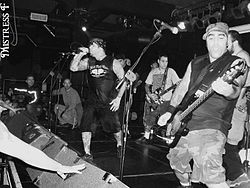
[edit]New York hardcore developed early slam dancing into what is now understood as moshing. In their distinction, participants may stay in one position on their own or collide with others, while executing a more exaggerated version of the arm and leg swinging of California slam dancing.[75]
As fans of heavy metal began to attend New York hardcore performances, they developed their own style of dancing based on New York hardcore's style of slam dancing. Beginning around 1983, metalheads began to refer to the slower sections of hardcore songs as "mosh parts", while hardcore musicians had called them "skank parts".[76] It was this group, particularly Scott Ian and Billy Milano who popularised the word "moshing".[77] Ian and Milano's band Stormtroopers of Death released their debut album Speak English or Die in 1985, which included the track "Milano Mosh". This led to the term being applied to the style of dance. The same year, moshing began to incorporate itself into live performances by heavy metal bands, with one early example being during Anthrax's 1985 set at the Ritz.[78] The term was then further popularised by Anthrax's 1987 song "Caught in a Mosh".[79]
With the popularity of tough guy hardcore came increased violence during performance.[28] To the extent that in the late-1980s, many clubs, namely CBGB began to refuse to book hardcore bands to perform, due to the increasing violence and gang behavior that was present at them. This also led many long time members of the scene to depart.[12]
Politics
[edit]Some of the mid-1980s NYHC groups were aligned with right-wing ideology and had strong stances on immigration and patriotism, all the while openly condemning racism and nazism. Similarly, leftist groups associated with the scene such as Born Against and Nausea also exist within the scene.[67] Naturally, conflict can sometimes arise between the two groups.
Sam McPheeters argues that:
What early New York Hardcore bands lacked in distinctive output, however, they more than compensated for in sheer menace. As the scene coalesced in Reagan's first term, the New York Hardcore scene—known in the shorthand of graffiti and knuckle tattoos as NYHC—injected class into the subculture in a way that no other city could. It was a world marinating in poverty and violence.[67]
See also
[edit]References
[edit]- ^ Savage 1991, pp. 86–90, 59–60.
- ^ Walker (1991), p. 662.
- ^ Savage (1992), p. 89.
- ^ "Patti Smith—Biography". Arista Records. Archived from the original on November 3, 2007. Retrieved October 23, 2007. Strongman (2008), p. 57; Savage (1991), p. 91; Pareles and Romanowski (1983), p. 511; Bockris and Bayley (1999), p. 106.
- ^ Savage 1991, pp. 90–91.
- ^ Isler, Scott; Robbins, Ira. "Richard Hell & the Voidoids". Trouser Press. Archived from the original on October 22, 2007. Retrieved October 23, 2007.
- ^ Walsh (2006), p. 27.
- ^ a b Blush, Steven (October 19, 2010). American Hardcore: A Tribal History (Second ed.). Feral House. pp. 193–194, 137, 140. ISBN 9780922915712. Retrieved February 15, 2016.
- ^ Vinnie Stigma, Drew Stone (May 3, 2020). The NYHC Chronicles Live Episode 13 (video).
- ^ "AGNOSTIC FRONT To Team Up With SICK OF IT ALL For Spring 2020 East Coast Tour". Blabbermouth.net. January 27, 2020. Retrieved June 9, 2021.
- ^ Jason Buhrmester, "Agnostic Front's Victim in Pain at 25", Village Voice, December 1, 2009.
- ^ a b c d e Stahl, Michael (August 10, 2016). "The Last Time New York Was Hardcore". Narratively. Retrieved June 11, 2021.
- ^ a b Rettman, Tony (2015). NYHC : New York Hardcore 1980-1990. Brooklyn, NY. p. 219. ISBN 9781935950127.
Steve Wishnia: At some point there was a split between what would be considered the peace punks - us, Reagan Youth, Heart Attack, No Thanks, A.P.P.L.E - and the skinhead bands like Cro-Mags and Agnostic Front.
{{cite book}}: CS1 maint: location missing publisher (link) - ^ Rettman, Tony (2015). NYHC : New York Hardcore 1980-1990. Brooklyn, NY. p. 221. ISBN 9781935950127.
Todd Youth: The whole peace-punk political thing didn't have anything to do with our world. They were all trying to be British peace-punk bands and do the Crass-type thing.
{{cite book}}: CS1 maint: location missing publisher (link) - ^ Rettman, Tony (2015). NYHC : New York Hardcore 1980-1990. Brooklyn, NY. p. 222. ISBN 9781935950127.
Nausea was definitely a catalyst in 1985 for forging an alternative to the CBGB hardcore matinees. Their brand of highly politically charged punk had antecedents in NYC with documented groups like False Prophets and Reagan Youth, and the unknown ones like Sacrilege and Counterforce. But Nausea had a connection to the squatter movement that spoke to people who felt disconnected from the NYHC scene of the day.
{{cite book}}: CS1 maint: location missing publisher (link) - ^ a b Rettman, Tony (January 8, 2015). "The Crossover Of Hardcore & Metal – An Exclusive Excerpt From NYHC: NEW YORK HARDCORE 1980–1990". Crossover Rettman. Retrieved June 9, 2021.
- ^ Ramadier, Laurent. "Cryptic Slaughter". Archived from the original on July 28, 2018. Retrieved July 28, 2018.
- ^ a b Alva, Freddy (June 2, 2014). "The Heavy Metal Roots of New York Hardcore". Retrieved June 9, 2021.
- ^ Alexandros Anesiadis, Crossover The Edge: Where Hardcore, Punk and Metal Collide, London: Cherry Red Books, 2019, p. 36.
- ^ a b The New York Hardcore Chronicles Film (Documentary). Event occurs at 43m. Retrieved June 9, 2021.
- ^ a b c Rettman, Tony (November 14, 2017). Straight Edge A Clear-Headed Hardcore Punk History.
- ^ "[Youth of Today] spearheaded the almost jock-like "Youth Crew" movement embraced by some and mocked by others in the late '80s (ever heard the phrase '88 hardcore'?). [...] YOT's no-frills music was filled with such now public-domain signifiers as gang vocals and 'heavy breakdowns' ... " Ryan J. Downey, "Youth of Today", "Blood Runs Deep: 23 Bands Who Shaped the Scene", Alternative Press #240, July 2008, p. 109.
- ^ a b The New York Hardcore Chronicles Film (Documentary). Event occurs at 1h17m. Retrieved June 9, 2021.
- ^ a b Sanneh, Kelefa (March 9, 2015). "How Hardcore Conquered New York". The New Yorker. Archived from the original on January 4, 2019. Retrieved June 7, 2021.
- ^ "5 Under the Radar Metal Bands That Are Pushing Boundaries". Radio.com. October 21, 2013. Archived from the original on March 30, 2014. Retrieved November 11, 2017.
Tough guy hardcore has been around as long as I have. An impressive act here and there have combined circle pits and gang vocals with elements of Metallica-type thrash, but none in recent years have pushed that hybrid to the brink quite like Dallas, Texas' Power Trip.
- ^ Black, Billy. "POSITIVE MENTAL ATTITUDE: 5 ESSENTIAL YOUTH CREW RECORDS". Crack. Retrieved August 24, 2023.
- ^ Rettman, Tony (2015). NYHC : New York Hardcore 1980–1990. Brooklyn, NY. pp. 294–295. ISBN 9781935950127.
Breakdown is considered one of the first "tough guy" bands to come out of New York. When Breakdown started playing, the Sick of It All demo had just come out a few months earlier. Sheer Terror was still slogging it out with demos, trying to make a name for themselves. The Krakdown demo had just come out, along with Leeway's Enforcer demo, plus Rest in Pieces and stuff like that. Some of the original NYHC bands were slowly disappearing, like Major Conflict, Reagan Youth, and Antidote. Around 1986 and 1987 a whole new wave of bands emerged that were influenced by the original New York bands but added something different.
{{cite book}}: CS1 maint: location missing publisher (link) - ^ a b Koenig, David (August 8, 2020). New York Hardcore 1986–1993. Mexico City: PPR. p. 109.
I really soured on hard New York hardcore bands. I started avoiding shows with bands like Killing Time, Burn and Sick of It All, bands that I really liked. As the tough guy sound got more and more popular in the 1990s, the violence just got worse.
- ^ Levi, Josh (August 4, 2011). "Madball". River Front Times. Archived from the original on November 13, 2017. Retrieved November 12, 2017.
- ^ BREIHAN, TOM (May 14, 2021). "The Month In Hardcore: May 2021". Stereogum. Retrieved October 10, 2024.
- ^ Andersen, Mark and Jenkins, Mark (2001). Dance of Days: Two Decades of Punk in the Nation's Capital. (New York: Soft Skull Press). ISBN 1-887128-49-2.
- ^ Blush, Steven (2001). American Hardcore: A Tribal History. (Los Angeles: Feral House). ISBN 0-922915-71-7.
- ^ VERDUCCI, RICHARD (November 17, 2010). "Freddy Cricien (Madball)". Retrieved October 10, 2024.
- ^ Ali, Reyan (November 23, 2012). "Q&A: Crime in Stereo Talk Breaking Up, Reuniting, What Cleveland Means, and the Two Types of Hardcore". Village Voice. Archived from the original on November 13, 2017. Retrieved November 12, 2017.
- ^ Heilman, Max (November 5, 2020). "6 new albums to pick up on Bandcamp Friday". Retrieved October 10, 2024.
For anyone who wishes modern tough-guy hardcore music had more to offer than suburban chest-beating, look no further than Sunami. This band brings beatdown hardcore back to its source
- ^ Lawson, Dom (December 10, 2019). "Death metal: The bluffer's guide". Metal Hammer. Retrieved October 20, 2024.
- ^ "All About Death Metal: 5 Notable Death Metal Bands". MasterClass. June 16, 2021. Retrieved August 28, 2024.
- ^ Duer, Brook (January 27, 2009). "The Acacia Strain Continent (2008)". Retrieved October 11, 2024.
- ^ John, Tracey (2004). "Despised Icon: the Heal Process". CMJ (132): 39.
Thought deathcore may cause purists to cringe, multiple listens should convince doubters that a band can find a middle ground between tough guy hardcore and destructive death metal.
- ^ Andersen, Mark and Jenkins, Mark (2001). Dance of Days: Two Decades of Punk in the Nation's Capital. (New York: Soft Skull Press). ISBN 1-887128-49-2.
- ^ Blush, Steven (2001). American Hardcore: A Tribal History. (Los Angeles: Feral House). ISBN 0-922915-71-7.
- ^ Law, Sam (July 8, 2020). "The 50 Best Albums From 1990". Kerrang!. Retrieved October 13, 2024.
- ^ Def Jam, Inc., Russell Simmons, Rick Rubin, and the Extraordinary Story of the World's Most Inf (by Stacy Gueraseva) - page 239. Random House Publishing. March 30, 2011. ISBN 978-0-307-52039-5. Retrieved September 23, 2018.
{{cite book}}:|website=ignored (help) - ^ Mashurov, NM. "The definitive oral history of Korn's "Freak On A Leash"". The Fader. Retrieved October 13, 2024.
- ^ Sacher, Andrew. "13 great songs from the current hardcore / alt-rock crossover". Retrieved October 13, 2024.
- ^ HUNTRESS, HAELA (March 17, 2024). "Orange 9mm Announce Reunion With New Lineup". MetalSucks. Retrieved October 13, 2024.
- ^ Terich, Jeff (June 23, 2024). "'Meantime': Helmet's Early 90s Heavy Rock Masterpiece". uDiscover Music. Retrieved October 13, 2024.
- ^ SUAREZ, GARY (December 7, 2011). "ALBUM OF THE DAY: CRO-MAGS, ALPHA OMEGA". MetalSucks. Retrieved October 13, 2024.
- ^ Anderson, Jason. "River Runs Red Review by Jason Anderson". AllMusic. Retrieved October 13, 2024.
- ^ "Life of Agony Chart History Vinyl Albums". Billboard. Eldridge Industries. Retrieved March 17, 2021.
- ^ Chase, Jesse (May 2005). "Life of Agony – "River Runs Red"". Decibel. Retrieved May 11, 2018.
- ^ Sacher, Andrew. "23 great punk & pop punk albums from 1997". Retrieved October 13, 2024.
- ^ Heller, Jason. "Punk turned in on itself in 1995, and out came the wolves". The A.V. Club. Retrieved October 13, 2024.
- ^ Steel, Jackson (July 13, 2016). Das Lexikon der Musikrichtungen – Was ist eigentlich Metal ?: Von Heavy Metal über Death Metal bis White Metal (in German). Neobooks.
Ein besonderes Subgenre des Metallic Hardcores oder New School Hardcores ist der "Mosh Style", überwiegend auch als "Beatdown" bezeichnet und von Gruppen wie Insurgence und Undertow vertreten. Mosh-Core zeichnet sich durch einen langsameren Tempo Beat, Groove- Orientierung und harte Breakdowns mit Tempowechseln aus, die die Menschenmenge vor der Bühne zum "Moshen" animieren sollen. Als die Begründer des Beatdown Hardcore wird häufig die New Yorker Band Bulldoze genannt. Einige moderne Beatdown-Gruppen fügen ihrer Musik mittlerweile auch Rap-Parts hinzu.
- ^ Farin, Klaus; Möller, Kurt (June 20, 2014). Kerl sein. Kulturelle Szenen und Praktiken von Jungen (in German). Hirnkost.
Als Begründer oder zumindest als Namensgeber gilt die New Yorker Hardcore-Band Bulldoze mit ihrem Song "Beatdown" von ihrem 1998 veröffentlichten Album The Final Beatdown.
- ^ Heilman, Max (November 5, 2020). "6 new albums to pick up on Bandcamp Friday". Retrieved October 10, 2024.
For anyone who wishes modern tough-guy hardcore music had more to offer than suburban chest-beating, look no further than Sunami. This band brings beatdown hardcore back to its source
- ^ Caporn, Brett. "Self-Realization: A True Lesson in Hardcore by Terror Zone [Re-release]". Retrieved August 26, 2023.
- ^ Ramirez, Carlos (June 28, 2016). "Best Beatdown Hardcore Bands". Retrieved August 26, 2023.
- ^ Sfetcu, Nicolae. American Music. p. 354.
Heavy hardcore: Throughout the following couple decades the newer style became just as predominant as its faster cousin. Prominent bands include 25 ta Life, Vision Of Disorder, 100 Demons, All Out War, Neglect, Shattered Realm, Death Threat, Next Step Up, E-Town Concrete, Hoods, Subzero, Sworn Enemy, Breakdown, Knuckledust, Mushmouth, Settle The Score, Angel Crew, and The Bad Luck 13 Riot Extravaganza who became infamous for their unpredictable and chaotic live sets.
- ^ Enis, Eli (August 16, 2021). "10 MOST INFLUENTIAL METALCORE ALBUMS OF ALL TIME". Revolver. Retrieved August 29, 2023.
- ^ Enis, Eli (July 22, 2019). "Metal And Hardcore Legends Remember All Out War's For Those Who Were Crucified". Kerrang!. Retrieved August 29, 2023.
- ^ McKenty, Finn (April 8, 2011). "LET'S TALK ABOUT VISION OF DISORDER!". MetalSucks. Retrieved August 29, 2023.
- ^ Prato, Greg. "Bloodsimple / Sept. 24, 2005 / Levittown, N.Y. (Club Voltage)". Billboard. Retrieved August 29, 2023.
- ^ a b Peralta, Edgar M. "HARDCORE CREWS: FRIENDS, CREWS OR STREET GANGS?". Retrieved August 21, 2023.
- ^ Purchla, Jeff (June 2011). "The Powers that be: Processes of Control in 'Crew Scene hardcore'". Ethnography. 12 (2): 198–223. doi:10.1177/1466138110362012. S2CID 145616134.
Actors within the field may often refer to the crew scene as 'beatdown hardcore', 'thugcore', or 'tough guy hardcore'. The third and most common of these phrases is often taken to be demeaning by those involved with the scene. By employing 'crew scene hardcore' as a descriptor, this study aims to avoid imposing what may be considered a demeaning phrase upon actors in the scene...DMS formed in the early 1980s around New York's Lower East Side as 'Doc Martin Skins', which is a reference to a type of boot popular amongst skinheads at the time. Skinheads in punk and hardcore scenes, despite popular connotation, are not a unified faction of racists. The complex racial ideology that has accompanied hardcore, especially in its early days, exceeds the limits of this paper and deserves further research. The DMS crew, as one member informed, does not adhere to racist ideology and has dropped allusions to the skinhead scene. Now the acronym is more likely to mean 'Dirty Money Syndicate', or 'Drugs Money Sex'. The FSU crew started as 'Friends Stand United', and has been also referred to as 'Fuck Shit Up', or 'Forever Society's Underdogs'. The pliability of crew names will be addressed later in the article.
- ^ Alva, Freddy (November 7, 2014). "The Sunset Skins, NYHC Crew: A Chat with Lou Morales, Minus, and Jorge Rosado". Retrieved October 13, 2024.
- ^ a b c d Sam McPheeters, "Survival of the Streets", Vice Magazine, 2010.
- ^ Abbey & Helb 2014, p. 142.
- ^ Pike 2017, p. 146-147.
- ^ Abbey & Helb 2014, p. 151.
- ^ Ambrosch 2018, p. 146.
- ^ Parker, Ben (August 26, 2015). "Age of Quarrel". n+1. Archived from the original on September 5, 2015. Retrieved February 15, 2019.
- ^ The New York Hardcore Chronicles Film (Documentary). Event occurs at 14m. Retrieved June 9, 2021.
- ^ Pennant, Cass (August 13, 2013). Congratulations You Have Just Met the ICF They Have Style, They Have Violence... The Intercity Firm Are All Your Worst Nightmares Come True. Bonnier Books UK.
It's [been] rumoured that Harley from one of America's top Hardcore bands that's an American heavy punk sound not unlike British Oi! – 'nicked' the crossed-hammers I.C.F. logo he saw on a visit to London back in the late Seventies to invent the now world-famous New York Hardcore cross. Steve Whale from The Business recently asked Harley if this was true... and he confirmed.
- ^ Tsitsos, William (October 1999). "Rules of Rebellion: Slamdancing, Moshing, and the American Alternative Scene". Popular Music. 18 (3): 405–406, 410. doi:10.1017/S0261143000008941. S2CID 159966036.
Much like slamdancing was a modification of the pogo, moshing emerged in the mid-1980s as a variation on slamdancing...
In contrast to slamdancing, moshing lacks the elements, such as circular pit motion, which promote unity in the pit. The development of moshing in New York City in the 1980s even saw the partial breakdown of the convention of picking up fallen dancers, as pit violence increased. New York City straight edge shows became legendary for their brutality...
Moshers keep their bodies more bent over and compacted, and they swing either both arms or just one (usually the right) arm around across the body in a move that one of my interviewees called 'the death swing'. This swinging of the arm(s) in moshing is far more theatrical and exaggerated than in slamdancing. If a mosher swings only one arm, the non-swinging arm is kept ready to provide some guard against collisions with other moshers. The dancers often stand in a stationary position while performing these moves, but sometimes they run into other people inside and on the edge of the pit. To do so, dancers generally just move to where there are other dancers clustered and colliding with each other and join in the collision. This run-and-collide style of moshing can be distinguished from the style of slamdancing which also involves running and colliding by the more exaggerated body movements in moshing. Moshers do not move in counter-clockwise group motion...
Compared with slamming, the fundamental body movements of moshing, such as the more violent swinging of the arms, the more violent body contact, and the lack of group motion place even greater emphasis on individual territoriality over community. Whereas the bodily motion of swinging arms and high-stepping legs has remained the traditional motion of slamdancing since it first emerged, moshing has seen the introduction of new moves such as jumping karate kicks. - ^ Christie, Ian, Sound of the Beast: The Complete Headbanging History of Heavy Metal
- ^ Blush, Steven (October 2001). American Hardcore: A Tribal History. Feral House. p. 300.
Mike Schnapp (NYHC scene): In 1985, I started hearing a new word: Moshing. It was a Metal word from Billy Milano and Scott Ian of S.O.D., and was a new term for a similar thing I knew as slamdancing in the Punk world. Some of the Metal kids showing up at the Hardcore shows didn't understand the nuances of the scene. They saw kids banging into each other and just joined in. So some of the Hardcore crew didn't like the Metal crowd at "their" shows. You took your life in your hands if you were one of the lone longhairs at a CBGB's matinee. That's when things got rough, and the violence really messed things up. People lost focus. It used to be about the bands and the music. It started one way and ended another"
- ^ Ambrose, Joe (2010). The Violent World Of Moshpit Culture. Omnibus Press.
Then," says Martin, "the metal clowns started calling them 'mosh pits', the slow parts where everybody would dance harder in hardcore songs. When I was playing in Agnostic Front and I would write a slow part or whatever, those guys would be like, Oh, that's a good skank part. And then the metal people started calling them mosh parts." The word emerged into common New York parlance around '83/'84.
Alternatively the term may have been coined by Anthrax or SOD (Stormtroopers Of Death), an Anthrax affiliated project whose 'Milano Mosh' was an influential track. New York rock publicist Trevor Silmser recalls: "What made the word popular was in '85 this group SOD put out a record and had a song called 'Milano Mosh' and that was a pretty big crossover record, basically getting tons of metal kids into hardcore." Billy Milano from SOD says that although there was a certain period during which people stopped calling it slamming and started calling it moshing, it was SOD and not Anthrax that actually started it.
Scott Ian of Anthrax, who also plays in SOD with Milano, gives the credit to the more commercial of his two bands: "The first time I saw moshing at a metal show was when Anthrax played the old Ritz in early '85 and a pit opened up. So yeah I can definitely say, as far as I know, we definitely brought it out into the world of heavy metal. Sadly I would have to take some responsibility for that. - ^ Christie, Ian, Sound of the Beast: The Complete Headbanging History of Heavy Metal
External links
[edit]- Spiritribe webzine interviews and photos
New York hardcore
View on GrokipediaNew York hardcore (NYHC) is a subgenre of hardcore punk that originated in New York City in the early 1980s, evolving from the city's punk rock foundations into a faster, heavier sound with metallic guitar riffs, rhythmic breakdowns, and gang shouts addressing urban survival and defiance.[1][2]
The scene coalesced around all-ages matinee shows at venues like CBGB and the Anthrax (A7), where bands such as Agnostic Front, Cro-Mags, and Murphy's Law pioneered a tough, working-class ethos that prized physical intensity through mosh pits and stage dives, often amid a backdrop of street violence and territorial crew dynamics.[3][1][4]
Influenced by Washington, D.C.'s straight edge movement, New York acts like Youth of Today integrated sobriety and personal discipline into the subculture, countering the excesses of earlier punk while amplifying themes of self-reliance and anti-drug stances, though the scene's raw aggression also fueled criticisms of machismo and infighting.[3][2][1]
NYHC's defining records, including Agnostic Front's Victim in Pain (1984) and Cro-Mags' The Age of Quarrel (1986), achieved lasting impact by blending punk fury with thrash metal elements, spawning offshoots like metallic hardcore and influencing global punk variants through tours and DIY ethics.[4][1]