
Recent from talks
Crocodile farm
Knowledge base stats:
Talk channels stats:
Members stats:
Crocodile farm
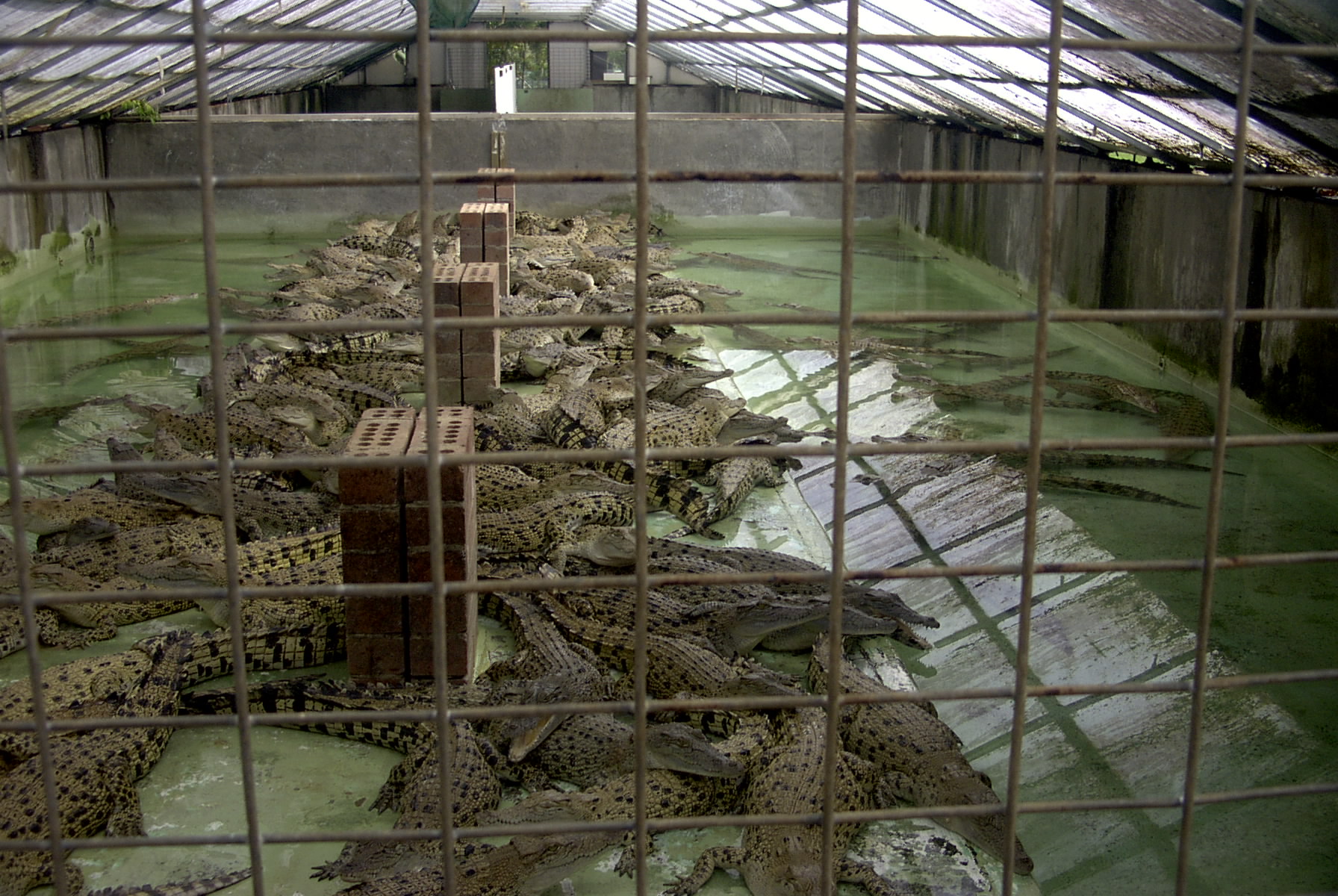
A crocodile farm or alligator farm is an establishment for breeding and raising of crocodilians in order to produce crocodile and alligator meat, leather from crocodile and alligator skin, and other goods. Many species of both alligators and crocodiles are farmed internationally. In Louisiana alone, alligator farming is a $60 to $70 million industry. Most crocodile farms are located in Thailand. Around 1.33-1.5 million crocodiles were slaughtered from 2007 to 2010 in crocodile farms.
Alligators and crocodiles are not truly domesticated and their being bred in farms probably began as late as the early 20th century. Most of the early businesses, such as St. Augustine Alligator Farm Zoological Park, established in 1893, were farms in name only, primarily keeping alligators and crocodiles as a tourist attraction. Only in the 1960s did commercial operations that either harvested eggs from the wild or bred alligators on-site begin to appear. This was largely driven by diminishing stocks of wild alligators, which had been hunted nearly to extinction by that time.
As the American alligator was placed under official protection in 1967 (under a law preceding the 1973 Endangered Species Act), farming alligators for skins became the most viable option for producing leather. Mostly concentrated in the Southern U.S. states of Louisiana, Florida, and Georgia, the practice quickly spread to other nations. Both the American and Chinese alligator are farmed intensively today, mostly within each species' respective native region. The Nile crocodile is found in ranches all over Africa, and the saltwater crocodile is farmed in Australia and other areas. The smaller caimans are generally not of enough market value to farm, though captive breeding of the spectacled caiman does take place in South America.
Farming alligators and crocodiles first grew out of the demand for skins, which can fetch hundreds of dollars each. But alligator and crocodile meat, long a part of Southern cooking (especially Cajun cuisine) and some Asian and African cuisines, began to be sold and shipped to markets unfamiliar with crocodilian meat. Chinese cuisine based on traditional Chinese medicine considers the meat to be a curative food for colds and cancer prevention, although there is no scientific evidence to support this. Crocodile meat was eaten, albeit rarely and as an exotic dish, in Vietnamese cuisine, but it was taboo and off limits for Chinese. In Vietnam, skinning is performed on still living crocodiles.
A common misconception[among whom?] is that crocodilians are an easy source of revenue and not difficult to care for in captivity; however, few crocodilian businesses are successful in the developing world. To offset overhead costs and have a regular source of income, crocodilian facilities can add tourism; in this way alligator farming can assist native species and provide people with work.
Alligator farming has minimal adverse effects on the environment, and has at least two positive direct effects on alligator conservation. Because the luxury goods industry has a reliable stream of product, illegal poaching is reduced. Juvenile crocodilians can also be released into the wild to support a steady population. Wild alligator conservation has also benefited indirectly from farming. Ranching businesses protect alligator habitats to take care of nesting sites. The fiscal incentive to keep a healthy environment for breeding alligators means that the environment and its wildlife are seen as an economic resource. This can augment the government's willingness to take care of crocodilian populations.
Animals other than crocodilians may benefit from a similar application of sustainable and ethical farming.
Ranching, wild harvesting, and captive breeding are the three ways to obtain crocodilians recognized by the Convention on International Trade in Endangered Species (CITES) and the Crocodile Specialist Group (CSG). Alligators can be raised in captivity on farms or on ranches. Alligator farms breed alligators, whereas ranches incubate and rear hatchlings collected from the wild. Farms do collect eggs from the wild but they also keep breeding adults in their facilities to produce their own eggs whereas ranches do not. Farming and ranching operations typically return a certain percentage of juveniles to the wild at a size associated with a high survival rate, an approach that increases overall alligator survival rates from the low numbers of successful eggs and juveniles usually observed in the wild.
Hub AI
Crocodile farm AI simulator
(@Crocodile farm_simulator)
Crocodile farm
A crocodile farm or alligator farm is an establishment for breeding and raising of crocodilians in order to produce crocodile and alligator meat, leather from crocodile and alligator skin, and other goods. Many species of both alligators and crocodiles are farmed internationally. In Louisiana alone, alligator farming is a $60 to $70 million industry. Most crocodile farms are located in Thailand. Around 1.33-1.5 million crocodiles were slaughtered from 2007 to 2010 in crocodile farms.
Alligators and crocodiles are not truly domesticated and their being bred in farms probably began as late as the early 20th century. Most of the early businesses, such as St. Augustine Alligator Farm Zoological Park, established in 1893, were farms in name only, primarily keeping alligators and crocodiles as a tourist attraction. Only in the 1960s did commercial operations that either harvested eggs from the wild or bred alligators on-site begin to appear. This was largely driven by diminishing stocks of wild alligators, which had been hunted nearly to extinction by that time.
As the American alligator was placed under official protection in 1967 (under a law preceding the 1973 Endangered Species Act), farming alligators for skins became the most viable option for producing leather. Mostly concentrated in the Southern U.S. states of Louisiana, Florida, and Georgia, the practice quickly spread to other nations. Both the American and Chinese alligator are farmed intensively today, mostly within each species' respective native region. The Nile crocodile is found in ranches all over Africa, and the saltwater crocodile is farmed in Australia and other areas. The smaller caimans are generally not of enough market value to farm, though captive breeding of the spectacled caiman does take place in South America.
Farming alligators and crocodiles first grew out of the demand for skins, which can fetch hundreds of dollars each. But alligator and crocodile meat, long a part of Southern cooking (especially Cajun cuisine) and some Asian and African cuisines, began to be sold and shipped to markets unfamiliar with crocodilian meat. Chinese cuisine based on traditional Chinese medicine considers the meat to be a curative food for colds and cancer prevention, although there is no scientific evidence to support this. Crocodile meat was eaten, albeit rarely and as an exotic dish, in Vietnamese cuisine, but it was taboo and off limits for Chinese. In Vietnam, skinning is performed on still living crocodiles.
A common misconception[among whom?] is that crocodilians are an easy source of revenue and not difficult to care for in captivity; however, few crocodilian businesses are successful in the developing world. To offset overhead costs and have a regular source of income, crocodilian facilities can add tourism; in this way alligator farming can assist native species and provide people with work.
Alligator farming has minimal adverse effects on the environment, and has at least two positive direct effects on alligator conservation. Because the luxury goods industry has a reliable stream of product, illegal poaching is reduced. Juvenile crocodilians can also be released into the wild to support a steady population. Wild alligator conservation has also benefited indirectly from farming. Ranching businesses protect alligator habitats to take care of nesting sites. The fiscal incentive to keep a healthy environment for breeding alligators means that the environment and its wildlife are seen as an economic resource. This can augment the government's willingness to take care of crocodilian populations.
Animals other than crocodilians may benefit from a similar application of sustainable and ethical farming.
Ranching, wild harvesting, and captive breeding are the three ways to obtain crocodilians recognized by the Convention on International Trade in Endangered Species (CITES) and the Crocodile Specialist Group (CSG). Alligators can be raised in captivity on farms or on ranches. Alligator farms breed alligators, whereas ranches incubate and rear hatchlings collected from the wild. Farms do collect eggs from the wild but they also keep breeding adults in their facilities to produce their own eggs whereas ranches do not. Farming and ranching operations typically return a certain percentage of juveniles to the wild at a size associated with a high survival rate, an approach that increases overall alligator survival rates from the low numbers of successful eggs and juveniles usually observed in the wild.
Recent media