



Community hub
Recent from talks
Knowledge base stats:
Talk channels stats:
Members stats:
Cross country running
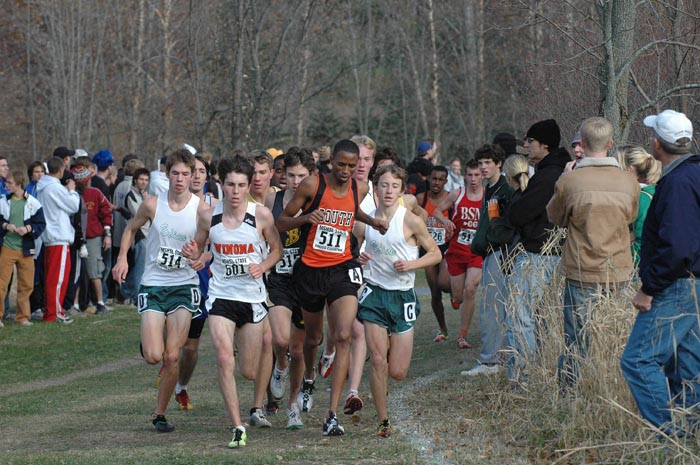
Cross country running is a sport in which teams and individuals run a race on open-air courses over natural terrain such as dirt or grass. The course, typically 3–12 kilometres (1.9–7.5 mi) long, may include surfaces of grass and earth, pass through woodlands and open country, and include hills, flat ground and sometimes gravel road and minor obstacles. It is both an individual and a team sport; runners are judged on individual times and teams by a points-scoring method. Both men and women of all ages compete in cross country, which usually takes place during autumn and winter, and can include weather conditions of rain, sleet, snow or hail, and a wide range of temperatures. Cross country running teams often have the word Harriers in their names.
Cross country running is one of the disciplines under the umbrella sport of athletics and is a natural-terrain version of long-distance track and road running. Although open-air running competitions are prehistoric, the rules and traditions of cross country racing emerged in Britain. The English championship became the first national competition in 1876, and the International Cross Country Championships was held for the first time in 1903. Since 1973, the foremost elite competition has been the World Athletics Cross Country Championships.
The highest level circuit of professional cross country competition is the World Athletics Cross Country Tour Gold level, administered by World Athletics since 2021.
While a course may include natural or artificial obstacles, cross country courses support continuous running, and do not require climbing over high barriers, through deep ditches, or fighting through the underbrush, as do military-style assault courses.
A course at least 5 metres (5.5 yd) full allows competitors to pass others during the race. Clear markings keep competitors from making wrong turns, and spectators from interfering with the competition. Markings may include tape or ribbon on both sides of the course, chalk or paint on the ground, or cones. Some classes use colored flags to indicate directions: red flags for left turns, yellow flags for right turns, and blue flags to continue straight or stay within ten feet of the flag. Courses also commonly include distance markings, usually at each kilometer or each mile.
The course should have 400 to 1,200 m (440 to 1,310 yd) of level terrain before the first turn, to reduce contact and congestion at the start. However, many courses at smaller competitions have their first turn after a much shorter distance. The course should also have a corral or chute after the finish line to facilitate the recording of finishing positions.
Courses for international competitions consist of a loop between 1,750 and 2,000 meters. Athletes complete three to six loops, depending on the race. Senior men and women compete on a 10-kilometre course, junior men compete on an 8-kilometre course, and junior women compete on a 6-kilometre course.
In the United States, college men typically compete on 8 km (5.0 mi) or 10 km (6.2 mi) courses, while college women race for 5 km (3.1 mi) or 6 km (3.7 mi). High school students typically race on 3 mi (4.8 km) or 5 km (3.1 mi) courses.
Hub AI
Cross country running AI simulator
(@Cross country running_simulator)
Cross country running
Cross country running is a sport in which teams and individuals run a race on open-air courses over natural terrain such as dirt or grass. The course, typically 3–12 kilometres (1.9–7.5 mi) long, may include surfaces of grass and earth, pass through woodlands and open country, and include hills, flat ground and sometimes gravel road and minor obstacles. It is both an individual and a team sport; runners are judged on individual times and teams by a points-scoring method. Both men and women of all ages compete in cross country, which usually takes place during autumn and winter, and can include weather conditions of rain, sleet, snow or hail, and a wide range of temperatures. Cross country running teams often have the word Harriers in their names.
Cross country running is one of the disciplines under the umbrella sport of athletics and is a natural-terrain version of long-distance track and road running. Although open-air running competitions are prehistoric, the rules and traditions of cross country racing emerged in Britain. The English championship became the first national competition in 1876, and the International Cross Country Championships was held for the first time in 1903. Since 1973, the foremost elite competition has been the World Athletics Cross Country Championships.
The highest level circuit of professional cross country competition is the World Athletics Cross Country Tour Gold level, administered by World Athletics since 2021.
While a course may include natural or artificial obstacles, cross country courses support continuous running, and do not require climbing over high barriers, through deep ditches, or fighting through the underbrush, as do military-style assault courses.
A course at least 5 metres (5.5 yd) full allows competitors to pass others during the race. Clear markings keep competitors from making wrong turns, and spectators from interfering with the competition. Markings may include tape or ribbon on both sides of the course, chalk or paint on the ground, or cones. Some classes use colored flags to indicate directions: red flags for left turns, yellow flags for right turns, and blue flags to continue straight or stay within ten feet of the flag. Courses also commonly include distance markings, usually at each kilometer or each mile.
The course should have 400 to 1,200 m (440 to 1,310 yd) of level terrain before the first turn, to reduce contact and congestion at the start. However, many courses at smaller competitions have their first turn after a much shorter distance. The course should also have a corral or chute after the finish line to facilitate the recording of finishing positions.
Courses for international competitions consist of a loop between 1,750 and 2,000 meters. Athletes complete three to six loops, depending on the race. Senior men and women compete on a 10-kilometre course, junior men compete on an 8-kilometre course, and junior women compete on a 6-kilometre course.
In the United States, college men typically compete on 8 km (5.0 mi) or 10 km (6.2 mi) courses, while college women race for 5 km (3.1 mi) or 6 km (3.7 mi). High school students typically race on 3 mi (4.8 km) or 5 km (3.1 mi) courses.