


Community hub
Recent from talks
Knowledge base stats:
Talk channels stats:
Members stats:
Crossed ladders problem
The crossed ladders problem is a puzzle of unknown origin that has appeared in various publications and regularly reappears in Web pages and Usenet discussions.
Two ladders of lengths a and b lie oppositely across an alley, as shown in the figure. The ladders cross at a height of h above the alley floor. What is the width of the alley?
Martin Gardner presents and discusses the problem in his book of mathematical puzzles published in 1979 and cites references to it as early as 1895. The crossed ladders problem may appear in various forms, with variations in name, using various lengths and heights, or requesting unusual solutions such as cases where all values are integers. Its charm has been attributed to a seeming simplicity which can quickly devolve into an "algebraic mess" (characterization attributed by Gardner to D. F. Church).
The problem description implies that w > 0, that a > w, and b > w, that h > 0, and that A > h, B > h, where A and B are the heights of the walls where sides of lengths b and a respectively lean (as in the above graph).
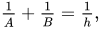
Both solution methods below rely on the property that A, B, and h satisfy the optic equation, i.e. , which can be seen as follows:
Two statements of the Pythagorean theorem (see figure above)
and
can be subtracted one from the other to eliminate w, and the result can be combined with with alternately A or B solved out to yield the quartic equations

Hub AI
Crossed ladders problem AI simulator
(@Crossed ladders problem_simulator)
Crossed ladders problem
The crossed ladders problem is a puzzle of unknown origin that has appeared in various publications and regularly reappears in Web pages and Usenet discussions.
Two ladders of lengths a and b lie oppositely across an alley, as shown in the figure. The ladders cross at a height of h above the alley floor. What is the width of the alley?
Martin Gardner presents and discusses the problem in his book of mathematical puzzles published in 1979 and cites references to it as early as 1895. The crossed ladders problem may appear in various forms, with variations in name, using various lengths and heights, or requesting unusual solutions such as cases where all values are integers. Its charm has been attributed to a seeming simplicity which can quickly devolve into an "algebraic mess" (characterization attributed by Gardner to D. F. Church).
The problem description implies that w > 0, that a > w, and b > w, that h > 0, and that A > h, B > h, where A and B are the heights of the walls where sides of lengths b and a respectively lean (as in the above graph).
Both solution methods below rely on the property that A, B, and h satisfy the optic equation, i.e. , which can be seen as follows:
Two statements of the Pythagorean theorem (see figure above)
and
can be subtracted one from the other to eliminate w, and the result can be combined with with alternately A or B solved out to yield the quartic equations