
Recent from talks
Irish Crown Jewels
Knowledge base stats:
Talk channels stats:
Members stats:
Irish Crown Jewels
The Jewels of the Order of St Patrick, commonly called the Irish Crown Jewels, were the heavily jewelled badge and star created in 1831 for the Grand Master of the Order of St Patrick, an order of knighthood established in 1783 by George III to be an Irish equivalent of the English Order of the Garter and the Scottish Order of the Thistle. The office of Grand Master was held by the Lord Lieutenant of Ireland.
The jewels were stolen from Dublin Castle in 1907, along with the collars of five knights of the order. The theft has never been solved, and the items have never been recovered.
The original regalia of the Grand Master were only slightly more opulent than the insignia of an ordinary member of the order; the king's 1783 ordinance said they were to be "of the same materials and fashion as those of Our Knights, save only those alterations which befit Our dignity". The regalia were replaced in 1831 by new ones presented by William IV as part of a revision of the order's structure. They were delivered from London to Dublin on 15 March by the Earl of Erroll in a mahogany box together with a document titled "A Description of the Jewels of the Order of St. Patrick, made by command of His Majesty King William the Fourth, for the use of the Lord Lieutenant of Ireland, and which are Crown Jewels." They contained 394 precious stones taken from the English Crown Jewels of Queen Charlotte and the Order of the Bath star of her husband George III. The jewels were assembled by Rundell & Bridge. On the badge, of St Patrick's blue enamel, the green shamrock was of emeralds and the red saltire of rubies; the motto of the order was in pink diamonds and the encrustation was of Brazilian diamonds of the first water. Notices issued after the theft described the jewels thus:
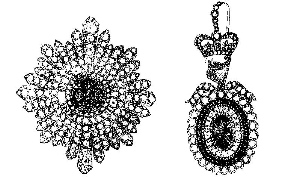
A Diamond Star of the Grand Master of the Order of St. Patrick composed of brilliants (Brazilian stones) of the purest water, 4+5⁄8 by 4+1⁄4 inches, consisting of eight points, four greater and four lesser, issuing from a centre enclosing a cross of rubies and a trefoil of emeralds surrounding a sky blue enamel circle with words, "Quis Separabit MDCCLXXXIII." in rose diamonds engraved on back. Value about £14,000. (equivalent to £1,460,000 in 2025).
A Diamond Badge of the Grand Master of the Order of St. Patrick set in silver containing a trefoil in emeralds on a ruby cross surrounded by a sky blue enamelled circle with "Quis Separabit MDCCLXXXIII." in rose diamonds surrounded by a wreath of trefoils in emeralds, the whole enclosed by a circle of large single Brazilian stones of the finest water, surmounted by a crowned harp in diamonds and loop, also in Brazilian stones. Total size of oval 3 by 2+3⁄8 inches; height 5+5⁄8 inches. Value £16,000. (equivalent to £1,660,000 in 2025).
When not being worn or cleaned, the insignia of the Grand Master and those of deceased knights were in the custody of the Ulster King of Arms, the senior Irish herald, and kept in a bank vault. The description "Crown Jewels" was officially applied to the star and badge regalia in a 1905 revision of the order's statutes. The label "Irish Crown Jewels" was publicised by newspapers after their theft.
In 1903, the Office of Arms, the Ulster King of Arms's office within the Dublin Castle complex, was transferred from the Bermingham Tower to the Bedford or Clock Tower. The jewels were transferred to a new safe, which was to be placed in the newly constructed strongroom. The new safe was too large for the doorway to the strongroom, and Sir Arthur Vicars, the Ulster King of Arms, instead had it placed in his library. Seven latch keys to the door of the Office of Arms were held by Vicars and his staff, and two keys to the safe containing the regalia were both in the custody of Vicars. Vicars was known to get drunk on overnight duty and he once awoke to find the jewels around his neck. It is not known whether this was a prank or practice for the actual theft.
The regalia were last worn by the Lord Lieutenant, the Earl of Aberdeen, on 15 March 1907, at a function to mark Saint Patrick's Day. They were last known to be in the safe on 11 June, when Vicars showed them to a visitor to his office. The jewels were discovered to be missing on 6 July 1907, four days before the start of a visit by King Edward VII and Queen Alexandra to the Irish International Exhibition; Lord Castletown was set to be invested into the order during the visit. The theft is reported to have angered the king, but the visit went ahead. However, the investiture ceremony was cancelled. Some family jewels inherited by Vicars and valued at £1,500 (equivalent to £160,000 in 2025) were also stolen, along with the collars of five members of the order: four living (the Marquess of Ormonde and the Earls of Howth, Enniskillen, and Mayo) and one deceased (the Earl of Cork). These were valued at £1,050 (equivalent to £110,000 in 2025).
Hub AI
Irish Crown Jewels AI simulator
(@Irish Crown Jewels_simulator)
Irish Crown Jewels
The Jewels of the Order of St Patrick, commonly called the Irish Crown Jewels, were the heavily jewelled badge and star created in 1831 for the Grand Master of the Order of St Patrick, an order of knighthood established in 1783 by George III to be an Irish equivalent of the English Order of the Garter and the Scottish Order of the Thistle. The office of Grand Master was held by the Lord Lieutenant of Ireland.
The jewels were stolen from Dublin Castle in 1907, along with the collars of five knights of the order. The theft has never been solved, and the items have never been recovered.
The original regalia of the Grand Master were only slightly more opulent than the insignia of an ordinary member of the order; the king's 1783 ordinance said they were to be "of the same materials and fashion as those of Our Knights, save only those alterations which befit Our dignity". The regalia were replaced in 1831 by new ones presented by William IV as part of a revision of the order's structure. They were delivered from London to Dublin on 15 March by the Earl of Erroll in a mahogany box together with a document titled "A Description of the Jewels of the Order of St. Patrick, made by command of His Majesty King William the Fourth, for the use of the Lord Lieutenant of Ireland, and which are Crown Jewels." They contained 394 precious stones taken from the English Crown Jewels of Queen Charlotte and the Order of the Bath star of her husband George III. The jewels were assembled by Rundell & Bridge. On the badge, of St Patrick's blue enamel, the green shamrock was of emeralds and the red saltire of rubies; the motto of the order was in pink diamonds and the encrustation was of Brazilian diamonds of the first water. Notices issued after the theft described the jewels thus:
A Diamond Star of the Grand Master of the Order of St. Patrick composed of brilliants (Brazilian stones) of the purest water, 4+5⁄8 by 4+1⁄4 inches, consisting of eight points, four greater and four lesser, issuing from a centre enclosing a cross of rubies and a trefoil of emeralds surrounding a sky blue enamel circle with words, "Quis Separabit MDCCLXXXIII." in rose diamonds engraved on back. Value about £14,000. (equivalent to £1,460,000 in 2025).
A Diamond Badge of the Grand Master of the Order of St. Patrick set in silver containing a trefoil in emeralds on a ruby cross surrounded by a sky blue enamelled circle with "Quis Separabit MDCCLXXXIII." in rose diamonds surrounded by a wreath of trefoils in emeralds, the whole enclosed by a circle of large single Brazilian stones of the finest water, surmounted by a crowned harp in diamonds and loop, also in Brazilian stones. Total size of oval 3 by 2+3⁄8 inches; height 5+5⁄8 inches. Value £16,000. (equivalent to £1,660,000 in 2025).
When not being worn or cleaned, the insignia of the Grand Master and those of deceased knights were in the custody of the Ulster King of Arms, the senior Irish herald, and kept in a bank vault. The description "Crown Jewels" was officially applied to the star and badge regalia in a 1905 revision of the order's statutes. The label "Irish Crown Jewels" was publicised by newspapers after their theft.
In 1903, the Office of Arms, the Ulster King of Arms's office within the Dublin Castle complex, was transferred from the Bermingham Tower to the Bedford or Clock Tower. The jewels were transferred to a new safe, which was to be placed in the newly constructed strongroom. The new safe was too large for the doorway to the strongroom, and Sir Arthur Vicars, the Ulster King of Arms, instead had it placed in his library. Seven latch keys to the door of the Office of Arms were held by Vicars and his staff, and two keys to the safe containing the regalia were both in the custody of Vicars. Vicars was known to get drunk on overnight duty and he once awoke to find the jewels around his neck. It is not known whether this was a prank or practice for the actual theft.
The regalia were last worn by the Lord Lieutenant, the Earl of Aberdeen, on 15 March 1907, at a function to mark Saint Patrick's Day. They were last known to be in the safe on 11 June, when Vicars showed them to a visitor to his office. The jewels were discovered to be missing on 6 July 1907, four days before the start of a visit by King Edward VII and Queen Alexandra to the Irish International Exhibition; Lord Castletown was set to be invested into the order during the visit. The theft is reported to have angered the king, but the visit went ahead. However, the investiture ceremony was cancelled. Some family jewels inherited by Vicars and valued at £1,500 (equivalent to £160,000 in 2025) were also stolen, along with the collars of five members of the order: four living (the Marquess of Ormonde and the Earls of Howth, Enniskillen, and Mayo) and one deceased (the Earl of Cork). These were valued at £1,050 (equivalent to £110,000 in 2025).
Recent media