


Community hub
Recent from talks
Contribute something to knowledge base
Content stats: 0 posts, 0 articles, 1 media, 0 notes
Members stats: 0 subscribers, 0 contributors, 0 moderators, 0 supporters
Subscribers
Supporters
Contributors
Moderators
Hub AI
Cruiser Mk VIII Challenger AI simulator
(@Cruiser Mk VIII Challenger_simulator)
Hub AI
Cruiser Mk VIII Challenger AI simulator
(@Cruiser Mk VIII Challenger_simulator)
Cruiser Mk VIII Challenger
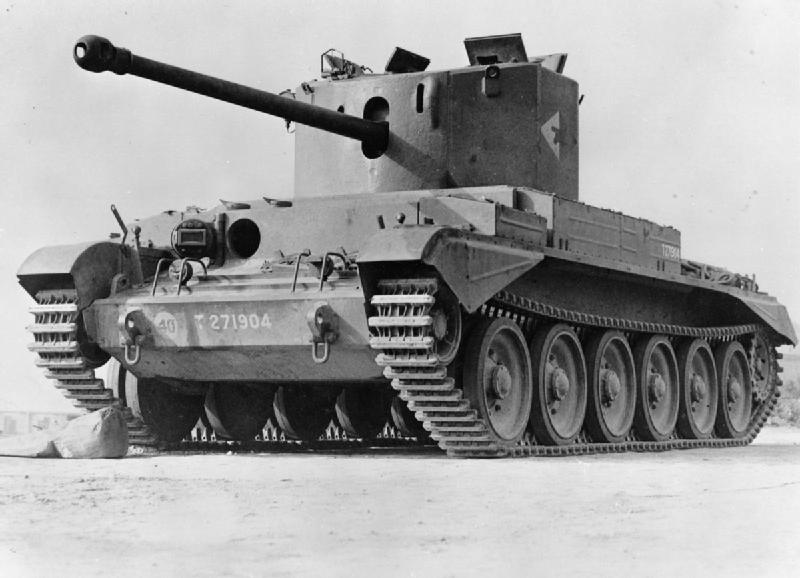
The Tank, Cruiser, Challenger (A30) was a British tank of World War II. It mounted the QF 17-pounder anti-tank gun on a chassis derived from the Cromwell tank to add anti-tank firepower to the cruiser tank units. The design compromises made in fitting the large gun onto the Cromwell chassis resulted in a tank with a powerful weapon and reduced armour. However, the extemporised 17-pounder Sherman Firefly conversion of the US-supplied Sherman proved easier to produce and, with delays in production, only 200 Challengers were built. The Challenger was able to keep up with the fast Cromwell tank and was used with them.
Development of the Challenger was led by William Arthur Robotham. "Roy" Robotham had been a Rolls-Royce executive in the car division who, with no work to do, had led a team to develop a tank powerplant from the Rolls-Royce Merlin aircraft engine. The Rolls-Royce Meteor gave the British a powerful, reliable engine, which was used in the A27M Cruiser Mk VIII Cromwell tank. Robotham's contributions gained him a place in the Ministry of Supply and on the Tank Board, despite his lack of experience in tank design.
The General Staff brought forward specification A29 for a 45 ton, 17 pounder-armed cruiser tank based on needs identified in the African desert campaign. British tanks were generally underarmed compared to German vehicles. The design weight of this vehicle was subsequently seen as excessive and the specification was passed over in favour of the alternate specification, A30, which was 10 long tons (10 t) lighter. In 1942, an order for the development of an A30 based tank was placed with Birmingham Railway Carriage & Wagon Company (BRC&W) expecting it to be based on the Cromwell components also being manufactured by BRC&W. The turret and gun mounting were in the hands of Stothert & Pitt. Birmingham Carriage had to modify the Cromwell hull to take a bigger turret.
The first prototype was ready in August 1942, only seven months after development had commenced, but proved to be very flawed. An improved second prototype was presented in January 1943 but was still considered unacceptable. A committee met to determine whether a requirement for a 17-pounder tank existed. The Challenger had been developed in anticipation of more heavily armoured Axis tanks, following the trend in Nazi German tank design. At roughly the same time the Tiger I entered service with the German army, placing an immediate need for a 17-pounder armed tank in response. When the second prototype was tested at Lulworth, it was found that although it would be effective at long range against the current best-gunned tank in German service (the Panzer IV "Special" with the long 75 mm (3.0 in) gun), at shorter ranges it would be at a disadvantage due to its slow firing rate and thin armour. The design received additional emphasis when, in May 1943, it was found that the Cromwell could not carry its intended armament. Vickers had been developing a 75 mm (3.0 in) 50-calibre-long high-velocity tank gun. It was realised late in the design process that the Cromwell's turret ring was too small for this gun.[page needed] The Challenger would be the only British cruiser tank to mount a weapon that could tackle heavier German armour until the arrival of the A34 Comet. So in February 1943 an order was made of two hundred vehicles; the Army General Staff took five months to approve the Challenger design for production (in February 1943, the only significant alteration was to the ammunition stowage), and Robotham was also critical of the decision to continue manufacturing the Cromwell with a 6-pounder gun (the 17-pounder gun was "infinitely better").
British tank production was constrained by limited resources and insufficient numbers could be made. This was compensated by American production. In the lead up to D-Day, Sherman tanks were fitted with the 17 pounder, creating the interim 17 pounder Sherman Firefly. Converting Sherman tanks was simpler than producing Challengers, so it was decided in November 1943 to terminate the A30 production run after the two hundred vehicles had been built, allowing BRC&W to concentrate on the Cromwell. At the same time, the A 40 "Challenger Stage II" project was cancelled, which had envisaged a 36 tonne type with heavier armour. Future design priority was concentrated on the A34 Comet, which eventually replaced the Cromwell, Firefly and Challenger. Challenger production started in March 1944. That year, 145 vehicles were delivered with another 52 in 1945. Production was in two batches. A first run of forty vehicles had a 40 mm gun mantlet; with the second batch, this was replaced by a 102 mm mantlet. From the hundredth vehicle onwards, appliqué 25 mm armour plates were fitted on the turret - these had already been applied to existing vehicles by field units.
The tank was rendered obsolete when the Vickers HV 75 mm gun was developed to become the 77 mm HV (actually 3 inch = 76.2 mm calibre) to arm the Comet tank.[citation needed] The 77 mm HV used the same projectiles as the 17 pounder with a reduced propellant charge. The 17 pounder gun was used on the earliest marks of the Comet's successor, the Centurion tank.
The turret mounted the Ordnance QF 17-pounder gun required in the Tank Board specification and the hull machine gun was removed to provide stowage space for the long 17-pounder cartridges. The War Office expected that this larger ammunition, together with its stowage forward, would require two loaders alongside the commander and gunner in the turret. To fit the larger weapon and additional crewman in the turret, a much larger turret than that of the Cromwell was specified, developed separately, which had a significant effect on the design and was not resolved until later development of Avenger.
To carry the weight of the 17-pounder and ammunition, an extra wheel station and suspension arm was needed, lengthening the hull. This change in length, without a corresponding change in width across the tracks, reduced mobility compared to the Cromwell, although speed remained high at 25 mph. To limit the weight, the amount of armour was reduced but this could only be achieved on the turret, 63 mm (2.5 in) on the front (the mantlet was 102 mm of IT 90) and 40 mm (1.6 in) on the sides compared to 75 mm (3.0 in) and 60 mm (2.4 in) on the Cromwell. Applique armour, 25 mm thick, was later added to turret and hull front. The turret did not use a conventional turret ring: to increase the aperture diameter by four inches, it rested on a ball mount on the hull floor. Therefore, the base of the turret was unprotected, and it would cantilever if struck by enemy rounds. A jacking feature, with four internal semi-automatic jacks, was fitted to clear jams. The additional length allowed larger hatches to be fitted in the hull while still clearing the turret, providing easier access than Cromwell.
Cruiser Mk VIII Challenger
The Tank, Cruiser, Challenger (A30) was a British tank of World War II. It mounted the QF 17-pounder anti-tank gun on a chassis derived from the Cromwell tank to add anti-tank firepower to the cruiser tank units. The design compromises made in fitting the large gun onto the Cromwell chassis resulted in a tank with a powerful weapon and reduced armour. However, the extemporised 17-pounder Sherman Firefly conversion of the US-supplied Sherman proved easier to produce and, with delays in production, only 200 Challengers were built. The Challenger was able to keep up with the fast Cromwell tank and was used with them.
Development of the Challenger was led by William Arthur Robotham. "Roy" Robotham had been a Rolls-Royce executive in the car division who, with no work to do, had led a team to develop a tank powerplant from the Rolls-Royce Merlin aircraft engine. The Rolls-Royce Meteor gave the British a powerful, reliable engine, which was used in the A27M Cruiser Mk VIII Cromwell tank. Robotham's contributions gained him a place in the Ministry of Supply and on the Tank Board, despite his lack of experience in tank design.
The General Staff brought forward specification A29 for a 45 ton, 17 pounder-armed cruiser tank based on needs identified in the African desert campaign. British tanks were generally underarmed compared to German vehicles. The design weight of this vehicle was subsequently seen as excessive and the specification was passed over in favour of the alternate specification, A30, which was 10 long tons (10 t) lighter. In 1942, an order for the development of an A30 based tank was placed with Birmingham Railway Carriage & Wagon Company (BRC&W) expecting it to be based on the Cromwell components also being manufactured by BRC&W. The turret and gun mounting were in the hands of Stothert & Pitt. Birmingham Carriage had to modify the Cromwell hull to take a bigger turret.
The first prototype was ready in August 1942, only seven months after development had commenced, but proved to be very flawed. An improved second prototype was presented in January 1943 but was still considered unacceptable. A committee met to determine whether a requirement for a 17-pounder tank existed. The Challenger had been developed in anticipation of more heavily armoured Axis tanks, following the trend in Nazi German tank design. At roughly the same time the Tiger I entered service with the German army, placing an immediate need for a 17-pounder armed tank in response. When the second prototype was tested at Lulworth, it was found that although it would be effective at long range against the current best-gunned tank in German service (the Panzer IV "Special" with the long 75 mm (3.0 in) gun), at shorter ranges it would be at a disadvantage due to its slow firing rate and thin armour. The design received additional emphasis when, in May 1943, it was found that the Cromwell could not carry its intended armament. Vickers had been developing a 75 mm (3.0 in) 50-calibre-long high-velocity tank gun. It was realised late in the design process that the Cromwell's turret ring was too small for this gun.[page needed] The Challenger would be the only British cruiser tank to mount a weapon that could tackle heavier German armour until the arrival of the A34 Comet. So in February 1943 an order was made of two hundred vehicles; the Army General Staff took five months to approve the Challenger design for production (in February 1943, the only significant alteration was to the ammunition stowage), and Robotham was also critical of the decision to continue manufacturing the Cromwell with a 6-pounder gun (the 17-pounder gun was "infinitely better").
British tank production was constrained by limited resources and insufficient numbers could be made. This was compensated by American production. In the lead up to D-Day, Sherman tanks were fitted with the 17 pounder, creating the interim 17 pounder Sherman Firefly. Converting Sherman tanks was simpler than producing Challengers, so it was decided in November 1943 to terminate the A30 production run after the two hundred vehicles had been built, allowing BRC&W to concentrate on the Cromwell. At the same time, the A 40 "Challenger Stage II" project was cancelled, which had envisaged a 36 tonne type with heavier armour. Future design priority was concentrated on the A34 Comet, which eventually replaced the Cromwell, Firefly and Challenger. Challenger production started in March 1944. That year, 145 vehicles were delivered with another 52 in 1945. Production was in two batches. A first run of forty vehicles had a 40 mm gun mantlet; with the second batch, this was replaced by a 102 mm mantlet. From the hundredth vehicle onwards, appliqué 25 mm armour plates were fitted on the turret - these had already been applied to existing vehicles by field units.
The tank was rendered obsolete when the Vickers HV 75 mm gun was developed to become the 77 mm HV (actually 3 inch = 76.2 mm calibre) to arm the Comet tank.[citation needed] The 77 mm HV used the same projectiles as the 17 pounder with a reduced propellant charge. The 17 pounder gun was used on the earliest marks of the Comet's successor, the Centurion tank.
The turret mounted the Ordnance QF 17-pounder gun required in the Tank Board specification and the hull machine gun was removed to provide stowage space for the long 17-pounder cartridges. The War Office expected that this larger ammunition, together with its stowage forward, would require two loaders alongside the commander and gunner in the turret. To fit the larger weapon and additional crewman in the turret, a much larger turret than that of the Cromwell was specified, developed separately, which had a significant effect on the design and was not resolved until later development of Avenger.
To carry the weight of the 17-pounder and ammunition, an extra wheel station and suspension arm was needed, lengthening the hull. This change in length, without a corresponding change in width across the tracks, reduced mobility compared to the Cromwell, although speed remained high at 25 mph. To limit the weight, the amount of armour was reduced but this could only be achieved on the turret, 63 mm (2.5 in) on the front (the mantlet was 102 mm of IT 90) and 40 mm (1.6 in) on the sides compared to 75 mm (3.0 in) and 60 mm (2.4 in) on the Cromwell. Applique armour, 25 mm thick, was later added to turret and hull front. The turret did not use a conventional turret ring: to increase the aperture diameter by four inches, it rested on a ball mount on the hull floor. Therefore, the base of the turret was unprotected, and it would cantilever if struck by enemy rounds. A jacking feature, with four internal semi-automatic jacks, was fitted to clear jams. The additional length allowed larger hatches to be fitted in the hull while still clearing the turret, providing easier access than Cromwell.
Recent media
Recent media