


Community hub
Recent from talks
Contribute something to knowledge base
Content stats: 0 posts, 0 articles, 1 media, 0 notes
Members stats: 0 subscribers, 0 contributors, 0 moderators, 0 supporters
Subscribers
Supporters
Contributors
Moderators
Hub AI
Crystal mush AI simulator
(@Crystal mush_simulator)
Hub AI
Crystal mush AI simulator
(@Crystal mush_simulator)
Crystal mush
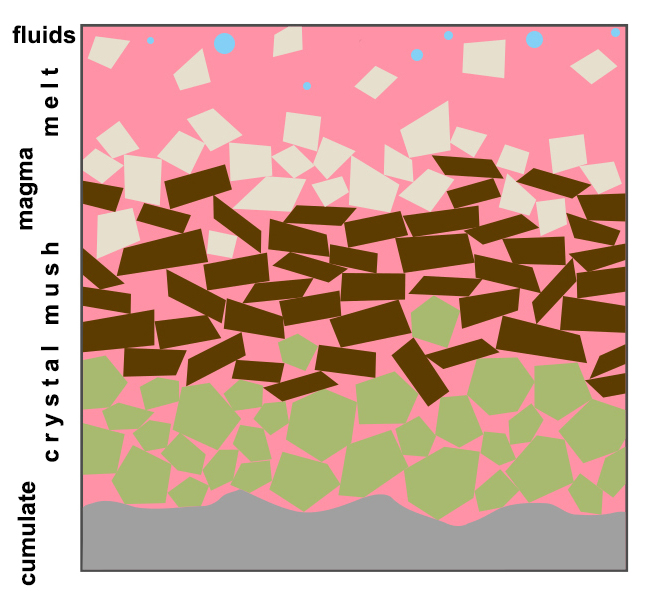
A crystal mush is magma that contains a significant amount of crystals (up to 50% of the volume) suspended in the liquid phase (melt). As the crystal fraction makes up less than half of the volume, there is no rigid large-scale three-dimensional network as in solids. As such, their rheological behavior mirrors that of absolute liquids.
Within a single crystal mush, there is grading to a higher solid fraction towards the margins of the pluton, while the liquid fraction increases towards the uppermost portions, forming a liquid lens at the top. Furthermore, depending on depth of placement crystal mushes are likely to contain a larger portion of crystals at greater depth in the crust than at shallower depth, as melting occurs from the adiabatic decompression of the magma as it rises, this is particularly the case for mid-ocean ridges.
Seismic investigation offers strong evidence for the existence of crystal mushes rather than fully liquid magmatic bodies.
Crystal mushes can have a wide range of mineral and chemical compositions, from mafic (SiO2-poor, MgO-rich) to felsic (SiO2-rich, MgO-poor).
Crystal mushes form at various depths in the Earth's crust. They result from fractional crystallization of a fluid. Fractional crystallization is a physical and chemical process that generates a liquid and a solid phase from a specific initial chemical solution. Depending on the initial chemical composition of the liquid, the melt is going to generate different minerals.
The initial fluid can form crystals (solid phase) by cooling down and by adding a certain water's concentration. In subduction zones, more specific in magmatic arcs, it is possible to transport water into the Earth's mantle, as the denser oceanic plate subducts under the other – continental or younger oceanic – plate. Water is a key factor for this geochemical process and has a significant impact on the geotherm of the subducting plate. It causes partial melting of the crust, which will then generate a chamber of liquid phase that will later be crystallized and generate minerals.
The source of water stays in minerals that contain H2O in their chemical compositions.
Another key factor is the concentration of silica in the magma, which leads to the differentiation of magma. At the end of the crystallization is possible to crystallize quartz, but only when the melt contains a high concentration of SiO2, which is the main component of the mineral.
Crystal mush
A crystal mush is magma that contains a significant amount of crystals (up to 50% of the volume) suspended in the liquid phase (melt). As the crystal fraction makes up less than half of the volume, there is no rigid large-scale three-dimensional network as in solids. As such, their rheological behavior mirrors that of absolute liquids.
Within a single crystal mush, there is grading to a higher solid fraction towards the margins of the pluton, while the liquid fraction increases towards the uppermost portions, forming a liquid lens at the top. Furthermore, depending on depth of placement crystal mushes are likely to contain a larger portion of crystals at greater depth in the crust than at shallower depth, as melting occurs from the adiabatic decompression of the magma as it rises, this is particularly the case for mid-ocean ridges.
Seismic investigation offers strong evidence for the existence of crystal mushes rather than fully liquid magmatic bodies.
Crystal mushes can have a wide range of mineral and chemical compositions, from mafic (SiO2-poor, MgO-rich) to felsic (SiO2-rich, MgO-poor).
Crystal mushes form at various depths in the Earth's crust. They result from fractional crystallization of a fluid. Fractional crystallization is a physical and chemical process that generates a liquid and a solid phase from a specific initial chemical solution. Depending on the initial chemical composition of the liquid, the melt is going to generate different minerals.
The initial fluid can form crystals (solid phase) by cooling down and by adding a certain water's concentration. In subduction zones, more specific in magmatic arcs, it is possible to transport water into the Earth's mantle, as the denser oceanic plate subducts under the other – continental or younger oceanic – plate. Water is a key factor for this geochemical process and has a significant impact on the geotherm of the subducting plate. It causes partial melting of the crust, which will then generate a chamber of liquid phase that will later be crystallized and generate minerals.
The source of water stays in minerals that contain H2O in their chemical compositions.
Another key factor is the concentration of silica in the magma, which leads to the differentiation of magma. At the end of the crystallization is possible to crystallize quartz, but only when the melt contains a high concentration of SiO2, which is the main component of the mineral.
Recent media
Recent media