


Community hub
Recent from talks
Contribute something
Nothing was collected or created yet.
Ctenobethylus
View on Wikipedia
| Ctenobethylus Temporal range: Baltic amber
| |
|---|---|

| |
Scientific classification 
| |
| Kingdom: | Animalia |
| Phylum: | Arthropoda |
| Class: | Insecta |
| Order: | Hymenoptera |
| Family: | Formicidae |
| Subfamily: | Dolichoderinae |
| Tribe: | Tapinomini |
| Genus: | †Ctenobethylus Brues, 1939 |
| Species: | †C. goepperti
|
| Binomial name | |
| †Ctenobethylus goepperti (Mayr, 1868)
| |
| Synonyms | |
| |
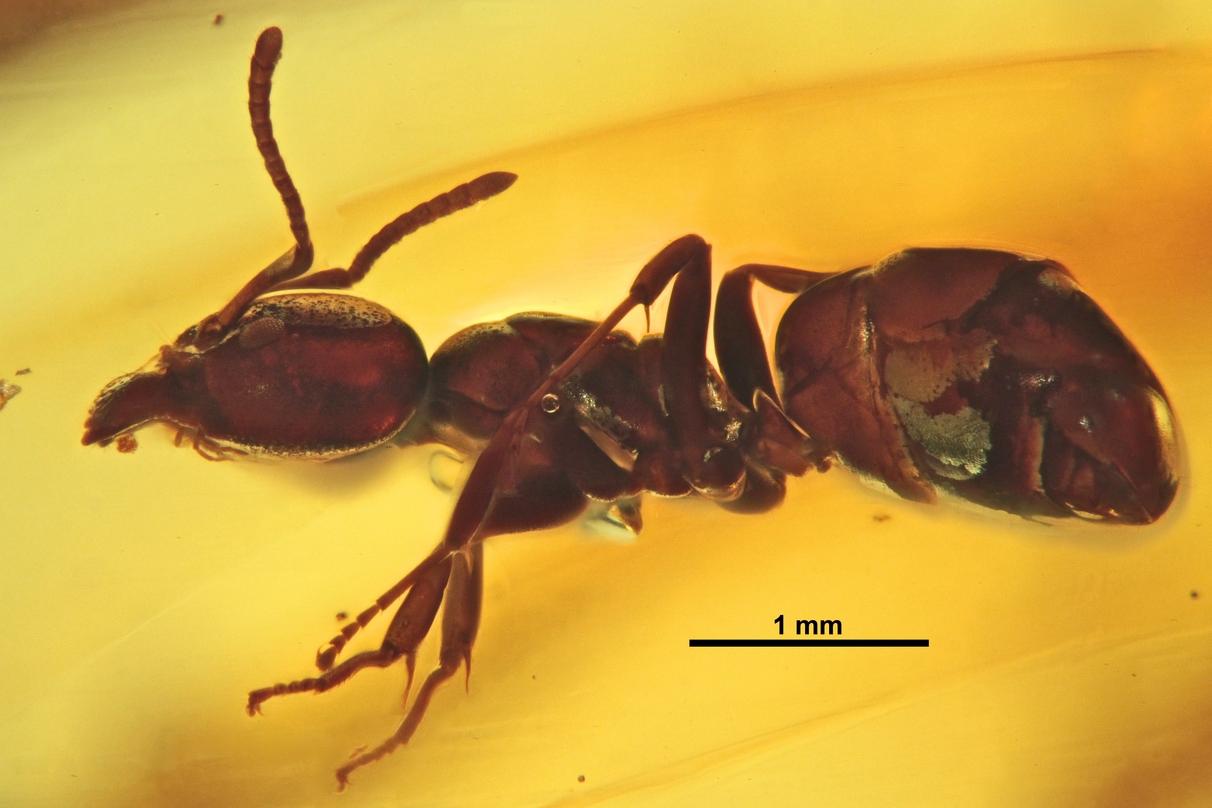
Ctenobethylus is an extinct genus of ants in the subfamily Dolichoderinae. The genus contains a single described species Ctenobethylus goepperti, where the fossil is known to be from the Baltic Amber.[1] The fossil contained a preserved mesostigmatid mite attached to the head of the ant, which is perhaps the oldest known evidence of ecological association between mites and ants.[2]
Taxonomy
[edit]Ctenobethylus goepperti, the sole species of the extinct genus Ctenobethylus, is a fossil ant in the family Formicidae. The genus was established in 1939 by Charles Thomas Brues, while the species was first described in 1868 by Gustav Mayr under the name Hypoclinea goepperti.[3]
Fossils were reported from 25 collections across Europe, including Germany, Lithuania, Poland, Russia, and Ukraine, spanning the Priabonian of the upper Eocene to the Rupelian of the lower Oligocene (38–28.1 Ma). The species accumulated several synonyms over time, including Iridomyrmex goepperti, Liometopum goepperti, and Ctenobethylus succinalis.[4] The specific epithet honors the Prussian paleontologist Johann Heinrich Robert Göppert.[5]
Description
[edit]Morphologically, males have a blackish-brown body with pale wings, a rounded head with prominent eyes and three ocelli, a short scape, and a 13-segmented funicle. The thorax is rounded, legs are long and brownish, and the abdomen is subspherical. Total length ranges from 3 mm (male) to 6.25 mm (wingless female).[6]

A specimen from Johann Wolfgang von Goethe's amber collection was examined using synchrotron micro-computed tomography, revealing internal structures such as the tentorium and prosternum. Phylogenetic analysis suggests C. goepperti was closely related to the modern arboreal genus Liometopum and likely a dominant Eocene forest ant.[3]
References
[edit]- ^ Bolton, Barry (June 1994). Identification Guide to the Ant Genera of the World (1st ed.). Cambridge, Massachusetts: Harvard University Press. p. 26. ISBN 0-674-44280-6.
- ^ Dunlop, J. A.; Kontschan, J.; Walter, D. E.; Perrichot, V. (10 September 2014). "An ant-associated mesostigmatid mite in Baltic amber". Biology Letters. 10 (9) 20140531. doi:10.1098/rsbl.2014.0531. PMC 4190962. PMID 25209198.
- ^ a b Boudinot, B. E.; Bock, B. L.; Tröger, D.; Weingardt, M.; Hammel, J. U.; Grabe, V.; Solórzano‑Kraemer, M. M.; Jandausch, K. J.; Oberski, J. T.; Schmuck, T. (22 January 2026). "Discovery of Goethe's amber ant: its phylogenetic and evolutionary implications". Scientific Reports. 16 2880. doi:10.1038/s41598-026-36004-4.
- ^ "Ctenobethylus Brues 1939 (ant)". The Paleobiology Database. Retrieved 31 January 2026.
- ^ Mayr, Gustav (1868). Die Ameisen des baltischen Bernsteins. Beiträge zur Naturkunde Preussens (in German). Vol. 1. pp. 1–102.
- ^ Théobald, Nicolas (1937). "Les insectes fossiles des terrains oligocènes de France". Mémoires de la Société géologique de France (in French). 15: 1–264.