



Community hub
Recent from talks
Knowledge base stats:
Talk channels stats:
Members stats:
Cubase
Cubase is a digital audio workstation (DAW) developed by Steinberg for music and MIDI recording, arranging and editing. The first version, which was originally only a MIDI sequencer and ran on the Atari ST computer, was released in 1989. Cut-down versions of Cubase are included with almost all Yamaha audio and MIDI hardware, as well as hardware from other manufacturers.
Cubase can be used to edit and sequence audio signals coming from an external sound source and MIDI, and can host VST instruments and effects. It has a number of features designed to aid in composition, such as:
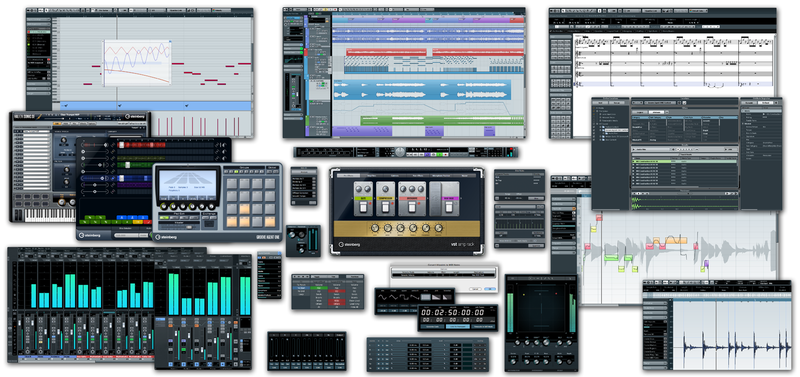
MIDI parts can be edited using a piano roll, a dedicated drum editor, a score editor, or as a filterable complete list of MIDI events.
The user can also mix the various tracks down into a stereo .wav file ready to be burned to a compact disc (CD) in Red Book format, or .mp3 burned to CD or DVD as files, or to be published on the Web.
Cubase VST 3.7 in 1999 introduced a virtual instrument interface for software synthesizers known as VSTi. This made it possible for third-party software programmers to create and sell virtual instruments for Cubase. This technology has become a de facto standard for other DAW software, when integrating software based instruments on the Macintosh and Windows platforms. A new version of VST, VST3, was introduced with Steinberg's Cubase 4 which introduced improved handling of automation and audio output, native sidechaining, and many other features. Cubase 6 included VSTs such as HALion Sonic SE, Groove Agent ONE, LoopMash 2 and VST Amp Rack.
When Cubase 6 was released in 2011, Steinberg introduced 5 different editions for different levels of use. From highest to lowest they are: Cubase (now known as Cubase Pro), Cubase Artist, Cubase Elements, Cubase AI and Cubase LE. They have all been updated as new versions come out. While they all run on the same audio engine, the lower tiers have limits on the number of certain types of tracks. The number of audio tracks allowed in Cubase Pro is unlimited, Artist: 64, Elements: 48, AI: 32, LE: 16.
Cubase has existed in three main incarnations. Initially Cubase, which featured only MIDI, and which was available on the Atari ST, Macintosh and Windows. The first version of Cubase was for Atari ST, and the Macintosh and Windows versions followed later. Cubase was visualized by Wolfgang Kundrus, and implemented by a team including Werner Kracht, Stefan Scheffler, Michael Michaelis and Karl Steinberg who mainly contributed the run-time system M-ROS.
After a brief period with audio integration, the next version, Cubase VST, featured fully integrated audio recording and mixing along with effects. It added Virtual Studio Technology (VST) support, a standard for audio plug-ins, which led to a plethora of third-party effects, both freeware and commercial. Cubase VST was only for Macintosh and Windows; Atari support had been effectively dropped by this time, despite such hardware still being a mainstay in many studios. Cubase VST was offering a tremendous amount of power to the home user, but computer hardware took some time to catch up. By the time it did, VST's audio editing ability was found to be lacking, when compared with competitors such as Pro Tools DAE and Digital Performer MAS.
Hub AI
Cubase AI simulator
(@Cubase_simulator)
Cubase
Cubase is a digital audio workstation (DAW) developed by Steinberg for music and MIDI recording, arranging and editing. The first version, which was originally only a MIDI sequencer and ran on the Atari ST computer, was released in 1989. Cut-down versions of Cubase are included with almost all Yamaha audio and MIDI hardware, as well as hardware from other manufacturers.
Cubase can be used to edit and sequence audio signals coming from an external sound source and MIDI, and can host VST instruments and effects. It has a number of features designed to aid in composition, such as:
MIDI parts can be edited using a piano roll, a dedicated drum editor, a score editor, or as a filterable complete list of MIDI events.
The user can also mix the various tracks down into a stereo .wav file ready to be burned to a compact disc (CD) in Red Book format, or .mp3 burned to CD or DVD as files, or to be published on the Web.
Cubase VST 3.7 in 1999 introduced a virtual instrument interface for software synthesizers known as VSTi. This made it possible for third-party software programmers to create and sell virtual instruments for Cubase. This technology has become a de facto standard for other DAW software, when integrating software based instruments on the Macintosh and Windows platforms. A new version of VST, VST3, was introduced with Steinberg's Cubase 4 which introduced improved handling of automation and audio output, native sidechaining, and many other features. Cubase 6 included VSTs such as HALion Sonic SE, Groove Agent ONE, LoopMash 2 and VST Amp Rack.
When Cubase 6 was released in 2011, Steinberg introduced 5 different editions for different levels of use. From highest to lowest they are: Cubase (now known as Cubase Pro), Cubase Artist, Cubase Elements, Cubase AI and Cubase LE. They have all been updated as new versions come out. While they all run on the same audio engine, the lower tiers have limits on the number of certain types of tracks. The number of audio tracks allowed in Cubase Pro is unlimited, Artist: 64, Elements: 48, AI: 32, LE: 16.
Cubase has existed in three main incarnations. Initially Cubase, which featured only MIDI, and which was available on the Atari ST, Macintosh and Windows. The first version of Cubase was for Atari ST, and the Macintosh and Windows versions followed later. Cubase was visualized by Wolfgang Kundrus, and implemented by a team including Werner Kracht, Stefan Scheffler, Michael Michaelis and Karl Steinberg who mainly contributed the run-time system M-ROS.
After a brief period with audio integration, the next version, Cubase VST, featured fully integrated audio recording and mixing along with effects. It added Virtual Studio Technology (VST) support, a standard for audio plug-ins, which led to a plethora of third-party effects, both freeware and commercial. Cubase VST was only for Macintosh and Windows; Atari support had been effectively dropped by this time, despite such hardware still being a mainstay in many studios. Cubase VST was offering a tremendous amount of power to the home user, but computer hardware took some time to catch up. By the time it did, VST's audio editing ability was found to be lacking, when compared with competitors such as Pro Tools DAE and Digital Performer MAS.