

Recent from talks
Cubic plane curve
Knowledge base stats:
Talk channels stats:
Members stats:
Cubic plane curve
In mathematics, a cubic plane curve , often called simply a cubic is a plane algebraic curve defined by a homogeneous polynomial of degree 3 in three variables or by the corresponding polynomial in two variables


Typically, the coefficients of the polynomial belong to but they may belong to any field , in which case, one talks of a cubic defined over . The points of the cubic are the points of the projective space of dimension three over the field of the complex numbers (or over an algebraic closure of ), whose projective coordinates satisfy the equation of the cubic A point at infinity of the cubic is a point such that . A real point of the cubic is a point with real coordinates. A point defined over is a point with coordinates in .


Generally, the defining polynomial is implicitly assumed to be irreducible, since, otherwise, the equation defines either three lines (not necessarily distinct), or a conic section and a line. However, it is often convenient to include the decomposed curves into the cubics. When the distinction is needed, one talks of irreducible cubics and decomposed cubics (or degenerated cubics).
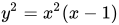
A cubic curve may have a singular point, in which case it has a parametrization in terms of a projective line. The singular points of an irreducible plane cubic curve are quite limited: one double point, one cusp, or one isolated point. Singular irreducible plane cubic curves include the folium of Descartes, the Tschirnhausen cubic, and the trisectrix of Maclaurin (all having a double point) and the semicubical parabola and cissoid of Diocles (both having a cusp). The curve provides an example having an isolated point, at the origin. A cubic curve may be non-singular in the Euclidean plane, while having a singular point in the projective plane. This is the case for the cubic parabola (the graph of the cube function), which has a cusp at infinity, for the trident curve with a double point at infinity, and for the witch of Agnesi, which has an isolated point at infinity.
A reducible plane cubic curve is either a conic and a line or three lines. For a conic and a line, its singularities may consist either of two double points where the conic crosses the line, or a tacnode where the conic is tangent to the line. Three distinct lines may have up to three double points, or a single triple point (concurrent lines).
Every irreducible cubic curve can be transformed by a projective transformation into the special form . A cubic curve in this form is singular if and only if the cubic polynomial in has a double or a triple root. A nonsingular cubic curve in this form is called an elliptic curve; for some authors, elliptic curves must have rational number coefficients. These include the Mordell curves and the Frey curves . Elliptic curves are commonly studied in number theory, in terms of the points on them that have rational coordinates, or more generally replacing the rationals by another number field. Elliptic curves over finite fields are commonly used in public key cryptography.




A cubic curve F in the projective plane can be expressed as a non-zero linear combination of the third-degree monomials
These are ten in number; therefore the cubic curves themselves form a projective space of dimension 9, over any given field K. Each point P imposes a single linear condition on F, if we ask that C pass through P. Therefore, we can find some cubic curve through any nine given points. This cubic may be degenerate, and may not be unique, but will be unique and non-degenerate if the points are in general position; compare to two points determining a line and how five points determine a conic.
Hub AI
Cubic plane curve AI simulator
(@Cubic plane curve_simulator)
Cubic plane curve
In mathematics, a cubic plane curve , often called simply a cubic is a plane algebraic curve defined by a homogeneous polynomial of degree 3 in three variables or by the corresponding polynomial in two variables
Typically, the coefficients of the polynomial belong to but they may belong to any field , in which case, one talks of a cubic defined over . The points of the cubic are the points of the projective space of dimension three over the field of the complex numbers (or over an algebraic closure of ), whose projective coordinates satisfy the equation of the cubic A point at infinity of the cubic is a point such that . A real point of the cubic is a point with real coordinates. A point defined over is a point with coordinates in .
Generally, the defining polynomial is implicitly assumed to be irreducible, since, otherwise, the equation defines either three lines (not necessarily distinct), or a conic section and a line. However, it is often convenient to include the decomposed curves into the cubics. When the distinction is needed, one talks of irreducible cubics and decomposed cubics (or degenerated cubics).
A cubic curve may have a singular point, in which case it has a parametrization in terms of a projective line. The singular points of an irreducible plane cubic curve are quite limited: one double point, one cusp, or one isolated point. Singular irreducible plane cubic curves include the folium of Descartes, the Tschirnhausen cubic, and the trisectrix of Maclaurin (all having a double point) and the semicubical parabola and cissoid of Diocles (both having a cusp). The curve provides an example having an isolated point, at the origin. A cubic curve may be non-singular in the Euclidean plane, while having a singular point in the projective plane. This is the case for the cubic parabola (the graph of the cube function), which has a cusp at infinity, for the trident curve with a double point at infinity, and for the witch of Agnesi, which has an isolated point at infinity.
A reducible plane cubic curve is either a conic and a line or three lines. For a conic and a line, its singularities may consist either of two double points where the conic crosses the line, or a tacnode where the conic is tangent to the line. Three distinct lines may have up to three double points, or a single triple point (concurrent lines).
Every irreducible cubic curve can be transformed by a projective transformation into the special form . A cubic curve in this form is singular if and only if the cubic polynomial in has a double or a triple root. A nonsingular cubic curve in this form is called an elliptic curve; for some authors, elliptic curves must have rational number coefficients. These include the Mordell curves and the Frey curves . Elliptic curves are commonly studied in number theory, in terms of the points on them that have rational coordinates, or more generally replacing the rationals by another number field. Elliptic curves over finite fields are commonly used in public key cryptography.
A cubic curve F in the projective plane can be expressed as a non-zero linear combination of the third-degree monomials
These are ten in number; therefore the cubic curves themselves form a projective space of dimension 9, over any given field K. Each point P imposes a single linear condition on F, if we ask that C pass through P. Therefore, we can find some cubic curve through any nine given points. This cubic may be degenerate, and may not be unique, but will be unique and non-degenerate if the points are in general position; compare to two points determining a line and how five points determine a conic.
Recent media