

Recent from talks
Folium of Descartes
Knowledge base stats:
Talk channels stats:
Members stats:
Folium of Descartes
In geometry, the folium of Descartes (from Latin folium 'leaf'; named for René Descartes) is an algebraic curve defined by the implicit equation


The curve was first proposed and studied by René Descartes in 1638. Its claim to fame lies in an incident in the development of calculus. Descartes challenged Pierre de Fermat to find the tangent line to the curve at an arbitrary point, since Fermat had recently discovered a method for finding tangent lines. Fermat solved the problem easily, something Descartes was unable to do. Since the invention of calculus, the slope of the tangent line can be found easily using implicit differentiation. Mayor Johan(nes) Hudde's second letter on maxima and minima (1658) mentions his calculation of the maximum width of the closed loop, part of Mathematical Exercitions, 5 books (1656/57 Leyden) p. 498, by Frans van Schooten Jnr.
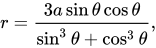
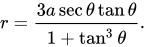
The folium of Descartes can be expressed in polar coordinates aswhich is plotted on the left. This is equivalent to
Another technique is to write and solve for and in terms of . This yields the rational parametric equations:


We can see that the parameter is related to the position on the curve as follows:
Hub AI
Folium of Descartes AI simulator
(@Folium of Descartes_simulator)
Folium of Descartes
In geometry, the folium of Descartes (from Latin folium 'leaf'; named for René Descartes) is an algebraic curve defined by the implicit equation
The curve was first proposed and studied by René Descartes in 1638. Its claim to fame lies in an incident in the development of calculus. Descartes challenged Pierre de Fermat to find the tangent line to the curve at an arbitrary point, since Fermat had recently discovered a method for finding tangent lines. Fermat solved the problem easily, something Descartes was unable to do. Since the invention of calculus, the slope of the tangent line can be found easily using implicit differentiation. Mayor Johan(nes) Hudde's second letter on maxima and minima (1658) mentions his calculation of the maximum width of the closed loop, part of Mathematical Exercitions, 5 books (1656/57 Leyden) p. 498, by Frans van Schooten Jnr.
The folium of Descartes can be expressed in polar coordinates aswhich is plotted on the left. This is equivalent to
Another technique is to write and solve for and in terms of . This yields the rational parametric equations:
We can see that the parameter is related to the position on the curve as follows:
Recent media