Hubbry Logo
Point at infinityPoint at infinityMain
Open search
Point at infinity
Community hub
Point at infinity
logo
8 pages, 0 posts
0 subscribers
Be the first to start a discussion here.
Contribute something
Point at infinity
Point at infinity
from Wikipedia
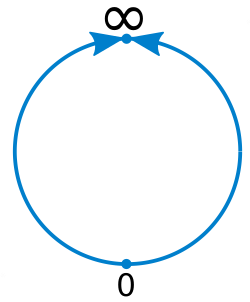
The real line with the point at infinity; it is called the real projective line.

In geometry, a point at infinity or ideal point is an idealized limiting point at the "end" of each line.

In the case of an affine plane (including the Euclidean plane), there is one ideal point for each pencil of parallel lines of the plane. Adjoining these points produces a projective plane, in which no point can be distinguished, if we "forget" which points were added. This holds for a geometry over any field, and more generally over any division ring.[1]

In the real case, a point at infinity completes a line into a topologically closed curve. In higher dimensions, all the points at infinity form a projective subspace of one dimension less than that of the whole projective space to which they belong. A point at infinity can also be added to the complex line (which may be thought of as the complex plane), thereby turning it into a closed surface known as the complex projective line, CP1, also called the Riemann sphere (when complex numbers are mapped to each point).

In the case of a hyperbolic space, each line has two distinct ideal points. Here, the set of ideal points takes the form of a quadric.

Affine geometry

[edit]

In an affine or Euclidean space of higher dimension, the points at infinity are the points which are added to the space to get the projective completion.[citation needed] The set of the points at infinity is called, depending on the dimension of the space, the line at infinity, the plane at infinity or the hyperplane at infinity, in all cases a projective space of one less dimension.[2]

As a projective space over a field is a smooth algebraic variety, the same is true for the set of points at infinity. Similarly, if the ground field is the real or the complex field, the set of points at infinity is a manifold.

Perspective

[edit]

In artistic drawing and technical perspective, the projection on the picture plane of the point at infinity of a class of parallel lines is called their vanishing point.[3]

Hyperbolic geometry

[edit]

In hyperbolic geometry, points at infinity are typically named ideal points.[4] Unlike Euclidean and elliptic geometries, each line has two points at infinity: given a line l and a point P not on l, the right- and left-limiting parallels converge asymptotically to different points at infinity.

All points at infinity together form the Cayley absolute or boundary of a hyperbolic plane.

Projective geometry

[edit]

A symmetry of points and lines arises in a projective plane: just as a pair of points determine a line, so a pair of lines determine a point. The existence of parallel lines leads to establishing a point at infinity which represents the intersection of these parallels. This axiomatic symmetry grew out of a study of graphical perspective where a parallel projection arises as a central projection where the center C is a point at infinity, or figurative point.[5] The axiomatic symmetry of points and lines is called duality.

Though a point at infinity is considered on a par with any other point of a projective range, in the representation of points with projective coordinates, distinction is noted: finite points are represented with a 1 in the final coordinate while a point at infinity has a 0 there. The need to represent points at infinity requires that one extra coordinate beyond the space of finite points is needed.

Other generalizations

[edit]

This construction can be generalized to topological spaces. Different compactifications may exist for a given space, but arbitrary topological space admits Alexandroff extension, also called the one-point compactification when the original space is not itself compact. Projective line (over arbitrary field) is the Alexandroff extension of the corresponding field. Thus, the circle is the one-point compactification of the real line, and the sphere is the one-point compactification of the plane. Projective spaces Pn for n > 1 are not one-point compactifications of corresponding affine spaces for the reason mentioned above under § Affine geometry, and completions of hyperbolic spaces with ideal points are also not one-point compactifications.

See also

[edit]

References

[edit]
Revisions and contributorsEdit on WikipediaRead on Wikipedia
from Grokipedia
In mathematics, points at infinity are idealized points added to the in , where each set of in the same direction intersects at a single point at infinity, thereby ensuring that every pair of lines meets at exactly one point, and the point at infinity is added to the in to compactify it into the , handling behaviors as the modulus of a tends to unbounded values. This concept, first systematically developed in the by mathematicians such as building on earlier ideas from , unifies finite and infinite elements in geometric constructions. In , points at infinity lie on the line at infinity, a distinguished line in the that completes the affine plane; for instance, in (x:y:z)(x : y : z), these points satisfy z=0z = 0, representing directions rather than positions. This extension eliminates exceptions in theorems, such as those involving , and facilitates proofs of incidence properties like the Desargues and Pappus theorems by treating all points uniformly under projective transformations. Applications span , where it models vanishing points in perspective projections, and , aiding the study of conics and higher-dimensional varieties. In , the point at infinity, often denoted \infty, forms the extended complex plane C{}\mathbb{C} \cup \{\infty\}, topologically equivalent to a via , where the corresponds to \infty. This allows analytic functions to be analyzed globally, including residues at infinity for and the classification of rational functions as mappings of the to itself, with poles or essential singularities potentially at \infty. The construction, introduced by in the 1850s, enables the uniform treatment of meromorphic functions and is fundamental to conformal mapping and the study of Riemann surfaces.

Origins in Euclidean Geometry

Parallel Lines and Vanishing Points

In , parallel lines are defined as straight lines in a plane that do not intersect, no matter how far they are extended, a property directly stemming from Euclid's fifth postulate. This postulate states that if a straight line falling on two straight lines makes the interior angles on the same side less than two right angles, then the two straight lines, if produced indefinitely, meet on that side on which the angles are less than two right angles; conversely, if the sum equals two right angles, the lines remain parallel and never meet. This axiom ensures uniqueness in constructing parallels through a point not on a given line but introduces a conceptual tension: while parallels maintain constant separation, real-world observations suggest they converge at great distances, prompting the intuitive idea of a "meeting point" at infinity to reconcile geometry with . Vanishing points arise in perspective drawing as the apparent where sets of seem to converge when viewed from a finite , mimicking the visual effect of depth on a two-dimensional surface. In artistic and optical representations, such as linear perspective developed in the , lines parallel in project onto an and intersect at these points, creating the illusion of . A classic example is the view of railroad tracks, which are parallel along their but appear to meet at a single on the , as observed in photographs or drawings where the tracks recede into the . This phenomenon highlights the limitation of Euclidean axioms in capturing projective effects, where the "infinity" of compresses parallels visually. The concept of a point at infinity addresses this by positing a location where all parallels in a given direction intersect, resolving the Euclidean inconsistency that treats parallels as non-intersecting while perspective demands convergence. This intuitive motivation formalizes the as an ideal intersection, later systematized in to unify line behaviors across finite and infinite extents.

Historical Development

The ancient exhibited an early awareness of perspective in their , particularly in vase paintings from the BCE, where painters used techniques such as foreshortening and multiple ground lines to suggest spatial depth, though without any formal mathematical treatment of or vanishing points. This intuitive approach to representing recession in space laid groundwork for later developments but remained tied to empirical observation rather than systematic . During the , these artistic intuitions were mathematized, beginning with Filippo Brunelleschi's experiments around 1415, in which he demonstrated linear perspective by painting the and using a peephole and mirror to verify the convergence of parallel lines at a . built on this in his 1435 treatise Della pittura (On Painting), codifying the rules for one-point perspective and describing the as the fixed location where all orthogonal lines meet on the horizon, enabling precise depictions of on a two-dimensional surface. In the , advanced these ideas toward formal in his 1639 pamphlet Brouillon project d'une atteinte aux evenemens des rencontres du Cone avec un Plan, where he implicitly introduced points at infinity by treating the intersections of as a unified concept in his projective theory of conics, independent of metric distances. This work, though not widely recognized at the time, marked a shift from artistic perspective to abstract geometric invariance under projection. The 19th century saw explicit formalization, with Jean-Victor Poncelet's 1822 Traité des propriétés projectives des figures serving as a milestone by systematically using points at infinity—termed "ideal points"—to resolve exceptions in , such as the non-intersection of parallels, and to establish projective properties like the that hold regardless of distance. Building on this, provided rigorous analytical foundations in his 1827 paper Der barycentrische Calcul, introducing that naturally incorporated points at infinity into , enabling transformations and configurations central to modern geometry.

Projective Geometry

The Projective Plane

The real projective plane, denoted RP2\mathbb{RP}^2, is a fundamental construct in defined as the set of all straight lines passing through the origin in three-dimensional R3\mathbb{R}^3. Equivalently, RP2\mathbb{RP}^2 can be viewed as the quotient space formed by the equivalence classes of nonzero points (x,y,z)R3(x, y, z) \in \mathbb{R}^3 under , where (x,y,z)(λx,λy,λz)(x, y, z) \sim (\lambda x, \lambda y, \lambda z) for any nonzero scalar λR\lambda \in \mathbb{R}. This construction incorporates points at naturally, extending the affine plane by adding a "line at infinity" to resolve issues with . Points in RP2\mathbb{RP}^2 are represented using homogeneous coordinates [x:y:z][x : y : z], where x,y,zRx, y, z \in \mathbb{R} are not all zero, and the notation identifies points that differ by a nonzero scalar multiple. The affine points correspond to those with z0z \neq 0, which can be normalized to [x/z:y/z:1][x/z : y/z : 1] to recover standard Cartesian coordinates (x/z,y/z)(x/z, y/z). In contrast, points at infinity are precisely those with homogeneous coordinates [x:y:0][x : y : 0], where xx and yy are not both zero, forming the projective line at infinity RP1\mathbb{RP}^1. Axiomatic characterization defines a as an of points and lines satisfying: (1) any two distinct points determine a unique line; (2) any two distinct lines intersect in a unique point; and (3) there exist at least four points with no three collinear. RP2\mathbb{RP}^2 realizes these axioms over the reals, where from the underlying affine plane intersect at a unique point on the line at . Removing the line at from RP2\mathbb{RP}^2 yields the affine plane R2\mathbb{R}^2, which recovers the and its .

Points and Lines at Infinity

In the , the line at infinity consists of all points with of the form [x:y:0][x : y : 0], where (x,y)(0,0)(x, y) \neq (0, 0), and these points represent directions in the underlying affine plane. This collection forms a , which is topologically homeomorphic to a , as it can be identified with the set of lines through the origin in the plane modulo scaling. A key property of the line at infinity is that every line in the affine plane intersects it at exactly one point, corresponding to the direction of that line; specifically, in the affine plane share the same intersection point at , ensuring that all pairs of lines meet uniquely. Thus, two affine lines meet at a point on the line at if and only if they are parallel, while the line at itself intersects every affine line precisely once, preserving the of the . In terms of equations, affine relations in the plane, such as the line ax+by+c=0ax + by + c = 0, extend to the projective setting via by considering the form ax+by+cz=0ax + by + cz = 0; points at satisfy this with z=0z = 0, yielding ax+by=0ax + by = 0 to determine the direction. Topologically, adjoining the line at compactifies the affine plane, transforming it into the closed surface of the real RP2\mathbb{RP}^2.

Affine Spaces

Embedding into Projective Space

One fundamental way to incorporate points at infinity into is by embedding the A2\mathbb{A}^2 into the RP2\mathbb{RP}^2. This embedding utilizes , where a point (x,y)(x, y) in the affine plane is mapped to the [x:y:1][x : y : 1] in RP2\mathbb{RP}^2, with points identified up to by nonzero reals. Directions, corresponding to slopes or parallel classes, are represented by points at of the form [a:b:0][a : b : 0], which lie on the line at infinity defined by the equation z=0z = 0. To recover the affine structure from this embedding, dehomogenization is applied: for a point [x:y:z][x : y : z] with z0z \neq 0, the affine coordinates are obtained by scaling so that z=1z = 1, yielding (x/z,y/z)(x/z, y/z). This process excludes the line at infinity, where z=0z = 0, thus distinguishing finite points from those at infinity. This construction generalizes to higher dimensions, embedding the Rn\mathbb{R}^n into the RPn\mathbb{RP}^n via the map that sends (x1,,xn)(x_1, \dots, x_n) to [x1::xn:1][x_1 : \dots : x_n : 1], with the at infinity given by z=0z = 0. The resulting structure provides a uniform treatment of finite and infinite points, allowing —previously non-intersecting in —to meet at points on the at infinity, thereby resolving issues arising from parallelism in classical . For instance, in RP3\mathbb{RP}^3, points at infinity correspond to directions in 3D affine space, represented as [a:b:c:0][a : b : c : 0], enabling a consistent framework for lines and planes extending to infinity.

Applications in Perspective

In linear perspective, the point at infinity manifests as the vanishing point, where parallel lines in three-dimensional space appear to converge on a two-dimensional image plane, simulating depth and spatial recession. This technique employs one-point perspective when lines are parallel to the viewer's line of sight, resulting in a single vanishing point, or two-point perspective for angular views, where two vanishing points appear on the horizon line, both corresponding to directions at infinity. A seminal historical application is seen in Masaccio's fresco The Holy Trinity (c. 1427), located in , , which utilizes a single positioned at the viewer's eye level to create an illusion of architectural depth extending infinitely into the painted space. In , the projects parallel rays from distant objects—effectively originating from points at infinity—onto the , converging them at a that represents the horizon or infinite direction. Modern applications in , such as ray tracing, model points at to render horizons and infinite planes accurately, ensuring parallel rays from distant scenes intersect the plane at appropriate vanishing points for realistic depth . These projections rely on projective transformations, which preserve the line at —comprising all points at —allowing consistent handling of parallel structures across affine embeddings into .

Non-Euclidean Geometries

In , points at infinity are known as ideal points, which lie on the boundary at infinity of the hyperbolic plane and represent directions toward which geodesics extend indefinitely. These ideal points are not part of the hyperbolic plane itself but are added to complete the structure, allowing for the description of parallel and asymptotic behaviors of lines. The boundary at infinity forms a conformal structure that captures the asymptotic properties of the space, often visualized as a circle or line in various models. Several models of the hyperbolic plane illustrate ideal points distinctly. In the , the hyperbolic plane consists of points inside the open unit disk {zC:z<1}\{ z \in \mathbb{C} : |z| < 1 \}, with ideal points being the Euclidean points on the boundary unit circle {zC:z=1}\{ z \in \mathbb{C} : |z| = 1 \}. In the Klein model, the hyperbolic plane is the interior of the unit disk, and the ideal points reside on the boundary conic, which serves as the "circle of infinity," with hyperbolic lines represented as straight chords connecting these points. For example, in the upper half-plane model, where the hyperbolic plane is {z=x+iyC:y>0}\{ z = x + iy \in \mathbb{C} : y > 0 \}, the ideal points comprise the real line R\mathbb{R} together with a single point at infinity representing the vertical direction. Geodesics, or hyperbolic lines, approach ideal points asymptotically but never reach them within finite distance, as the hyperbolic distance to any ideal point is infinite. Parallel lines in hyperbolic geometry, which do not intersect in the plane, diverge toward distinct ideal points on the boundary, distinguishing this geometry from Euclidean parallels that meet at a single infinity. The boundary at infinity acts as an absolute conic, providing a projective framework for the metric. Horocycles, which are curves equidistant from a geodesic in a limiting sense, are tangent to the boundary at infinity at a single ideal point; in the Poincaré disk, they appear as Euclidean circles inside the disk tangent to the unit circle. Hyperbolic isometries, generated by the group PSL(2, R\mathbb{R}), act on the ideal points by fixing them, pairing them, or moving them along the boundary, preserving the and thus the geometric structure. For instance, parabolic isometries fix exactly one ideal point, while hyperbolic isometries fix two, corresponding to their axes ending at those points. This action extends the to the compactified boundary, facilitating the study of limiting behaviors and tessellations.

Elliptic Geometry

In , the elliptic plane is constructed as the quotient of by identifying antipodal points, where each point represents a pair of opposite locations on the sphere's surface. This model endows the space with a constant positive , making it compact and closed without boundary. Consequently, there are no points at ; all geodesics, or "lines," intersect within the finite space, eliminating the concept of parallelism found in . The positive ensures that any two lines meet at exactly one point, as the geometry's prevents divergence to . The elliptic plane is closely related to the real projective plane RP2\mathbb{RP}^2, which can be realized as modulo the , equipped with a metric induced from the . In this framework, there is no separate line at , as all points are treated as finite within the projective structure; the identification of incorporates what might otherwise be viewed as infinite directions into the ordinary point set. This contrasts with affine or Euclidean spaces, where points at arise to handle . A representative example illustrates this: on the sphere, lines correspond to great circles, which always intersect at two antipodal points. The antipodal identification merges these intersection points into a single finite point in the elliptic plane, ensuring all such "parallel" directions converge without extending to infinity. Unlike , which retains the full double-covering of the sphere and treats as distinct, elliptic geometry avoids this redundancy by quotienting, yielding a single, orientable surface without duplicated points.

Generalizations

In Complex Analysis

In complex analysis, the point at infinity, denoted \infty, is adjoined to the complex plane C\mathbb{C} to form the extended complex plane C^=C{}\hat{\mathbb{C}} = \mathbb{C} \cup \{\infty\}, which is topologically equivalent to a sphere known as the . This construction compactifies the plane, providing a natural framework for studying the behavior of analytic functions at large distances. The can be visualized as the unit sphere S2S^2 in R3\mathbb{R}^3 with equation x12+x22+x32=1x_1^2 + x_2^2 + x_3^2 = 1, where the is identified with the equatorial plane via from the (0,0,1)(0,0,1). Specifically, a point z=x+iyCz = x + iy \in \mathbb{C} maps to the point (x1,x2,x3)=(2xx2+y2+1,2yx2+y2+1,x2+y21x2+y2+1)(x_1, x_2, x_3) = \left( \frac{2x}{x^2 + y^2 + 1}, \frac{2y}{x^2 + y^2 + 1}, \frac{x^2 + y^2 - 1}{x^2 + y^2 + 1} \right) on the , and the corresponds to \infty. This projection preserves angles and maps circles and lines in the plane to circles on the , facilitating the analysis of conformal mappings. The Riemann sphere admits a description using homogeneous coordinates over C\mathbb{C}, where points are equivalence classes [Z1:Z2][Z_1 : Z_2] with Z1,Z2CZ_1, Z_2 \in \mathbb{C} not both zero, and identification (Z1,Z2)(λZ1,λZ2)(Z_1, Z_2) \sim (\lambda Z_1, \lambda Z_2) for λ0\lambda \neq 0. Finite points zCz \in \mathbb{C} correspond to [z:1][z : 1], while \infty is represented by [1:0][1 : 0]. This projective structure endows C^\hat{\mathbb{C}} with the topology of a compact Riemann surface, allowing holomorphic functions on C\mathbb{C} to extend meromorphically to the sphere by considering poles or essential singularities at \infty. For instance, a function holomorphic on C\mathbb{C} has a Laurent series expansion at \infty obtained by the substitution w=1/zw = 1/z, yielding a series in powers of ww around w=0w = 0, which determines the type of singularity at \infty. A key property is the extension of residues to infinity: the residue of a meromorphic function ff at \infty is defined as Resf=Res0(1w2f(1w))\operatorname{Res}_\infty f = -\operatorname{Res}_0 \left( \frac{1}{w^2} f\left(\frac{1}{w}\right) \right), arising from the change of variables in the residue theorem applied to large contours enclosing all finite singularities. This ensures that the sum of residues over the entire sphere, including \infty, is zero for a meromorphic function with finitely many poles. Möbius transformations, given by w=az+bcz+dw = \frac{az + b}{cz + d} with adbc0ad - bc \neq 0, form the group of biholomorphic automorphisms of the Riemann sphere, mapping \infty to finite points (specifically, to d/c-d/c if c0c \neq 0) and preserving the spherical metric. These transformations are essential for uniformizing the sphere and analyzing global properties of analytic functions.

In Algebraic Geometry

In algebraic geometry, the projective space Pn(k)\mathbb{P}^n(k) over a field kk is constructed using [x0:x1::xn][x_0 : x_1 : \dots : x_n], where points are equivalence classes of tuples in kn+1{0}k^{n+1} \setminus \{0\} under by nonzero elements of kk. This construction embeds the An(k)\mathbb{A}^n(k) as the open subset where x00x_0 \neq 0, with the at defined by x0=0x_0 = 0, consisting of points [0:x1::xn][0 : x_1 : \dots : x_n] that capture directions or asymptotic behavior in the . An VAn(k)V \subset \mathbb{A}^n(k) is compactified by taking its projective closure VPn(k)\overline{V} \subset \mathbb{P}^n(k), obtained via homogenization of the defining ideal of VV, which adds the points where the variety meets the . This closure ensures that V\overline{V} is a , proper over Speck\operatorname{Spec} k, meaning morphisms from V\overline{V} to other schemes behave well with respect to limits and fibers, analogous to in . The points in this compactification can resolve apparent singularities arising from unbounded behavior in the part, as the projective allows birational modifications that smooth the variety globally, including . For example, consider the affine parabola defined by y=x2y = x^2 in A2(k)\mathbb{A}^2(k). Its homogenization yields YZ=X2Y Z = X^2 in P2(k)\mathbb{P}^2(k), and intersecting with the line at infinity Z=0Z = 0 gives the single point [0:1:0][0 : 1 : 0], transforming the parabola into a smooth projective conic. In , Bézout's theorem states that two plane curves of degrees dd and ee in P2(k)\mathbb{P}^2(k) intersect in exactly ded e points, counting multiplicity and including intersections at infinity on the line Z=0Z = 0; this accounts for cases like parallel lines meeting at a point at infinity, ensuring the count is invariant under projective transformations.

References

Add your contribution
Related Hubs
Contribute something
User Avatar
No comments yet.