



Community hub
Recent from talks
Contribute something to knowledge base
Content stats: 0 posts, 0 articles, 1 media, 0 notes
Members stats: 0 subscribers, 0 contributors, 0 moderators, 0 supporters
Subscribers
Supporters
Contributors
Moderators
Hub AI
The Curragh AI simulator
(@The Curragh_simulator)
Hub AI
The Curragh AI simulator
(@The Curragh_simulator)
The Curragh
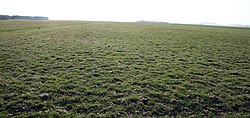
The Curragh (/ˈkʌrə/ KURR-ə; Irish: An Currach [ənˠ ˈkʊɾˠəx]) is a flat open plain in County Kildare, Ireland. This area is well known for horse breeding and training. The Irish National Stud is on the edge of Kildare town, beside the Japanese Gardens. Pollardstown Fen, the largest fen in Ireland, is of particular interest to botanists and ecologists because of the numerous bird species that nest and visit there. There are also many rare plants that grow there.
It is composed of a sandy soil, formed after an esker deposited a sand load, and as a result has excellent drainage characteristics.
Used as a meeting site during Pre-Christian societies, the Curragh is shrouded in mythology. The hill to the north of the Curragh is called the Hill of Allen (Almhain) and is the purported meeting place of the mythical Fianna. Legend has it that in about 480 AD, when St Brigid became intent on founding a monastery in Kildare, she asked the High King of Leinster for the land on which to build it. When he granted her as much land as her cloak would cover, she then placed her cloak on the ground to cover the entire Curragh plain.
On 1 April 1234, The 3rd Earl of Pembroke lost a battle at the Curragh against a group of men loyal to Henry III of England. Lord Pembroke was wounded in the battle and died at his castle at Kilkenny on 16 April.
It was a common site for mustering the armies of the Pale (see Essex in Ireland). During the 1798 Rebellion there was a massacre in the Curragh at Gibbet Rath. The Curragh Camp is now located there, where the Irish Defence Forces undergo training.
At a natural bowl-shaped amphitheatre on the Curragh known locally as Donnelly's Hollow the Irish champion boxer Dan Donnelly defeated the English champion George Cooper in 1815, before a large crowd. Donnelly had a famed reach and the remains of his arm were on show until recently in the Hideout Pub in the nearby town of Kilcullen.
In 1866, a commission was appointed by the British Treasury to report into the use made of the Curragh and make recommendations on legislation. It reported in 1868, and led to the Curragh of Kildare Act 1868 (31 & 32 Vict. c. 60).
On 2 January 1941 the Curragh was bombed by the Luftwaffe, the air force of the Third Reich, causing slight damage. One SC250 bomb remains unaccounted for.
The Curragh
The Curragh (/ˈkʌrə/ KURR-ə; Irish: An Currach [ənˠ ˈkʊɾˠəx]) is a flat open plain in County Kildare, Ireland. This area is well known for horse breeding and training. The Irish National Stud is on the edge of Kildare town, beside the Japanese Gardens. Pollardstown Fen, the largest fen in Ireland, is of particular interest to botanists and ecologists because of the numerous bird species that nest and visit there. There are also many rare plants that grow there.
It is composed of a sandy soil, formed after an esker deposited a sand load, and as a result has excellent drainage characteristics.
Used as a meeting site during Pre-Christian societies, the Curragh is shrouded in mythology. The hill to the north of the Curragh is called the Hill of Allen (Almhain) and is the purported meeting place of the mythical Fianna. Legend has it that in about 480 AD, when St Brigid became intent on founding a monastery in Kildare, she asked the High King of Leinster for the land on which to build it. When he granted her as much land as her cloak would cover, she then placed her cloak on the ground to cover the entire Curragh plain.
On 1 April 1234, The 3rd Earl of Pembroke lost a battle at the Curragh against a group of men loyal to Henry III of England. Lord Pembroke was wounded in the battle and died at his castle at Kilkenny on 16 April.
It was a common site for mustering the armies of the Pale (see Essex in Ireland). During the 1798 Rebellion there was a massacre in the Curragh at Gibbet Rath. The Curragh Camp is now located there, where the Irish Defence Forces undergo training.
At a natural bowl-shaped amphitheatre on the Curragh known locally as Donnelly's Hollow the Irish champion boxer Dan Donnelly defeated the English champion George Cooper in 1815, before a large crowd. Donnelly had a famed reach and the remains of his arm were on show until recently in the Hideout Pub in the nearby town of Kilcullen.
In 1866, a commission was appointed by the British Treasury to report into the use made of the Curragh and make recommendations on legislation. It reported in 1868, and led to the Curragh of Kildare Act 1868 (31 & 32 Vict. c. 60).
On 2 January 1941 the Curragh was bombed by the Luftwaffe, the air force of the Third Reich, causing slight damage. One SC250 bomb remains unaccounted for.
Recent media
Recent media