Hubbry Logo
CursiveCursiveMain
Open search
Cursive
Community hub
Cursive
logo
8 pages, 0 posts
0 subscribers
Be the first to start a discussion here.
Contribute something
Cursive
Cursive
from Wikipedia

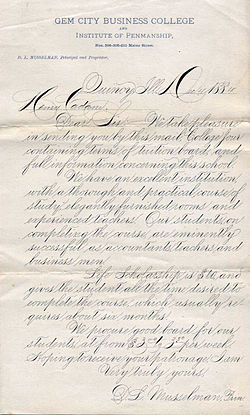
Example of classic American business cursive handwriting known as Spencerian script, from 1884

Cursive (also known as joined-up writing[1][2]) is any style of penmanship in which characters are written joined in a flowing manner, generally for the purpose of making writing faster, in contrast to block letters. It varies in functionality and modern-day usage across languages and regions; being used both publicly in artistic and formal documents as well as in private communication. Formal cursive is generally joined, but casual cursive is a combination of joins and pen lifts. The writing style can be further divided as "looped", "italic", or "connected".

The cursive method is used with many alphabets due to infrequent pen lifting which allows increased writing speed. However, more elaborate or ornamental calligraphic styles of writing can be slower to reproduce. In some alphabets, many or all letters in a word are connected, sometimes making a word one single complex stroke.

History

[edit]

Cursive is a style of penmanship in which the symbols of the language are written in a conjoined, or flowing, manner, generally for the purpose of making writing faster. This writing style is distinct from "print-script" using block letters, in which the letters of a word are unconnected. Not all cursive copybooks join all letters; formal cursive is generally joined, but casual cursive is a combination of joins and pen lifts. In the Arabic, Syriac, Latin, and Cyrillic scripts, many or all letters in a word are connected (while others must not), sometimes making a word one single complex stroke. In Hebrew cursive and Roman cursive, the letters are not connected. In Maharashtra, there was a cursive alphabet, known as the 'Modi' script, used to write the Marathi language.

Subclasses

[edit]

Ligature

[edit]

Ligature is writing the letters of words with lines connecting the letters so that one does not have to pick up the pen or pencil between letters. Commonly some of the letters are written in a looped manner to facilitate the connections. In common printed Greek texts, the modern small letter fonts are called "cursive" (as opposed to uncial) though the letters do not connect.

Looped

[edit]
The first verse of "Good King Wenceslas" in cursive
Looped cursive, as taught in Britain in the mid-20th century

In looped cursive penmanship, some ascenders and descenders have loops which allows for the letters to link. This is generally what people refer to when they say "cursive" in the context of English.[3] The letters in this style have their own unique characteristics. For example the lowercase t is taller, while the lowercase v and w are rounder. Also, the lowercase x links out at the baseline.[4]

Italic

[edit]

Cursive italic penmanship—derived from chancery cursive—uses non-looped joins, and not all letters are joined. In italic cursive, there are no joins from g, j, q, or y, and a few other joins are discouraged.[5][failed verification] Italic penmanship became popular in the 15th-century Italian Renaissance. The term "italic" as it relates to handwriting is not to be confused with italic typed letters. Many, but not all, letters in the handwriting of the Renaissance were joined, as most are today in cursive italic.

Origin

[edit]

The origins of the cursive method are associated with the practical advantages of writing speed and infrequent pen-lifting to accommodate the limitations of the quill. Quills are fragile, easily broken, and will spatter unless used properly. They also run out of ink faster than most contemporary writing utensils. Steel dip pens followed quills; they were sturdier, but still had some limitations. The individuality of the provenance of a document (see Signature) was a factor also, as opposed to machine font.[6] Cursive was also favoured because the writing tool was rarely taken off the paper. The term cursive derives from Middle French cursif from Medieval Latin cursivus, which literally means 'running'. This term in turn derives from Latin currere ('to run, hasten').[7] Although by the 2010s, the use of cursive appeared to be on the decline, as of 2019 it seemed to be coming back into use.[8]

Bengali

[edit]
Half of the National Anthem of Bangladesh, written in cursive Bengali

In the Bengali cursive script[9] (also known in Bengali as "professional writing"[citation needed]) the letters are more likely to be more curvy in appearance than in standard Bengali handwriting. Also, the horizontal supporting bar on each letter (matra) runs continuously through the entire word, unlike in standard handwriting. This cursive handwriting often used by literature experts differs in appearance from the standard Bengali alphabet as it is free hand writing, where sometimes the alphabets are complex and appear different from the standard handwriting.[citation needed]

Chinese

[edit]

Cursive forms of Chinese characters are used in calligraphy; "running script" is the semi-cursive form and "rough script" (mistakenly called "grass script" due to literal misinterpretation) is the cursive. The running aspect of this script has more to do with the formation and connectedness of strokes within an individual character than with connections between characters as in Western connected cursive. The latter are rare in hanzi and in the derived Japanese kanji characters which are usually well separated by the writer.

English

[edit]
An English letter from 1894, written in Continuous Cursive
William Shakespeare's will, written in secretary hand[10]

Cursive writing was used in English before the Norman Conquest. Anglo-Saxon charters typically include a boundary clause written in Old English in a cursive script. A cursive handwriting style—secretary hand—was widely used for both personal correspondence and official documents in England from early in the 16th century.

Cursive handwriting developed into something approximating its current form from the 17th century, but its use was neither uniform, nor standardized either in England itself or elsewhere in the British Empire. In the English colonies of the early 17th century, most of the letters are clearly separated in the handwriting of William Bradford, though a few were joined as in a cursive hand. In England itself, Edward Cocker had begun to introduce a version of the French ronde style, which was then further developed and popularized throughout the British Empire in the 17th and 18th centuries as round hand by John Ayers and William Banson.[11]

Cursive writing in the United Kingdom

[edit]

Today there is no standardised teaching script stipulated in the various national curriculums for schools in the United Kingdom, only that one font style needs to be used consistently throughout the school.[12] In both the cursive and the continuous cursive writing styles, letters are created through joining lines and curve shapes in a particular way. Once pupils have learnt how to clearly form single letters, they are taught how single letters can be joined to form a flowing script.[13]

Characteristics of cursive and continuous cursive scripts:[14]

Cursive Continuous cursive
Starting point for letters Variable Always on the writing line
Finishing point for letters Always on the writing line (except for o, r, v and w, which have a top exit stroke)
Single letter formation Letters taught with exit strokes only Letters taught with entry and exit strokes

Whether cursive or continuous cursive is to be favoured remains a subject of debate. While many schools in the United Kingdom are opting to teach continuous cursive throughout the year groups, often starting in Reception, critics have argued that conjoined writing styles leave many children struggling with the high level of gross and fine motor coordination required.[15]

Cursive writing in North America

[edit]

Development in the 18th and 19th centuries

[edit]

In the American colonies, on the eve of their independence from the Kingdom of Great Britain, it is notable that Thomas Jefferson joined most, but not all the letters when drafting the United States Declaration of Independence. However, a few days later, Timothy Matlack professionally re-wrote the presentation copy of the Declaration in a fully joined, cursive hand. Eighty-seven years later, in the middle of the 19th century, Abraham Lincoln drafted the Gettysburg Address in a cursive hand that would not look out of place today.

Not all such cursive, then or now, joined all of the letters within a word.

Cursive handwriting from the 19th-century US

In both the British Empire and the United States in the 18th and 19th centuries, before the typewriter, professionals used cursive for their correspondence. This was called a "fair hand", meaning it looked good, and firms trained all their clerks to write in exactly the same script.

Although women's handwriting had noticeably different particulars from men's[further explanation needed], the general forms were not prone to rapid change. In the mid-19th century, most children were taught the contemporary cursive; in the United States, this usually occurred in second or third grade (around ages seven to nine). Few simplifications appeared as the middle of the 20th century approached.[citation needed]

After the 1960s, a movement originally begun by Paul Standard in the 1930s to replace looped cursive with cursive italic penmanship resurfaced. It was motivated by the claim that cursive instruction was more difficult than it needed to be; that conventional (looped) cursive was unnecessary, and it was easier to write in cursive italic. Because of this, various new forms of cursive italic appeared, including Getty-Dubay Italic, and Barchowsky Fluent Handwriting. In the 21st century, some of the surviving cursive writing styles are Spencerian, Palmer Method, Zaner-Bloser, and D'Nealian script.[16]

Decline of English cursive in the United States

[edit]
D'Nealian script, a cursive alphabet, shown in lower case and upper case

Numerous factors have impacted the declining use of English cursive in the United States. Largely, they have been technologically based, but in the 2000s cultural changes (such as diminished instruction of educators how to teach it) have also contributed to its marginalization. However, by the second decade of the 2000s “back to basics“ movements have emerged advocating for its preservation.

The declining emphasis on using cursive began in the 20th century, first from the introduction of the typewriter and its widespread adoption by the 1920s. The post-World War II proliferation of the inexpensive ballpoint pen added convenience to writing by hand and eliminated the flourishes liquid ink and flexible metal tips had allowed. In the digital era, the introduction of technologies such as the word processor and personal computer in the 1980s and smartphone in the 2000s have increasingly displaced all forms of handwriting, most significantly cursive.[17][18]

Cursive has also been in decline throughout the 21st century because it is no longer perceived as necessary.[19][20] The Fairfax Education Association, the largest teachers' union in Fairfax County, Virginia, has called cursive a "dying art".

On the 2006 SAT, an American university matriculation exam, only 15 percent of the students wrote their essay answers in cursive.[21] However, students might be discouraged from using cursive on standardized tests because they will receive lower marks if their answers are hard to read, and some graders may have difficulties reading cursive.[22] Nevertheless, in 2007, a survey of 200 teachers of first through third grades in all 50 American states, 90 percent of respondents said their schools required the teaching of cursive.[23] In spite of this mandate, a nationwide survey in 2008 found elementary school teachers lacking formal training in teaching handwriting; only 12 percent reported having taken a course in how to teach it.[24]

In 2012, the American states of Indiana and Hawaii announced that their schools would no longer be required to teach cursive (but will still be permitted to), and instead will be required to teach "keyboard proficiency". Nationwide Common Core State Standards (which do not include instruction in cursive) were proposed in 2009 and had been adopted by 44 states as of July 2011—all of which have debated whether to augment them with cursive.[25][26]

Conservation efforts and effects on the learning disabled

[edit]

Despite the decline in the day-to-day use of cursive, it is being reintroduced to the curriculum of some schools in the United States. California passed cursive handwriting legislation in 2023, adding to a wave of state legislation between 2013 and 2023 that requires the incorporation of cursive handwriting into elementary education.[27][28][29] Other states such as Idaho, Kansas, Massachusetts, North Carolina, South Carolina, New Jersey, and Tennessee had already mandated cursive in schools as a part of the Back to Basics program designed to maintain the integrity of cursive handwriting.[30] Cursive instruction is required by grade 5 in Illinois, starting with the 2018–2019 school year.[31]

Some[who?] argue that cursive is not worth teaching in schools and "in the 1960s cursive was implemented because of preference and not an educational basis; Hawaii and Indiana have replaced cursive instruction with 'keyboard proficiency' and 44 other states are currently weighing similar measures."[32]

Many historical documents, such as the United States Constitution, are written in cursive. Some argue the inability to read cursive therefore precludes one from being able to fully appreciate such documents in their original format.[33]

Maria Montessori argued that writing with straight lines is more difficult than writing with curved lines and children would benefit from learning cursive first.[34]

Students with dyslexia, who have difficulty learning to read because their brains have difficulty associating sounds and letter combinations efficiently, have found that cursive can help them with the decoding process because it integrates hand-eye coordination, fine motor skills, and other brain and memory functions.[35] However, students with dysgraphia may be badly served, or even substantially hindered, by demands for cursive.[36]

German

[edit]
Alphabet sample of German "Kurrentschrift"
Alphabet sample of German "Vereinfachte Ausgangsschrift"
Kurrent (left, pre-19th century) and Vereinfachte Ausgangsschrift (right, from 1969)

Up to the 19th century, Kurrent (also known as German cursive) was used in German-language longhand. Kurrent was not used exclusively, but rather in parallel to modern cursive (which is the same as English cursive). Writers used both cursive styles: location, contents and context of the text determined which style to use. A successor of Kurrent, Sütterlin, was widely used in the period 1911–1941 until the Nazi Party banned it and its printed equivalent Fraktur. German speakers brought up with Sütterlin continued to use it well into the post-war period.

Today, three different styles of cursive writing are taught in German schools, the Lateinische Ausgangsschrift [de] (introduced in 1953), the Schulausgangsschrift [de] (1968), and the Vereinfachte Ausgangsschrift (1969).[37] The German National Primary Schoolteachers' Union has proposed replacing all three with Grundschrift, a simplified form of non-cursive handwriting adopted by Hamburg schools.[38]

Greek

[edit]
Greek cursive script, 6th century CE

The Greek alphabet has had several cursive forms in the course of its development. In antiquity, a cursive form of handwriting was used in writing on papyrus. It employed slanted and partly connected letter forms as well as many ligatures. Some features of this handwriting were later adopted into Greek minuscule, the dominant form of handwriting in the medieval and early modern era. In the 19th and 20th centuries, an entirely new form of cursive Greek, more similar to contemporary Western European cursive scripts, was developed.

Marathi

[edit]
A verse from the Dnyaneshwari in the Modi script

Modi is a cursive script used to write Marathi that is thought to be derived from the Devanagari script.[39] It was used alongside Devanagari until the 20th century as a shorthand script for quick writing in business and administration. Due to the promotion of the Balbodh variant of Devanagari as the standard writing system for Marathi, Modi largely fell out of use by the mid-20th century. Since then there have been attempts to revive this script.[40]

A distinctive feature of this script is that the head stroke is written before the letters, in order to produce a "ruled page" for writing in lines. It has several characteristics that facilitate writing so that moving from one character to the next minimises lifting the pen from the paper for dipping in ink. Some characters are "broken" versions of their Devanagari counterparts. Many characters are more circular in shape. The long 'ī' (ई) and short 'u' (उ) are used in place of the short 'i' (इ) and long 'ū' (ऊ) respectively.[39]

Roman

[edit]
Example of old Roman cursive

Roman cursive is a form of handwriting (or a script) used in ancient Rome and to some extent into the Middle Ages. It is customarily divided into old (or ancient) cursive, and new cursive. Old Roman cursive, also called majuscule cursive and capitalis cursive, was the everyday form of handwriting used for writing letters, by merchants writing business accounts, by schoolchildren learning the Latin alphabet, and even by emperors issuing commands. New Roman, also called minuscule cursive or later cursive, developed from old cursive. It was used from approximately the 3rd century to the 7th century, and uses letter forms that are more recognizable to modern eyes; "a", "b", "d", and "e" have taken a more familiar shape, and the other letters are proportionate to each other rather than varying wildly in size and placement on a line.

Russian

[edit]
The standard modern Russian Cyrillic cursive alphabet with uppercase and lowercase letters, used in school education

The Russian Cursive Cyrillic alphabet is used (instead of the block letters) when handwriting the modern Russian language. While several letters resemble Latin counterparts, many of them represent different sounds. Most handwritten Russian, especially personal letters and schoolwork, uses the cursive Russian (Cyrillic) alphabet although use of block letters in private writing has been rising.[citation needed] Most children in Russian schools are taught in the first grade how to write using this Russian script.

Examples

[edit]

See also

[edit]

References

[edit]
[edit]
Revisions and contributorsEdit on WikipediaRead on Wikipedia
from Grokipedia
Cursive is a style of handwriting characterized by letters that are joined together in a flowing manner, enabling faster writing speed compared to disconnected print letters. Its origins trace back to ancient Greece and Rome, where early connected scripts facilitated rapid transcription, evolving into more standardized forms in Europe by the 16th century and further refined in the 19th century with systems like Spencerian script in the United States. In contemporary contexts, cursive's instructional role has sparked debate, particularly in education, where it was de-emphasized under standards like the in 2010 but has seen resurgence with mandates in 24 U.S. states by 2024, driven by of cognitive advantages. Neurological studies indicate that cursive engages regions involved in letter recognition and more effectively than , enhancing reading acquisition and fine motor skills in children. This activation includes synchronized rhythms and greater electrical activity, supporting memory and learning processes. Despite arguments favoring , empirical data underscores cursive's role in preserving readability and fostering distinct neural pathways absent in keyboard-based input.

Definition and Core Features

Distinction from Print Writing

Cursive handwriting, also known as script, differs fundamentally from print handwriting—often termed manuscript or block lettering—in its use of connecting strokes or ligatures that join adjacent letters into a continuous flow, minimizing pen lifts and enabling a streaming motion across words. In print handwriting, each letter is formed discretely without such joins, requiring the writer to lift the pen or reposition it after completing individual characters, which introduces more interruptions and angular breaks. This structural contrast arose historically, with manuscript forms standardized around 1920 to approximate printed typography for legibility in early education, while cursive evolved from earlier flowing scripts prioritizing speed over isolation. Mechanically, cursive promotes sustained contact between the pen and paper, reducing starts and stops compared to the segmented process of print, which demands precise repositioning for each letter and results in a higher proportion of lift strokes. Consequently, proficient cursive writers achieve approximately 25% greater speed than in print, as the joined forms align with natural arm and wrist kinematics for fluid propulsion rather than repetitive isolated formations. In standard cursive alphabets, all lowercase letters initiate from the baseline, streamlining entry strokes and limiting stroke varieties to a few basic patterns (e.g., loops, ovals, and slants), whereas print letters vary in starting positions—such as mid-height for circles or ascender tops—necessitating diverse motor sequences. These distinctions yield functional trade-offs: cursive's continuity enhances writing efficiency for extended composition but can compromise readability if connections obscure letter identities, particularly in unpracticed hands, while print's modularity facilitates clearer initial legibility at the expense of tempo. Empirical assessments in handwriting analysis confirm that cursive exhibits rounded angles and running lines within words, contrasting print's blocky, separated profiles, aiding forensic differentiation of authorship.

Mechanical and Structural Characteristics

Cursive writing mechanically relies on a continuous, pen that joins letters through minimal interruptions, typically limiting pen lifts to word boundaries or informal variants. This process demands coordinated fine to execute rhythmic upstrokes and downstrokes, with downstrokes often applying greater pressure for thicker lines, enhancing speed by reducing discrete letter formations—formal cursive connects all letters within words via baseline or overhead joins. Structurally, cursive modifies print letterforms by incorporating entry and exit strokes—such as baseline extensions, loops, or hooks—that facilitate ligation, often with a uniform rightward slant of approximately 5 to 10 degrees to align connections ergonomically. Looped variants feature ovoid extensions on ascenders (e.g., b, h) and (e.g., g, y) for seamless flow, while unlooped or italic styles prioritize simplified curves and minimal embellishments. Connecting strokes vary by script: baseline joins predominate in Latin cursive for efficiency, whereas overhead joins appear in looped systems to preserve . These characteristics enable cursive's primary : sustained in writing, as the joined minimizes angular changes in pen direction, contrasting with print's orthogonal lifts. Empirical analysis of reveals cursive's lower variability in continuity, supporting its historical use for rapid .

Purpose and Functional Advantages

Cursive handwriting primarily serves to expedite the by connecting letters with ligatures, thereby reducing the frequency of pen lifts and stroke interruptions compared to print writing. This continuous flow enables writers to produce text more rapidly once proficiency is achieved, with studies indicating that experienced cursive users can achieve writing speeds up to 20-30% faster than print equivalents under timed conditions. The mechanical efficiency stems from the rhythmic, unidirectional movement of the hand, which minimizes cognitive overhead associated with discrete letter formation and supports sustained transcription tasks, such as or correspondence. Functionally, cursive enhances fine and dexterity through its demand for precise, fluid control of writing implements, fostering and hand-eye that transfer to other manual activities. Empirical observations in educational settings show that cursive practice reduces common errors like letter reversals—such as confusing 'b' and 'd'—by enforcing directional consistency in letter sequences, which aids early development in children. Neurologically, cursive engages bilateral activation, integrating sensory-motor pathways in the parietal and frontal lobes more extensively than print or , as evidenced by functional MRI demonstrating heightened connectivity during cursive tasks. High-density EEG research on adolescents further reveals that cursive synchronizes theta-range waves (4-7 Hz), priming neural circuits for enhanced learning and retention of written content. Beyond efficiency, cursive facilitates personal authentication through unique, fluid signatures that are harder to forge than printed equivalents, a practical advantage in legal and commercial documents historically and presently. It also promotes orthographic processing, where the holistic recognition of word forms improves reading fluency and spelling accuracy, with longitudinal studies linking early cursive instruction to superior performance in language arts benchmarks. While legibility debates persist—cursive excelling in speed but potentially requiring training for optimal clarity—its advantages in cognitive integration and motor fluency underscore its role in comprehensive handwriting curricula.

Historical Development

Ancient Origins in Classical Scripts

The development of cursive writing traces back to ancient civilizations where scribes sought faster alternatives to monumental or formal scripts for everyday use. In , script emerged as a cursive derivative of hieroglyphs during the 1st Dynasty, approximately 2925–2775 BCE, characterized by simplified, ligatured signs written with ink on or ostraca to facilitate administrative records, letters, and religious texts. This script's fluid, connected forms prioritized speed over pictorial fidelity, evolving through stages of increasing abbreviation until its gradual replacement by demotic around 700 BCE, while retaining utility for priestly documents into the Ptolemaic period. In the , analogous cursive practices arose independently for practical documentation. , particularly Old Roman Cursive, originated in the late around the 1st century BCE, employed on tablets, , and for business transactions, legal notes, and personal correspondence, featuring highly stylized, interconnected letters that diverged markedly from the angular capital forms of public inscriptions. This script persisted into the 3rd century CE before transitioning to New Roman Cursive, which introduced more recognizable minuscule-like elements and spread across the empire for administrative purposes. Similarly, documentary hands on papyri from Hellenistic , dating to the 3rd century BCE, incorporated cursive elements in private and bureaucratic texts, bridging epigraphic majuscules with later minuscule developments, though formal literary works retained uncial styles. These early cursive systems in classical Mediterranean scripts underscored a universal adaptation: ligatures and abbreviations enabled rapid transcription amid growing demands in expanding bureaucracies, laying foundational mechanics for subsequent evolutions in connected . In parallel, East Asian traditions saw the genesis of Chinese cursive (caoshu) during the Eastern (25–220 CE), with draft cursive forms prioritizing expressive flow over legibility for drafts and notes, though this postdates Mediterranean origins.

Evolution in Medieval and Early Modern Periods

During the medieval period, cursive scripts evolved primarily from the , a standardized lowercase script promoted by Charlemagne's court scribes around 780–800 CE to enhance legibility and uniformity across the . This rounded, clear form contrasted with earlier uncials and served as a bookhand, but practical needs for faster writing in administrative contexts led to the development of cursive variants, such as early cursive minuscules used in charters and legal documents by the 9th–10th centuries. By the , the Carolingian script began transforming into proto-Gothic forms, with increased angularity and compression to fit more text on expensive , resulting in denser, pointed scripts like textualis that prioritized space efficiency over readability. Cursive hands emerged distinctly for speed in non-literary uses, with regional variations such as the English Anglicana script developing from textualis around the 13th century, characterized by looped ascenders and more fluid connections between letters, becoming prevalent in Britain and northern for everyday documents by the . These cursive forms, often employed by clerks for account books and administrative records, incorporated ligatures and abbreviations to accelerate production, reflecting the causal pressure of expanding bureaucratic demands in feudal administrations. In contrast, Gothic bookhands remained formal and non-cursive, but the coexistence of these styles underscored cursive's role as a utilitarian adaptation rather than an aesthetic choice. In the early modern period, the Renaissance revival of classical antiquity prompted a deliberate return to Carolingian-inspired humanist minuscule in Italy by the late 14th century, with scholars like Poggio Bracciolini refining it into a more legible, rounded script that rejected Gothic density. This evolved into italic cursive, pioneered by Florentine scholar Niccolò Niccoli in the 1420s, featuring slanted, connected letters for rapid yet elegant writing, initially as a personal hand before standardization in chanceries. The chancery cursive (cancelleresca corsiva), used in the papal administration from the 15th century, emphasized fluidity and minimal pen lifts, influencing printing types like Aldus Manutius's 1501 italic font, which accelerated the dissemination of texts. Northern Europe saw parallel developments, such as the secretary hand in England, a cursive Gothic derivative persisting into the 17th century for legal and personal correspondence, while German Kurrent maintained looped, angular forms rooted in medieval cursives. These shifts were driven by humanism's emphasis on classical clarity and the printing press's demand for reproducible models, marking cursive's transition from administrative tool to refined scholarly instrument.

18th-20th Century Standardization and Commercialization

In early 18th-century England, Copperplate script, also known as English Round Hand, emerged as a standardized cursive style tailored for commercial efficiency, replacing more ornate secretary hands with fluid, legible forms suitable for business correspondence and legal documents. Writing masters promoted this style through copybooks engraved on copper plates, enabling mass production and dissemination of uniform exemplars that facilitated consistent instruction across practitioners. This commercialization marked a shift toward penmanship as a marketable skill, with manuals emphasizing precise shading and connections to enhance speed and readability in expanding trade networks. The style crossed to the American colonies, where by the late , cursive remained largely confined to elites and merchants, but the 1791 publication of John Jenkins's Art of Writing introduced the first fully American copybook, adapting English models for local use and spurring domestic instruction. Into the early , itinerant writing masters traveled to teach standardized hands, capitalizing on growing demand from commerce and , though variations persisted until mid-century reforms. Platt Rogers Spencer developed in the 1840s, drawing from Copperplate principles but simplifying for practicality, which became the de facto standard for American business and government documents from approximately 1850 to 1925 through widespread adoption in schools and offices. Spencer's family-operated schools and series of copybooks, such as the Spencerian System of Business and Ladies' (first issued around 1860), commercialized the method by selling millions of copies and training teachers, embedding uniform cursive in national literacy efforts. By the late 19th century, Austin Norman Palmer introduced the around 1888, emphasizing whole-arm movement over finger control to produce a plainer, faster cursive that supplanted Spencerian's flourishes for industrial-era efficiency. Palmer's , founded in the , aggressively marketed instructional texts like Palmer's Guide to Business Writing (1894) and established teacher-training institutes, standardizing the style in public schools nationwide by the early and generating substantial revenue from supplies and curricula. This era's boom reflected cursive's role in professional identity, with standardized systems enabling legible mass documentation amid , though typewriters began eroding its dominance post-1920.

Styles and Typologies

Ligature and Joined Forms

In cursive handwriting, ligatures are the connecting strokes that link consecutive letters, permitting continuous pen movement without interruption between characters. This mechanism, essential for the script's efficiency, originated in ancient Roman cursive around the 1st century BCE, where abbreviated and joined letter forms facilitated rapid everyday documentation such as accounts and letters. By the 3rd to 7th centuries CE, New Roman Cursive further emphasized these joins for practical administrative use, evolving from discrete forms in formal scripts like Rustic Capitals. Joined forms adapt individual letters with specific entry and exit —typically curving from or to the baseline—to ensure fluid transitions, distinguishing cursive from unjoined print writing. Mechanics involve gliding motions along the baseline for most connections, with ascenders (e.g., b, h) and (e.g., g, y) incorporating vertical or looped extensions for linkage. Teaching systems classify joins into four groups: bottom-to-bottom (e.g., a-o), bottom-to-c-shape (e.g., n-u), e-family top and bottom (e.g., e-v), and top joins (e.g., b-l), promoting systematic development. These adaptations reduce writing time by approximately 20-30% compared to print, as measured in historical scribal practices. Ligature density varies by style; tight, minimal connections in scripts like Italic reflect deliberate speed, while elaborate loops in Spencerian cursive (developed 1840s-1880s) prioritize aesthetic flow through extended joining strokes. In graphology, pronounced ligatures indicate integrated motor control and cognitive fluency, contrasting with disjointed forms signaling hesitation or deliberation. Across languages, joined forms maintain core principles but adapt to phonetic needs, as seen in Cyrillic cursive where baseline hooks link consonants efficiently.

Looped and Flowing Variants

Looped and flowing variants of cursive handwriting incorporate prominent loops on ascenders like b, d, h, and l, as well as like g, p, and y, to create smooth, continuous connections between letters while maintaining a , rhythmic motion. These characteristics enhance writing speed and aesthetic appeal, distinguishing them from more angular or simplified forms, and became prominent in 19th-century Western systems derived from earlier English roundhand traditions. The , devised by Platt Rogers Spencer and first published in his 1864 Spencerian System of Business and Ladies' Penmanship, represents a quintessential looped and flowing style, with its light, elliptical strokes, subtle shading, and elongated loops that emphasize elegance and individuality in . Adopted widely in American commerce and education from the 1850s until the early 1900s, Spencerian facilitated rapid yet ornate writing, as evidenced by its use in documents like 19th-century ledgers and letters, before being overtaken by plainer methods for practicality. Building on Spencerian principles, the , developed by Austin Norman Palmer and introduced via his 1894 textbook Book of Practical Penmanship, standardized looped forms through repetitive oval exercises and whole-arm movements to achieve uniform flow and legibility. This approach, which stressed muscular memory over finger control, dominated U.S. school curricula from the late through the , producing millions of practitioners whose featured consistent, non-shaded loops for efficient daily use, as documented in period instruction manuals. In European antecedents, the English running hand, evolving from 17th-century scripts, offered a flowing variant with subtler loops and abbreviated forms for speed in legal and administrative documents, as seen in specimens from the that prioritize unbroken strokes over ornamentation. This style influenced transatlantic adaptations, underscoring a causal progression toward looped fluidity for balancing and connectivity in practical writing.

Italic and Simplified Modern Styles

Italic cursive, known also as chancery cursive or , originated in Renaissance around 1420, pioneered by the Florentine scholar Niccolò Niccoli as a semi-cursive adaptation of antique Roman capitals and for enhanced writing speed and legibility. This style incorporates slanted, connected letterforms with minimal loops and ascenders, enabling fluid pen strokes that contrasted with the angular Gothic scripts prevalent in medieval Europe, and it gained formal adoption in the papal chancery by the early for administrative efficiency. Its emphasis on humanistic proportions and reduced ornamentation facilitated broader dissemination through printed exemplars, influencing typographic italics and serving as a model for subsequent European handwriting reforms. Simplified modern cursive styles arose in the late 19th and early 20th centuries as responses to the ornate Spencerian script's impracticality for mass education and commercial use, prioritizing plain joins, consistent sizing, and arm-based motions over elaborate flourishes. The , patented in 1888 and widely disseminated by 1894 through Austin Norman Palmer's books, streamlined letter connections into a semi-angular, loop-minimal form trained via repetitive drills to achieve rapid, uniform output suitable for business ledgers and correspondence. Concurrently, the Zanerian Manual of Alphabets and (1895) by Charles Paxton Zaner introduced graded simplifications, evolving into the Zaner-Bloser by 1918, which featured broader, more legible ovals and entry/exit strokes to ease transitions from print to cursive in American schools. These approaches reflected causal adaptations to competition and compulsory schooling, with empirical observations of student proficiency showing faster mastery of simplified forms over traditional looped variants. In the mid-20th century, italic-inspired simplifications gained traction in educational reforms, as seen in Alfred Fairbank's 1952 revival through the Society for Italic Handwriting, which promoted a basic, sloped cursive with disconnected options for beginners to foster early literacy without excessive motor demands. European variants, such as Germany's Vereinfachte Ausgangsschrift introduced in 1953, further pared connections to hybrid print-cursive models, emphasizing phonetic consistency and reducing in primary instruction across languages. By the 1970s, systems like —developed by Donald Thurber in 1978—integrated simplified cursive precursors into print teaching, using continuous strokes and minimal lifts to bridge manuscript and joined writing, backed by classroom data indicating improved retention rates over isolated-letter methods. These evolutions underscore a pragmatic shift toward functionality, where simplification correlates with higher scores in standardized assessments, though adoption varied by region amid debates over digital alternatives.

Linguistic and Regional Variations

Cursive in Latin-Based Scripts

Cursive handwriting in Latin-based scripts encompasses a range of styles adapted to the phonetic and orthographic needs of languages such as English, French, German, Italian, Spanish, and , evolving from shared medieval precedents into regionally distinct forms by the . These variations prioritize speed and legibility through letter joining, but differ in slant, looping, and angularity influenced by local scribal traditions and printing influences. In , chancery cursive—also known as —developed in the during the as a semi-cursive style for papal and administrative documents, featuring slanted, minimally looped letters that facilitated rapid writing while maintaining clarity. This form, pioneered by scribes like Niccolò Niccoli, spread across , influencing typographic italics and serving as a model for simplified . In , cursive evolved toward rounded, flowing variants like the ronde style in the , emphasizing smooth connections suited to the language's nasal vowels and liaisons, with greater emphasis on loops in letters like l and b for fluidity. German cursive, by contrast, retained angularity from Gothic influences, with script emerging in the as the dominant form for everyday and official writing, characterized by intricate, hooked strokes and distinct letter forms such as the resembling a modern f. persisted as the standard in German-speaking regions until the early , when the simplified variant was mandated in Prussian schools from 1915 to 1941 to streamline teaching amid standardization efforts. In English-speaking contexts, particularly the , Spencerian script dominated from approximately 1850 to 1925, devised by educator Platt Rogers Spencer as a business-oriented system using elliptical arm movements for elegant, shaded strokes that conveyed professionalism in correspondence and ledgers. This style contrasted with British roundhand traditions by incorporating more ornamental flourishes, reflecting commercial expansion. Iberian languages like Spanish and adopted hybrid forms blending Italic influences with local flourishes, as seen in 16th-century documents such as Pero Vaz de Caminha's 1500 letter on Brazil's discovery, which used elongated, joined letters adapted to nasal sounds. Modern cursive in Latin scripts often simplifies these historical styles—termed écriture attachée in or Schulschrift in —retaining joins but varying in letter shapes, such as the looped y in French versus the printed-like ß in German, with ongoing instruction in countries like , , and to support , while U.S. adoption has waned since the 2010 [Common Core](/page/Common Core) exclusion.

Cursive in Cyrillic and Other Alphabetic Systems

Cursive handwriting in Cyrillic scripts emerged as a distinct form around the 15th century in Muscovy, coinciding with the centralization of Russian state power, where letters began to connect partially for faster writing while differing from printed ustav and semi-ustav forms. This development built on earlier tachygraphic traditions for rapid notation, evolving into a standardized cursive by the 18th century under influences like Peter the Great's orthographic reforms of 1708–1710, which introduced the Civil Script to simplify and westernize Cyrillic letterforms for broader administrative use. In Soviet education from the 1970s onward, cursive was taught as chistopisanie (clean writing), emphasizing fluid connections and legibility, with school curricula enforcing its daily application until recent shifts toward print-dominant typing. Russian Cyrillic cursive features notable deviations from print, such as the lowercase т resembling a Latin m, ш looping like a connected i-i, and р forming a loop akin to p, which can create ambiguities like distinguishing м from тн without context; these traits prioritize speed over isolated clarity, reflecting adaptations for phonetic Cyrillic structure. Unlike Serbian Cyrillic cursive, which retains closer print resemblance due to historical Serbo-Croatian reforms, Russian variants emphasize ligatures for consonants like б, в, and д, maintaining utility in personal correspondence despite digital decline. In Greek alphabetic script, cursive evolved from uncial majuscules to minuscule forms by the AD, with Byzantine minuscule serving as a precursor to modern lowercase letters, enabling slanted, connected strokes for efficient manuscript production in monastic and scholarly settings. This transition, post-800 AD, incorporated cursive elements like joined α and ν in fluid chains, distinct from rigid epigraphic capitals, and persisted in 19th-century handwriting tables showing variant forms for letters such as σ (lunate or looped) to balance with writing economy in administrative texts. Other alphabetic systems exhibit analogous cursive adaptations: Hebrew script developed ktav ashuri cursive variants by the medieval period, with connected forms for letters like ב and כ used in daily rabbinic and mercantile writing, prioritizing right-to-left flow over print block styles. Armenian and Georgian alphabets, invented in the 5th century AD, incorporated cursive-like ligatures in manuscripts, though less formalized than in Cyrillic or Greek, with Armenian bolorgir evolving semi-cursive connections for speed in historical codices. These forms underscore a universal alphabetic tendency toward joined strokes for efficiency, verified in paleographic analyses of pre-modern documents across Eurasia.

Cursive Forms in Non-Alphabetic Scripts

In Chinese writing, a logographic system, cursive forms emerged to facilitate rapid inscription while preserving character recognizability. The , known as xingshu or running script, evolved from the during the late Eastern around 220 CE, enabling scribes to connect strokes for efficiency without fully sacrificing legibility. This style gained prominence in the Eastern Jin dynasty (317–420 CE), where it supported quicker documentation in administrative and literary contexts. The fully cursive caoshu, or grass script, further abstracted forms into fluid, abbreviated strokes, originating similarly at the Han's end and prioritizing speed over precise readability, often resembling abstract expression. These variants derive from freestyle adaptations of earlier scripts, with caoshu demanding specialized training for interpretation due to its high abstraction. Japanese syllabaries, hiragana and , trace their origins to cursive renditions of imported via phonetic usage around the 9th century. Hiragana, the more rounded and cursive variant, simplified from sōsho-style cursives, facilitating native Japanese expression in private correspondence, poetry, and women's literature by the (794–1185 CE). This evolution allowed fluid, joined writing suited to brushwork, contrasting angular derived from abbreviated parts for glosses and foreign terms. In modern , sōsho extends cursive principles to , emphasizing dynamic stroke linkage for artistic velocity. Among Brahmic abugidas, the represents a cursive adaptation of for Marathi, developed by the 15th century to expedite manuscript production in administrative and literary use. Modi characters feature continuous, slanted ligatures and reduced strokes compared to block Devanagari, enabling faster right-to-left or horizontal writing on paper until its phased replacement by standardized Devanagari in the early . This script's inherent connectivity, akin to cursive alphabets, supported voluminous record-keeping in the , with forms visually echoing but distinct from Devanagari through abbreviation and flow. Bengali script exhibits informal cursive handwriting practices for velocity, though lacking a formalized historical cursive variant like Modi, with modern styles emphasizing joined matras and consonants in personal notation.

Cognitive and Neurological Impacts

Brain Activation and Motor Skill Integration

Cursive writing engages the and more extensively than discrete printing or typing, as it demands continuous, fluid strokes that connect letters through precise hand movements and proprioceptive feedback. (fMRI) studies indicate that such integrated motor sequences activate dorsal motor systems in the frontal and parietal lobes, facilitating the coordination of hand-eye synchronization essential for skilled . This process recruits the for effector-specific control and supplementary motor areas for planning sequential actions, distinguishing cursive from block-letter formation by emphasizing rhythmic, ballistic motions over isolated lifts. Peer-reviewed analyses confirm that cursive's ligatures enhance cerebellar involvement in error correction and timing, refining gross-to-fine motor transitions during letter formation. The integration of motor skills in cursive extends to sensory-motor loops, where tactile feedback from pen pressure and paper texture reinforces neural pathways linking the somatosensory cortex with premotor regions. (EEG) evidence reveals that cursive handwriting induces widespread theta and alpha band connectivity across brain networks, surpassing that of keyboarding by synchronizing oscillatory activity for sustained and motor planning. In developmental contexts, this integration supports the maturation of automatization in children aged 5-12, where repeated cursive practice strengthens interhemispheric communication via the , aiding bilateral hand coordination. Unlike , which isolates finger strikes, cursive's holistic arm-shoulder involvement promotes proprioceptive awareness, reducing on during transcription tasks. Empirical data from longitudinal underscore that early cursive exposure accelerates consolidation, with fMRI showing heightened activation in the left premotor and superior parietal cortices—regions specialized for visuomotor transformations—compared to non-cursive methods. This activation pattern correlates with improved dexterity metrics, such as reduced variability and faster writing , as measured in kinematic analyses of children's scripts. Such findings highlight cursive's role in forging robust motor-cognitive synergies, though effects vary by individual and practice intensity.

Empirical Evidence from Neuroscientific Studies

Neuroimaging studies using (fMRI) have demonstrated that letters activates brain regions associated with reading and letter recognition more effectively than or alone. In a 2013 study involving pre-literate children aged 4-5, participants trained to produce letters by hand exhibited significantly greater activation in the left —an area critical for orthographic processing and skilled reading—compared to those trained via or passive viewing. This effect persisted across multiple fMRI scans, suggesting that the sensorimotor experience of forming letter shapes by hand facilitates early neural recruitment for literacy-related processes. Electroencephalography (EEG) research further indicates that promotes synchronized rhythms conducive to learning and . A 2020 EEG study by van der Meer et al. on adults and children found that handwriting letters on synchronized waves (4-7 Hz) across parietal and central regions, enhancing encoding efficiency, whereas keyboard typing did not produce comparable . This priming effect was linked to increased electrical activity during the writing process, potentially priming the for subsequent learning tasks. However, direct comparisons between cursive and printed handwriting reveal limited neuroscientific differentiation in activation patterns. An fMRI analysis reported no significant differences in brain activity between producing printed versus cursive forms, with both eliciting similar engagement in motor and visual integration areas. Cursive's fluid, connected strokes may confer advantages in functional connectivity, as evidenced by a 2023 study showing (versus typewriting) increased connectivity in networks supporting reading, writing, and , attributed to precise demands. Yet, these benefits appear tied to handwriting generally rather than cursive specificity, with peer-reviewed lacking robust isolation of cursive's unique neural impacts over . In populations with or , cursive training has shown preliminary EEG correlates of improved automatization, reducing in executive function areas like the , though causal links remain under-explored in large-scale trials. Overall, while outperforms digital input in fostering integrated networks, claims of cursive's superior neurodevelopmental effects warrant caution due to methodological confounds and sparse direct contrasts with .

Effects on Reading, Memory, and Literacy Development

Research indicates that handwriting practice, including cursive, facilitates early letter recognition and reading fluency in children by integrating motor execution with visual processing, leading to stronger neural connections in brain regions associated with reading, such as the left fusiform gyrus. A 2014 neuroimaging study found that preschool children with handwriting experience showed greater activation in reading-related areas during letter perception compared to those without, suggesting handwriting's role in priming literacy pathways. Similarly, a 2025 review of studies reported that children practicing handwriting exhibited superior reading comprehension and fluency over those using typing, attributed to enhanced visuomotor integration. Regarding memory, cursive writing engages broader neural networks than typing, promoting better retention through synchronized waves (4-7 Hz) that facilitate encoding and . from EEG analyses demonstrates increased activity in and learning regions during cursive tasks, outperforming keyboard input by reinforcing fine motor-sensory loops essential for long-term storage. A 2024 study confirmed handwriting's superiority for word and conceptual understanding, with cursive's fluid motions amplifying these effects via heightened somatosensory feedback. In literacy development, cursive instruction from has been linked to improved accuracy and writing fluency, though benefits depend on mastery of print first to avoid confusion. A 2012 study in & observed that cursive practice enhanced and composition in elementary students, supporting overall gains. However, a analysis found no significant impact of cursive mandates on print reading or communication skills, indicating effects may be domain-specific rather than broadly transformative. Neuroscientific data underscores that while accelerates milestones by recruiting executive function areas, premature cursive emphasis without print foundations can hinder and early decoding. Overall, evidence favors integrated curricula for fostering , with cursive contributing uniquely through its demands on sustained attention and letter connectivity.

Educational Role and Pedagogical Debates

Historical Teaching Methods

In the , cursive handwriting instruction in American schools centered on the Spencerian system, developed by Platt Rogers Spencer around 1848 and widely adopted by 1850 as a standardized method emphasizing fluid, oval-based strokes derived from natural movements. This approach taught students through progressive exercises beginning with seven fundamental strokes at a 52-degree slant, progressing to letter formation and connected words, using copybooks that promoted rhythm and uniformity to foster legibility and speed. Teachers enforced strict posture and arm motion, viewing mastery as a moral discipline linked to character development, with the script's elegance serving as a tool for amid industrialization. By the late 1880s, the Palmer Method supplanted Spencerian dominance, introduced by Austin Norman Palmer as a simplified "business writing" system prioritizing muscular arm movements over finger control to achieve rapid, enduring penmanship suitable for commercial efficiency. Instruction involved repetitive drills on ovals, push-pull strokes, and slant lines, detailed in Palmer's 1894 manual and subsequent editions, which sold millions and trained teachers via business institutes reaching over 3,000 schools by 1900. Students practiced daily for 15-20 minutes, focusing on legibility, ease, and endurance through copies that reinforced whole-arm propulsion, reducing fatigue compared to rigid finger-based techniques. Earlier European influences, traceable to 18th-century writing masters who established dedicated academies by the 1750s, informed these methods with engraved exemplars and iterative copying, though American adaptations prioritized practicality over ornamental flourishes. Throughout the early , Palmer remained standard until the 1950s, with curricula allocating dedicated class time—often 100 hours annually—to build via graded workbooks, reflecting penmanship's status as a alongside arithmetic. These techniques contrasted with print-first approaches by integrating cursive directly after basic letter recognition, aiming to encode motor memory for fluid transcription.

Benefits for General and Special Education

Cursive handwriting instruction in education has been linked to enhanced brain connectivity and outcomes compared to typewriting. A study using EEG on children and young adults found that cursive writing produced more elaborate /alpha connectivity patterns across brain regions involved in , , and , surpassing those from keyboard typing. This connectivity supports improved learning and retention, as handwriting engages motor and sensory areas that facilitate letter recognition and reading fluency. Empirical data from experiments indicate that handwriting practice accelerates letter learning and generalizes to untrained tasks more effectively than non-motor methods, with cursive's fluid strokes promoting in writing speed and composition quality over time. In settings, cursive teaching correlates with superior lexical and reduced letter reversals relative to manuscript , though initial writing speed may lag until proficiency develops. A 2015 neuroimaging analysis showed that viewing cursive letters suppressed motor cortex activity more than printed forms, suggesting motor memory from writing aids perceptual processing for reading. These effects stem from cursive's integration of fine with cognitive sequencing, fostering problem-solving and abstract thinking via cross-hemispheric activation. However, direct comparisons to yield mixed results on cognitive superiority, with some reviews finding no unique advantages beyond handwriting's general benefits over digital input. For , cursive offers targeted advantages for students with and by treating words as continuous units, which reinforces multisensory retention and minimizes discrete stroke errors common in printing. The International Dyslexia Association endorses cursive for its role in building fluency and compositional complexity, as the joined letter flow reduces cognitive load on sequencing and supports . In cases of attention-deficit/hyperactivity disorder (ADHD), the rhythmic, embodied nature of cursive may enhance focus through sustained hand-eye coordination, though evidence remains primarily observational rather than from large-scale trials. For , cursive's emphasis on improves fine motor endurance and , with studies noting faster adaptation in primary grades compared to isolated print letters. These benefits are most pronounced when introduced after basic print mastery, avoiding overload for motor-impaired learners, but transitions to keyboarding can further boost output volume post-cursive foundation.

Criticisms and Empirical Counterarguments

Critics of cursive instruction argue that it consumes valuable instructional time in an already overcrowded , potentially displacing emphasis on foundational skills like and computational fluency. This is particularly acute in resource-constrained public schools, where empirical evaluations of curricular trade-offs prioritize measurable gains in performance over niche forms. Additionally, detractors contend that cursive offers no unique cognitive advantages over printed or typing, with one analysis concluding a lack of conclusive evidence linking cursive mastery to improved or academic outcomes. Proponents of de-emphasizing cursive highlight its obsolescence in digital communication, where keyboard proficiency correlates more directly with modern workplace demands, and note that irregular practice leads to skill , rendering the investment inefficient for most students. Empirical counterarguments, drawn from neuroscientific and educational research, challenge these views by demonstrating handwriting's—particularly cursive's—superiority over typing in facilitating learning processes. A 2014 functional magnetic resonance imaging (fMRI) study of preschool children revealed that handwriting letters, as opposed to typing, recruits integrated brain networks for letter perception and production, enhancing early reading acquisition through strengthened visuomotor pathways. This effect stems from cursive's continuous stroke mechanics, which demand greater sensorimotor integration than discrete printing or keystrokes, priming theta-range brain waves (4-7 Hz) for synchronized encoding of linguistic information. Variable handwritten exemplars, including cursive forms, further improve letter recognition in prereaders compared to uniform typed fonts, as variability mimics natural script exposure and bolsters orthographic processing. Meta-analytic evidence reinforces these findings across broader learning contexts. A 2022 and of modalities found handwritten notes yield significantly higher retention and conceptual understanding than typed equivalents, with effect sizes amplified when students summarize rather than verbatim transcribe. Another 2021 confirmed handwriting's edge in word learning and accuracy, attributing gains to deeper cognitive via kinesthetic feedback absent in typing. These advantages hold for cursive specifically, as its fluid connectivity fosters faster idea generation and by reducing letter-by-letter segmentation, countering claims of redundancy with print. While not all studies isolate cursive from general , the causal mechanisms—enhanced neural connectivity and motor-cognitive coupling—suggest its instructional value persists despite technological shifts, provided integration avoids excessive time allocation.

Decline, Revival, and Current Status

Technological and Curricular Factors in Decline

The proliferation of digital technologies, including personal computers, keyboards, and mobile devices, has significantly diminished the practical necessity for cursive in daily communication and . Beginning in the late with the widespread adoption of typewriters and escalating in the and through connectivity and , individuals increasingly composed text via rather than , rendering fluid handwriting less essential for efficiency. In educational settings, this shift prompted curricula to allocate instructional time toward keyboarding proficiency, as schools integrated computers and tablets to prepare students for a digital ; by the , many primary classrooms emphasized skills over practice, correlating with observed declines in overall abilities. Curricular reforms in the United States formalized this de-emphasis through the 2010 adoption of the State Standards, which omitted cursive instruction from mandatory arts requirements for K-12 , focusing instead on foundational print writing and digital composition skills. This policy influenced 45 states initially, leading to the removal or reduction of dedicated cursive lessons in many districts during the , as educators prioritized standardized testing and technology integration amid constrained instructional hours. Internationally, similar trends emerged, such as Finland's 2016 decision to eliminate cursive from its in favor of keyboard-based . These changes reflected a broader pedagogical rationale that fluency better aligns with modern economic demands, though they accelerated the generational gap in handwriting proficiency.

State-Level Mandates and Policy Shifts (2010s-2025)

In the early 2010s, the adoption of the State Standards, initiated in 2010 and embraced by 41 states by 2011, prompted many jurisdictions to eliminate or de-emphasize cursive instruction in favor of keyboarding and skills, as the standards explicitly omitted cursive requirements. This shift reflected a broader curricular prioritization of testable outcomes in reading and writing fundamentals over traditional , leading to widespread discontinuation of dedicated cursive lessons by the mid-2010s. By 2016, only 14 states maintained some form of cursive requirement, often through pre-existing standards or local policies not fully supplanted by . A reversal began in the late , driven by legislative efforts citing practical needs such as reading , forging personal signatures, and potential cognitive benefits from fine motor practice, with proponents arguing that digital dominance had eroded essential analog skills without sufficient empirical justification for the prior removal. By 2019, the number rose to 20 states, reflecting targeted bills in response to parental and educator advocacy. This momentum accelerated into the 2020s, reaching 24 states by early 2025 and 25 by mid-year, with mandates typically specifying instruction from grades 2–5 and proficiency assessments by elementary endpoints. Notable enactments include Arkansas's 2015 law requiring local assessments by third grade; Delaware's 2018–2019 policy for fourth-grade proficiency; Indiana's House Bill 1640 in 2019 for elementary curricula; California's Assembly Bill 446, signed October 13, 2023, mandating 1st–6th grade instruction to enable access; New Hampshire's House Bill 170 in 2023 for fifth-grade mastery; and Kentucky's Senate Bill 167, effective for the 2025 school year, targeting proficiency by fifth grade after reinstating it post-Common Core. States like (from 2017) and (2019 law) exemplify the pattern of integrating cursive into broader literacy standards, often without allocating additional funding, relying instead on existing instructional time.
StateEnactment/Requirement DetailsGrade Levels
AB 446 signed 20231st–6th
SB 167 effective 20251st–5th
HB 170, 2023Up to 5th
HB 1640, 2019Elementary
Law 2015Up to 3rd
These policy reversals, concentrated in Republican-led states but including Democratic ones like , underscore a decentralized pushback against uniform national standards, prioritizing verifiable skills like legible handwriting amid evidence of generational gaps in document interpretation. As of July 2025, Pennsylvania's House approved a bill to mandate elementary cursive, potentially elevating the total to 26, signaling ongoing legislative interest despite persistent debates over opportunity costs in crowded curricula.

Global Usage Patterns and Future Prospects

In , cursive handwriting remains a standard component of in many countries, often taught directly from age five without an initial print phase. For instance, French schools introduce cursive script in as the primary writing method, emphasizing fluid letter connections for legibility and speed. Similarly, nations like and incorporate simplified cursive forms into curricula, with historical scripts like evolving into modern variants still used for personal correspondence. This contrasts with the , where cursive instruction declined post-2010 adoption but has seen revival, with 24 states mandating it by November 2024, including California's 2024 law requiring grades 1-6 to learn it. In , cursive usage for Latin alphabets occurs mainly in English-language instruction, where students in , , and Korea produce neat cursive forms, though native scripts like Chinese caoshu or Japanese sosho maintain cursive traditions for artistic and historical purposes. African and Latin American countries, often influenced by European colonial systems, continue cursive teaching in elementary schools, prioritizing connected writing for efficiency in resource-limited settings. Globally, while daily practice wanes due to digital keyboards, cursive persists in formal for about 70% of non-U.S. Western nations, per educational surveys, aiding archival and personal signatures. Looking to future prospects, cursive's role diminishes in a digital-dominant world, with supplanting for most communication, as evidenced by a 2025 analysis predicting skill atrophy among youth without mandates. However, neuroscientific evidence linking cursive to enhanced connectivity, retention, and fine motor integration—superior to in studies—fuels pedagogical pushes for retention. Rising digital cursive apps, with 40% growth from 2020-2023, and increasing state-level revivals suggest hybrid persistence: optional for and heritage, but non-essential for routine tasks. Empirical trends indicate stabilization in education rather than extinction, driven by benefits amid screen fatigue concerns.

Practical Applications and Examples

Cursive handwriting has traditionally been employed for signatures on legal documents due to its perceived difficulty in forgery and historical prevalence in official scripts. In the United States, the signatures on the Declaration of Independence, executed on July 4, 1776, exemplify early American use of flowing, connected scripts akin to cursive for authenticating pivotal legal and political instruments. Similar practices persisted through the 19th and 20th centuries, where cursive was viewed as a mark of education and formality in contracts, wills, and deeds. However, no federal or state mandates that signatures on legal documents be written in cursive. The U.S. Citizenship and Immigration Services (USCIS) policy manual specifies that a valid signature may consist of any intentional mark, including printed names or symbols like an "X," without requiring cursive form. Legal validity hinges on the signer's intent to authenticate the document and verifiable identity, rather than stylistic elements. Courts have upheld printed or block-letter signatures as equivalent, provided they represent the signer's consistent mark. The decline in cursive education has prompted adaptations in legal practice, with institutions accepting non-cursive handwritten signatures to accommodate generations unfamiliar with connected writing. Nonetheless, cursive's fluidity continues to offer forensic advantages in handwriting analysis for disputed signatures, as its continuous strokes provide more unique characteristics than printed forms. Electronic signatures, authorized under the Electronic Signatures in Global and National Commerce Act (E-SIGN) of 2000, further diminish reliance on traditional cursive, prioritizing digital authentication over manual style.

Archival Access and Historical Literacy

Proficiency in reading cursive enables direct access to vast collections of pre-digital historical documents preserved in national and state archives, where handwriting styles predominant until the mid-20th century often feature connected letter forms characteristic of cursive scripts. In the United States, the National Archives maintains millions of such records, including Revolutionary War pension files and foundational texts like the Declaration of Independence from 1776 and the U.S. Constitution, both executed in cursive hands. Similarly, state archives, such as those in North Dakota, house thousands of pages from the 18th to early 20th centuries requiring cursive decoding for accurate indexing and interpretation. The decline in cursive instruction since the adoption of the State Standards in 2010, which omitted it in 45 states, has created barriers to engagement, compelling younger researchers to depend on potentially incomplete or mediated transcriptions. This reliance can obscure nuances in original manuscripts, such as , alterations, or authentic signatures, which are critical for verifying document integrity and . In response, institutions like the initiated citizen archivist programs in January 2025, explicitly seeking volunteers skilled in cursive to transcribe undigitized or unprocessed holdings, underscoring the practical necessity of the skill for preservation efforts. Historical literacy, defined as the capacity to interpret and contextualize past events through authentic artifacts, is demonstrably impaired without cursive competence, as evidenced by challenges in and paleographic studies where cursive fluency parallels the specialized training required for scripts like Elizabethan . Documents such as Thomas Jefferson's letters or the exemplify this, demanding cursive literacy to bypass interpretive filters and confront historical actors' unedited voices. While digitization advances mitigate some access issues, the uneven coverage—particularly for non-elite or local records—preserves cursive as an indispensable tool for unmediated scholarly inquiry and public heritage stewardship.

Comparative Handwriting Samples

Cursive handwriting connects adjacent letters with ligatures, enabling continuous pen movement and often resulting in a more fluid appearance compared to (print) handwriting, which forms isolated letters without joins, mimicking discrete printed types. This structural difference affects formation: cursive requires mastery of slant, loops, and exits/entries for each letter, while print emphasizes uniform shapes and baseline alignment for simplicity. Historical samples, such as 19th-century used in American business correspondence, exemplify cursive's ornate connectivity with elongated ascenders and for aesthetic speed. In contrast, modern print samples, like basic block letters taught in early , prioritize angular strokes and separation to facilitate initial acquisition. Empirical comparisons reveal trade-offs in legibility and speed. Printed manuscript handwriting demonstrates higher word recognition accuracy in both adults and children, as cursive's joins can obscure letter boundaries, particularly in less proficient writers; one study found printed fonts reduced reading errors by up to 15% over cursive equivalents. Speed assessments indicate that exclusive cursive or manuscript styles yield similar output rates when legibility is controlled, but mixed styles—combining print capitals with cursive lowercase—achieve 10-20% faster transcription without sacrificing readability. Proponents of cursive argue its continuity boosts writing fluency post-mastery, potentially increasing output by 25% in skilled users via reduced lift-and-start motions, though this advantage diminishes for novices or those with motor challenges. Cognitive processing differs subtly: both styles activate motor and perceptual regions for letter recognition, but cursive's demands on sequencing and flow may enhance connectivity in reading networks over isolated print practice, per fMRI evidence from early training. However, no robust data supports cursive conferring superior overall cognitive benefits, such as or executive function, beyond general engagement. Cross-cultural samples, like German Kurrentschrift (a looped cursive phased out post-1941) versus Vereinfachte Ausgangsschrift (a simplified, semi-connected modern script), highlight legibility evolution: the former's dense ligatures hindered readability, prompting shifts to print-like forms for clarity in and administration.
AspectCursive CharacteristicsPrint/Manuscript CharacteristicsEmpirical Notes
LegibilityLower for beginners due to joins; improves with Higher initial accuracy; less ambiguity in letter formsPrint reduces recognition errors by ~15% in developmental studies
SpeedPotentially faster (up to 25% in experts) via flowComparable when legible; mixed styles fastestNo speed edge for pure cursive over matched print
FormationConnected strokes, slant emphasisDiscrete lifts, block shapesCursive demands more

References

Add your contribution
Related Hubs
Contribute something
User Avatar
No comments yet.