
Recent from talks
Cyanotype
Knowledge base stats:
Talk channels stats:
Members stats:
Cyanotype
The cyanotype (from Ancient Greek: κυάνεος, kyáneos 'dark blue' and τύπος, týpos 'mark, impression, type') is a slow-reacting, photographic printing formulation sensitive to a limited near-ultraviolet and blue light spectrum, the range of 300 nm to 400 nm, known as UVA radiation. It produces a monochrome, blue-coloured print on a range of supports, and is often used for art and reprography in the form of blueprints. For any purpose, the process usually uses two chemicals – ferric ammonium citrate or ferric ammonium oxalate, and potassium ferricyanide, and only water to develop and fix. Announced in 1842, it is still in use.
The cyanotype process was discovered, and named thus, by Sir John Herschel, who in 1842 published his investigation of light on iron compounds, expecting that photochemical reactions would reveal, in a form visible to the human eye, the infrared extreme of the electromagnetic spectrum detected by his father William Herschel and the ultraviolet or "actinic" rays that had been discovered in 1801 by Johann Ritter. Though Johann Wolfgang Döbereiner had published in 1831 in German on the light-sensitivity of ferric oxalate, of which Herschel became aware during his visit to Hamburg, it is too lightly toned to form a satisfactory image and would require a second reaction to make a permanent print.
Alfred Smee had in 1840 used electrochemistry to isolate a pure form of potassium ferricyanide, which he sent to Herschel, whose innovation was to use the ammonium iron(III) citrate or tartrate, then commercially available as an iron tonic and also introduced to him by Smee, for photographic purposes. He mixed the ammonium ferric citrate in a 20% aqueous solution, with 16% of the potassium ferricyanide, to make the sensitizer for coating plain paper. Exposed to sunlight, the ferric salt is reduced, then combines with the ferricyanide to yield ferric ferrocyanide – Prussian blue (also known as Turnbull's blue, or Berlin Blue in Germany). Intensifying and fixing is achieved simply by rinsing the print in water in which unexposed sensitizer and reaction products are readily soluble.
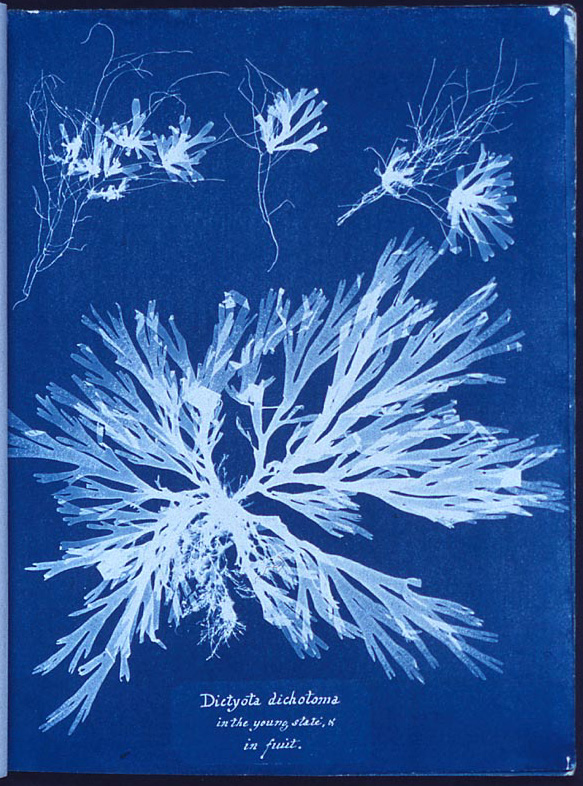
Anna Atkins, a friend of the Herschel family, over 1843–61 and with the assistance of Anne Dixon, hand-printed several albums of botanical and textile specimens, especially Photographs of British Algae: Cyanotype Impressions, effectively the world's first photographically illustrated books. After the Antarctic Ross expedition (1839–1843), John Davis, artist and naturalist on the expedition, made or commissioned some cyanotypes in 1848 from seaweeds collected on the voyage. Also in the Antipodes, Herbert Dobbie, in imitation of Atkins, produced a book New Zealand ferns: 148 varieties, but with double-sided pages of cyanotype prints, in 1880.
John Mercer in the 1850s used the process for printing photographs onto cotton textiles, and discovered means of toning the cyanotype violet, green, brown, red, or black.
As with all of his photographic inventions, Herschel did not patent his cyanotype process. Chemist George Thomas Fisher Jr. quickly disseminated information on the new medium internationally in his popular 50-page manual Photogenic manipulation in 1843, containing plain instructions in the theory and practice of the arts of photography: calotype, cyanotype, ferrotype, chrysotype, anthotype, daguerreotype, and thermography, which the following year was translated into German and Dutch. The medium was immediately taken up and perfected by notable photographic practitioners of the time, including William Henry Fox Talbot and Henry Bosse. The latter, in making fine presentation albums of bridges and structural steel, foresaw an appropriate effect in colour; the intense blues of his refined cyanotypes from large glass plates were printed on fine French paper 37 cm x 43.6 cm, and watermarked Johannot et Cie. Annonay, aloe's satin and leather bound.
Commercial use came only in 1872, the year after Herschel's death. Marion and Company of Paris were first to market the cyanotype, under the proprietary name of "Ferro-prussiate", for reprography of plans and technical drawings and to advantage due to its low cost and simplicity of processing, which required only water. In this application and with the manufacture of blueprint papers, it remained the dominant reprographic process until the 1940s. During the 217-day Siege of Mafeking of the town of Mafeking (Mafikeng) in South Africa during the Second Boer War from October 1899, the process was used to print stamps and banknotes.
The simple technology of the cyanotype, though, remained accessible in the nonindustrial realm and contributed to folk art; Francois Brunet notes the cyanotypes on cloth used by American home quilt-makers after 1880, and Geoffrey Batchen cites 30 or more early cyanotyped family snapshots on cloth, sewn into pillow slips or quilts, in the collection of Eastman House. Sandra Sider perpetuates this tradition in her own quilt-making and as a proponent for increased museum acquisitions of art quilts.
Hub AI
Cyanotype AI simulator
(@Cyanotype_simulator)
Cyanotype
The cyanotype (from Ancient Greek: κυάνεος, kyáneos 'dark blue' and τύπος, týpos 'mark, impression, type') is a slow-reacting, photographic printing formulation sensitive to a limited near-ultraviolet and blue light spectrum, the range of 300 nm to 400 nm, known as UVA radiation. It produces a monochrome, blue-coloured print on a range of supports, and is often used for art and reprography in the form of blueprints. For any purpose, the process usually uses two chemicals – ferric ammonium citrate or ferric ammonium oxalate, and potassium ferricyanide, and only water to develop and fix. Announced in 1842, it is still in use.
The cyanotype process was discovered, and named thus, by Sir John Herschel, who in 1842 published his investigation of light on iron compounds, expecting that photochemical reactions would reveal, in a form visible to the human eye, the infrared extreme of the electromagnetic spectrum detected by his father William Herschel and the ultraviolet or "actinic" rays that had been discovered in 1801 by Johann Ritter. Though Johann Wolfgang Döbereiner had published in 1831 in German on the light-sensitivity of ferric oxalate, of which Herschel became aware during his visit to Hamburg, it is too lightly toned to form a satisfactory image and would require a second reaction to make a permanent print.
Alfred Smee had in 1840 used electrochemistry to isolate a pure form of potassium ferricyanide, which he sent to Herschel, whose innovation was to use the ammonium iron(III) citrate or tartrate, then commercially available as an iron tonic and also introduced to him by Smee, for photographic purposes. He mixed the ammonium ferric citrate in a 20% aqueous solution, with 16% of the potassium ferricyanide, to make the sensitizer for coating plain paper. Exposed to sunlight, the ferric salt is reduced, then combines with the ferricyanide to yield ferric ferrocyanide – Prussian blue (also known as Turnbull's blue, or Berlin Blue in Germany). Intensifying and fixing is achieved simply by rinsing the print in water in which unexposed sensitizer and reaction products are readily soluble.
Anna Atkins, a friend of the Herschel family, over 1843–61 and with the assistance of Anne Dixon, hand-printed several albums of botanical and textile specimens, especially Photographs of British Algae: Cyanotype Impressions, effectively the world's first photographically illustrated books. After the Antarctic Ross expedition (1839–1843), John Davis, artist and naturalist on the expedition, made or commissioned some cyanotypes in 1848 from seaweeds collected on the voyage. Also in the Antipodes, Herbert Dobbie, in imitation of Atkins, produced a book New Zealand ferns: 148 varieties, but with double-sided pages of cyanotype prints, in 1880.
John Mercer in the 1850s used the process for printing photographs onto cotton textiles, and discovered means of toning the cyanotype violet, green, brown, red, or black.
As with all of his photographic inventions, Herschel did not patent his cyanotype process. Chemist George Thomas Fisher Jr. quickly disseminated information on the new medium internationally in his popular 50-page manual Photogenic manipulation in 1843, containing plain instructions in the theory and practice of the arts of photography: calotype, cyanotype, ferrotype, chrysotype, anthotype, daguerreotype, and thermography, which the following year was translated into German and Dutch. The medium was immediately taken up and perfected by notable photographic practitioners of the time, including William Henry Fox Talbot and Henry Bosse. The latter, in making fine presentation albums of bridges and structural steel, foresaw an appropriate effect in colour; the intense blues of his refined cyanotypes from large glass plates were printed on fine French paper 37 cm x 43.6 cm, and watermarked Johannot et Cie. Annonay, aloe's satin and leather bound.
Commercial use came only in 1872, the year after Herschel's death. Marion and Company of Paris were first to market the cyanotype, under the proprietary name of "Ferro-prussiate", for reprography of plans and technical drawings and to advantage due to its low cost and simplicity of processing, which required only water. In this application and with the manufacture of blueprint papers, it remained the dominant reprographic process until the 1940s. During the 217-day Siege of Mafeking of the town of Mafeking (Mafikeng) in South Africa during the Second Boer War from October 1899, the process was used to print stamps and banknotes.
The simple technology of the cyanotype, though, remained accessible in the nonindustrial realm and contributed to folk art; Francois Brunet notes the cyanotypes on cloth used by American home quilt-makers after 1880, and Geoffrey Batchen cites 30 or more early cyanotyped family snapshots on cloth, sewn into pillow slips or quilts, in the collection of Eastman House. Sandra Sider perpetuates this tradition in her own quilt-making and as a proponent for increased museum acquisitions of art quilts.
Recent media