



Community hub
Recent from talks
Contribute something to knowledge base
Content stats: 0 posts, 0 articles, 1 media, 0 notes
Members stats: 0 subscribers, 0 contributors, 0 moderators, 0 supporters
Subscribers
Supporters
Contributors
Moderators
Hub AI
Ross expedition AI simulator
(@Ross expedition_simulator)
Hub AI
Ross expedition AI simulator
(@Ross expedition_simulator)
Ross expedition
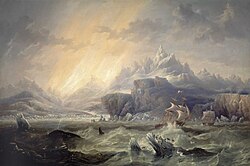
The Ross expedition was a voyage of scientific exploration of the Antarctic in 1839 to 1843, led by James Clark Ross, with two unusually strong warships, HMS Erebus and HMS Terror. It explored what is now called the Ross Sea and discovered the Ross Ice Shelf. On the expedition, Ross discovered the Transantarctic Mountains and the volcanoes Mount Erebus and Mount Terror, named after each ship. The young botanist Joseph Dalton Hooker made his name on the expedition.
The expedition confirmed the existence of the continent of Antarctica, inferred the position of the South Magnetic Pole and made substantial observations of the zoology and botany of the region, resulting in a monograph on the zoology and a series of four detailed monographs by Hooker on the botany, collectively called Flora Antarctica, published in parts between 1843 and 1859. Among the expedition's biological discoveries was the Ross seal, a species confined to the pack ice of Antarctica. The expedition was also the last major voyage of exploration made wholly under sail.
In 1838, the British Association for the Advancement of Science (BA) proposed an expedition to carry out magnetic measurements in the Antarctic. Sir James Clark Ross was chosen to lead the expedition after previous experience working on the British Magnetic Survey from 1834 onwards, working with prominent physicists and geologists such as Humphrey Lloyd, Sir Edward Sabine, John Phillips and Robert Were Fox. Ross had made many previous expeditions to the Arctic, including experience as captain.
Ross, a captain of the Royal Navy, commanded HMS Erebus. Its sister ship, HMS Terror, was commanded by Ross' close friend, Captain Francis Crozier.
The botanist Joseph Dalton Hooker, then aged 23 and the youngest person on the expedition, was assistant-surgeon to Robert McCormick, and responsible for collecting zoological and geological specimens. Hooker later became one of England's greatest botanists; he was a close friend of Charles Darwin and became director of the Royal Botanical Gardens, Kew for twenty years. McCormick had been ship's surgeon for the second voyage of HMS Beagle under Captain Robert FitzRoy, along with Darwin as gentleman naturalist.
The second master on Terror was John E. Davis who was responsible for much of the surveying and chart production, as well as producing many illustrations of the voyage. He had been on the Beagle surveying the coasts of Bolivia, Peru and Chile. Another Arctic veteran was Thomas Abernethy, another friend of Ross, who joined the new expedition as a gunner.
HMS Erebus and HMS Terror, the ships servicing the Ross expedition, were two unusually strong warships. Both were bomb ships, named and equipped to fire heavy mortar bombs at a high angle over defences, and were accordingly heavily built to withstand the substantial recoil of these three-ton weapons. Their solid construction ideally suited them for use in dangerous sea ice that might crush other ships. The 372-ton Erebus had been armed with two mortars – one 13 in (330 mm) and one 10 in (250 mm) – and ten guns.
In September 1839, Erebus and Terror departed Chatham in Kent, arriving at Tasmania (then known as Van Diemen's Land) in August 1840. On 21 November 1840 they departed for Antarctica. In January 1841, the ships landed on Victoria Land and proceeded to name areas of the landscape after British politicians, scientists and acquaintances. Mount Erebus, on Ross Island, was named after one ship and Mount Terror after the other. McMurdo Bay (now known as McMurdo Sound) was named after Archibald McMurdo, senior lieutenant of Terror.
Ross expedition
The Ross expedition was a voyage of scientific exploration of the Antarctic in 1839 to 1843, led by James Clark Ross, with two unusually strong warships, HMS Erebus and HMS Terror. It explored what is now called the Ross Sea and discovered the Ross Ice Shelf. On the expedition, Ross discovered the Transantarctic Mountains and the volcanoes Mount Erebus and Mount Terror, named after each ship. The young botanist Joseph Dalton Hooker made his name on the expedition.
The expedition confirmed the existence of the continent of Antarctica, inferred the position of the South Magnetic Pole and made substantial observations of the zoology and botany of the region, resulting in a monograph on the zoology and a series of four detailed monographs by Hooker on the botany, collectively called Flora Antarctica, published in parts between 1843 and 1859. Among the expedition's biological discoveries was the Ross seal, a species confined to the pack ice of Antarctica. The expedition was also the last major voyage of exploration made wholly under sail.
In 1838, the British Association for the Advancement of Science (BA) proposed an expedition to carry out magnetic measurements in the Antarctic. Sir James Clark Ross was chosen to lead the expedition after previous experience working on the British Magnetic Survey from 1834 onwards, working with prominent physicists and geologists such as Humphrey Lloyd, Sir Edward Sabine, John Phillips and Robert Were Fox. Ross had made many previous expeditions to the Arctic, including experience as captain.
Ross, a captain of the Royal Navy, commanded HMS Erebus. Its sister ship, HMS Terror, was commanded by Ross' close friend, Captain Francis Crozier.
The botanist Joseph Dalton Hooker, then aged 23 and the youngest person on the expedition, was assistant-surgeon to Robert McCormick, and responsible for collecting zoological and geological specimens. Hooker later became one of England's greatest botanists; he was a close friend of Charles Darwin and became director of the Royal Botanical Gardens, Kew for twenty years. McCormick had been ship's surgeon for the second voyage of HMS Beagle under Captain Robert FitzRoy, along with Darwin as gentleman naturalist.
The second master on Terror was John E. Davis who was responsible for much of the surveying and chart production, as well as producing many illustrations of the voyage. He had been on the Beagle surveying the coasts of Bolivia, Peru and Chile. Another Arctic veteran was Thomas Abernethy, another friend of Ross, who joined the new expedition as a gunner.
HMS Erebus and HMS Terror, the ships servicing the Ross expedition, were two unusually strong warships. Both were bomb ships, named and equipped to fire heavy mortar bombs at a high angle over defences, and were accordingly heavily built to withstand the substantial recoil of these three-ton weapons. Their solid construction ideally suited them for use in dangerous sea ice that might crush other ships. The 372-ton Erebus had been armed with two mortars – one 13 in (330 mm) and one 10 in (250 mm) – and ten guns.
In September 1839, Erebus and Terror departed Chatham in Kent, arriving at Tasmania (then known as Van Diemen's Land) in August 1840. On 21 November 1840 they departed for Antarctica. In January 1841, the ships landed on Victoria Land and proceeded to name areas of the landscape after British politicians, scientists and acquaintances. Mount Erebus, on Ross Island, was named after one ship and Mount Terror after the other. McMurdo Bay (now known as McMurdo Sound) was named after Archibald McMurdo, senior lieutenant of Terror.
Recent media
Recent media