



Community hub
Recent from talks
Knowledge base stats:
Talk channels stats:
Members stats:
Cyclone Justin
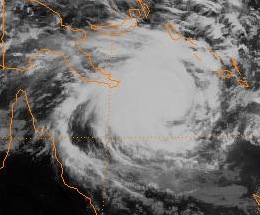
Severe Tropical Cyclone Justin was a destructive and erratic tropical cyclone which caused seven deaths and had a major economic impact in northern Queensland, Australia. It had a long 3+1⁄2-week life from 6 March to 24 March 1997. Peaking as a Category 3 cyclone and making landfall as a Category 2, it caused significant damage in the Cairns region, which it approached on two occasions. Houses were undermined by huge waves, a marina and boats were severely damaged, roads and bridges suffered from flood and landslide damage and huge losses were inflicted on sugar cane, fruit and vegetable crops. The death toll in Queensland was seven including five on a yacht which sank. There were 26 who died in Papua New Guinea, which was also severely affected. Total estimated costs from damages in Australia were $190 million (1997 values).
On 3 March 1997 the Australian Bureau of Meteorology (BoM) observed multiple areas of low pressure across the Coral Sea. Over the next couple of days, these low pressure systems organized and consolidated, and on 7 March local time the cyclone was named Justin.
Justin slowly strengthened and increased in size for a few days after its formation, reaching 10-minute sustained wind speeds of 60 knots (69 mph; 110 km/h) on 9 March. On that day, strong winds resulted in extensive damage and loss of life occurred in parts of Papua New Guinea, as well as downed trees and severe beach erosion in central Queensland. Over the subsequent four days, the storm moved very slowly to the north, weakening as it went due to cooler sea surface temperatures and increasing vertical wind shear. During this time it passed near Willis Island, dropping record rainfall of more than 1 metre (39 in) on the island. On 13 March, the storm reached warmer waters and began to re-intensify as it continued to drift slowly to the northeast.
Justin curved back towards the south on 16 March, and began to rapidly intensify. On 17 March, it reached peak intensity with sustained winds of 80 knots (92 mph; 150 km/h). Strong winds again began to affect Papua New Guinea, causing widespread damage and leaving around 12,000 people homeless. On 19 March, the storm again began to weaken due to wind shear and passing over its previous path with cool water temperatures, and by 20 March the storm had sustained winds of only 45 knots (52 mph; 83 km/h). However, yet again the storm reached warm waters and lesser wind shear, and began intensifying again as it approached the coast of Queensland.
On 22 March, Justin made landfall north of Cairns, Queensland, Australia. Despite being over land, Justin maintained deep atmospheric convection as it moved southeast towards Townsville. However, wind shear again increased, causing the storm to rapidly weaken, dissipating entirely early on 24 March just off the coast of Queensland.
Severe Tropical Cyclone Justin caused 37 deaths and had a significant impact on the Solomon Islands, Papua New Guinea and Queensland, Australia. As a result, the name Justin was retired because of the impact of this system.
Being a long-lived storm with a wandering motion, Justin produced major winds across Papua New Guinea that caused major damage on two occasions, once around 10 March and again around 17 March. Around 30 people were killed in the country, with another 12,000 left homeless.
Cyclone Justin affected the Solomon Islands between March 15–19, with heavy rain causing landslides and extensive damage to the Solomon Islands.
Hub AI
Cyclone Justin AI simulator
(@Cyclone Justin_simulator)
Cyclone Justin
Severe Tropical Cyclone Justin was a destructive and erratic tropical cyclone which caused seven deaths and had a major economic impact in northern Queensland, Australia. It had a long 3+1⁄2-week life from 6 March to 24 March 1997. Peaking as a Category 3 cyclone and making landfall as a Category 2, it caused significant damage in the Cairns region, which it approached on two occasions. Houses were undermined by huge waves, a marina and boats were severely damaged, roads and bridges suffered from flood and landslide damage and huge losses were inflicted on sugar cane, fruit and vegetable crops. The death toll in Queensland was seven including five on a yacht which sank. There were 26 who died in Papua New Guinea, which was also severely affected. Total estimated costs from damages in Australia were $190 million (1997 values).
On 3 March 1997 the Australian Bureau of Meteorology (BoM) observed multiple areas of low pressure across the Coral Sea. Over the next couple of days, these low pressure systems organized and consolidated, and on 7 March local time the cyclone was named Justin.
Justin slowly strengthened and increased in size for a few days after its formation, reaching 10-minute sustained wind speeds of 60 knots (69 mph; 110 km/h) on 9 March. On that day, strong winds resulted in extensive damage and loss of life occurred in parts of Papua New Guinea, as well as downed trees and severe beach erosion in central Queensland. Over the subsequent four days, the storm moved very slowly to the north, weakening as it went due to cooler sea surface temperatures and increasing vertical wind shear. During this time it passed near Willis Island, dropping record rainfall of more than 1 metre (39 in) on the island. On 13 March, the storm reached warmer waters and began to re-intensify as it continued to drift slowly to the northeast.
Justin curved back towards the south on 16 March, and began to rapidly intensify. On 17 March, it reached peak intensity with sustained winds of 80 knots (92 mph; 150 km/h). Strong winds again began to affect Papua New Guinea, causing widespread damage and leaving around 12,000 people homeless. On 19 March, the storm again began to weaken due to wind shear and passing over its previous path with cool water temperatures, and by 20 March the storm had sustained winds of only 45 knots (52 mph; 83 km/h). However, yet again the storm reached warm waters and lesser wind shear, and began intensifying again as it approached the coast of Queensland.
On 22 March, Justin made landfall north of Cairns, Queensland, Australia. Despite being over land, Justin maintained deep atmospheric convection as it moved southeast towards Townsville. However, wind shear again increased, causing the storm to rapidly weaken, dissipating entirely early on 24 March just off the coast of Queensland.
Severe Tropical Cyclone Justin caused 37 deaths and had a significant impact on the Solomon Islands, Papua New Guinea and Queensland, Australia. As a result, the name Justin was retired because of the impact of this system.
Being a long-lived storm with a wandering motion, Justin produced major winds across Papua New Guinea that caused major damage on two occasions, once around 10 March and again around 17 March. Around 30 people were killed in the country, with another 12,000 left homeless.
Cyclone Justin affected the Solomon Islands between March 15–19, with heavy rain causing landslides and extensive damage to the Solomon Islands.