


Community hub
Recent from talks
Contribute something to knowledge base
Content stats: 0 posts, 0 articles, 1 media, 0 notes
Members stats: 0 subscribers, 0 contributors, 0 moderators, 0 supporters
Subscribers
Supporters
Contributors
Moderators
Hub AI
Cyprus problem AI simulator
(@Cyprus problem_simulator)
Hub AI
Cyprus problem AI simulator
(@Cyprus problem_simulator)
Cyprus problem
The Cyprus problem, also known as the Cyprus conflict, Cyprus issue, Cyprus dispute, or Cyprus question, is an ongoing dispute between the Greek Cypriot and the Turkish Cypriot community in the north of the island of Cyprus, where troops of the Republic of Turkey are deployed. This dispute is an example of a protracted social conflict. The Cyprus dispute began after the Greek Cypriot community challenged the British occupation of the island in 1955, the 1974 Cypriot coup d'état executed by the Cypriot National Guard and sponsored by the Greek military junta, and the ensuing Turkish military invasion of the island, and hence the presence of Turkish soldiers, despite a legal reinstatement of a stable government. The desire of some of the ethnic Turkish people for the partition of the island of Cyprus through Taksim, the desire of some of the ethnic Greek people for the unification with Greece (Enosis), and mainland Turkish nationalists settling in as a show of force as a supposed means of protecting their people from what they considered to be the threat of Greek Cypriots also plays a role in the dispute.
Initially, with the occupation of the island by the British Empire from the Ottoman Empire in 1878 and subsequent annexation in 1914, the "Cyprus dispute" referred to general conflicts between Greek and Turkish islanders.
However, the current international complications of the dispute stretch beyond the boundaries of the island itself and involve the guarantor powers under the Zürich and London Agreement (namely Greece, Turkey and the United Kingdom), the United Nations, and the European Union. The now-defunct Czechoslovakia and Eastern Bloc had previously interfered politically.
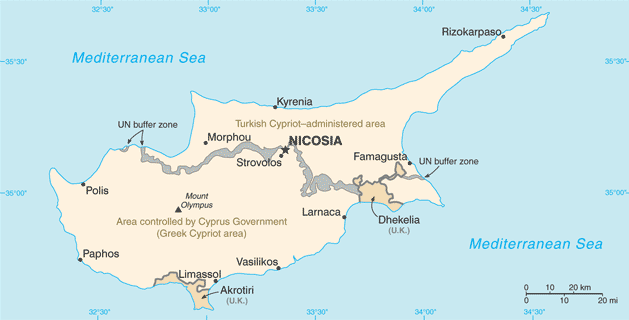
The problem entered its current phase in the aftermath of the 1974 Turkish invasion of Cyprus, occupying the northern third of Cyprus. Although the invasion was triggered by the 1974 Cypriot coup d'état, Turkish forces refused to depart after the legitimate government was restored. The Turkish Cypriot leadership later declared independence as the Turkish Republic of Northern Cyprus, although only Turkey has considered the move legal, and there continues to be broad international opposition to Northern Cyprus independence. According to the European Court of Human Rights, the Turkish Republic of Northern Cyprus should be considered a puppet state under effective Turkish occupation, and legitimately belongs to Cyprus. The United Nations Security Council Resolution 550 of 1984 calls for members of the United Nations to not recognize the Turkish Republic of Northern Cyprus.
As a result of the two communities and the guarantor countries committing themselves to finding a peaceful solution to the dispute, the United Nations maintains a buffer zone (known as the "Green Line") to avoid further intercommunal tensions and hostilities. This zone separates the southern areas of the Republic of Cyprus (predominantly inhabited by Greek Cypriots), from the northern areas (where Turkish Cypriots and Turkish settlers now reside). There was a warming of relations between Greek and Turkish Cypriots in the 2010s, with a renewal of talks officially beginning in early 2014. The Crans-Montana negotiations raised hopes for a long-term solution, but they ultimately stalled. UN-led talks in 2021 similarly failed.
The island of Cyprus was first inhabited in 9000 BC, with the arrival of farming societies who built round houses with floors of terrazzo. Cities were first built during the Bronze Age and the inhabitants had their own Eteocypriot language until around the 4th century BC. The island was part of the Hittite Empire as part of the Ugarit Kingdom during the late Bronze Age until the arrival of two waves of Greek settlement.
Cyprus experienced an uninterrupted Greek presence on the island dating from the arrival of Mycenaeans around 1400 BC, when the burials began to take the form of long dromos. The Greek population of Cyprus survived through multiple conquerors, including Egyptian and Persian rule. In the 4th century BC, Cyprus was conquered by Alexander the Great and then ruled by the Ptolemaic Egypt until 58 BC, when it was incorporated into the Roman Empire. In the division of the Roman Empire around the 4th century AD, the island was assigned to the predominantly Greek-speaking Byzantine Empire.
Roman rule in Cyprus was interrupted in 649, when the Arab armies of the Umayyad Caliphate invaded the island. Fighting over the island between the Muslims and Romans continued for several years, until in 668 the belligerents agreed to make Cyprus a condominium. This arrangement persisted for nearly 300 years, until a Byzantine army conquered the island in around 965. Cyprus would become a theme of the Byzantine Empire until the late 12th century.
Cyprus problem
The Cyprus problem, also known as the Cyprus conflict, Cyprus issue, Cyprus dispute, or Cyprus question, is an ongoing dispute between the Greek Cypriot and the Turkish Cypriot community in the north of the island of Cyprus, where troops of the Republic of Turkey are deployed. This dispute is an example of a protracted social conflict. The Cyprus dispute began after the Greek Cypriot community challenged the British occupation of the island in 1955, the 1974 Cypriot coup d'état executed by the Cypriot National Guard and sponsored by the Greek military junta, and the ensuing Turkish military invasion of the island, and hence the presence of Turkish soldiers, despite a legal reinstatement of a stable government. The desire of some of the ethnic Turkish people for the partition of the island of Cyprus through Taksim, the desire of some of the ethnic Greek people for the unification with Greece (Enosis), and mainland Turkish nationalists settling in as a show of force as a supposed means of protecting their people from what they considered to be the threat of Greek Cypriots also plays a role in the dispute.
Initially, with the occupation of the island by the British Empire from the Ottoman Empire in 1878 and subsequent annexation in 1914, the "Cyprus dispute" referred to general conflicts between Greek and Turkish islanders.
However, the current international complications of the dispute stretch beyond the boundaries of the island itself and involve the guarantor powers under the Zürich and London Agreement (namely Greece, Turkey and the United Kingdom), the United Nations, and the European Union. The now-defunct Czechoslovakia and Eastern Bloc had previously interfered politically.
The problem entered its current phase in the aftermath of the 1974 Turkish invasion of Cyprus, occupying the northern third of Cyprus. Although the invasion was triggered by the 1974 Cypriot coup d'état, Turkish forces refused to depart after the legitimate government was restored. The Turkish Cypriot leadership later declared independence as the Turkish Republic of Northern Cyprus, although only Turkey has considered the move legal, and there continues to be broad international opposition to Northern Cyprus independence. According to the European Court of Human Rights, the Turkish Republic of Northern Cyprus should be considered a puppet state under effective Turkish occupation, and legitimately belongs to Cyprus. The United Nations Security Council Resolution 550 of 1984 calls for members of the United Nations to not recognize the Turkish Republic of Northern Cyprus.
As a result of the two communities and the guarantor countries committing themselves to finding a peaceful solution to the dispute, the United Nations maintains a buffer zone (known as the "Green Line") to avoid further intercommunal tensions and hostilities. This zone separates the southern areas of the Republic of Cyprus (predominantly inhabited by Greek Cypriots), from the northern areas (where Turkish Cypriots and Turkish settlers now reside). There was a warming of relations between Greek and Turkish Cypriots in the 2010s, with a renewal of talks officially beginning in early 2014. The Crans-Montana negotiations raised hopes for a long-term solution, but they ultimately stalled. UN-led talks in 2021 similarly failed.
The island of Cyprus was first inhabited in 9000 BC, with the arrival of farming societies who built round houses with floors of terrazzo. Cities were first built during the Bronze Age and the inhabitants had their own Eteocypriot language until around the 4th century BC. The island was part of the Hittite Empire as part of the Ugarit Kingdom during the late Bronze Age until the arrival of two waves of Greek settlement.
Cyprus experienced an uninterrupted Greek presence on the island dating from the arrival of Mycenaeans around 1400 BC, when the burials began to take the form of long dromos. The Greek population of Cyprus survived through multiple conquerors, including Egyptian and Persian rule. In the 4th century BC, Cyprus was conquered by Alexander the Great and then ruled by the Ptolemaic Egypt until 58 BC, when it was incorporated into the Roman Empire. In the division of the Roman Empire around the 4th century AD, the island was assigned to the predominantly Greek-speaking Byzantine Empire.
Roman rule in Cyprus was interrupted in 649, when the Arab armies of the Umayyad Caliphate invaded the island. Fighting over the island between the Muslims and Romans continued for several years, until in 668 the belligerents agreed to make Cyprus a condominium. This arrangement persisted for nearly 300 years, until a Byzantine army conquered the island in around 965. Cyprus would become a theme of the Byzantine Empire until the late 12th century.
Recent media
Recent media