Hubbry Logo
TerrazzoTerrazzoMain
Open search
Terrazzo
Community hub
Terrazzo
logo
8 pages, 0 posts
0 subscribers
Be the first to start a discussion here.
Terrazzo
Terrazzo
from Wikipedia
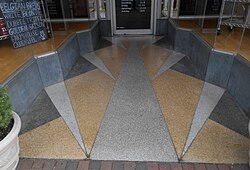
Terrazzo entryway on Beverley Street in Staunton, Virginia, U.S.
One of the most well known examples of terrazzo flooring is the Hollywood Walk of Fame.

Terrazzo is a composite material, poured in place or precast, which is used for floor and wall treatments. It consists of chips of marble, quartz, granite, glass, or other suitable material, poured with a cementitious binder (for chemical binding), polymeric (for physical binding), or a combination of both. Metal strips often divide sections, or changes in color or material in a pattern. Additional chips may be sprinkled atop the mix before it sets. After it is cured it is ground and polished smooth or otherwise finished to produce a uniformly textured surface. "Terrazzo" is also often used to describe any pattern similar to the original terrazzo floors.[1] Modern forms of terrazzo include polished concrete.

History

[edit]

Terrazzo proper

[edit]

Although the history of terrazzo can be traced back to the ancient mosaics of Egypt, its more recent predecessors come from Italy. The form of terrazzo used today derives partly from the 18th century pavimento alla Veneziana (Venetian pavement) and the cheaper seminato. Pavimento alla Veneziana had workers place marble fragments next to each other in a mortar base. Terrazzo is also related to the technique seminato for which workers tossed larger marble chips into the cement that was then ground and polished. Together, these methods create the generic form of terrazzo that involves pieces of stone that are bonded to a cement bed. Terrazzo was first introduced in the United States in the late 1890s, but did not achieve popularity until the 1920s.[2] Until then it was hand polished with a long handled tool called a galera.[2] Due to its likelihood of cracking, terrazzo was used at a small scale in comparison to the large expanses we see today. Two inventions resulted in its rise in popularity: divider strips and the electric grinding machine. The invention of divider strips by L. Del Turco and Bros. in 1924 contained the cracking of terrazzo by allowing the material greater space to expand and shrink after installation. This invention made terrazzo a durable and reliable material in addition to allowing for further design work within the floor.[3] Installers use the dividing strips as guides when they work with different colored terrazzo. Additionally, the electric grinding machine and mechanization of the production process cut down on costs and installation time, making terrazzo an affordable flooring option.

Art Deco and Moderne styles from the 1920s to 1940s favored terrazzo with the dividers allowing for straight or curved lines that increased the decorative potential.[4] The popularity of terrazzo led to an increase in installers in the 1920s. The National Terrazzo and Mosaic Organization was formed in 1931 to further professionalize the practice of terrazzo installation.[5] One of the best-known examples of terrazzo is the Hollywood Walk of Fame. Created in 1958, the walk honors celebrities in the form of a terrazzo star that displays their name.[6]

Archaeological use of the term

[edit]

Archaeologists have adopted the term terrazzo to describe the floors of early Neolithic buildings (PPNA and PPNB, ca. 9,000–8,000 BC) in Western Asia constructed of burnt lime and clay, colored red with ochre and polished. The embedded crushed limestone gives it a slightly mottled appearance. The use of fire to produce burnt lime, which was also used for the hafting of implements, predates production of fired pottery by almost a thousand years.[7] In the early Neolithic settlement of Çayönü in eastern Turkey about 90 m2 (970 sq ft) of terrazzo floors have been uncovered. The floors of the PPN B settlement of Nevalı Çori measure about 80 m2 (860 sq ft). They are 15 cm (5.9 in) thick, and contain about 10–15% lime.

These floors are almost impenetrable to moisture and very durable, but their construction involved a high input of energy. Gourdin and Kingery (1975) estimate that the production of any given amount of lime requires about five times that amount of wood.[8][clarification needed] Recent experiments by Affonso and Pernicka[9] have shown that only twice the amount is needed, but that would still amount to 4.5 metric tonnes of dry wood for the floors in Çayönü. Other sites with terrazzo floors include Nevalı Çori, Göbekli Tepe, Jericho, and Kastros (Cyprus).

Production

[edit]
Terrazzo with stylized Native-American design at the Hoover Dam
Terrazzo wall at the Gamla stan metro station, Stockholm

Terrazzo artisans create walls, floors, patios, and panels by exposing marble chips and other fine aggregates on the surface of finished concrete or epoxy-resin. Much of the preliminary work of terrazzo workers is similar to that of cement masons. Marble-chip, cementitious terrazzo requires three layers of materials. First, cement masons or terrazzo workers build a solid, level concrete foundation that is 3 to 4 inches (76 to 102 mm) deep. After the forms are removed from the foundation, workers add a 1 inch (25 mm) layer of sandy concrete. Before this layer sets, terrazzo workers partially embed metal divider strips in the concrete wherever there is to be a joint or change of color in the terrazzo. For the final layer, terrazzo workers blend and place into each of the panels a fine marble chip mixture that may be color-pigmented. While the mixture is still wet, workers toss additional marble chips of various colors into each panel and roll a weighted roller (100–125 pounds (45–57 kg)) over the entire surface.

In the 1970s, polymer-based terrazzo was introduced and is called thin-set terrazzo. Initially polyester and vinyl ester resins were used as the binder resin. Today, most of the terrazzo installed is epoxy terrazzo. The advantages of this material over cementitious terrazzo include a wider selection of colors, 14 to 38 inch (6.4 to 9.5 mm) installation thickness, lighter weight, faster installation, impermeable finish, higher strength, and less susceptibility to cracking. The disadvantage of epoxy resin–based terrazzo is that it can only be used for interior, not exterior, applications. Epoxy-based terrazzo will lose its color and slightly peel when used outdoors, whereas cement-based terrazzo will not. In addition to marble aggregate blends, other aggregates have been used, such as mother of pearl and abalone shell. Recycled aggregates include: glass, porcelain, concrete, and metal. Shapes and medallions can be fabricated on site by bending divider strips, or off site by water-jet cutting.

When the terrazzo is thoroughly cured, helpers grind it with a terrazzo grinder, which is somewhat like a floor polisher, only much heavier. Slight depressions left by the grinding are filled with a matching grout material and hand-troweled for a smooth, uniform surface; it is then cleaned, polished, and sealed.[10]

Types and systems

[edit]
Norfolk and Western Railway terrazzo logo, Roanoke, Virginia

Terrazzo installation includes both bonded and unbonded methods. Bonded systems include: bonded underbed, monolithic, chemically bonded, and the most recent, thin set method (epoxy resin). Bonded terrazzo is applied over a sand-cement mortar underbed which sits on top of a concrete slab. The sand-cement layer allows for variations in the finished concrete slab that it sits on. Monolithic terrazzo is applied directly over an extremely flat and high quality concrete sub-floor. Thin-set terrazzo does not require a concrete sub-floor. Instead, a flexible membrane can be installed so that cracks do not appear on the surface.[11] Unbonded includes the sand cushion method which uses wire reinforcing, an isolation sheet, and sand dusting that absorbs any movement from the concrete slab.[12]

Relation to mosaics

[edit]

Although terrazzo derives from the mosaic artform, it does not necessarily place individual pieces in a decorative pattern. Instead, small pieces are thrown into the mortar base creating a more uniform surface appearance. Decorative patterns are often created by using dividers which creates lines between different colored terrazzo mixtures.

Deterioration

[edit]

Cracking is a common form of failure and is often caused by the structural system that supports the terrazzo rather than the material itself. Contact with alkalis or acids can deteriorate the bonding agents used in terrazzo. As the aggregates are often marble dust which is calcium carbonate, strong acid can also cause deterioration to the aggregates. When partial replacement is necessary, a "bracketing" system mixing and matching different chips is used to create potential matches.[12] Aged terrazzo can be resurfaced to restore its original look by re-polishing.[13]

See also

[edit]

References

[edit]
[edit]
Revisions and contributorsEdit on WikipediaRead on Wikipedia
from Grokipedia
Terrazzo is a used primarily for flooring, walls, and countertops, consisting of aggregates such as , , , , or shell chips embedded in a cementitious or resinous (typically ) matrix, which is poured in place, troweled smooth, ground, and polished to achieve a seamless, durable finish. This technique originated in 15th-century , , where stonemasons repurposed discarded scraps by embedding them in clay or mortar bases and polishing the surface with hand tools, creating an affordable and decorative surfacing method for homes and public spaces. Archaeological evidence suggests even earlier precedents dating back to 8,000–10,000 BCE in the , where similar aggregate-in-binder floors were used in structures, though the Venetian style formalized the modern poured-in-place process. Introduced to the in the late by Italian immigrants, terrazzo gained prominence in the 1920s and 1930s with the advent of electric grinding equipment, enabling smoother polishes and broader applications in architecture, institutional buildings, and public works like the . The development of epoxy-based systems in the revolutionized the material, offering thinner installations (as low as 1/4 inch), greater color flexibility through pigments, and improved chemical resistance compared to traditional terrazzo, which remains favored for its classic aesthetic and outdoor suitability. Today, terrazzo is valued for its durability (lasting over 50 years with minimal ), customizability (allowing intricate patterns, , and unlimited color combinations via aggregates and binders), and sustainability (incorporating recycled materials and contributing to certifications through low VOC emissions and recyclability). Common uses span commercial spaces like airports, schools, and hospitals; residential interiors; and artistic installations, where its non-porous, slip-resistant surface ensures longevity and hygiene. Despite its strengths, terrazzo requires skilled installation to prevent cracking from substrate movement, and cement variants can stain if not properly sealed.

Definition and Materials

Composition and Characteristics

Terrazzo is a composite surface material consisting of aggregates such as , , , , or shell chips embedded in a binder matrix, typically or , which is poured in place or precast and then polished to create a smooth, durable finish primarily used for , walls, and countertops. The term "terrazzo" originates from the Italian word meaning "terrace," reflecting its historical development by Venetian artisans who repurposed scrap fragments to create terrace in workshops during the . Key characteristics of terrazzo include exceptional , with properly installed and maintained surfaces lasting 75 to 100 years or more due to its dense composition resistant to impact, abrasion, and heavy foot traffic. When sealed, it exhibits low , rendering it impervious to penetration and stains, which enhances its longevity and ease of maintenance. Its aesthetic versatility stems from the exposed aggregates, allowing for customizable colors, patterns, and textures through aggregate selection and binder pigmentation, while its properties help regulate indoor temperatures by absorbing and releasing heat slowly. Additionally, textured finishes, such as those in rustic or systems, provide non-slip surfaces that meet safety standards like ADA requirements for wet conditions. The basic for creating terrazzo involves mixing selected aggregates with the binder to form a pourable matrix, applying it to the substrate, allowing it to cure, and then grinding and polishing the surface to expose the chips and achieve a glossy sheen. This technique draws briefly from ancient precedents, where small stones were set into mortar, but terrazzo refines it into a monolithic, polished composite.

Aggregates and Binders

Aggregates in terrazzo flooring primarily consist of chipped materials such as , , , , mother-of-pearl shells, and metal fragments, selected for their aesthetic appeal and durability. These materials are crushed into irregular shapes to embed within the binder, providing the visible decorative surface after polishing. chips, derived from natural stone quarries, offer a classic veined appearance, while aggregates introduce translucent, vibrant effects; both are available in various colors to achieve custom designs. Sourcing considerations emphasize , with recycled from and scraps from fabrication processes reducing environmental impact and qualifying for certifications. Aggregate sizes are standardized by organizations like the National Terrazzo & Mosaic Association (NTMA) to ensure uniform distribution and compatibility with the terrazzo thickness, typically ranging from fine particles under 2 mm to coarse chips up to 20 mm in diameter. Fine aggregates, such as #0 size (dust to 1/16 inch or 0-1.6 mm), fill voids and enhance smoothness, while coarse #2 size (1/8 to 1/4 inch or 3-6 mm) creates bolder patterns in standard 3/8-inch installations. For systems, sizes are limited to #0 through #2 to maintain structural integrity in thinner applications, whereas cementitious systems accommodate larger chips up to 3/4 inch (19 mm) for rustic effects. Selection criteria include compatibility with the binder and desired finish, with finer sizes suiting high-traffic areas for better wear resistance. Binders serve as the matrix to hold aggregates together, with common types including cementitious formulations based on mixed with lime or for adhesion and flexibility. Epoxy resins, a two-part system comprising a and hardener, provide superior chemical resistance and seamless bonding, curing to a non-porous surface ideal for indoor environments. Polyacrylate binders modify with acrylic polymers to improve tensile strength and moisture tolerance, while resins offer an alternative resinous option with good UV stability for exterior uses. Binders can incorporate inorganic pigments to tint the matrix, complementing aggregate colors without altering the primary material properties. The interaction between aggregates and binders influences the final terrazzo's polishability and longevity, particularly through differences in material hardness measured on the . Softer aggregates like (3-4 Mohs) polish to a high sheen but may wear faster under abrasion, whereas harder (7 Mohs) enhances overall surface durability and maintains clarity during grinding. This variance requires careful matching: epoxy binders, with their , pair well with mixed-hardness aggregates to achieve uniform , while cementitious binders may highlight hardness contrasts in the finished texture. Typical proportions in terrazzo mixes allocate 70-80% aggregates by volume to the binder for optimal strength and , ensuring the chips dominate the visible surface post-polishing. In cementitious systems, a common ratio is 2 parts aggregate to 1 part by weight, adjusted with water for workability. formulations follow similar volume ratios but use precise resin-to-aggregate measurements, often 1:4 by weight, to minimize shrinkage during curing. These guidelines balance load-bearing capacity with decorative exposure, with higher aggregate content improving impact resistance.

History

Ancient Origins and Early Applications

The earliest known precursors to terrazzo appear in the period in the , where floors mixed with or aggregates were used in construction. Archaeological evidence from sites like in reveals terrazzo floors in rectangular buildings dating to the , around 9600–8000 BCE, marking an early innovation in durable surfacing for communal structures. Similarly, in southwest at Girmeler Cave near , special buildings with red-painted terrazzo floors, some containing human burials, date to the early seventh millennium BCE, suggesting ritual or social functions tied to nearby natural features like hot springs. These floors represented a shift from simple mud or earth surfaces to more stable composite materials, enhancing stability and durability in early settlements. In , particularly during the Roman era, a comparable technique known as emerged, consisting of combined with crushed pottery, tiles, or brick fragments to create hydraulic, waterproof surfaces. This material was widely employed from approximately 300 BCE to 500 CE across the , serving practical needs in water management and . Unlike modern Venetian terrazzo, which involves polished chips set in a binder, focused on functionality over , though it occasionally incorporated decorative elements. The term "terrazzo" is a retrospective misapplication in some archaeological descriptions of these ancient lime-aggregate floors, as it properly refers to the later Italian tradition; notable examples include plain or patterned pavements in Pompeii and , where it formed the base for mosaics or standalone flooring. Early applications of these materials emphasized utility in everyday and public settings, transitioning from rudimentary mud floors to engineered composites that resisted wear and moisture. In Roman contexts, lined baths, aqueducts, cisterns, and villa floors for its waterproofing properties, preventing dampness in high-traffic areas like thermal pools and courtyards. Public spaces, such as forums and basilicas, also benefited from its durability, while decorative variants added subtle patterns using colored aggregates. This innovation was driven by resource availability in ancient cultures, repurposing waste materials like broken pottery and local stone to create economical, resilient surfaces amid growing urban demands. These prehistoric and classical practices, rooted in lime-based binders and aggregates, provided foundational techniques that influenced later evolutions, such as the Venetian terrazzo of the .

Venetian Development and Modern Evolution

In the 15th and 16th centuries, Venetian artisans, known as terrazzieri, developed terrazzo as a resourceful technique in , , by embedding scraps of from local workshops into clay or on outdoor terraces, or "terrazzi," and polishing the surface with manual grinding stones to create a smooth, durable finish. This method originated from the need to repurpose waste materials amid high demand for mosaics during the , transforming discarded chips into affordable, decorative pavements that reflected the city's maritime wealth and craftsmanship. By the 18th century, terrazzo craftsmanship had formalized through guilds in , where terrazzieri organized to regulate training, quality, and trade, elevating the practice from utilitarian terraces to more intricate interior applications in palazzos and public spaces. These guilds fostered socio-economic stability for workers, many from the region, but began to fragment under economic pressures, setting the stage for migration. In the 1920s and 1930s, waves of Italian immigrants, particularly from Friuli villages, brought terrazzo expertise to the , where they adapted it for urban construction amid booming public and commercial projects. This influx led to the founding of the National Terrazzo & Mosaic Association (NTMA) in 1923 in by Italian-American contractor Gus Cassini, initially uniting 29 firms—80% Italian-owned—to standardize practices, promote the material, and address labor challenges in the growing American market. Terrazzo's evolution accelerated post-World War II, shifting from a luxury craft to a versatile commercial material, with peak popularity during the era of the 1920s, where its geometric patterns complemented bold, streamlined architecture in buildings like Beach's historic district. By the mid-20th century, it became integral to designs in the 1950s and 1960s, favored by architects like for its clean lines and seamless integration in residential and institutional spaces across the U.S. Southwest and . A notable example is the , installed starting in 1960, featuring over 2,700 pink terrazzo stars embedded with brass, symbolizing terrazzo's cultural icon status in public monuments. In the late , epoxy binders were introduced in the , enabling faster curing times—often under 24 hours compared to weeks for —and greater color flexibility, which broadened terrazzo's use in high-traffic while reducing labor costs and environmental impact through thinner pours. Entering the , trends emphasize sustainability, incorporating recycled aggregates like glass, oyster shells, and industrial byproducts to achieve credits for material reuse and low emissions, aligning with global green building standards. Digital design tools, such as software and robotic printers, now allow precise pattern customization, enabling complex logos and graphics that enhance terrazzo's adaptability in contemporary architecture.

Production and Installation

Traditional Cement-Based Methods

Traditional cement-based terrazzo involves a meticulous, labor-intensive process that relies on as the binder, combined with aggregates and pigments to create durable, decorative surfaces. The preparation begins with mixing the cement binder, typically white or gray , with water to form a slurry, into which aggregates such as marble chips are incorporated at a of approximately 70% aggregate to 30% binder by volume for optimal strength and appearance. Colors are added through pigments blended into the wet cement mix to achieve desired hues, ensuring even distribution before the aggregates are folded in using mechanical mixers or trowels to avoid segregation. Divider strips, essential for controlling patterns and accommodating , are installed prior to pouring; these are typically made of , , or and are set into the underlayment or directly on the slab at intervals of 4 to 6 feet to form bays that prevent cracking and define elements like borders or color fields. Pouring occurs directly over a prepared concrete slab, either as a monolithic single pour for uniform fields or in multi-color sequences where adjacent bays receive different mixes while the previous one is still workable; the mixture is spread to a thickness of about 1/2 inch using trowels and straightedges for leveling. Initial setting takes 24 to 48 hours, during which the surface is kept moist to prevent rapid drying, followed by a full of 7 to 28 days under controlled to achieve maximum hardness before grinding. Finishing transforms the rough pour into a polished surface through progressive grinding: coarse abrasives starting at #24 grit remove excess material and expose aggregates, progressing to finer up to #120 or higher for smoothness, using rotary grinders and buffing machines that create a wet for cooling and dust control. The process concludes with cleaning, application of penetrating sealers to enhance stain resistance and sheen, and optional buffing for a high-gloss finish. Site-specific considerations include underlayment preparation, such as embedding 1/4-inch rods or strips in the slab to ensure levelness and proper for drainage; thin-set systems bond the 3/8-inch-thick terrazzo directly to the slab with a latex-modified mortar bed, while thicker sand-bed systems use a 1.5- to 2-inch sand-cushion underlayment over wood or for sound isolation and crack suppression in multi-story applications. Compared to modern systems, cement-based methods require longer curing times, often extending project schedules by weeks.

Modern Epoxy and Alternative Systems

Modern epoxy terrazzo systems represent a significant advancement in flooring technology, utilizing binders to achieve enhanced performance characteristics compared to traditional cement-based methods. These systems typically consist of a two-part resin—comprising a (Part A) and a hardener (Part B)—mixed with selected aggregates such as , , or chips. The mixture is formulated to create a seamless, durable surface with a nominal thickness of 1/4 to 3/8 inch, allowing for installation over existing substrates without substantial structural modifications. Key advantages of epoxy terrazzo include rapid curing times, often achieving full hardness within 12 to 24 hours, which minimizes project downtime and enables quicker handover to other trades. This quick cure is facilitated by the between the and hardener, contrasting with longer hydration periods. Additionally, epoxy systems offer superior chemical resistance, low , and high tensile and compressive strengths, making them ideal for high-traffic environments like commercial lobbies and healthcare facilities. Their resiliency reduces cracking risks, and the ability to produce unlimited matrix colors provides extensive design flexibility. Applications commonly include poured-in-place seamless floors and precast tiles, where the thin profile supports in space-constrained areas. Alternative binders have expanded the options for non-cement terrazzo, addressing specific needs like cost, environmental impact, or installation conditions. Polyester resin binders, often used in prefabricated tiles, provide a more economical alternative to while maintaining good chemical and stain resistance. However, polyester systems emit higher volatile organic compounds (VOCs) during application, necessitating enhanced ventilation, and they exhibit greater brittleness, potentially leading to cracking under impact. Polyacrylate binders, typically polymer-modified cementitious formulations, offer a water-based, eco-friendly option with moderate and fast installation, suitable for areas with vapor transmission where pure might fail; these achieve a 3/8-inch thickness and support chip sizes from 0 to 2. Hybrid systems, such as -acrylic combinations, blend the durability of with the mineral aesthetic of , enabling low-VOC, joint-free installations up to 100 square meters while incorporating recycled aggregates for . Production of modern epoxy and alternative systems involves precise steps to ensure uniformity and performance. On-site methods begin with surface preparation, including priming the substrate, followed by mixing the binder components with pre-blended aggregates in ratios like 5:1 ( to hardener by volume); the mixture is then poured, troweled to level, and allowed to cure before grinding and polishing 16 to 48 hours later. For large areas, specialized mixing equipment and trowels facilitate even distribution, though pumps are occasionally used for self-leveling variants in expansive pours. Factory , common for or tiles, involves mold filling, curing in controlled environments, and finishing off-site for consistent quality and reduced on-site disruption. UV resistance additives, such as stabilizers, can be incorporated into formulations for light-exposed applications to prevent yellowing, enhancing longevity in non-interior settings. Since the 2000s, innovations in these systems have emphasized and functionality, aligning with standards. Low-VOC, LEED-certified formulas, often zero-VOC, have become standard, contributing to improved and earning credits in categories like Materials and Resources. additives, integrated into the matrix, inhibit bacterial and fungal growth, proving valuable in healthcare and environments by preventing formation without leaching. In the 2020s, advancements include bio-based binders and increased use of recycled plastics in aggregates—such as post-consumer glass and plastic chips—reducing embodied carbon while maintaining aesthetic versatility; these developments support principles, with some systems achieving up to 40% recycled content.

Types and Variations

Division and Placement Techniques

Terrazzo installations are categorized by division types that influence structural and surface appearance, including monolithic systems, which involve a seamless ½-inch-thick matrix poured directly onto a prepared for economical, on-grade applications. These systems rely on the substrate's flatness to minimize cracks, with divider strips placed according to underlying joints to manage shrinkage. Honed finishes, in contrast to polished ones, provide a matte surface achieved through finer grinding without full buffing, reducing reflectivity while maintaining smoothness for contemporary designs. Placement techniques vary by system to accommodate different substrates and movement tolerances, such as bonded terrazzo, where a 1¾-inch underbed and topping bond directly to the for interior use, requiring precise subfloor preparation to prevent reflective cracking. Thin-set epoxy systems apply a ⅜-inch layer over a crack-isolation , offering flexibility and rapid installation without a thick underbed, suitable for renovations. Floating or unbonded placements, like sand cushion systems, use a 2½- to 3-inch assembly with wire reinforcement, isolation sheets, and sand bedding to decouple the terrazzo from the slab, absorbing substrate defects and movements effectively. Precast terrazzo involves off-site fabrication of units like tiles or treads for modular assembly, reducing on-site time but requiring precise fitting, whereas poured-in-place methods allow seamless, custom pours directly on location for larger areas. Control joints are essential for managing expansion and contraction, typically formed with , aluminum, , or divider strips embedded during pouring to create panels and suppress cracks. According to NTMA guidelines, divider strips in cement-based systems form panels typically 4 feet by 4 feet or up to 25 square feet (aspect ratio 1.5:1) to align with pour lines per ACI 302.1R (e.g., maximum 12 feet for a 4-inch slab), while epoxy systems follow substrate joints at no more than 1.5 times the pour width, such as 9 feet maximum for a 6-foot corridor. In seismic zones, adaptations incorporate flexible membranes beneath the terrazzo to isolate cracks and absorb horizontal movements from earthquakes, as recommended by NTMA for enhanced durability in earthquake-prone regions. These membranes, often applied over control joints, prevent transmission of substrate shifts to the surface, ensuring long-term performance without compromising the binder's adhesion.

Design Patterns and Customization

Terrazzo offers a wide array of that enhance both aesthetic appeal and functional versatility in and surfaces. Common types include random chip scatter, where aggregates are distributed unevenly to create a speckled, organic appearance reminiscent of natural stone formations. Veined patterns utilize linear arrangements of aggregates to mimic the flowing lines of or veins, providing a more structured and directional visual flow. Inset designs incorporate , medallions, or custom motifs by embedding larger precast elements or stenciled outlines during the pouring process, allowing for personalized branding or artistic focal points. These patterns can vary in scale, from micro designs featuring fine chips under 1/8 inch for subtle textures to macro layouts with large inserts exceeding 1 inch, enabling designers to adapt the material for intimate spaces or expansive installations. Customization in terrazzo extends to precise color matching through the addition of pigments to the binder, which can produce hues ranging from earthy neutrals to vibrant accents while maintaining . Integration with complementary materials, such as inlays for contrasting grains or accents for metallic highlights, further personalizes designs by blending terrazzo's monolithic surface with tactile elements. Since the 2010s, (CAD) software has facilitated pre-planning by converting artistic sketches into digital files for precise stencil cutting via waterjet or ultrasonic machines, streamlining the transfer of intricate patterns to the final pour. Terrazzo functions as an industrialized evolution of traditional techniques, employing similar methods of chip embedding in a binder but achieving a seamless finish through mechanical rather than hand-setting individual tesserae. This approach shares historical roots with Byzantine artistry, where fragmented stones were arranged for decorative effect, influencing terrazzo's use in opulent architectural settings. In the 2020s, terrazzo trends have shifted toward biophilic designs that incorporate natural aggregates like recycled , , or shell to evoke organic environments and promote wellness through earthy tones and fluid patterns. Digital fabrication techniques, such as 3D-printed dividers, have emerged to create frameworks for these patterns, enabling complex geometries that were previously labor-intensive. Aggregate variety, including options like or , supports these customizable aesthetics by providing diverse textures and colors for pattern integration.

Applications and Uses

Architectural and Interior Design Contexts

Terrazzo is extensively used as in high-traffic public and commercial spaces, such as , schools, and buildings, where its seamless durability withstands heavy foot traffic and rolling loads. In addition to horizontal applications, terrazzo serves as wall panels and accents for aesthetic enhancement, countertops and stairs for its resistance to wear and impact, and vertical surfaces through thin pours that enable lightweight, pour-in-place installations up to 3/8 inch thick. In architectural styles, terrazzo holds iconic status in designs, where its polished aggregates complement clean lines and geometric patterns, and in Miami's hotels from the 1920s and 1930s, featuring original terrazzo floors that preserve the era's streamlined elegance, as seen in preserved lobbies of properties like the Shelborne and Marlin Hotel. In contemporary sustainable builds, terrazzo incorporates recycled aggregates like glass and stone to align with eco-friendly goals, appearing in modern commercial projects that prioritize low-VOC materials and resource efficiency. It meets accessibility standards through high slip resistance ratings compliant with ADA requirements, typically achieving coefficients of friction above 0.6 for wet and dry conditions. Furthermore, epoxy terrazzo integrates seamlessly with HVAC systems for radiant heating, as its thermal conductivity allows efficient heat distribution from underfloor hydronic or electric elements without compromising structural integrity. Terrazzo gained dominance in the United States following the , when Italian artisans and the advent of electric grinding equipment popularized cement-based terrazzo in public architecture during the era, leading to widespread adoption in institutional and commercial projects. In recent decades, it has seen a resurgence in and for luxury retail environments, where custom aggregate designs enhance high-end storefronts and interiors. This trend extends to the commercial boom in eco-hotels, featuring terrazzo with recycled materials for durable, low-impact luxury spaces.

Advantages, Limitations, and Case Examples

Terrazzo flooring is renowned for its exceptional durability and longevity, often lasting 50 to 100 years or more with regular maintenance such as periodic polishing and sealing, which minimizes the need for replacements and reduces long-term costs compared to materials like ceramic tile that may require renewal every 10-20 years. This extended lifespan stems from the material's composition of resilient aggregates embedded in a strong binder, making it highly resistant to wear, stains, and heavy foot traffic in commercial and residential settings. Additionally, terrazzo provides versatility in through a wide array of colors, patterns, and textures achieved by incorporating aggregates such as , , or into or binders, allowing for customized aesthetics that enhance architectural projects. From an economic perspective, while the upfront investment is significant, terrazzo proves cost-effective over its lifecycle, with lifecycle analyses showing annual maintenance costs as low as $0.80 per square foot over 40 years, versus higher cumulative expenses from frequent tile replacements that can exceed initial terrazzo outlays within a decade. Environmentally, terrazzo supports sustainability by utilizing up to 80% recycled materials like or chips, and its recyclability at end-of-life further reduces waste, contributing to credits for low-emitting and resource-efficient construction. Despite these benefits, terrazzo has notable limitations that can impact its suitability for certain applications. The initial installation cost is high, typically ranging from $20 to $50 per square foot for poured systems, driven by premium materials and skilled labor requirements that exceed those of vinyl or basic tile options. The process is labor-intensive, often taking several days to weeks for on-site pouring, grinding, and polishing, which demands experienced contractors and can disrupt project timelines in fast-paced builds. Cement-based terrazzo is prone to cracking if installed over unstable or poorly prepared substrates, such as those with excessive moisture or structural movement, potentially leading to reflective cracks that compromise appearance and integrity. terrazzo, while thinner and stronger, may yellow over time when exposed to ultraviolet (UV) light without UV stabilizers, affecting its visual appeal in sunlit areas unless mitigated with protective topcoats. Real-world applications highlight terrazzo's strengths and challenges. In the Guggenheim Museum in , designed by and completed in 1959, cement-based terrazzo floors cover expansive areas of the rotunda, demonstrating the material's enduring durability and seamless integration with modernist architecture; these floors, installed over 60 years ago, continue to perform with minimal intervention beyond routine cleaning. A modern example is the epoxy terrazzo installation at , completed in recent years, which incorporates recycled glass aggregates in various colors for over 100,000 square feet of flooring; this project showcases epoxy's thinner profile (3/8 inch) for easier retrofits, enhanced sustainability through recycled content, and resistance to high-traffic demands, though it required precise substrate preparation to avoid cracking in a dynamic environment. Compared to alternatives, terrazzo outperforms vinyl in durability, resisting scratches and fading far longer in high-use spaces, but it lacks the flexibility and cushioning of rubber flooring, which better absorbs impacts in areas like gyms or hospitals.

Maintenance and Sustainability

Installation Best Practices and Deterioration Factors

Proper installation of terrazzo requires meticulous substrate preparation to ensure and longevity. For both cement-based and systems, the substrate must be structurally sound, level within 1/4 inch over 10 feet, and free of contaminants such as dust, oils, or curing compounds. testing is essential; the maximum allowable vapor emission rate is 3 pounds per 1,000 square feet per 24 hours using the test (ASTM F1869), or relative below 75-80% using in-situ probes (ASTM F2170). If levels exceed these thresholds, vapor barriers or systems should be applied to prevent blistering or . Temperature control during installation is critical to avoid thermal stresses and ensure proper curing. Ambient, substrate, and material temperatures should be maintained between 50°F and 90°F, with no installation below 50°F or above 90°F to prevent incomplete curing or cracking. For terrazzo, the minimum is often 55°F to achieve optimal flow and bonding. Joint sealing involves placing divider strips at control joints and expansion joints, filled with flexible sealants to accommodate movement. Expansion joints must be aligned with underlying joints, typically spaced not to exceed 1.5 times the width of the concrete pour (e.g., maximum 12 feet for a 4-inch slab per ACI 302.1), to mitigate shrinkage and . Deterioration in terrazzo surfaces often stems from environmental and installation-related factors. In cement-based systems, alkali-silica reaction (ASR) occurs when reactive silica in aggregates reacts with alkalis in the cement, exacerbated by moisture, leading to expansive gel formation and cracking over time. Efflorescence, the appearance of white salt deposits on the surface, results from soluble salts in the cement or aggregates migrating with moisture to the surface and crystallizing upon evaporation. Staining from oils or chemicals is common in unsealed or porous installations, as terrazzo aggregates can absorb contaminants if not properly protected. For epoxy systems, delamination arises from poor substrate adhesion, often due to residual moisture or inadequate surface profiling, causing the resin matrix to separate from the base. Prevention strategies focus on controlled curing and to minimize these risks. Cement-based terrazzo requires moist curing for at least 72 hours to limit drying shrinkage, which can reach up to 0.1%, reducing the potential for random cracking. systems have negligible shrinkage but demand precise mixing ratios to avoid voids. Incorporating expansion joints as per underlying structure helps distribute stresses from building movement. Abrasion resistance of aggregates should be verified using ASTM C241, ensuring under foot traffic; typical terrazzo installations withstand heavy use without significant wear when properly formulated. Repair methods, such as grinding and resealing minor cracks, can extend but are addressed in subsequent guidelines.

Repair, Longevity, and Environmental Considerations

Repairing terrazzo involves targeted techniques to address stains, cracks, chips, and surface wear while preserving the material's integrity. For surface stains, professionals often perform shallow grinding using -impregnated pads to remove discoloration without compromising the overall thickness. Patching is common for cracks and chips, where a matching resin mixed with compatible aggregates is applied to fill voids, followed by grinding and polishing to blend seamlessly with the surrounding surface. In cases of extensive damage, full resurfacing may be required, involving the removal of deteriorated sections, preparation of the substrate, and application of a new thin layer of or cement-based terrazzo, typically using grinding tools for initial leveling. Terrazzo exhibits exceptional , with properly installed and maintained systems lasting 40 to 100 years or more. Factors influencing include installation and maintenance frequency, with indoor applications generally requiring less intervention than outdoor due to reduced exposure to weather. High-traffic areas may need more frequent to maintain appearance and prevent wear. Periodic sealing enhances resistance to and stains, further extending service life. Warranties from manufacturers and installers, such as those affiliated with the National Terrazzo & Mosaic Association (NTMA), typically range from 1 to 3 years, covering defects in materials and workmanship, though some systems offer extended coverage up to 10 years for specific performance guarantees. Environmentally, terrazzo benefits from low embodied carbon, particularly when incorporating recycled aggregates like or chips, which reduce the need for virgin materials and lower overall production impacts. As of 2025, many terrazzo formulations feature 70-80% recycled content, supporting practices and contributing to certifications. Modern epoxy binders emit low volatile organic compounds (VOCs), often zero or under 50 g/L, minimizing indoor during and after installation. At end-of-life, terrazzo is highly recyclable, with worn floors crushed and repurposed as aggregates for new or terrazzo, achieving up to 95% recovery rates. Sustainability trends emphasize practices, such as producing terrazzo from and demolition waste, as seen in innovations like Respo Circular Terrazzo, which diverts landfill-bound materials into durable . Certifications like Cradle to Cradle support these efforts by verifying material health, renewability, and recyclability in certified products.

References

Add your contribution
Related Hubs
User Avatar
No comments yet.