


Community hub
Recent from talks
Contribute something
Nothing was collected or created yet.
Cyprus problem
View on Wikipedia
| Cyprus problem | ||||||||
|---|---|---|---|---|---|---|---|---|
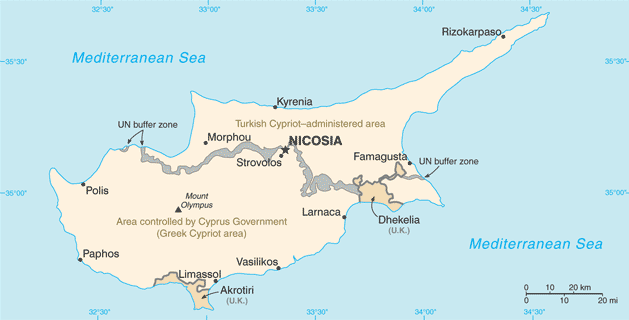
 Flag map showing the current division, with territory controlled by the internationally-recognised Cyprus and Turkish-backed Northern Cyprus separated by the UN buffer zone. UK bases (Akrotiri and Dhekelia) are also depicted. | ||||||||
| ||||||||
| Belligerents | ||||||||
 Cyprus CyprusSupported by:  Greece Greece (with international community recognition) |
 UNFICYP UNFICYP Akrotiri and Dhekelia (UK bases) Akrotiri and Dhekelia (UK bases) |
 Northern Cyprus Northern CyprusSupported by:  Turkey Turkey | ||||||
| Part of a series on the Cyprus dispute |
| Cyprus peace process |
|---|
 |
.svg) |
|---|

The Cyprus problem, also known as the Cyprus conflict, Cyprus issue, Cyprus dispute, or Cyprus question, is an ongoing dispute between the Greek Cypriot and the Turkish Cypriot community in the north of the island of Cyprus, where troops of the Republic of Turkey are deployed. This dispute is an example of a protracted social conflict. The Cyprus dispute began after the Greek Cypriot community challenged the British occupation of the island in 1955, the 1974 Cypriot coup d'état executed by the Cypriot National Guard and sponsored by the Greek military junta, and the ensuing Turkish military invasion of the island, and hence the presence of Turkish soldiers, despite a legal reinstatement of a stable government. The desire of some of the ethnic Turkish people for the partition of the island of Cyprus through Taksim, the desire of some of the ethnic Greek people for the unification with Greece (Enosis), and mainland Turkish nationalists settling in as a show of force as a supposed means of protecting their people from what they considered to be the threat of Greek Cypriots also plays a role in the dispute.
Initially, with the occupation of the island by the British Empire from the Ottoman Empire in 1878 and subsequent annexation in 1914, the "Cyprus dispute" referred to general conflicts between Greek and Turkish islanders.[1][2]
However, the current international complications of the dispute stretch beyond the boundaries of the island itself and involve the guarantor powers under the Zürich and London Agreement (namely Greece, Turkey and the United Kingdom), the United Nations, and the European Union. The now-defunct Czechoslovakia and Eastern Bloc had previously interfered politically.[3]
The problem entered its current phase in the aftermath of the 1974 Turkish invasion of Cyprus, occupying the northern third of Cyprus. Although the invasion was triggered by the 1974 Cypriot coup d'état, Turkish forces refused to depart after the legitimate government was restored. The Turkish Cypriot leadership later declared independence as the Turkish Republic of Northern Cyprus, although only Turkey has considered the move legal, and there continues to be broad international opposition to Northern Cyprus independence. According to the European Court of Human Rights, the Turkish Republic of Northern Cyprus should be considered a puppet state under effective Turkish occupation, and legitimately belongs to Cyprus.[4][5][6] The United Nations Security Council Resolution 550 of 1984 calls for members of the United Nations to not recognize the Turkish Republic of Northern Cyprus.
As a result of the two communities and the guarantor countries committing themselves to finding a peaceful solution to the dispute, the United Nations maintains a buffer zone (known as the "Green Line") to avoid further intercommunal tensions and hostilities. This zone separates the southern areas of the Republic of Cyprus (predominantly inhabited by Greek Cypriots), from the northern areas (where Turkish Cypriots and Turkish settlers now reside). There was a warming of relations between Greek and Turkish Cypriots in the 2010s, with a renewal of talks officially beginning in early 2014. The Crans-Montana negotiations raised hopes for a long-term solution, but they ultimately stalled.[7][8] UN-led talks in 2021 similarly failed.[9]
Historical background before 1960
[edit]
The island of Cyprus was first inhabited in 9000 BC, with the arrival of farming societies who built round houses with floors of terrazzo. Cities were first built during the Bronze Age and the inhabitants had their own Eteocypriot language until around the 4th century BC.[10] The island was part of the Hittite Empire as part of the Ugarit Kingdom[11] during the late Bronze Age until the arrival of two waves of Greek settlement.
Cyprus experienced an uninterrupted Greek presence on the island dating from the arrival of Mycenaeans around 1400 BC, when the burials began to take the form of long dromos.[12] The Greek population of Cyprus survived through multiple conquerors, including Egyptian and Persian rule. In the 4th century BC, Cyprus was conquered by Alexander the Great and then ruled by the Ptolemaic Egypt until 58 BC, when it was incorporated into the Roman Empire. In the division of the Roman Empire around the 4th century AD, the island was assigned to the predominantly Greek-speaking Byzantine Empire.
Roman rule in Cyprus was interrupted in 649, when the Arab armies of the Umayyad Caliphate invaded the island. Fighting over the island between the Muslims and Romans continued for several years, until in 668 the belligerents agreed to make Cyprus a condominium. This arrangement persisted for nearly 300 years, until a Byzantine army conquered the island in around 965. Cyprus would become a theme of the Byzantine Empire until the late 12th century.
After an occupation by the Knights Templar and the rule of Isaac Komnenos, the island in 1192 came under the rule of the Lusignan family, who established the Kingdom of Cyprus. In February 1489 it was seized by the Republic of Venice.[citation needed] Between September 1570 and August 1571 it was conquered by the Ottoman Empire,[citation needed] starting three centuries of Turkish rule over Cyprus.
Starting in the early 19th century, ethnic Greeks of the island sought to bring about an end to almost 300 years of Ottoman rule and unite Cyprus with Greece. The United Kingdom took administrative control of the island in 1878, to prevent Ottoman possessions from falling under Russian control following the Cyprus Convention, which led to the call for union with Greece (enosis) to grow louder.[citation needed] Under the terms of the agreement reached between Britain and the Ottoman Empire,[citation needed] the island remained an Ottoman territory.
The Christian Greek-speaking majority of the island welcomed the arrival of the British,[citation needed] as a chance to voice their demands for union with Greece.
When the Ottoman Empire entered World War I on the side of the Central Powers, Britain renounced the Agreement, rejected all Turkish claims over Cyprus and declared the island a British colony. In 1915, Britain offered Cyprus to Constantine I of Greece on the condition that Greece join the war on the side of the British, which he declined.[13]
1918 to 1955
[edit]
Under British rule in the early 20th century, Cyprus escaped the conflicts and atrocities that went on elsewhere between Greeks and Turks during the Greco-Turkish War and the 1923 population exchange between Greece and Turkey. Meanwhile, Turkish Cypriots consistently opposed the idea of union with Greece.
In 1925, Britain declared Cyprus a crown colony. In the years that followed, the determination of Greek Cypriots to achieve enosis continued. In 1931 this led to open revolt. A riot resulted in the death of six civilians, injuries to others and the burning of Britain's Government House in Nicosia. In the months that followed, about 2,000 people were convicted of crimes in connection with the struggle for union with Greece. Britain reacted by imposing harsh restrictions. Military reinforcements were dispatched to the island and the constitution suspended.[14][15] A special "epicourical" (reserve) police force was formed consisting of only Turkish Cypriots, press restrictions were instituted[16][17] and political parties were banned. Two bishops and eight other prominent citizens directly implicated in the conflict were exiled.[18] Municipal elections were suspended, and until 1943 all municipal officials were appointed by the government.[citation needed] The governor was to be assisted by an Executive Council, and two years later an Advisory Council was established; both councils consisted only of appointees and were restricted to advising on domestic matters only. In addition, the flying of Greek or Turkish flags or the public display of visages of Greek or Turkish heroes was forbidden.[citation needed]
The struggle for enosis was put on hold during World War II. In 1946, the British government announced plans to invite Cypriots to form a Consultative Assembly to discuss a new constitution. The British also allowed the return of the 1931 exiles.[19] Instead of reacting positively, as expected by the British, the Greek Cypriot military hierarchy reacted angrily because there had been no mention of enosis.[citation needed] The Cypriot Orthodox Church had expressed its disapproval, and Greek Cypriots declined the British invitation, stating that enosis was their sole political aim. The efforts by Greeks to bring about enosis now intensified, helped by active support of the Church of Cyprus, which was the main political voice of the Greek Cypriots at the time. However, it was not the only organisation claiming to speak for the Greek Cypriots. The Church's main opposition came from the Cypriot Communist Party (officially the Progressive Party of the Working People; Ανορθωτικό Κόμμα Εργαζόμενου Λαού; or AKEL), which also wholeheartedly supported the Greek national goal of enosis. However the British military forces and colonial administration in Cyprus did not see the pro-Soviet communist party as a viable partner.[citation needed]
During the 1940s, politically charged Turkish and Turkish-Cypriot newspaper reports, poems, and stories, including those by Dursun Cevlâni, contributed to a concerted effort to deny any Greek identity of the island and foster a political movement in support of a Turkish Cyprus.[20] By the mid-1950s, the "Cyprus is Turkish" party, movement, and slogan gained force in both Cyprus and Turkey.[20] In a 1954 editorial, Turkish Cypriot leader Dr. Fazil Kuchuk expressed the sentiment that the Turkish youth had grown up with the idea that "as soon as Great Britain leaves the island, it will be taken over by the Turks", and that "Turkey cannot tolerate otherwise".[21] By 1954 a number of Turkish mainland institutions were also active in the Cyprus issue such as the National Federation of Students, the Committee for the Defence of Turkish rights in Cyprus, the Welfare Organisation of Refugees from Thrace and the Cyprus Turkish Association.[citation needed] Above all, the Turkish trade unions were to prepare the right climate for the then main Turkish goal, the division of the island (taksim) into Greek and Turkish parts, thus keeping the British military presence and installations on the island intact. By this time a special Turkish Cypriot paramilitary organisation Turkish Resistance Organisation (TMT) was also established which was to act as a counterbalance to the Greek Cypriot enosis fighting organisation of EOKA.[22]

In 1950, Michael Mouskos, Bishop Makarios of Kition (Larnaca), was elevated to Archbishop Makarios III of Cyprus. In his inaugural speech, he vowed not to rest until union with "mother Greece" had been achieved.[citation needed] In Athens, enosis was a common topic of conversation, and a Cypriot native, Colonel George Grivas, was becoming known for his strong views on the subject. In anticipation of an armed struggle to achieve enosis, Grivas visited Cyprus in July 1951. He discussed his ideas with Makarios but was disappointed by the archbishop's contrasting opinion as he proposed a political struggle rather than an armed revolution against the British. From the beginning, and throughout their relationship, Grivas resented having to share leadership with the archbishop. Makarios, concerned about Grivas's extremism from their very first meeting, preferred to continue diplomatic efforts, particularly efforts to get the United Nations involved. The feelings of uneasiness that arose between them never dissipated. In the end, the two became enemies. In the meantime, on 16 August [Papagos Government] 1954, Greece's UN representative formally requested that self-determination for the people of Cyprus be applied.[23] Turkey rejected the idea of the union of Cyprus and Greece. Turkish Cypriot community opposed Greek Cypriot enosis movement, as under British rule the Turkish Cypriot minority status and identity were protected. Turkish Cypriot identification with Turkey had grown stronger in response to overt Greek nationalism of Greek Cypriots, and after 1954 the Turkish government had become increasingly involved. In the late summer and early autumn of 1954, the Cyprus problem intensified. On Cyprus the colonial government threatened publishers of seditious literature with up to two years imprisonment.[24] In December the UN General Assembly announced the decision "not to consider the problem further for the time being, because it does not appear appropriate to adopt a resolution on the question of Cyprus". Reaction to the setback at the UN was immediate and violent, resulting in the worst rioting in Cyprus since 1931.[citation needed]
EOKA campaign and creation of TMT, 1955–1959
[edit]
In January 1955, Grivas founded the National Organisation of Cypriot Fighters (Ethniki Organosis Kyprion Agoniston – EOKA). On 1 April 1955, EOKA opened an armed campaign against British rule in a coordinated series of attacks on police, military, and other government installations in Nicosia, Famagusta, Larnaca, and Limassol. This resulted in the deaths of 387 British servicemen and personnel[25] and some Greek Cypriots suspected of collaboration.[26] As a result of this a number of Greek Cypriots began to leave the police. This however did not affect the Colonial police force as they had already created the solely Turkish Cypriot (Epicourical) reserve force to fight EOKA paramilitaries. At the same time, it led to tensions between the Greek and Turkish Cypriot communities. In 1957 the Turkish Resistance Organisation (Türk Mukavemet Teşkilatı TMT), which had already been formed to protect the Turkish Cypriots from EOKA, took action. In response to the growing demand for enosis, a number of Turkish Cypriots became convinced that the only way to protect their interests and identity of the Turkish Cypriot population in the event of enosis would be to divide the island – a policy known as taksim ("partition" in Turkish borrowed from Taqsīm (تقسیم) in Arabic) – into a Greek sector in the south and a Turkish sector in the north.
Establishment of the constitution
[edit]By now the island was on the verge of civil war. Several attempts to present a compromise settlement had failed. Therefore, beginning in December 1958, representatives of Greece and Turkey, the so-called "mother lands" opened discussions of the Cyprus issue. Participants for the first time discussed the concept of an independent Cyprus, i.e., neither enosis nor taksim. Subsequent talks always headed by the British yielded a so-called compromise agreement supporting independence, laying the foundations of the Republic of Cyprus. The scene then naturally shifted to London, where the Greek and Turkish representatives were joined by representatives of the Greek Cypriots, the Turkish Cypriots (represented by Arch. Makarios and Dr Fazıl Küçük with no significant decision-making power), and the British. The Zürich-London agreements that became the basis for the Cyprus constitution of 1960 were supplemented with three treaties – the Treaty of Establishment, the Treaty of Guarantee, and the Treaty of Alliance. The general tone of the agreements was one of keeping the British sovereign bases and military and monitoring facilities intact. Some Greek Cypriots, especially members of organisations such as EOKA, expressed disappointment because enosis had not been attained. In a similar way some Turkish Cypriots especially members of organisations such as TMT expressed their disappointment as they had to postpone their target for taksim, however most Cypriots that were not influenced by the three so called guarantor powers (Greece, Turkey, and Britain), welcomed the agreements and set aside their demand for enosis and taksim. According to the Treaty of Establishment, Britain retained sovereignty over 256 square kilometres, which became the Dhekelia Sovereign Base Area, to the northeast of Larnaca, and the Akrotiri Sovereign Base Area to the southwest of Limassol.
Cyprus achieved independence on 16 August 1960.
Independence, constitutional breakdown, and intercommunal talks, 1960–1974
[edit]

According to constitutional arrangements, Cyprus was to become an independent, non-aligned republic with a Greek Cypriot president and a Turkish Cypriot vice-president. General executive authority was vested in a council of ministers with a ratio of seven Greeks to three Turks. (The Greek Cypriots represented 78% of the population and the Turkish Cypriots 18%. The remaining 4% was made up by the three minority communities: the Latins, Maronites and Armenians.) A House of Representatives of fifty members, also with a seven-to-three ratio, were to be separately elected by communal balloting on a universal suffrage basis. In addition, separate Greek Cypriot and Turkish Cypriot Communal Chambers were provided to exercise control in matters of religion, culture, and education. According to Article 78(2) "any law imposing duties or taxes shall require a simple majority of the representatives elected by the Greek and Turkish communities respectively taking part in the vote". Legislation on other subjects was to take place by simple majority but again the President and the vice-president had the same right of veto—absolute on foreign affairs, defence and internal security, delaying on other matters—as in the Council of Ministers. The judicial system would be headed by a Supreme Constitutional Court, composed of one Greek Cypriot and one Turkish Cypriot and presided over by a contracted judge from a neutral country. The Constitution of Cyprus, while establishing an independent and sovereign republic, was, in the words of de Smith, an authority on Constitutional Law, "Unique in its tortuous complexity and in the multiplicity of the safeguards that it provides for the principal minority; the Constitution of Cyprus stands alone among the constitutions of the world".[27] Within a short period of time the first disputes started to arise between the two communities. Issues of contention included taxation and the creation of separate municipalities. Because of the legislative veto system, this resulted in a lockdown in communal and state politics in many cases.
Crisis of 1963–1964
[edit]Repeated attempts to solve the disputes failed. Eventually, on 30 November 1963, Makarios put forward to the three guarantors a thirteen-point proposal designed, in his view, to eliminate impediments to the functioning of the government. The thirteen points involved constitutional revisions, including the abandonment of the veto power by both the president and the vice-president. Turkey initially rejected it (although later in future discussed the proposal). A few days later, on Bloody Christmas, 21 December 1963, fighting erupted between the communities in Nicosia. In the days that followed it spread across the rest of the island, resulting in the death of 364 Turkish Cypriots and 174 Greek Cypriots, and the forced displacement of 25,000 Turkish Cypriots. At the same time, the power-sharing government collapsed. How this happened is one of the most contentious issues in modern Cypriot history. The Greek Cypriots argue that the Turkish Cypriots withdrew to form their own administration. The Turkish Cypriots maintain that they were forced out. Many Turkish Cypriots chose to withdraw from the government. However, in many cases those who wished to stay in their jobs were prevented from doing so by the Greek Cypriots. Also, many of the Turkish Cypriots refused to attend because they feared for their lives after the recent violence that had erupted. There was even some pressure from the TMT as well. In any event, in the days that followed the fighting a frantic effort was made to calm tensions. In the end, on 27 December 1963, an interim peacekeeping force, the Joint Truce Force, was put together by Britain, Greece and Turkey. After the partnership government collapsed, the Greek Cypriot led administration was recognised as the legitimate government of the Republic of Cyprus at the stage of the debates in New York in February 1964.[28] The Joint Truce Force held the line until a United Nations peacekeeping force, UNFICYP, was formed following United Nations Security Council Resolution 186, passed on 4 March 1964.
Peacemaking efforts, 1964–1974
[edit]At the same time as it established a peacekeeping force, the Security Council also recommended that the Secretary-General, in consultation with the parties and the guarantor powers, designate a mediator to take charge of formal peacemaking efforts. U Thant, then the UN Secretary-General, appointed Sakari Tuomioja, a Finnish diplomat. While Tuomioja viewed the problem as essentially international in nature and saw enosis as the most logical course for a settlement, he rejected union on the grounds that it would be inappropriate for a UN official to propose a solution that would lead to the dissolution of a UN member state. The United States held a differing view. In early June, following another Turkish threat to intervene, Washington launched an independent initiative under Dean Acheson, a former Secretary of State. In July he presented a plan to unite Cyprus with Greece. In return for accepting this, Turkey would receive a sovereign military base on the island. The Turkish Cypriots would also be given minority rights, which would be overseen by a resident international commissioner. Makarios rejected the proposal, arguing that giving Turkey territory would be a limitation on enosis and would give Ankara too strong a say in the island's affairs. A second version of the plan was presented that offered Turkey a 50-year lease on a base. This offer was rejected by the Greek Cypriots and by Turkey. After several further attempts to reach an agreement, the United States was eventually forced to give up its effort.
Following the sudden death of Ambassador Tuomioja in August, Galo Plaza was appointed Mediator. He viewed the problem in communal terms. In March 1965 he presented a report criticising both sides for their lack of commitment to reaching a settlement. While he understood the Greek Cypriot aspiration of enosis, he believed that any attempt at union should be held in voluntary abeyance. Similarly, he considered that the Turkish Cypriots should refrain from demanding a federal solution to the problem. Although the Greek Cypriots eventually accepted the report, despite its opposition to immediate enosis, Turkey and the Turkish Cypriots rejected the plan, calling on Plaza to resign on the grounds that he had exceeded his mandate by advancing specific proposals. He was simply meant to broker an agreement. But the Greek Cypriots made it clear that if Galo Plaza resigned they would refuse to accept a replacement. U Thant was left with no choice but to abandon the mediation effort. Instead he decided to make his Good Offices available to the two sides via resolution 186 of 4 March 1964 and a Mediator was appointed. In his Report (S/6253, A/6017, 26 March 1965), the Mediator, now rejected by the Turkish Cypriot community, Dr Gala Plaza, criticized the 1960 legal framework, and proposed major amendments which were rejected by Turkey and Turkish Cypriots.
The end of the mediation effort was effectively confirmed when, at the end of the year, Plaza resigned and was not replaced.
In March 1966, a more modest attempt at peacemaking was initiated under the auspices of Carlos Bernades, the Secretary-General's Special Representative for Cyprus. Instead of trying to develop formal proposals for the parties to bargain over, he aimed to encourage the two sides agree to settlement through direct dialogue. However, ongoing political chaos in Greece prevented any substantive discussions from developing. The situation changed the following year.
On 21 April 1967, a coup d'état in Greece brought to power a military administration. Just months later, in November 1967, Cyprus witnessed its most severe bout of intercommunal fighting since 1964. Responding to a major attack on Turkish Cypriot villages in the south of the island, which left 27 dead, Turkey bombed Greek Cypriot forces and appeared to be readying itself for an intervention. Greece was forced to capitulate. Following international intervention, Greece agreed to recall General George Grivas, the Commander of the Greek Cypriot National Guard and former EOKA leader, and reduce its forces on the island.[29] Capitalising on the weakness of the Greek Cypriots, the Turkish Cypriots proclaimed their own provisional administration on 28 December 1967. Makarios immediately declared the new administration illegal. Nevertheless, a major change had occurred. The Archbishop, along with most other Greek Cypriots, began to accept that the Turkish Cypriots would have to have some degree of political autonomy. It was also realised that unification of Greece and Cyprus was unachievable under the prevailing circumstances.
In May 1968, intercommunal talks began between the two sides[30] under the auspices of the Good Offices of the UN Secretary-General. Unusually, the talks were not held between President Makarios and Vice-president Kucuk. Instead they were conducted by the presidents of the communal chambers, Glafcos Clerides and Rauf Denktaş. Again, little progress was made. During the first round of talks, which lasted until August 1968, the Turkish Cypriots were prepared to make several concessions regarding constitutional matters, but Makarios refused to grant them greater autonomy in return. The second round of talks, which focused on local government, was equally unsuccessful. In December 1969 a third round of discussion started. This time they focused on constitutional issues. Yet again there was little progress and when they ended in September 1970 the Secretary-General blamed both sides for the lack of movement. A fourth and final round of intercommunal talks also focused on constitutional issues, but again failed to make much headway before they were forced to a halt in 1974.
1974 Greek coup d'état and Turkish Intervention
[edit] |
The intercommunal strife was partly overshadowed by the division of the Greeks between the pro-independence Makarios, and the enosist National Front supported by the military junta of Greece. Grivas returned in 1971 and founded the EOKA-B, a militant enosist group, to oppose Makarios. Greece demanded Cyprus submit to its influence and the dismissal of the Cypriot foreign minister. Makarios survived an assassination attempt and retained enough popular support to remain in power. Enosist pressure continued to mount; although Grivas died suddenly in January 1974, a new junta had formed in Greece in September 1973.
In July 1974, the Cypriot National Guard launched a coup d'état that installed the pro-enosis Nikos Sampson as president. Makarios fled the country with British help. Faced with Greek control of the island, Turkey demanded that Greece dismiss Sampson, withdraw its armed forces, and respect Cyprus' independence; Greece refused. From the United States, envoy Joseph Sisco could not persuade Greece to accept Ecevit's Cyprus settlement which included Turkish-Cypriot control of a coastal region in the north and negotiations for a federal solution. The Soviet Union did not support enosis as it would strengthen NATO and weaken the left in Cyprus.
The Turkish invasion was driven by the assertive foreign policy of Bülent Ecevit, its prime minister, who was supported by his coalition partner Necmettin Erbakan. Turkey decided upon unilateral action after an invitation for joint action, made under the Treaty of Guarantee, was declined by Britain. On 20 July, Turkey invaded Cyprus with limited forces. The invasion achieved limited initial success, resulting in Greek forces occupying Turkish-Cypriot enclaves across the island. Within two days, Turkey secured a narrow corridor linking the northern coast with Nicosia, and on 23 July agreed to a cease-fire after securing a satisfactory bridgehead.
In Greece, the Turkish invasion caused political turmoil. On 23 July, the military junta collapsed and was replaced by Konstantinos Karamanlis's civilian government. On Cyprus the same day, Sampson was replaced by Acting President Glafcos Clerides in the absence of Makarios.
Formal peace talks convened two days later in Geneva, Switzerland, between Greece, Turkey and Britain. During the next five days, Turkey agreed to halt its advance on the condition that it would remain on the island until a political settlement was reached. Meanwhile, Turkish forces continued to advance as Greek forces occupied more Turkish-Cypriot enclaves. A new cease-fire line was agreed. On 30 July, the powers declared that the withdrawal of Turkish forces should be linked to a "just and lasting settlement acceptable to all parties concerned", with mentions of "two autonomous administrations – that of Greek-Cypriot community and that of the Turkish-Cypriot community".
Another round of talks was held on 8 August, this time including Cypriot representatives. Turkish Cypriots, supported by Turkey, demanded geographical separation from the Greek Cypriots; it was rejected by Makarios, who was committed to a unitary state. Deadlock ensued. On 14 August, Turkey demanded that Greece accept a Cypriot federal state, which would have resulted in the Turkish Cypriots - making up 18% of the population and 10% of land ownership – receiving 34% of the island. The talks ended when Turkey refused Clerides' request for 36 to 48 hours to consult the Cypriot and Greek governments. Within hours, Turkey launched a second offensive.[citation needed] Turkey controlled 36%[31] of the island by the time of the last ceasefire on 16 August 1974. The area between the combatants became a United Nations-administered buffer zone, or "green line".[32]
The Greek coup and Turkish invasion resulted in thousands of Cypriot casualties.[citation needed] The Government of Cyprus reported providing for 200,000 refugees.[33] 160,000[31] Greek Cypriots living in the Turkish-occupied northern region fled before Turkish forces or were evicted[citation needed]; they had made up 82% of the region's population. The United Nations approved the voluntary resettlement of the remaining 51,000 Turkish Cypriots in the south in the northern area; many had fled to the British areas and awaited permission to migrate to the Turkish-controlled area.
The divided island, 1974–1997
[edit]
At the second Geneva Conference beginning 9 August 1974, Turkey pressed for a federal solution to the problem against stiffening Greek resistance. While Turkish Cypriots wanted a bi-zonal federation, Turkey, under American advice, submitted a cantonal plan involving separation of Turkish-Cypriot areas from one another.[34] For security reasons Turkish-Cypriots did not favour cantons. Each plan embraced about thirty-four per cent of the territory.
These plans were presented to the conference on 13 August by the Turkish Foreign Minister, Turan Güneş. Clerides wanted thirty-six to forty-eight hours to consider the plans, but Güneş demanded an immediate response. This was regarded as unreasonable by the Greeks, the British, and the Americans, who were in close consultation.[35] Nevertheless, the next day, the Turkish forces extended their control to some 36 per cent of the island, afraid that delay would turn international opinion strongly against them.
Turkey's international reputation suffered as a result of the precipitous move of the Turkish military to extend control to a third of the island. The British prime minister regarded the Turkish ultimatum as unreasonable since it was presented without allowing adequate time for study. In Greek eyes, the Turkish proposals were submitted in the full awareness that the Greek side could not accept them, and reflected the Turkish desire for a military base in Cyprus. The Greek side went some way in their proposals by recognising Turkish 'groups' of villages and Turkish administrative 'areas'. But they stressed that the constitutional order of Cyprus should retain its bi-communal character based on the co-existence of the Greek and Turkish communities within the framework of a sovereign, independent and integral republic. Essentially the Turkish side's proposals were for geographic consolidation and separation and for a much larger measure of autonomy for that area, or those areas, than the Greek side could accept.
1975–1979
[edit]On 28 April 1975, Kurt Waldheim, the UN Secretary-General, launched a new mission of good offices. Starting in Vienna, over the course of the following ten months Clerides and Denktaş discussed a range of humanitarian issues relating to the events of the previous year. However, attempts to make progress on the substantive issues – such as territory and the nature of the central government – failed to produce any results. After five rounds, the talks fell apart in February 1976. In January 1977, the UN succeeded in organising a meeting in Nicosia between Makarios and Denktaş. This led to a major breakthrough. On 12 February, the two leaders signed a four-point agreement confirming that a future Cyprus settlement would be based on a federation. The size of the states would be determined by economic viability and land ownership. The central government would be given powers to ensure the unity of the state. Various other issues, such as freedom of settlement and freedom of movement, would be settled through discussion. Just months later, in August 1977, Makarios died. He was replaced by Spyros Kyprianou, the foreign minister.
In 1979 the ABC plan was presented by the US, as a proposal for a permanent solution of the Cyprus problem. It projected a Bicommunal Bizonal Federation with a strong central government. It was first rejected by the Greek Cypriot leader Spyros Kyprianou and later by Turkey.[36][37]
In May 1979, Waldheim visited Cyprus and secured a further ten-point set of proposals from the two sides. In addition to re-affirming the 1977 High-Level Agreement, the ten points also included provisions for the demilitarisation of the island and a commitment to refrain from destabilising activities and actions. Shortly afterwards a new round of discussions began in Nicosia. Again, they were short-lived. For a start, the Turkish Cypriots did not want to discuss Varosha, a resort quarter of Famagusta that had been vacated by Greek Cypriots when it was overrun by Turkish troops. This was a key issue for the Greek Cypriots. Second, the two sides failed to agree on the concept of 'bicommunalism'. The Turkish Cypriots believed that the Turkish Cypriot federal state would be exclusively Turkish Cypriot and the Greek Cypriot state would be exclusively Greek Cypriot. The Greek Cypriots believed that the two states should be predominantly, but not exclusively, made up of a particular community.
Turkish Cypriots' declaration of independence
[edit] |
|---|
| Constitution |
In May 1983, an effort by Javier Pérez de Cuéllar, then UN Secretary-General, foundered after the United Nations General Assembly passed a resolution calling for the withdrawal of all occupation forces from Cyprus. The Turkish Cypriots were furious at the resolution, threatening to declare independence in retaliation. Despite this, in August, Pérez de Cuéllar gave the two sides a set of proposals for consideration that called for a rotating presidency, the establishment of a bicameral assembly along the same lines as previously suggested, and 60:40 representation in the central executive. In return for increased representation in the central government, the Turkish Cypriots would surrender 8–13 per cent of the land in their possession. Both Kyprianou and Denktaş accepted the proposals. However, on 15 November 1983, the Turkish Cypriots took advantage of the post-election political instability in Turkey and unilaterally declared independence. Within days the Security Council passed a resolution, no.541 (13–1 vote: only Pakistan opposed) making it clear that it would not accept the new state and that the decision disrupted efforts to reach a settlement. Denktaş denied this. In a letter informing the Secretary-General of the decision, he insisted that the move guaranteed that any future settlement would be truly federal in nature. Although the 'Turkish Republic of Northern Cyprus' (TRNC) was soon recognised by Turkey, the rest of the international community condemned the move. The Security Council passed another resolution, no.550[38] (13–1 vote: again only Pakistan opposed) condemning the "purported exchange of ambassadors between Turkey and the Turkish Cypriot leadership".
The Restart of the Cyprus talks
[edit]In September 1984, talks resumed. After three rounds of discussions it was again agreed that Cyprus would become a bi-zonal, bi-communal, non-aligned federation. The Turkish Cypriots would retain 29 per cent for their federal state and all foreign troops would leave the island. In January 1985, the two leaders met for their first face-to-face talks since the 1979 agreement. However, while the general belief was that the meeting was being held to agree to a final settlement, Kyprianou insisted that it was a chance for further negotiations. The talks collapsed. In the aftermath, the Greek Cypriot leaders came in for heavy criticism, both at home and abroad. After that Denktaş announced that he would not make so many concessions again. Undeterred, in March 1986, de Cuéllar presented the two sides with a Draft Framework Agreement Archived 18 April 2005 at the Wayback Machine. Again, the plan envisaged the creation of an independent, non-aligned, bi-communal, bi-zonal state in Cyprus. However, the Greek Cypriots were unhappy with the proposals. They argued that the questions of removing Turkish forces from Cyprus was not addressed, nor was the repatriation of the increasing number of Turkish settlers on the island. Moreover, there were no guarantees that the full three freedoms would be respected. Finally, they saw the proposed state structure as being confederal in nature. Further efforts to produce an agreement failed as the two sides remained steadfastly attached to their positions.
The "Set of Ideas"
[edit]In August 1988, Pérez de Cuéllar called upon the two sides to meet with him in Geneva in August. There the two leaders – George Vasiliou and Rauf Denktaş – agreed to abandon the Draft Framework Agreement and return to the 1977 and 1979 High Level Agreements. However, the talks faltered when the Greek Cypriots announced their intention to apply for membership of the European Community (EC, subsequently EU), a move strongly opposed by the Turkish Cypriots and Turkey. Nevertheless, in June 1989, de Cuellar presented the two communities with the "Set of Ideas". Denktaş quickly rejected them as he not only opposed the provisions, he also argued that the UN Secretary-General had no right to present formal proposals to the two sides. The two sides met again, in New York, in February 1990. However, the talks were again short lived. This time Denktaş demanded that the Greek Cypriots recognise the existence of two peoples in Cyprus and the basic right of the Turkish Cypriots to self-determination.
On 4 July 1990, Cyprus formally applied to join the EC. The Turkish Cypriots and Turkey, which had applied for membership in 1987, were outraged. Denktaş claimed that Cyprus could only join the Community at the same time as Turkey and called off all talks with UN officials. Nevertheless, in September 1990, the EC member states unanimously agreed to refer the Cypriot application to the commission for formal consideration. In retaliation, Turkey and the TRNC signed a joint declaration abolishing passport controls and introducing a customs union just weeks later. Undeterred, Javier Pérez de Cuéllar continued his search for a solution throughout 1991. He made no progress. In his last report to the Security Council, presented in October 1991 under United Nations Security Council Resolution 716, he blamed the failure of the talks on Denktaş, noting the Turkish Cypriot leader's demand that the two communities should have equal sovereignty and a right to secession.
On 3 April 1992, Boutros Boutros-Ghali, the new UN Secretary-General, presented the Security Council with the outline plan for the creation of a bi-zonal, bi-communal federation that would prohibit any form of partition, secession or union with another state. While the Greek Cypriots accepted the Set of Ideas as a basis for negotiation, Denktaş again criticised the UN Secretary-General for exceeding his authority. When he did eventually return to the table, the Turkish Cypriot leader complained that the proposals failed to recognise his community. In November, Ghali brought the talks to a halt. He now decided to take a different approach and tried to encourage the two sides to show goodwill by accepting eight confidence building measures (CBMs). These included reducing military forces on the island, transferring Varosha to direct UN control, reducing restrictions on contacts between the two sides, undertaking an island-wide census and conducting feasibility studies regarding a solution. The Security Council endorsed the approach.
On 24 May 1993, the Secretary-General formally presented the two sides with his CBMs. Denktaş, while accepting some of the proposals, was not prepared to agree to the package as a whole. Meanwhile, on 30 June, the European Commission returned its opinion on the Cypriot application for membership. While the decision provided a ringing endorsement of the case for Cypriot membership, it refrained from opening the way for immediate negotiations. The Commission stated that it felt that the issue should be reconsidered in January 1995, taking into account "the positions adopted by each party in the talks". A few months later, in December 1993, Glafcos Clerides proposed the demilitarisation of Cyprus. Denktaş dismissed the idea, but the next month he announced that he would be willing to accept the CBMs in principle. Proximity talks started soon afterwards. In March 1994, the UN presented the two sides with a draft document outlining the proposed measures in greater detail. Clerides said that he would be willing to accept the document if Denktaş did, but the Turkish Cypriot leader refused on the grounds that it would upset the balance of forces on the island. Once again, Ghali had little choice but to pin the blame for another breakdown of talks on the Turkish Cypriot side. Denktas would be willing to accept mutually agreed changes, but Clerides refused to negotiate any further changes to the March proposals. Further proposals put forward by the Secretary-General in an attempt to break the deadlock were rejected by both sides.
Deadlock and legal battles, 1994–1997
[edit]At the Corfu European Council, held on 24–25 June 1994, the EU officially confirmed that Cyprus would be included in the Union's next phase of enlargement. Two weeks later, on 5 July, the European Court of Justice imposed restrictions on the export of goods from Northern Cyprus into the European Union. Soon afterwards, in December, relations between the EU and Turkey were further damaged when Greece blocked the final implementation of a customs union. As a result, talks remained completely blocked throughout 1995 and 1996.
In December 1996, the European Court of Human Rights (ECHR) delivered a landmark ruling that declared that Turkey was an occupying power in Cyprus. The case – Loizidou v. Turkey – centred on Titina Loizidou, a refugee from Kyrenia, who was judged to have been unlawfully denied the control of her property by Turkey. The case also had severe financial implications as the Court later ruled that Turkey should pay Mrs Loizidou US$825,000 in compensation for the loss of use of her property. Ankara rejected the ruling as politically motivated.
After twenty years of talks, a settlement seemed as far off as ever. However, the basic parameters of a settlement were by now internationally agreed. Cyprus would be a bi-zonal, bi-communal federation. A solution would also be expected to address the following issues:
- Constitutional framework
- Territorial adjustments
- Return of property to pre-1974 owners and/or compensation payments
- Return of displaced persons
- Demilitarisation of Cyprus
- Residency rights/repatriation of Turkish settlers
- Future peacekeeping arrangements
August 1996 incidents
[edit]In August 1996, Greek Cypriot refugees demonstrated with a motorcycle protest in Deryneia against the Turkish occupation of Cyprus. The ‘Motorcyclists March’ involved 2000 bikers from European countries and was organised by the Motorcyclists’ Federation of Cyprus.[39] The rally begun from Berlin to Kyrenia (a city in Occupied Cyprus) in commemoration of the twenty-second year of Cyprus as a divided country and aimed to cross the border using peaceful means.[39] The demonstrators' demand was the complete withdrawal of Turkish troops and the return of Cypriot refugees to their homes and properties. Among them was Tassos Isaac who was beaten to death.[40]
Another man, Solomos Solomou, was shot to death by Turkish troops while he was climbing to a flagpole to strike Turkish Flag during the same protests on 14 August 1996.[41] An investigation by authorities of the Republic of Cyprus followed, and the suspects were named as Kenan Akin and Erdan Emanet. International legal proceedings were instigated and arrest warrants for both were issued via Interpol.[42] During the demonstrations on 14 August 1996, two British soldiers were also shot by the Turkish forces: Neil Emery and Jeffrey Hudson, both from 39th Regiment Royal Artillery. Bombardier Emery was shot in his arm, whilst Gunner Hudson was shot in the leg by a high velocity rifle round and was airlifted to hospital in Nicosia then on to RAF Akrotiri.
Missile crisis
[edit]The situation took another turn for the worse at the start of 1997 when the Greek Cypriots announced that they intended to purchase the Russian-made S-300 anti-aircraft missile system.[43] Soon afterwards, the Cyprus Missile Crisis started.[44] The crisis effectively ended in December 1998 with the decision of the Cypriot government to transfer the S-300s to Crete, in exchange for alternative weapons from Greece.
EU accession and the settlement process, 1997–present
[edit]
.svg)
In 1997 the basic parameters of the Cyprus Dispute changed. A decision by the European Union to open up accession negotiations with the Republic of Cyprus created a new catalyst for a settlement. Among those who supported the move, the argument was made that Turkey could not have a veto on Cypriot accession and that the negotiations would encourage all sides to be more moderate. However, opponents of the move argued that the decision would remove the incentive of the Greek Cypriots to reach a settlement. They would instead wait until they became a member and then use this strength to push for a settlement on their terms. In response to the decision, Rauf Denktaş announced that he would no longer accept federation as a basis for a settlement. In the future he would only be prepared to negotiate on the basis of a confederal solution. In December 1999 tensions between Turkey and the European Union eased somewhat after the EU decided to declare Turkey a candidate for EU membership, a decision taken at the Helsinki European Council. At the same time a new round of talks started in New York. These were short lived. By the following summer they had broken down. Tensions started to rise again as a showdown between Turkey and the European Union loomed over the island's accession.
Perhaps realising the gravity of the situation, and in a move that took observers by surprise, Rauf Denktaş wrote to Glafcos Clerides on 8 November 2001 to propose a face-to-face meeting. The offer was accepted. Following several informal meetings between the two men in November and December 2001 a new peace process started under UN auspices on 14 January 2002. At the outset the stated aim of the two leaders was to try to reach an agreement by the start of June that year. However, the talks soon became deadlocked. In an attempt to break the impasse, Kofi Annan, the UN Secretary-General visited the island in May that year. Despite this no deal was reached. After a summer break Annan met with the two leaders again that autumn, first in Paris and then in New York. As a result of the continued failure to reach an agreement, the Security Council agreed that the Secretary-General should present the two sides with a blueprint settlement. This would form the basis of further negotiations. The original version of the UN peace plan was presented to the two sides by Annan on 11 November 2002. A little under a month later, and following modifications submitted by the two sides, it was revised (Annan II). It was hoped that this plan would be agreed by the two sides on the margins of the European Council, which was held in Copenhagen on 13 December. However, Rauf Denktaş, who was recuperating from major heart surgery, declined to attend. After Greece threatened to veto the entire enlargement process unless Cyprus was included in the first round of accession,[45] the EU was forced to confirm that Cyprus would join the EU on 1 May 2004, along with Malta and eight other states from Central and Eastern Europe.


Although it had been expected that talks would be unable to continue, discussions resumed in early January 2003. Thereafter, a further revision (Annan III) took place in February 2003, when Annan made a second visit to the island. During his stay he also called on the two sides to meet with him again the following month in The Hague, where he would expect their answer on whether they were prepared to put the plan to a referendum. While the Greek Cypriot side, which was now led by Tassos Papadopoulos, agreed to do so, albeit reluctantly, Rauf Denktaş refused to allow a popular vote. The peace talks collapsed. A month later, on 16 April 2003, Cyprus formally signed the EU Treaty of Accession at a ceremony in Athens.
Throughout the rest of the year there was no effort to restart talks. Instead, attention turned to the Turkish Cypriot elections, which were widely expected to see a victory by moderate pro-solution parties. In the end, the assembly was evenly split. A coalition administration was formed that brought together the pro-solution CTP and the Democrat Party, which had traditionally taken the line adopted by Rauf Denktaş. This opened the way for Turkey to press for new discussions. After a meeting between Recep Tayyip Erdoğan and Kofi Annan in Switzerland, the leaders of the two sides were called to New York. There they agreed to start a new negotiation process based on two phases: phase one, which would just involve the Greek and Turkish Cypriots, being held on the island and phase two, which would also include Greece and Turkey, being held elsewhere. After a month of negotiations in Cyprus, the discussions duly moved to Burgenstock, Switzerland. The Turkish Cypriot leader Rauf Denktaş rejected the plan outright and refused to attend these talks. Instead, his son Serdar Denktaş and Mehmet Ali Talat attended in his place. There a fourth version of the plan was presented. This was short-lived. After final adjustments, a fifth and final version of the Plan was presented to the two sides on 31 March 2004.
The UN plan for settlement (Annan Plan)
[edit] |


Under the final proposals, the Republic of Cyprus would become the United Cyprus Republic. It would be a loose federation composed of two component states. The northern Turkish Cypriot constituent state would encompass about 28.5% of the island, the southern Greek Cypriot constituent state would be made up of the remaining 71.5%. Each part would have had its own parliament. There would also be a bicameral parliament on the federal level. In the Chamber of Deputies, the Turkish Cypriots would have 25% of the seats. (While no accurate figures are currently available, the split between the two communities at independence in 1960 was approximately 80:20 in favour of the Greek Cypriots.) The Senate would consist of equal parts of members of each ethnic group. Executive power would be vested in a presidential council. The chairmanship of this council would rotate between the communities. Each community would also have the right to veto all legislation.
One of the most controversial elements of the plan concerned property. During Turkey's military intervention/invasion in 1974, many Greek Cypriots (who owned 70% of the land and property in the north) were forced to abandon their homes. (Thousands of Turkish Cypriots were also forced to abandon their homes in the South.) Since then, the question of restitution of their property has been a central demand of the Greek Cypriot side. However, the Turkish Cypriots argue that the complete return of all Greek Cypriot properties to their original owners would be incompatible with the functioning of a bi-zonal, bi-communal federal settlement. To this extent, they have argued compensation should be offered. The Annan Plan attempted to bridge this divide. In certain areas, such as Morphou (Güzelyurt) and Famagusta (Gazimağusa), which would be returned to Greek Cypriot control, Greek Cypriot refugees would have received back all of their property according to a phased timetable. In other areas, such as Kyrenia (Girne) and the Karpass Peninsula, which would remain under Turkish Cypriot control, they would be given back a proportion of their land (usually one third assuming that it had not been extensively developed) and would receive compensation for the rest. All land and property (that was not used for worship) belonging to businesses and institutions, including the Church, the largest property owner on the island, would have been expropriated. While many Greek Cypriots found these provisions unacceptable in themselves, many others resented the fact that the Plan envisaged all compensation claims by a particular community to be met by their own side. This was seen as unfair as Turkey would not be required to contribute any funds towards the compensation.
Apart from the property issue, there were many other parts of the plan that sparked controversy. For example, the agreement envisaged the gradual reduction in the number of Greek and Turkish troops on the island. After six years, the number of soldiers from each country would be limited to 6,000. This would fall to 600 after 19 years. Thereafter, the aim would be to try to achieve full demilitarisation, a process that many hoped would be made possible by Turkish accession to the European Union. The agreement also kept in place the Treaty of Guarantee – an integral part of the 1960 constitution that gave Britain, Greece and Turkey a right to intervene militarily in the island's affairs. Many Greek Cypriots were concerned that the continuation of the right of intervention would give Turkey too large a say in the future of the island. However, most Turkish Cypriots felt that a continued Turkish military presence was necessary to ensure their security. Another element of the plan the Greek Cypriots objected to was that it allowed many Turkish citizens who had been brought to the island to remain. (The exact number of these Turkish 'settlers' is highly disputed. Some argue that the figure is as high as 150,000 or as low as 40,000. They are seen as settlers illegally brought to the island in contravention of international law. However, while many accepted Greek Cypriot concerns on this matter, there was a widespread feeling that it would be unrealistic – and legally and morally problematic – to forcibly remove every one of these settlers, especially as many of them had been born and raised on the island.)
Referendums, 24 April 2004
[edit]Under the terms of the plan, the Annan plan would only come into force if accepted by the two communities in simultaneous referendums. These were set for 24 April 2004. In the weeks that followed there was intense campaigning in both communities. However, and in spite of opposition from Rauf Denktaş, who had boycotted the talks in Switzerland, it soon became clear that the Turkish Cypriots would vote in favour of the agreement. Among Greek Cypriots opinion was heavily weighted against the plan. Tassos Papadopoulos, the president of Cyprus, in a speech delivered on 7 April called on Greek Cypriots to reject the plan. His position was supported by the centrist Diko party and the socialists of EDEK as well as other smaller parties. His major coalition partner AKEL, one of the largest parties on the island, chose to reject the plan bowing to the wishes of the majority of the party base. Support for the plan was voiced by Democratic Rally (DISY) leadership, the main right-wing party, despite opposition to the plan from the majority of party followers, and the United Democrats, a small centre-left party led by George Vasiliou, a former president. Glafcos Clerides, now retired from politics, also supported the plan. Prominent members of DISY who did not support the Annan plan split from the party and openly campaigned against it. The Greek Cypriot Church also opposed the plan in line with the views of the majority of public opinion.
The United Kingdom (a guarantor power) and the United States came out in favour of the plan. Turkey signalled its support for the plan. The Greek Government decided to remain neutral. However, Russia was troubled by an attempt by Britain and the US to introduce a resolution in the UN Security Council supporting the plan and used its veto to block the move. This was done because they believed that the resolution would provide external influence to the internal debate, which they did not view as fair.[46]
In 24 April referendum the Turkish Cypriots endorsed the plan by a margin of almost two to one. However, the Greek Cypriots resoundingly voted against the plan, by a margin of about three to one.
| Referendum result | Yes | No | Turnout | ||
|---|---|---|---|---|---|
| Total | % | Total | % | ||
| Turkish Cypriot community | 50,500 | 64.90% | 14,700 | 35.09% | 87% |
| Greek Cypriot Community | 99,976 | 24.17% | 313,704 | 75.83% | 88% |
| Total legitimate ballots in all areas | 150,500 | 31.42% | 328,500 | 68.58% | |
The Cyprus dispute after the referendum
[edit] | This section needs to be updated. (October 2016) |
In 2004, the Turkish Cypriot community was awarded "observer status" in the Parliamentary Assembly of the Council of Europe (PACE), as part of the Cypriot delegation. Since then, two Turkish Cypriot representatives of PACE have been elected in the Assembly of Northern Cyprus.[47][48]
On 1 May 2004, a week after the referendum, Cyprus joined the European Union. Under the terms of accession the whole island is considered to be a member of the European Union. However, the terms of the acquis communautaire, the EU's body of laws, have been suspended in Northern Cyprus.[49]

After the referendum, in June 2004, the Turkish Cypriot community, despite the objection of the Cypriot government, had its designation at the Organisation of Islamic Cooperation, of which it has been an observer since 1979, changed to the "Turkish Cypriot State".[50]
Despite initial hopes that a new process to modify the rejected plan would start by autumn, most of the rest of 2004 was taken up with discussions over a proposal by the European Union to open up direct trade with the Turkish Cypriots and provide €259,000,000 in funds to help them upgrade their infrastructure. This provoked considerable debate. The Greek Cypriots stated that there can be no direct trade via ports and airports in Northern Cyprus as these are unrecognised and said that Turkish Cypriots should use Greek Cypriot facilities in the south are they are internationally recognised. This was rejected by the Turkish Cypriots as insincere and mocking by Papadopoulos and his government. At the same time, attention turned to the question of the start of Turkey's future membership of the European Union. At a European Council held on 17 December 2004, and despite earlier Greek Cypriot threats to impose a veto, Turkey was granted a start date for formal membership talks on condition that it signed a protocol extending the customs union to the new entrants to the EU, including Cyprus. Assuming this was done, formal membership talks would begin on 3 October 2005.
Following the defeat of the UN plan in the referendum there has been no attempt to restart negotiations between the two sides. While both sides have reaffirmed their commitment to continuing efforts to reach an agreement, the UN Secretary-General has not been willing to restart the process until he can be sure that any new negotiations will lead to a comprehensive settlement based on the plan he put forward in 2004. To this end, he asked the Greek Cypriots to present a written list of the changes they would like to see made to the agreement. This was rejected by President Tassos Papadopoulos on the grounds that no side should be expected to present their demands in advance of negotiations. However, it appears as though the Greek Cypriots would be prepared to present their concerns orally. Another Greek Cypriot concern centres on the procedural process for new talks. Mr. Papadopoulos said that he would not accept arbitration or timetables for discussions. The UN fears that this would lead to another open-ended process that could drag on indefinitely.
In October 2012, Northern Cyprus became an "observer member" country of the Economic Cooperation Organization under the name "Turkish Cypriot State".
According to Stratis Efthymiou, even though defeated, the referendum had a formative impact on the Greek Cypriot community;[51] Greek Cypriots felt that reunification is a touchable reality, and this undermined the nationalist struggle and ideas of military defence. According to Efthymiou, since the referendum, the phenomenon of draft dodging has become prevalent and the defence budget has turned into a trivial amount.[51]
Formula One and the Cyprus dispute
[edit]The podium display after the 2006 Turkish Grand Prix caused a controversy, when winner Felipe Massa received the trophy from Mehmet Ali Talat, who was referred to as the "President of the Turkish Republic of Northern Cyprus". The government of the Republic of Cyprus filed an official complaint with the FIA. After investigating the incident, the FIA fined the organisers of the Grand Prix $5 million on 19 September 2006.[52] The Turkish Motorsports Federation (TOSFED) and the organisers of the Turkish Grand Prix (MSO) agreed to pay half the fined sum pending an appeal to be heard by the FIA International Court of Appeal on 7 November 2006.[53] TOSFED insisted the move was not planned and that Talat did fit FIA's criteria for podium presentations as a figure of world standing. It is likely that the FIA wanted to repair their impartiality in international politics, the FIA stood their ground forcing the appeal to be withdrawn.[54]
2008 elections in the Republic of Cyprus
[edit]
In the 2008 presidential elections, Papadopoulos was defeated by AKEL candidate Dimitris Christofias, who pledged to restart talks on reunification immediately.[55] Speaking on the election result, Mehmet Ali Talat stated that "this forthcoming period will be a period during which the Cyprus problem can be solved within a reasonable space of time – despite all difficulties – provided that there is will".[56] Christofias held his first meeting as president with the Turkish Cypriot leader on 21 March 2008 in the UN buffer zone in Nicosia.[57] At the meeting, the two leaders agreed to launch a new round of "substantive" talks on reunification, and to reopen Ledra Street, which has been cut in two since the intercommunal violence of the 1960s and has come to symbolise the island's division.[58] On 3 April 2008, after barriers had been removed, the Ledra Street crossing was reopened in the presence of Greek and Turkish Cypriot officials.[59]
2008–2012 negotiations and tripartite meetings
[edit]A first meeting of the technical committees was set to take place on 18 April 2008.[60] Talat and Christofias met socially at a cocktail party on 7 May 2008,[61] and agreed to meet regularly to review the progress of the talks so far.[62] A second formal summit was held on 23 May 2008 to review the progress made in the technical committees.[63] At a meeting on 1 July 2008, the two leaders agreed in principle on the concepts of a single citizenship and a single sovereignty,[64] and decided to start direct reunification talks very soon;[65] on the same date, former Australian foreign minister Alexander Downer was appointed as the new UN envoy for Cyprus.[66] Christofias and Talat agreed to meet again on 25 July 2008 for a final review of the preparatory work before the actual negotiations would start.[67] Christofias was expected to propose a rotating presidency for the united Cypriot state.[68] Talat stated he expected they would set a date to start the talks in September, and reiterated that he would not agree to abolishing the guarantor roles of Turkey and Greece,[69][70] with a reunification plan would be put to referendums in both communities after negotiations.[71]
In December 2008, the Athenian socialist daily newspaper To Vima described a "crisis" in relations between Christofias and Talat, with the Turkish Cypriots beginning to speak openly of a loose "confederation",[72][clarification needed] an idea strongly opposed by South Nicosia. Tensions were further exacerbated by Turkey's harassment of Cypriot vessels engaged in oil exploration in the island's Exclusive Economic Zone, and by the Turkish Cypriot leadership's alignment with Ankara's claim that Cyprus has no continental shelf.
On 29 April 2009, Talat stated that if the Court of Appeal of England and Wales (that will put the last point in Orams' case) makes a decision in the same spirit as the decision of European Court of Justice (ECJ) then the negotiation process in Cyprus will be damaged[73] in such a way that it will never be repaired once more.[74][full citation needed] The European Commission warned the Republic of Cyprus not to turn Orams' legal fight to keep their holiday home into a political battle over the divided island.[citation needed]
On 31 January 2010, United Nations Secretary-General Ban Ki-moon arrived in Cyprus to accelerate talks aimed at reuniting the country.[75] The election of nationalist Derviş Eroğlu of the National Unity Party as president in Northern Cyprus on was expected to complicate reunification negotiations;[76] however, Eroǧlu stated that he was now also in favour of a federal state, a change from his previous positions.[77]
A series of five tripartite meetings took place from 2010 to 2012, with Ban, Christofias and Eroǧlu negotiating, but without any agreement on the main issues. When asked about the process in March 2011, Ban replied "The negotiations cannot be an open-ended process, nor can we afford interminable talks for the sake of talks".[78] That month saw the 100th negotiation since April 2008 without any agreement over the main issues- a deadlock that continued through the next year and a half despite a renewed push for Cyprus to unite and take over the EU presidency in 2012.[79]
Talks began to fall apart in 2012, with Ban Ki-moon stating that "there is not enough progress on core issues of reunification talks for calling an international conference".[80][full citation needed] Special Advisor of the Secretary-General Alexander Downer further commented that "If the Greek Cypriot and Turkish Cypriot Leaders cannot agree with each other on a model for a united Cyprus, then United Nations cannot make them".[81][full citation needed] Eroglu stated that joint committees with the Greek Cypriot side had been set up to take confidence-building measures in September that year, but negotiations were suspended in early 2013 because of a change of government in the Greek Cypriot community of Cyprus.[82][full citation needed] On 11 February 2014, Alexander Downer, UN Secretary-General's special adviser, stepped down.[83] The Greek and Turkish Cypriot leaders declared a Joint Communique.[7][84]
2014 renewed talks
[edit]
In February 2014, renewed negotiations to settle the Cyprus dispute began after several years of warm relations between the north and the south. On 11 February 2014, the leaders of Greek and Turkish Cypriot communities, Nicos Anastasiades and Derviş Eroğlu, respectively, revealed the following joint declaration:[85]
- The status quo is unacceptable and its prolongation will have negative consequences for the Greek Cypriots and Turkish Cypriots. The leaders affirmed that a settlement would have a positive impact on the entire region, while first and foremost benefiting Turkish Cypriots and Greek Cypriots, respecting democratic principles, human rights and fundamental freedoms, as well as each other's distinct identity and integrity and ensuring their common future in a united Cyprus within the European Union.
- The leaders expressed their determination to resume structured negotiations in a results-oriented manner. All unresolved core issues will be on the table, and will be discussed interdependently. The leaders will aim to reach a settlement as soon as possible, and hold separate simultaneous referenda thereafter.
- The settlement will be based on a bi-communal, bi-zonal federation with political equality, as set out in the relevant Security Council Resolutions and the High Level Agreements. The united Cyprus, as a member of the United Nations and of the European Union, shall have a single international legal personality and a single sovereignty, which is defined as the sovereignty which is enjoyed by all member States of the United Nations under the UN Charter and which emanates equally from Greek Cypriots and Turkish Cypriots. There will be a single united Cyprus citizenship, regulated by federal law. All citizens of the united Cyprus shall also be citizens of either the Greek-Cypriot constituent state or the Turkish-Cypriot constituent state. This status shall be internal and shall complement, and not substitute in any way, the united Cyprus citizenship.
The powers of the federal government, and like matters that are clearly incidental to its specified powers, will be assigned by the constitution. The Federal constitution will also provide for the residual powers to be exercised by the constituent states. The constituent states will exercise fully and irrevocably all their powers, free from encroachment by the federal government. The federal laws will not encroach upon constituent state laws, within the constituent states' area of competences, and the constituent states' laws will not encroach upon the federal laws within the federal government's competences. Any dispute in respect thereof will be adjudicated finally by the Federal Supreme Court. Neither side may claim authority or jurisdiction over the other.
- The united Cyprus federation shall result from the settlement following the settlement's approval by separate simultaneous referenda. The Federal constitution shall prescribe that the united Cyprus federation shall be composed of two constituent states of equal status. The bi-zonal, bi-communal nature of the federation and the principles upon which the EU is founded will be safeguarded and respected throughout the island. The Federal constitution shall be the supreme law of the land and will be binding on all the federation's authorities and on the constituent states. Union in whole or in part with any other country or any form of partition or secession or any other unilateral change to the state of affairs will be prohibited.
- The negotiations are based on the principle that nothing is agreed until everything is agreed.
- The appointed representatives are fully empowered to discuss any issue at any time and should enjoy parallel access to all stakeholders and interested parties in the process, as needed. The leaders of the two communities will meet as often as needed. They retain the ultimate decision making power. Only an agreement freely reached by the leaders may be put to separate simultaneous referenda. Any kind of arbitration is excluded.
- The sides will seek to create a positive atmosphere to ensure the talks succeed. They commit to avoiding blame games or other negative public comments on the negotiations. They also commit to efforts to implement confidence building measures that will provide a dynamic impetus to the prospect for a united Cyprus.
The governments of both Greece and Turkey expressed their support for renewed peace talks.[86] The declaration was also welcomed by the European Union.[87]
On 13 February 2014, Archbishop Chrysostomos lent Anastasiades his backing on the Joint Declaration.[88]
On 14 February 2014, the Greek Cypriot negotiator Andreas Mavroyiannis and Turkish Cypriot negotiator Kudret Özersay held their first meeting and agreed to visit Greece and Turkey respectively.[89]
Reactions among the Greek Cypriot political parties were mixed. The opposition AKEL party declared its support for the declaration.[86] However, Nicolas Papadopoulos, the leader of DIKO, the main partner to Anastasiades' party DISY in the governing coalition, opposed the declaration, and DIKO's executive committee voted on 21 February to recommend to the party's central committee that the party withdraw from the coalition from 4 March.[90] On 27 February, DIKO decided to leave the coalition government, with the explanation that the Joint Declaration had conceded separate sovereignty to Turkish Cypriots.[91]
On 15 May 2015, in the first Akıncı–Anastasiades negotiation meeting, Northern Cyprus lifted visa requirements for Greek Cypriots, and Anastasiades presented maps of 28 minefields in the north, near the mountainous region of Pentadaktilos.[92]
2015–2017 talks
[edit]The President of the Republic of Cyprus, Nicos Anastasiades, and President of Northern Cyprus, Mustafa Akıncı, met for the first time and restarted peace talks on 12 May 2015. On 7 July 2017, the UN-sponsored talks which had been held in the Swiss Alps for the previous 10 days were brought to a halt after negotiations broke down.[93] Cyprus talks in Crans-Montana ended without a peace and reunification deal.[94]
On 1 October 2017, former British foreign secretary Jack Straw stated that only a partitioned island would bring the dispute between Turkish and Greek Cypriots to an end.[95] On 2 October, Turkish Cypriot FM Tahsin Ertugruloglu said federation on island is impossible.[96]
In late 2017, Business Monitor International, part of the Fitch Group, downgraded its assessment of a new Cyprus unification deal from slim to extremely remote.[97][98]
2018–2024 stalemate
[edit]In June 2018, in an attempt to jump-start the talks, UN Secretary-General António Guterres appointed Jane Holl Lute as his new adviser for Cyprus. Her mission was to consult the two Cypriot leaders, Nicos Anastasiades and Mustafa Akıncı, and the three guarantor parties (Greece, Turkey, and the United Kingdom) to determine if favourable conditions existed to resume UN-hosted negotiations and, if so, to prepare comprehensive "terms of reference". Lute conducted a first round of consultations in September 2018, a second in October 2018, a third in January 2019, and a fourth and final round on 7 April 2019, and found that both sides were seemingly farther apart.[99]
On 12 November 2018, the Dherynia checkpoint on the island's east coast and the Lefka-Aplikli checkpoint 52 km west of Nicosia were opened that brought the total crossing points to nine along the island's 180 km long buffer zone.[100]
On 5 February 2019, Greece and Turkey stated they wanted to defuse tensions between them through dialogue, including regarding the Cyprus dispute. Another dispute over oil and gas explorations in the waters of Cyprus' exclusive economic zone between the different parties is however keeping them from renewing talks.[101][102]
On 25 November 2019, Guterres, Anastasiades and Akıncı came together at an informal dinner in Berlin and discussed the next steps on the Cyprus issue. Greek Cypriots and Turkish Cypriots could not however agree "terms of reference" to restart phased, meaningful, and results-oriented Cyprus negotiations.[103]
On 20 January 2020, the United Nations special envoy for Cyprus said that "there's growing scepticism as to whether reunification is still possible" as negotiations remained deadlocked.[104]
In February 2020, Mustafa Akıncı, the President of Northern Cyprus, said in an interview with The Guardian that if the reunification efforts in Cyprus failed then northern Cyprus would grow increasingly dependent on Turkey and could end up being swallowed up, as a de facto Turkish province, adding that the prospect of a Crimea-style annexation would be "horrible".[105] Turkish officials condemned him. Turkey's vice-president Fuat Oktay said: "I condemn the remarks that target Republic of Turkey which stands with TRNC in all conditions and protect its rights and interests." Communications Director Fahrettin Altun said that Akıncı does not deserve to be president, adding that many Turkish Cypriots and Turkish soldiers lost their lives (for Cyprus) and that Turkey has no designs on the soil of any country. Justice Minister Abdulhamit Gül criticised Akıncı's remarks, which he said hurt the ancestors and martyrs. In addition, Turkish Cypriot Prime Minister Ersin Tatar criticised Akıncı.[106]
No Cyprus unity talks breakthrough were seen in 2020. Nicos Rolandis (foreign minister of Cyprus 1978–1983 and commerce minister 1998–2003) said a political settlement to Cyprus dispute is almost impossible for now.[107] Prime Minister Ersin Tatar, who supports a two-state solution, won the 2020 Northern Cypriot presidential election.[108]
After the election of Ersin Tatar, both Turkey and the Turkish Cypriots insisted a two-state solution was the only option. Greece, Cyprus, the EU and the United Nations maintained a federation as the only solution which led to a freeze in talks after 2020.
On 30 January 2022, Tatar specified that sovereign equality and the equal international status of the Turkish Cypriots are non-negotiable.[109][110][111][112]
On 11 November 2022, Northern Cyprus became a non-member observer state of the Organisation of Turkic States (OTS) with its official name "Turkish Republic of Northern Cyprus".[113] The Cypriot government condemned this action.[114] The European Union also condemned it and "expressed strong support to the principle of territorial integrity and the UN Charter."[115]
On 29 April 2023, Northern Cyprus became an observer member state of the Parliamentary Assembly of Turkic States (TURKPA) with its official name "Turkish Republic of Northern Cyprus".[116]
On 5 July 2024, the mandate of the UN Secretary General personal envoy, María Ángela Holguín, ended. Holguín found no common ground for Cyprus solution. In parting letter, Holguín called for Cypriots to "think differently" to find a solution to the Cyprus problem.[117][118]
On 15 October 2024, the UN Secretary General, António Guterres, stated that there is no common ground between Greek Cypriots and Turkish Cypriots in Cyprus for negotiations.[119]
2025- present
[edit]On 19 October 2025, Northern Cyprus elections saw the clear victory of Tufan Erhürman, a moderate politician who supports the resumption of talks and the reunification of Cyprus. This again opens the possibility of federation according to UN resolutions.[120]
Opinion on solutions
[edit]Peace scholars have suggested that a solution to the Cyprus conflict can only be found by including society on a broad base, as political elites were treating the conflict as a source of power and resources.[121]
Reunification of Cyprus
[edit]An international panel of legal experts proposed the "creation of a Constitutional Convention under European Union auspices and on the basis of the 1960 Cyprus Constitution to bring together the parties directly concerned in order to reach a settlement in conformity with the Fundamental Principles".[122]
In an official White House statement on 8 June 2016, US Vice-president Joe Biden and Turkish Prime Minister Binali Yildirim reaffirmed strong support for "an agreement that reunifies the island as a bi-zonal, bi-communal federation".[123] After the collapse of Crans-Montana Summit in 2017, the Turkish Cypriot leadership and Turkey changed their policy from bi-zonal, bi-communal federation to the two-state solution.[124]
At least since 1991, the United Nations Security Council has described its desired solution as "a bicommunal, bizonal federation with political equality".[125][126] The most recent expression of this opinion, in January 2025, was unanimous.[127]
Two-state solution
[edit]
Turkey has often expressed its support for the two-state solution, most notably by Turkish President Recep Tayyip Erdoğan during his visit to Northern Cyprus in 2020.[108] A number of observers suggest partition is the best solution.[128]
Polls
[edit]In April 2009, an opinion poll conducted for the Cyprus Broadcasting Corporation (CyBC) showed that the majority of Greek Cypriots supported partition.[129] In an opinion poll in 2010, 84% of Greek Cypriots and 70% of Turkish Cypriots assumed that: "the other side would never accept the actual compromises and concessions that are needed for a fair and viable settlement".[130]
According to a January 2020 poll by Gezici, the two-state solution had a support rate of 81.3% among Turkish Cypriots.[131] In an opinion poll conducted in May 2021 by CyBC, 36% of Greek Cypriots considered that the best solution to the Cyprus problem was a bi-zonal, bi-communal federation, 19% considered a unitary state, and 4% considered two separate states.[132] In another opinion poll conducted by Cypronetwork among Greek Cypriots on behalf of the CyBC in 2022, 36% stated that the best solution to the Cyprus problem was a bi-zonal, bi-communal federation, 18% stated two separate states was the best option, 19% preferred a unitary state, and 13% favoured the status quo.[133]
Relevant court cases
[edit]International law contains no prohibition on declarations of independence,[134] and the recognition of a country is a political issue.[135]
UNSC Resolution 1983/541 is non-binding
[edit]On 4 August 1986, Greece filed a case against the Council of the European Communities(supporter intervener: Commission of the European Communities). In the case, Greece first argued that the UN Security Council Resolution 1983/541 called "upon all States not to recognize any Cypriot State other than the Republic of Cyprus". Greece then reasoned that since the Turkish Government recognized the Turkish Republic of Northern Cyprus, the European Community "cannot grant it the special aid without ignoring that breach and thereby itself violating an obligation imposed on it under a measure which is binding on it by virtue of the principle of substitution."[136]
On 25 May 1988, the Council of the European Communities (supporter intervener: Commission of the European Communities) specified that the UN Security Council Resolution 1983/541 which is not passed under Article VII of the UN Charter is non-binding in nature, and the Council of EC and Commission of the EC stated that "It is manifest from the wording of the operative part and from the debates and the declarations of vote prior to the adoption of Resolution No 541 that the Resolution does not constitute a "decision" and is therefore not a binding measure, but a measure in the nature of a mere recommendation. Consequently, the States to which the declaration is addressed are NOT bound to comply with paragraph 7 of the resolution or to infer from the fact that paragraph 7 was not complied with the consequences which Greece claims they should infer."[137]
On 27 September 1988, European Court of Justice (ECJ) rejected all of Greece's arguments in the Case 204/86 (Greek Republic v. Council of the European Communities (supporter intervener: Commission of the European Communities)), and punished Greece to pay all the costs, including the costs of the intervener. ECJ stated (in prg28) that the Resolution 1983/541 of the United Nations Security Council is completely extraneous to relations between the Community and Turkey.[138]
International courts
[edit]- No prohibition of declarations of independence in international law: On 22 July 2010, the International Court of Justice (ICJ) stated in its advisory opinion on Kosovo's declaration of independence in 2010 that "the Security Council in an exceptional character attached illegality to the DOI of TRNC because it was, or would have been connected with the unlawful use of force" and "general international law contains no applicable prohibition of declarations of independence".[139]
- The ICJ's ruling was expected to bolster demands for recognition by Northern Cyprus.[140][141] The decision of the ICJ has also been regarded as opening more potential options for the TRNC to gain international legitimacy.[142]
- Legality of the acts of the TRNC's authorities: On 2 July 2013, the European Court of Human Rights (ECtHR) decided that "...notwithstanding the lack of international recognition of the regime in the northern area, a de facto recognition of its acts may be rendered necessary for practical purposes. Thus the adoption by the authorities of the "TRNC" of civil, administrative or criminal law measures, and their application or enforcement within that territory, may be regarded as having a legal basis in domestic law for the purposes of the Convention".[143]
- The legality, independence, and impartiality of the TRNC's courts: On 2 September 2015, the ECtHR decided that "...the court system set up in the "TRNC" was to be considered to have been "established by law" with reference to the "constitutional and legal basis" on which it operated, and it has not accepted the allegation that the "TRNC" courts as a whole lacked independence and/or impartiality".[144]
- The difference of TRNC than Transnistria, Abkhazia, and Crimea: On 25 June 2024, The European Court of Human Rights (ECtHR) [Ukraine v. Russia Case (Crimea); Applications 20958/14 and 38334/18] explained the reasons for the legality of the actions of TRNC laws in the north of Cyprus under the ECtHR framework (why the situation of the TRNC differs from that of Crimea, Transnistria, and Abkhazia):
930. Whereas the Court held that "TRNC Domestic Law" was based on the Anglo-Saxon legal tradition and was therefore accepted as "law" for the purposes of the Convention, in cases concerning Transnistria (the "MRT"), the Court found "no basis for assuming that [in the 'MRT'] there is a system reflecting a judicial tradition compatible with the Convention similar to the one in the remainder of the Republic of Moldova". The Court has reached similar conclusions regarding the "law" of Abkhazia and the "lawfulness" of Abkhaz courts.
932....Moreover, while the "MRT" and Abkhaz-related cases concerned the "law" of unrecognised entities that did not reflect "a judicial tradition ... similar to the one in the remainder of the Republic of Moldova" or "to the rest of Georgia" respectively, in Cyprus v. Turkey (merits) the Court held that "The civil courts operating in the 'TRNC' were in substance based on the Anglo-Saxon tradition and were not essentially different from the courts operating before the events of 1974 and from those which existed in the southern part of Cyprus". This particular aspect makes the latter case similar, yet different from the present case. The Cyprus v. Turkey case concerned the continued application of pre-existing Cypriot law valid in the territory of the "TRNC" before Turkey had obtained actual control of that territory, whereas the present case concerns the application in Crimea of the law of the Russian Federation (or the "law" of the local authorities, as its derivative) replacing the previously applicable and valid Ukrainian law.[145]
Courts of countries
[edit]- United States: On 9 October 2014, the Federal Court of the United States stated that "the TRNC purportedly operates as a democratic republic with a president, prime minister, legislature and judiciary...The TRNC is NOT vulnerable to a lawsuit in Washington.".[146][147][148]
Greek Cypriot Toumazou applied to the US Court of Appeals. The US Court of Appeals rejected Toumazou, too on 15 January 2016[149]
After the US Federal Court called and qualified TRNC as "Democratic Republic" and the US Court of Appeals affirmed the decision, The United States Secretary of State has started to describe the TRNC as the Area Administered by Turkish Cypriots.[150]
- United Kingdom: On 3 February 2017, United Kingdom's High Court stated "There was no duty in the United Kingdom law upon the Government to refrain from recognizing Northern Cyprus. The United Nations itself works with Northern Cyprus law enforcement agencies and facilitates co-operation between the two parts of the island".[151] and revealed that the co-operation between the United Kingdom police and law agencies in Northern Cyprus is legal.
See also
[edit]- Annan Plan
- Civilian casualties and displacements during the Cyprus conflict
- Cypriot refugees
- Operation Atilla
- United Nations High Commissioner for Refugees Representation in Cyprus
- Military operations during the Turkish invasion of Cyprus
- Confidence Building Measures for the Cyprus dispute
- Cyprus–Turkey maritime zones dispute
- Conflicts of Turkey
- Cyprus in the European Union
- Third Vienna Agreement
- Cyprus–NATO relations
- List of massacres in Cyprus
Notes
[edit]- ^ Anthony Eden, "Memoirs, Full Circle, Cassell, London 1960
- ^ Jolyon Jenkins. "UK's murky role in Cyprus crisis". BBC Radio 4's Document.
- ^ Koura, Jan (January 2021). Kedourie, Helen; Kelly, Saul (eds.). "Czechoslovakia and the 'Cyprus issue' in the years 1960–1974: Secret arms deals, espionage, and the Cold War in the Middle East". Middle Eastern Studies. 57 (4). Taylor & Francis: 516–533. doi:10.1080/00263206.2020.1860944. eISSN 1743-7881. ISSN 0026-3206. LCCN 65009869. OCLC 875122033. S2CID 234260226.
- ^ Milano, Enrico (2006). Unlawful Territorial Situations in International Law: Reconciling Effectiveness, Legality And Legitimacy. Martinus Nijhoff Publishers. p. 146. ISBN 978-9004149397.
- ^ Terry.D., Gill (2016). Yearbook of International Humanitarian Law 2015. Springer. p. 58. ISBN 9789462651418.
- ^ "Cyprus's Military Balance: Greek and Turkish Forces in Comparison - Balkanalysis". www.balkanalysis.com. Archived from the original on 13 January 2018. Retrieved 11 January 2017.
- ^ a b Cyprus Mail 11 Feb 2014 Archived 22 February 2014 at the Wayback Machine Joint Declaration
- ^ Xypolia, Ilia (29 June 2017). "Are the Cyprus reunification talks doomed to fail again?". The Conversation. Retrieved 5 July 2017.
- ^ Psaropoulos, John. "Cyprus' reunification: What next after failed talks?". www.aljazeera.com. Retrieved 24 January 2023.
- ^ Linguist List – Description of Eteocypriot Archived 25 December 2009 at the Wayback Machine. Retrieved 4 May 2011.
- ^ Thomas, Carol G. & Conant, C.: The Trojan War, pages 121–122. Greenwood Publishing Group, 2005. ISBN 0-313-32526-X, 9780313325267.
- ^ "Burial practices on Late Bronze Age Cyprus". [The British Museum]. February 2009.
- ^ Tribune, International Herald (22 October 2015). "1915: Greece Declines Cyprus Offer". IHT Retrospective Blog. Retrieved 22 February 2019.
- ^ "England sends troops to end Cyprus revolt". St. Petersburg Times. 23 October 1931. Retrieved 17 June 2010.
- ^ "Cyprus". Hansard. 259. 12 November 1931. Retrieved 17 June 2010.
- ^ "Cyprus (Press Restrictions)". Parliamentary Debates (Hansard). 2 July 1930. Retrieved 17 June 2010.
- ^ "Cyprus (Newspapers)". Parliamentary Debates (Hansard). 7 July 1930. Retrieved 17 June 2010.
- ^ "Cyprus (exiles)". Hansard. 260. 25 November 1931. Retrieved 17 June 2010.
- ^ Holland, Robert F. (1998). Britain and the revolt in Cyprus, 1954–1959. Oxford University Press. p. 14. ISBN 978-0-19-820538-8.
- ^ a b Bryant, Rebecca; Hatay, Mete (January 2015). "Turkish Perceptions of Cyprus: 1948 to the Present" (PDF). Peace Research Institute Oslo Cyprus Centre. pp. 7–18 – via Friedrich Ebert Foundation.
- ^ "Hostage to History: Cyprus from the Ottomans to Kissinger". The SHAFR Guide Online. doi:10.1163/2468-1733_shafr_sim180100011 (inactive 1 July 2025). Retrieved 2 February 2024.
{{cite journal}}: CS1 maint: DOI inactive as of July 2025 (link) - ^ Hür, Ayşe (27 July 2008). "Othello'nun güzel ülkesi Kıbrıs". Taraf (in Turkish). Archived from the original on 2 September 2008. Retrieved 27 July 2008.
- ^ Richmond, O.; Ker-Lindsay, J. (19 April 2001). The Work of the UN in Cyprus: Promoting Peace and Development. Springer. p. 9. ISBN 978-0-230-28739-6.
- ^ "Cypriots on spot". The Pittsburgh Press. 24 November 1956. p. 4. Retrieved 17 June 2010.
- ^ UK casualties of war Archived 25 July 2011 at the Wayback Machine UK army personnel killed by Greek Cypriot EOKA militant organisation
- ^ "britishcyprusmemorial.org". britishcyprusmemorial.org. Retrieved 18 March 2022.
- ^ "Report Submitted By Cyprus – Recent Political History And Developments". Humanrights.coe.int. Archived from the original on 25 January 2009. Retrieved 22 March 2009.
- ^ "UNFICYP: a living fossil of the Cold War" Archived 9 March 2014 at the Wayback Machine. Cyprus-Mail, 9 March 2014
- ^ Coşkun, Yasin (2018). "The Cyprus Crisis of 1967 and The British-Turkish Policies". Türk Dünyası İncelemeleri Dergisi (in Turkish). 18 (2): 377–398. doi:10.32449/egetdid.471803 (inactive 1 July 2025).
{{cite journal}}: CS1 maint: DOI inactive as of July 2025 (link) - ^ CoşKun, Yasin (2018). "The Beginning of a New Era in the Cyprus Problem after the 1967 Crisis: The Inter-Communal Talks". History Studies: International Journal of History. 10 (9): 55–84. doi:10.9737/hist.2018.675.
- ^ a b Ministry of Foreign Affairs of the Republic of Cyprus (22 February 2005). "Memorandum by the Ministry of Foreign Affairs of the Republic of Cyprus regarding the Foreign Affairs Committee of the United Kingdom Parliament Report on Cyprus". Archived from the original on 14 June 2007. Retrieved 18 October 2006.
- ^ "About the Buffer Zone". United Nations Peacekeeping Force in Cyprus. 20 November 2015. Retrieved 30 March 2021.
- ^ "Cyprus – Refugees and Social Reconstruction". Countrystudies.us. Retrieved 22 March 2009.
- ^ Van Hook, Laurie; Keefer, Edward C., eds. (9 August 1974). "Telegram From the Mission in Geneva to the Department of State". Foreign Relations of the United States 1969-76 Chapter 126. Greece; Cyprus; Turkey, 1973–1976. XXX. United States Government Printing Office (published 2007). Archived from the original on 28 September 2024 – via United States Office of the Historian.
- ^ Van Hook, Laurie; Keefer, Edward C., eds. (13 August 1974). "Memorandum of Conversation". Foreign Relations of the United States 1969-76 Chapter 129. Greece; Cyprus; Turkey, 1973–1976. XXX. United States Government Printing Office (published 2007). Archived from the original on 3 October 2024 – via United States Office of the Historian.
- ^ Kordoni 2016, p. 28.
- ^ Michael 2015, p. 229.
- ^ "Security Council resolution 220 (1966) on Cyprus". Archived from the original on 6 May 2012. Retrieved 14 February 2014.
- ^ a b Efthymiou, Stratis Andreas (2019). "Nationalism, Militarism and Masculinity After the Construction of the Border". Nationalism, Militarism and Masculinity in Post-Conflict Cyprus. Springer International. pp. 23–53. doi:10.1007/978-3-030-14702-0_2. ISBN 978-3-030-14701-3. S2CID 198621467.
- ^ "Antenna News in English 130896". www.hri.org. Archived from the original on 25 May 2022. Retrieved 21 August 2016.
- ^ "1 killed, 11 wounded as Turks shoot at Greek Cypriots armed with stones". Associated Press. 15 August 1996. Archived from the original on 5 June 2022. Retrieved 29 October 2007.
- ^ Christou, Jean (11 November 1997). "Denktash 'minister' on Interpol list over Solomou killing". Cyprus Mail. Archived from the original on 5 August 2022. Retrieved 4 July 2012.
- ^ Efthymiou, Stratis Andreas (30 September 2016). "Militarism in post-war Cyprus: the development of the ideology of defence" (PDF). Defence Studies. 16 (4): 408–426. doi:10.1080/14702436.2016.1229126. ISSN 1470-2436. S2CID 157301069.
- ^ Efthymiou, Stratis Andreas (2019). "Cypriot Energy: Nationalism, Militarism and Masculinity on the Maritime Boundaries". Nationalism, Militarism and Masculinity in Post-Conflict Cyprus. Springer International. pp. 217–236. doi:10.1007/978-3-030-14702-0_7. ISBN 978-3-030-14701-3. S2CID 198635065.
- ^ "Page 6" (PDF). Archived from the original (PDF) on 4 November 2021. Retrieved 21 September 2020.
- ^ "SECURITY COUNCIL FAILS TO ADOPT TEXT ON CYPRUS AS RUSSIAN FEDERATION CASTS TECHNICAL VETO". www.un.org.[dead link]
- ^ James Ker-Lindsay (UN SG's Former Special Representative for Cyprus) The Foreign Policy of Counter Secession: Preventing the Recognition of Contested States, p.149
- ^ Today's Zaman 2005–2007: CTP Özdil Nami; UBP Huseyin Ozgurgun
- ^ "Cyprus – EU member country profile | European Union". european-union.europa.eu. Retrieved 16 December 2023.
- ^ James Ker-Lindsay (UN SG's Former Special Representative for Cyprus) The Foreign Policy of Counter Secession: Preventing the Recognition of Contested States, p.141: "... despite strong objections from Nicosia, this designation was changed to the 'Turkish Cypriot State'"
- ^ a b Efthymiou, Stratis (2019). Nationalism, Militarism and Masculinity in Post-Conflict Cyprus. Cham: Palgrave Macmillan. ISBN 978-3-030-14702-0.
- ^ "Turks fined only $5m*, GrandPrix.com, 19 September 2006
- ^ "F1 News > Turks to appeal". Grandprix.com. 11 October 2006. Retrieved 22 March 2009.
- ^ "Turkey asks to withdraw fine appeal". Autoracingsport.com. 24 October 2006. Archived from the original on 26 June 2009. Retrieved 22 March 2009.
- ^ "Christofias wins Cyprus presidency". CNN. 24 February 2008. Archived from the original on 29 February 2008. Retrieved 25 February 2008.
- ^ "President Talat's Statement on 25 February 2008 on the Results of the Greek Cypriot Elections". TRNC Presidency website. 27 February 2008. Archived from the original on 5 March 2008. Retrieved 27 February 2008.
- ^ "Cyprus leaders begin peace talks". BBC News. 21 March 2008.
- ^ Tabitha Morgan (21 March 2008). "Cyprus peace back on the agenda". BBC News.
- ^ "Ledra Street crossing opens in Cyprus". International Herald Tribune. Associated Press. 3 April 2008.
- ^ "Greek Cypriot, Turkish Cypriot negotiators to meet Friday". SETimes.com. 17 April 2008. Retrieved 22 March 2009.
- ^ "UN welcomes Cyprus reunification efforts as the committees meet". Hürriyet. 18 April 2008. Retrieved 22 March 2009.
- ^ "Turkish-Greek Cypriot leaders to meet on May 23". Hürriyet. 8 May 2008. Retrieved 22 March 2009.
- ^ "Nächster Zypern-Gipfel am 23. Mai". Die Presse. 8 May 2008. Retrieved 22 March 2009.
- ^ "Turkish Cypriot, Greek Cypriot leaders agree on single sovereignty, citizenship". SETimes.com. Retrieved 22 March 2009.
- ^ "/ World – Cyprus leaders to start peace talks". Financial Times. 2 July 2008. Archived from the original on 10 December 2022. Retrieved 22 March 2009.
- ^ "Europe – Downer appointed as UN Cyprus envoy". Al Jazeera English. 1 July 2008. Retrieved 22 March 2009.
- ^ "Cypriot leaders meet to discuss key issues for reunification talks". People's Daily. 2 July 2008. Retrieved 22 March 2009.
- ^ "Christofias to propose rotating presidency in Cyprus". SETimes.com. 23 July 2008. Retrieved 22 March 2009.
- ^ "Talks for Cyprus solution expected to start in September". People's Daily. Retrieved 22 March 2009.
- ^ "Talat says Cyprus reunification talks will start in September". SETimes.com. 24 July 2008. Retrieved 22 March 2009.
- ^ "Cyprus sets date for peace talks". BBC News. 25 July 2008. Retrieved 22 March 2009.
- ^ Κρίση στις σχέσεις Χριστόφια και Ταλάτ [Crisis in relations between Christofias and Talat]. To Vima (in Greek). 30 November 2008. Retrieved 1 December 2008.
- ^ "President of Turkish Cyprus Talat holds three and a half hour meeting with political party leaders regard Orams case". Archived 6 June 2013 at the Wayback Machine
- ^ [1] "Müzakere sürecinin bir daha düzeltilmesi mümkün olmayan bir şekilde zedeleneceği uyarısında bulunuldu" means "in such a way that it will never be repaired once more in English. Archived 6 June 2013 at the Wayback Machine Hence, the expression in BRTK Turkish web site is missing some parts in BRTK English web site. Translation to English is corrected in Wikipedia.
- ^ "Ban holds talks with rival Cyprus leaders". The Hindu. 1 February 2010.
- ^ Vogel, Toby (19 April 2010). "Nationalist wins northern Cyprus election". European Voice.
- ^ "Neuer Präsident Nordzyperns für Bundesstaat" [New president of Northern Cyprus for federal state]. Der Standard (in German). Retrieved 2 April 2016.
- ^ "UN chief worried about talks". InCyprus. Archived from the original on 26 September 2011. Retrieved 2 April 2016.
- ^ "Turkish FM hopes for Cyprus reunification referendum in early 2012". Trend. 9 July 2011. Retrieved 2 April 2016.
- ^ UN News Center 21 April 2012
- ^ UNFICYP official website Archived 8 August 2014 at the Wayback Machine 27 April 2012
- ^ Cyprus Mail Archived 19 February 2014 at the Wayback Machine 2 February 2014
- ^ "Downer steps down" Archived 22 February 2014 at the Wayback Machine. Cyprus Mail. 11 February 2014.
- ^ "Turkish Cypriot, Greek Cypriot parties set up committees". WorldBulletin. Archived from the original on 13 December 2012. Retrieved 4 October 2012.
- ^ "Joint Declaration: final version as agreed between the two leaders". Cyprus Mail. 11 February 2014. Archived from the original on 22 February 2014. Retrieved 12 February 2014.
- ^ a b Morley, Nathan (11 February 2014). "Cyprus peace talks resume after two-year break". Deutsche Welle. Retrieved 23 February 2014.
- ^ "Big expectations as Cyprus peace talks restart". EUobserver. Brussels. 11 February 2014. Retrieved 23 February 2014.
- ^ "Anastasiades secures Archbishop's backing". Cyprus Mail. 13 February 2014. Archived from the original on 23 February 2014. Retrieved 13 May 2014.
- ^ Evripidou, Stefanos (15 February 2014). "Direct access to guarantors". Cyprus Mail. Archived from the original on 22 February 2014. Retrieved 13 May 2014.
- ^ Psillides, Constantinos (23 February 2014). "All eyes on DIKO's next move". Cyprus Mail. Archived from the original on 17 November 2015. Retrieved 23 February 2014.
- ^ Cyprus Mail Archived 17 November 2015 at the Wayback Machine 27 February 2014
- ^ "Turkish Cypriot Authorities Lift Visa Requirements for Greek Cypriots". Latin American Herald Tribune. Archived from the original on 14 April 2016. Retrieved 2 April 2016.
- ^ Smith, Helena (7 July 2017). "Cyprus reunification talks collapse amid angry scenes". The Guardian.
- ^ "Cyprus talks end without a peace and reunification deal". BBC News. 7 July 2017. Retrieved 24 March 2020.
- ^ "Only a partitioned island will bring the dispute between Turkish and Greek Cypriots to an end". The Independent. 1 October 2017. Retrieved 25 March 2020.
- ^ "Turkish Cypriot FM says federation on island impossible". Anadolu. 6 October 2017. Retrieved 25 March 2020.
- ^ Morelli, Vincent L. (15 April 2019). "Cyprus: Reunification Proving Elusive" (PDF). Congressional Research Service. p. 41. Retrieved 25 March 2020.
- ^ "Fitch Business Group Sees Almost No Hope for Cyprus Unity". The National Herald. 28 September 2017. Archived from the original on 25 March 2020. Retrieved 25 March 2020.
- ^ Morelli, Vincent L. (15 April 2019). "Cyprus: Reunification Proving Elusive" (PDF). Congressional Research Service. Retrieved 25 March 2020.
- ^ "Lefka and Dherynia crossing points are now open". Kathimerini. 12 November 2018. Retrieved 25 March 2020.
- ^ "Greece, Turkey vow to defuse tensions through dialogue". Euractiv. 6 February 2019. Retrieved 1 July 2019.
- ^ "Tensions ratchet up in Cyprus gas dispute". Asia Times. July 2019. Retrieved 1 July 2019.
- ^ "No movement expected on peace talks until after April 2020". Financial Mirror. 26 November 2019. Retrieved 25 March 2020.
- ^ "February Alerts and January Trends 2020". www.crisisgroup.org. 31 January 2020.
- ^ Harding, Luke (6 February 2020). "Turkish Cypriot leader warns Cyprus is facing permanent partition". The Guardian. ISSN 0261-3077. Retrieved 16 December 2023.
- ^ "Top Turkish officials slam Turkish Cypriot leader for remarks". Hürriyet.
- ^ "No Cyprus Unity Talks Breakthrough Seen This Year". The National Herald. 6 January 2020. Retrieved 25 March 2020.
- ^ a b "Erdogan visits Northern Cyprus, calls for two-state solution for island". Reuters. 15 November 2020.
- ^ "Tatar insists on sovereign equality to start Cyprus talks". Phile News. 30 January 2022. Archived from the original on 31 January 2022. Retrieved 31 January 2022.
- ^ "Tatar says he's ready for an informal dialogue". Cyprus-mail. 30 January 2022. Retrieved 31 January 2022.
- ^ "E. Tatar: First recognition of sovereign equality, then negotiation". Worldstockmarket. 30 January 2022. Retrieved 31 January 2022.
- ^ "Incendiary statements of Tatars: Varosia belongs to the pseudo-state – 'The federation is out of time'". Fourals. 30 January 2022. Archived from the original on 21 September 2022. Retrieved 31 January 2022.
- ^ "Turkish Republic of Northern Cyprus". 4 May 2023.
- ^ "'Observer status' at Turkic States for north is 'meaningless', foreign ministry says". 11 November 2022.
- ^ "Cyprus: Statement of the Spokesperson on the observer status for Turkish Cypriot secessionist entity in Organisation of Turkic States". 12 November 2022.
- ^ "No: 114, 29 April 2023, Press Release Regarding the Acceptance of the Assembly of the Turkish Republic of Northern Cyprus As An Observer Member of the Parliamentary Assembly of Turkic States". 29 April 2023.
- ^ "UNSC head says Holguin only found 'there is no common ground for Cyprus solution'". Cyprus Mail. 1 July 2024. Retrieved 20 August 2024.
- ^ "Inflammatory rhetoric soared as Cyprus marked 50th anniversary of Turkish troop presence". International Crisis Group. 15 July 2024. Retrieved 20 August 2024.
- ^ "Guterres: No Common Ground Between Leaders, Informal Expanded Meeting Planned". Cyprus Mirror. 16 October 2024. Retrieved 17 October 2024.
- ^ "Client Challenge". www.ft.com. Retrieved 20 October 2025.
- ^ Birte Vogel; Oliver Richmond (April 2013). Enabling civil society in conflict resolution (PDF). ISBN 978-82-7288-509-9. Archived from the original (PDF) on 4 March 2014. Retrieved 17 January 2014.
- ^ See "A principled basis for a just and lasting Cyprus settlement in the light of International and European Law". Archived 2 April 2012 at the Wayback Machine
- ^ "Readout of Vice President Biden's Call with Prime Minister Binali Yildirim of Turkey". whitehouse.gov (Press release). Washington, D.C. 8 June 2016. Retrieved 19 May 2018 – via National Archives.
- ^ See "Turkish Republic of Northern Cyprus as a De Facto and Limited Recognized State: From Federal Solution to Two State Model". Journal of International Analytics. Volume 13, No 4 (2022)
- ^ United Nations Security Council (31 January 2025). "Resolution 2771 (2025)".
- ^ United Nations Security Council (12 December 1991). "Resolution 723 (1991)".
- ^ United Nations Security Council (31 January 2025). "Security Council, 80th year: 9854th meeting".
- ^ For example:
- James Ker-Lindsay (UN Secretary-General's Special Advisor on Cyprus) (April 2011). The Cyprus Problem: What Everyone Needs to Know. Oxford University Press. ISBN 978-0199757152.
- Hugo Gobbi (United Nations Secretary General's former Special Representative on Cyprus) (26 February 1996). "Partition may be the only solution". Cyprus Mail.
- James Ker-Lindsay (expert advisor to UN Special Advisor on Cyprus): "As the status quo in Cyprus becomes untenable, perhaps the solution lies in a more radical option – partition." James Ker-Lindsay (3 September 2007). "The unmentionable solution - part 2". The Guardian. Retrieved 18 May 2018.
- Michael Moran (Sussex University). "Denktaş: Toplu mezarlar zamanına döneriz". Hürriyet (in Turkish). 18 June 2009.
- Riz Khan (Al-Jazeera): "Cyprus: time for formal partition?". 10 November 2010. Retrieved 18 May 2018.
- Jack Straw (UK Foreign Secretary): "Cyprus should be partitioned". Archived at Ghostarchive and the Wayback Machine: Today. BBC Radio 4. 8 November 2010.
- William Chislett (5 July 2010). "Cyprus: Time for a Negotiated Partition?". Spain: Real Instituto Elcano.
- Marios Matsakis (Greek Cypriot MEP), Hermes Solomon and Loucas Charalambous (Greek Cypriot columnists, Cyprus Mail), Nicola Solomonides (Greek Cypriot academic), Rauf Denktas (founder of Northern Cyprus)
- Clement Dodd: "Exactly fifty years after Cyprus became independent, the chances of reuniting the island look slim." Quoted in "To those who think Cyprus cannot be partitioned...it already is". Cyprus Mail. 12 December 2010.
- Chaim Kaufmann, quoted in Barbara F. Walter; Jack Snydered (1999). "When All Else Fails: Evaluating Population Transfers and Partition as Solutions to Ethnic Conflict". Civil War, Insecurity, and Intervention. New York: Columbia University Press. p. 248.
We should not fail to separate populations in cases that have already produced large-scale violence and intense security dilemmas.
- Chaim Kaufmann (22 May 2007). "An Assessment of the Partition of Cyprus". International Studies Perspectives. 8 (2): 220–221. doi:10.1111/j.1528-3585.2007.00281.x.
the partition of Cyprus contributed to the settlement of violent conflict there
- Cyprus Mail, 12 January 2014: "The only Plan B on offer is partition which may well be the only viable solution after all these years, but this should be made clear."
- ^ Loucas Charalambous (5 February 2017). "Why the majority want partition". Cyprus Mail. Archived from the original on 22 September 2022. Retrieved 5 February 2017.
- ^ "Cyprus 2015 Initiative: Solving the Cyprus Problem: Hopes and Fears; 2011, p. 38". UNDP. Retrieved 25 March 2020.
- ^ "Gezici Poll firm revealed survey results: Tatar is leading". Gundem Kibris, 20.01.2020. Retrieved 25 March 2020.
- ^ citation needed
- ^ "Majority of Cypriots feel 'anxious, dissatisfied and angry' – poll". Retrieved 18 November 2022.
- ^ BBC Archived 22 May 2018 at the Wayback Machine The President of the International Court of Justice (ICJ) Hisashi Owada (2010): "International law contains no prohibition on declarations of independence."
- ^ Oshisanya, An Almanac of Contemporary and Comparative Judicial Restatement, 2016 Archived 14 November 2022 at the Wayback Machine p.64: The ICJ maintained that ... the issue of recognition was apolitical.
- ^ Saltzman, Adam (2019). "Developing the principle of non-recognition". Adam Saltzman. 43 (1). Retrieved 17 January 2025.
- ^ "Opinion of the Advocate-General (of CoEC and CEC)". Advocate General Mancini. 1988. Retrieved 17 January 2025.
- ^ "Judgment of 27.9.1988 - Case 204/86". European Court of Justice (ECJ). 1988. Retrieved 23 January 2025.
- ^ "Accordance with International Law of the Unilateral Declaration of Independence in Respect of Kosovo, Paragraph 81" (PDF). International Court of Justice. 22 July 2010. Archived from the original (PDF) on 21 August 2010. Retrieved 11 February 2016.
- ^ Beaumont, Peter (22 July 2010). "Kosovo's independence is legal, world court rules". The Guardian. Peter Beaumont, The Guardian (UK), 22.07.2010. Retrieved 25 March 2020.
- ^ Beaumont, Peter (22 July 2010). "Kosovo's independence is legal, UN court rules". The Guardian. Peter Beaumont, The Guardian (UK), 22.07.2010. Retrieved 25 March 2020.
- ^ ""Can Kosovo Be A Sample For Cyprus"". Cuneyt Yenigun, International Conference on Balkan and North Cyprus Relations: Perspectives in Political, Economic and Strategic Studies Center for Strategic Studies, 2011. Retrieved 25 March 2020. After the ICJ's decision on Kosovo's unilateral declaration of independence, the TRNC gained a huge advantage on the negotiation table and also an innovative Neo-Wilsonist path reopened in international arena. Can Kosovo be a sample for Northern Cyprus? According to international law, previous decisions are not become a precedent. But practically especially after the advisory opinion of ICJ in 2010, it surely will be inspirational way and another option for Cyprus and Cypriot Turks.
- ^ ECtHR The decision of 02.07.2013. paragraph 29
- ^ ECtHR The decision of 02.09.2015. paragraph 237.
- ^ "HUDOC - European Court of Human Rights".
- ^ Courthouse News Center 13.10.2014 Property Spat Over Turk-Controlled Cyprus Fails
- ^ USA's Federal Court Michali Toumazou, Nicolas Kantzilaris and Maroulla Tompazou versus Republic of Turkey and Turkish Republic of Northern Cyprus
- ^ USA's Federal Court Toumazou et al. v. Republic of Turkey and Turkish Republic of Northern Cyprus
- ^ https://media.cadc.uscourts.gov/judgments/docs/2016/01/14-7170-1593754.pdf [bare URL PDF]
- ^ "Area Administered by Turkish Cypriots".
- ^ The Telegraph 03.02.2017 Criminals fleeing British justice can no longer use Cyprus as a safe haven, judges rule, in landmark decision
Sources
[edit]Official publications and sources
[edit]- The House of Commons Foreign Affairs Committee report on Cyprus.
- Letter by the President of the Republic, Mr Tassos Papadopoulos, to the U.N. Secretary-General, Mr Kofi Annan, dated June 7, which circulated as an official document of the U.N. Security Council Archived 28 September 2008 at the Wayback Machine
- Legal Issues arising from certain population transfers and displacements on the territory of the Republic of Cyprus in the period since 20 July 1974 Archived 28 September 2008 at the Wayback Machine
- Address to Cypriots by President Papadopoulos (FULL TEXT) Archived 21 August 2008 at the Wayback Machine
- The Republic of Cyprus Press and Information Office, Aspects of the Cyprus Problem Archived 20 May 2019 at the Wayback Machine
- European Court of Human Rights Case of Cyprus v. Turkey (Application no. 25781/94) Archived 27 September 2007 at the Wayback Machine
Other sources
[edit]- Christou, George (2012). "The European Commission as an Actor in the Cyprus Conflict". Journal of European Integration. 35 (2): 117–133. doi:10.1080/07036337.2012.690153. ISSN 0703-6337. S2CID 154529067.
- "Getting to Yes: Suggestions for the Embellishment of the Annan Plan for Cyprus (PDF)" Policy Paper, Southeast European Studies at Oxford, St Antony's College, Oxford University, February 2004
- "Economic Aspects of the Annan Plan for the Solution of the Cyprus Problem (PDF)" Wolfson College, Oxford University, February 2004
- "Options for Peace: Mapping the Possibilities for a Comprehensive Settlement in Cyprus (PDF)" Alexandros Lordos, May 2005
- "From U Thant to Kofi Annan: UN Peacemaking in Cyprus, 1964–2004 (PDF)" James Ker-Lindsay, Occasional Paper 5/05, Southeast European Studies at Oxford, St Antony's College, Oxford University, October 2005
- "EU and the Cyprus Conflict: Review of the Literature (PDF)" Archived 26 March 2009 at the Wayback Machine Olga Demetriou, Working Paper Series in EU Border Conflicts, Number 5, January 2004
- "The Property Regime in a Cyprus Settlement: A Reassessment of the Solution Proposed under the Annan Plan, Given the Performance of the Property Markets in Cyprus, 2003–2006 (PDF)" Stelios Platis, Stelios Orphanides and Fiona Mullen, PRIO Report 2/2006, PRIO Cyprus Centre, November 2006
- Kordoni, Artemis (2016). Οι διπλωματικές προσπάθειες επίλυσης του Κυπριακού από το 1974 ως το 2013 (Diplomatic efforts to solve Cyprus problem from 1975 to 2013) (PDF) (Thesis).
- Michael, Eleftherios A. (4 September 2015). Peacemaking Strategies in Cyprus: In Search of Lasting Peace. Cambridge Scholars Publishing. ISBN 978-1-4438-8194-4.
Further reading
[edit]Books
[edit]- Anastasiou, Harry (2008). The Broken Olive Branch: Nationalism, Ethnic Conflict and the Quest for Peace in Cyprus: The Impasse of Ethnonationalism. Syracuse, New York: Syracuse University Press. ISBN 978-0-8156-3196-5.
- Anastasiou, Harry (2009). The Broken Olive Branch: Nationalism, Ethnic Conflict and the Quest for Peace in Cyprus: Nationalism versus Europeanization. Syracuse, New York: Syracuse University Press. ISBN 978-0-8156-3197-2.
- Dodd, Clement (1998). The Cyprus Imbroglio. The Eothen Press. ISBN 978-0-906719-21-3.
- Dodd, Clement, ed. (1999). Cyprus: The Need for New Perspectives. The Eothen Press. ISBN 978-0-906719-23-7.
- Dodd, Clement (2010). The History and Politics of the Cyprus Conflict. Palgrave Macmillan. ISBN 978-0-230-24211-1.
- Brewin, Christopher (2000). European Union and Cyprus. Eothen Press. ISBN 978-0-906719-24-4.
- The European Parliament Policy Department External Policies (2008) The Influence of Turkish Military Forces on Political Agenda-Setting in Turkey, Analysed on The Basis of the Cyprus Question
- Gibbons, Harry Scott (1997). The Genocide Files. Charles Bravos Publishers. ISBN 978-0-9514464-2-3.
- Hannay, David (2005). Cyprus: The Search for a Solution. I.B. Tauris. ISBN 978-1-85043-665-2.
- Hitchens, Christopher (1997). Hostage to History: Cyprus from the Ottomans to Kissinger. Verso. ISBN 978-1-85984-189-1.
- Ker-Lindsay, James (2005). EU Accession and UN Peacemaking in Cyprus. Palgrave Macmillan. ISBN 978-1-4039-9690-9.
- Ker-Lindsay, James (2011). The Cyprus Problem: What everyone Needs to Know. Oxford University Press. ISBN 978-0-19-975715-2.
- Philippou, Lambros (2011). The Dialectic of the Cypriot Reason. Entipis, Nicosia.
- Laouris, Yiannis (2011). Masks of Demons. Createspace, Amazon. ISBN 978-1-4610-8320-7.
- Michael, Michalis S (2009). Resolving the Cyprus Conflict: Negotiating History. Palgrave Macmillan. ISBN 978-0-230-62002-5.
- Mirbagheri, Farid (1989). Cyprus and International Peacemaking. Hurst. ISBN 978-1-85065-354-7.
- Nicolet, Claude (2001). United States Policy Towards Cyprus, 1954–1974. Bibliopolis. ISBN 978-3-933925-20-6.
- Oberling, Pierre (1982). The Road to Bellapais. Columbia University Press. ISBN 978-0-88033-000-8.
- O'Malley, Brendan and Ian Craig (1999). The Cyprus Conspiracy. I.B. Tauris. ISBN 978-1-86064-737-6.
- Palley, Claire (2005). An International Relations Debacle: The UN Secretary-General's Mission of Good Offices in Cyprus, 1999–2004. Hart Publishing. ISBN 978-1-84113-578-6.
- Papadakis, Yiannis (2005). Echoes from the Dead Zone: Across the Cyprus Divide. I.B. Tauris. ISBN 978-1-85043-428-3.
- Plumer, Aytug (2003). Cyprus, 1963–64: The Fateful Years. Cyrep (Lefkosa). ISBN 978-975-6912-18-8.
- Richmond, Oliver (1998). Mediating in Cyprus. Frank Cass. ISBN 978-0-7146-4431-8.
- Richmond, Oliver; Ker-Lindsay, James, eds. (2001). The Work of the UN in Cyprus: Promoting Peace and Development. Palgrave Macmillan. ISBN 978-0-333-91271-3.
- Tocci, Nathalie (2004). EU Accession Dynamics and Conflict Resolution: Catalysing Peace or Consolidating Partition in Cyprus?. Ashgate. ISBN 978-0-7546-4310-4.
Articles
[edit]- UK's murky role in Cyprus crisis (BBC)
- Timeline – Cyprus (BBC)
- UN resolutions list on the Cyprus issue
- Recent U.N. document: The question of human rights in Cyprus
- Aspects of the Cyprus Problem from The Republic of Cyprus Press and Information Office Archived 20 May 2019 at the Wayback Machine
- A detailed Cyprus Problem site from The TFSC and Turkey
- Kissinger's Secret Phone Calls Concerning Cyprus English translation of Eleftherotypia article
- EU task-force on the Turkish Cypriot community
- Cyprus and Turkey's EU Process A Summary of the Problem from Turkish Perspective
- Lobby for Cyprus
- The Displaced Greek Communities of Cyprus
- Greek Cypriots begin removing Nicosia barrier
- Greek Cypriots tear down Nicosia's dividing wall
- Echoes Across the Divide (2008) is an Australian documentary film about an attempt to bridge the Green Line with a bicommunal music project performed from the rooftops of Old Nicosia.
External links
[edit]

- "Illegal excavations of churches in occupied Cyprus". Antigoni Papadopoulou. European parliament.
| Participants |
| | ||||
|---|---|---|---|---|---|---|
| Events |
| |||||
| Politics | ||||||
| Organisations | ||||||
| Lawsuits | ||||||
| Peace process | ||||||
| Africa | | ||
|---|---|---|---|
| Americas | |||
| Asia | |||
| Europe |
| ||
| Multilateral | |||
| Disputes | |||
| Missions | |||
| Related topics | |||
|  | |||||||||||||||||
|
| ||||||||||||||||||
| Bilateral relations | | |
|---|---|---|
| Multilateral relations | ||
| Cyprus dispute | ||
| United Nations | ||
| Other topics | ||
|  | |||||||||||||||||||||||||||||||||||||||||||||||||||||||||||||
|
| ||||||||||||||||||||||||||||||||||||||||||||||||||||||||||||||
| International | |
|---|---|
| National | |
| Other | |

Cyprus problem
View on GrokipediaPre-Independence Roots
Ottoman and British Rule
The Ottoman Empire conquered Cyprus from the Venetians in 1571 following the siege of Nicosia and subsequent capture of Famagusta, establishing direct rule over the island as an eyalet.[6] Ottoman authorities settled approximately 30,000 Turkish families on the island to bolster Muslim demographics and secure control, integrating them into the administrative and landowning structures under the millet system, which granted religious communities autonomy in personal affairs.[7] By the early 19th century, the population consisted of roughly 80,000 Christians (primarily Greek Orthodox) and 20,000 Muslims (mostly Turks), reflecting a Christian majority but with Turks holding disproportionate economic and political influence as a result of conquest-era policies.[8] Under Ottoman governance, intercommunal relations were governed by the millet framework, with the Orthodox Church administering Greek Cypriot affairs and Muslim Turks benefiting from timar land grants, fostering a degree of coexistence despite periodic revolts and heavy taxation that disproportionately affected Christians.[9] Cyprus remained an Ottoman province until 1878, when, amid the Congress of Berlin, the island was ceded to British administration under the Cyprus Convention, retaining nominal Ottoman sovereignty while Britain paid an annual tribute; this arrangement aimed to protect British interests en route to India but sowed seeds of Greek Cypriot expectations for eventual union with Greece (enosis).[6] British rule formalized in 1878 initially elicited support from Greek Cypriots, who viewed it as a step toward liberation from Ottoman dominance, though Britain maintained control without conceding self-rule.[10] The first British census in 1881 recorded a total population of 186,173, with 73.9% Greek Orthodox, 24.4% Muslims (predominantly Turkish Cypriots), and small minorities including Armenians and Maronites, demographics that remained relatively stable through subsequent censuses like 1931 (76.5% Greeks, 18.4% Turks).[11] British colonial policy employed a divide-and-rule strategy, recruiting disproportionate numbers of Turkish Cypriots into the police force to counter Greek unrest, which exacerbated ethnic tensions as Greek Cypriot nationalism surged post-Greek independence in 1830, culminating in the 1931 enosis revolt suppressed by British forces.[12] During the British era, Turkish Cypriots, fearing marginalization in a potential Greek-dominated state, began articulating opposition to enosis, laying groundwork for partitionist (taksim) sentiments influenced by Ankara, while economic modernization under Britain widened disparities, with Greeks dominating commerce and Turks agriculture.[13] By the 1950s, these dynamics intensified with the formation of EOKA by Greek Cypriots for armed struggle against British rule and enosis, prompting Turkish Cypriot countermeasures and intercommunal clashes, setting the stage for post-independence breakdowns.[2]Emergence of Ethnic Nationalism
Ethnic nationalism in Cyprus crystallized under British rule, which commenced in 1878 via the Cyprus Convention and formalized as a Crown Colony in 1925. Greek Cypriots, forming roughly 77-80% of the population by the early 20th century, channeled aspirations rooted in Byzantine and Hellenic heritage toward enosis, the union with Greece, amplified by church-led education and elite advocacy.[14] Turkish Cypriots, approximately 18%, initially prioritized communal safeguards but increasingly asserted Ottoman-Turkish identity in reaction to enosis pressures, fostering parallel nationalist structures.[14] Greek Cypriot enosis agitation surfaced in the Legislative Council established in 1882, with a 1903 resolution passing due to an absent Muslim member, signaling early ethnic divides.[14] Tensions boiled over in October 1931 with riots across Nicosia, Famagusta, and Larnaca, where crowds burned the governor's residence and demanded self-determination aligned with Greece, prompting British martial law, exile of bishops, and dissolution of the council until 1943.[15] Post-World War II, the Ethnarchy under Archbishop Makarios III intensified efforts; a January 1950 plebiscite, restricted largely to Greek Cypriots, saw 215,108 of 224,757 eligible voters (96%) endorse enosis, though boycotted by Turkish Cypriots and unrecognized by Britain.[16][17] Turkish Cypriot nationalism emerged defensively, with the Kıraathane-i Osmaniye (1890) as the inaugural Muslim association promoting cultural preservation amid Greek advances.[14] The Türk Teavün Cemiyeti (1908) and protests by 3,000 Muslims against enosis in 1911 underscored growing communal polarization.[14] By 1943, the Kıbrıs Türk Associasyonu (KATAK) formed to counter enosis, followed by the Kıbrıs Millî Türk Halk Partisi (KMTHP) in 1944, embedding Turkish identity in political organization.[14] The 1950s enosis surge, coupled with EOKA's 1955 guerrilla campaign, prompted adoption of taksim—partition into ethnic cantons—backed by Ankara; this crystallized in 1957 with the Türk Mukavemet Teşkilatı (TMT), a paramilitary mirroring EOKA, sparking intercommunal clashes that killed dozens by 1958.[14][7]Independence and Early Breakdown
1960 Constitution and Safeguards
The Zurich Agreement, signed on February 11, 1959, by Greece and Turkey, and the subsequent London Agreement on February 19, 1959, involving the United Kingdom, Greece, and Turkey, established the foundational framework for Cypriot independence, culminating in the Treaty of Establishment on August 16, 1960.[18][19] These accords addressed the ethnic composition of Cyprus—approximately 77% Greek Cypriot and 18% Turkish Cypriot at the time—by mandating power-sharing mechanisms to safeguard the Turkish Cypriot minority against potential majoritarian dominance while prohibiting enosis (union with Greece) or taksim (partition).[20] The resulting 1960 Constitution created a bicommunal republic with explicit protections, including separate elections for communal leaders and veto rights to ensure consensus on critical issues. Executive authority was divided between a Greek Cypriot President, elected by Greek Cypriots via universal suffrage for a five-year term, and a Turkish Cypriot Vice President, elected similarly by Turkish Cypriots, with both holding independent powers over their communities' appointments, such as designating religious officials and terminating communal civil servants.[21] Joint executive functions required concurrent approval, and either leader could veto legislation or decisions on foreign policy, defense, and security matters, reflecting the constitution's emphasis on blocking unilateral actions by the Greek Cypriot majority.[20] The Council of Ministers comprised ten members—seven Greek Cypriots and three Turkish Cypriots—nominated by the respective leaders, with the Turkish bloc able to veto foreign affairs, defense, or security-related proposals, further entrenching minority safeguards. Legislative power resided in a 50-member House of Representatives, allocated 70% (35 seats) to Greek Cypriots and 30% (15 seats) to Turkish Cypriots, mirroring population ratios to prevent underrepresentation; separate communal chambers handled matters like education, religion, and personal status laws.[21] Public administration followed the same 70-30 ratio for recruitment and promotions, while the military—capped at 2,000 personnel—was subject to proportional conscription and required veto approval for deployments or armaments exceeding basic needs.[20] Municipal governance allowed for separate administrations in Turkish-majority areas, with Greek and Turkish as co-official languages, ensuring cultural and administrative autonomy. The accompanying Treaty of Guarantee, signed by Cyprus, Greece, Turkey, and the UK, empowered the guarantor powers to intervene unilaterally or collectively to restore the constitutional order if it were violated, a provision rooted in preventing ethnic strife or external absorption.[19] Constitutional amendments to core safeguard articles required separate majorities from both communities and guarantor approval, rendering the system rigid to preserve bicommunal balance. These mechanisms, while innovative for minority protection in a divided society, presupposed mutual goodwill, which empirical tensions soon tested.[20]1963 Constitutional Crisis and Violence
On November 30, 1963, President Archbishop Makarios III unilaterally proposed thirteen amendments to the 1960 Constitution, aiming to abolish the Turkish Cypriot vice president's veto power over executive decisions, merge the ethnically separate municipalities (particularly in Nicosia), eliminate fixed communal ratios in the civil service in favor of demographic proportionality, and reorganize the security forces along similar lines.[22] These changes were intended to address what Makarios described as rigidities hindering governance, but they directly challenged the protective safeguards enshrined in the Zurich-London agreements to prevent majority domination over the Turkish Cypriot minority, which comprised about 18% of the population.[23] Turkish Cypriot Vice President Fazıl Küçük and leader Rauf Denktaş rejected the proposals outright, arguing they violated the constitution's requirement for communal consensus on such alterations and reflected a broader Greek Cypriot intent to centralize power.[24] Tensions escalated amid prior disputes, including a January 1963 Supreme Constitutional Court ruling that Makarios had overstepped his authority in related fiscal matters, highlighting the fragility of bicommunal institutions.[25] Declassified Greek Cypriot documents later revealed the existence of the "Akritas Plan," a strategy drafted in 1963 by Makarios's advisors to undermine constitutional vetoes through phased political and, if needed, coercive measures, including arming irregular groups to counter anticipated Turkish resistance.[26] On December 21, 1963—known to Turkish Cypriots as "Bloody Christmas"—a routine identity check by Greek Cypriot police in Nicosia sparked clashes when shots were fired, prompting organized attacks by police auxiliaries and paramilitary elements on Turkish Cypriot areas; two Greek Cypriots were killed in the initial exchange, but the response targeted Turkish Cypriot civilians, with machine-gun fire into homes and roadblocks enforcing selective killings.[27][28] The violence spread rapidly across Nicosia, Larnaca, and Limassol, with Greek Cypriot forces destroying Turkish Cypriot properties and villages; in the first month alone, 103 Turkish Cypriots and 16 Greek Cypriots were killed, escalating to approximately 170 Turkish Cypriot and 21 Greek Cypriot deaths by late 1964 amid over 600 incidents.[27] Turkish Cypriot sources report higher figures, estimating 364 killed and 25,000–30,000 displaced into isolated enclaves during the 1963–1964 unrest, attributing the disparity to underreporting by Greek Cypriot authorities who controlled media and investigations.[29] The attacks prompted Turkish Cypriots to withdraw en masse from government positions by February 1964, abandoning participation in the legislature, judiciary, and administration; they retreated to fortified enclaves covering roughly 3% of the island's land despite housing 18% of the population, sustaining themselves under blockade conditions with aid from Turkey.[27][30] This breakdown effectively ended bicommunal rule, as Greek Cypriots assumed unilateral control of state functions, while sporadic fighting continued until the UN peacekeeping force (UNFICYP) deployed in March 1964 to enforce ceasefires, though it could not restore the constitutional framework.[23]Escalation to Partition
International Diplomacy, 1964-1973
In response to escalating intercommunal violence following the 1963 constitutional crisis, the United Nations Security Council adopted Resolution 186 on March 4, 1964, recommending the establishment of a United Nations Peacekeeping Force in Cyprus (UNFICYP) to prevent further fighting and contribute to the restoration of law and order.[31] The resolution also called for the appointment of a mediator to assist in achieving a peaceful settlement, with UNFICYP initially authorized for three months and funded by UN resources, later extended repeatedly due to ongoing tensions.[32] Galo Plaza, appointed as the first UN mediator, submitted a report in June 1965 proposing solutions such as enosis (union with Greece) coupled with territorial concessions to Turkey or a double union (diptychi), but these were rejected by Turkey and Turkish Cypriots as insufficiently protective of minority rights, leading to Plaza's resignation.[33] To avert a potential Greco-Turkish war amid Turkish threats of intervention in 1964, U.S. diplomat Dean Acheson was tasked by UN Secretary-General U Thant with facilitating talks between Greece and Turkey, resulting in the "Acheson Plan" proposed in August 1964.[34] The plan envisioned enosis with Greece in exchange for ceding a significant portion of northern Cyprus (approximately 600 square miles including the Karpass Peninsula) to Turkish sovereignty or a long-term lease for military bases, alongside safeguards for Turkish Cypriots; a revised version suggested an independent state with Greek-Turkish condominium elements, but negotiations collapsed due to Greek opposition to territorial losses and Turkish insistence on security guarantees.[33] These efforts highlighted NATO's concerns over alliance fracture, with U.S. diplomacy credited for preventing Turkish landings that year.[35] From 1965 to 1967, UN mediation shifted to Bibiano Osotio-Tafall, but yielded no breakthroughs amid sporadic violence contained by UNFICYP, whose presence stabilized ceasefires without resolving underlying constitutional disputes. A 1967 crisis, triggered by Greek military preparations for enosis under the Papadopoulos junta, prompted massive Turkish mobilization and near-invasion, averted through intense U.S. and NATO shuttle diplomacy that pressured Athens to withdraw forces from Cyprus.[35] This episode underscored the guarantor powers' (Greece, Turkey, UK) Treaty of Guarantee obligations but exposed their inability to enforce power-sharing, as Greek Cypriot President Makarios III increasingly favored a unitary state over the 1960 bi-communal constitution.[36] Intercommunal talks commenced on June 25, 1968, under UN auspices in Nicosia, involving representatives from both communities mediated by José Rolz-Bennett and later Gunnar Jarring, focusing on constitutional and territorial issues but stalling over Greek Cypriot demands for unrestricted return of displaced Turkish Cypriots versus Turkish Cypriot insistence on geographic federation to ensure local majorities. By 1971-1973, secret bilateral Greco-Turkish discussions explored federation models, yet diverged as Ankara prioritized Turkish Cypriot autonomy amid reports of Greek Cypriot demographic engineering and militia activities, with no agreement reached before the 1974 escalation.[36] UN efforts, while maintaining a fragile peace through UNFICYP's 6,500 troops by 1973, failed to bridge irreconcilable positions rooted in mutual distrust and external guarantor influences.[37]1974 Greek Coup and Turkish Military Operation
On July 15, 1974, elements of the Cypriot National Guard, led by Greek officers loyal to the military junta ruling Greece, executed a coup d'état against the government of President Archbishop Makarios III.[38] The operation, coordinated from Athens, aimed to overthrow Makarios, whom the junta viewed as obstructing the goal of enosis (union with Greece), and to install Nikos Sampson, a hardline Greek Cypriot nationalist and former EOKA fighter with a history of involvement in intercommunal violence.[39] Sampson was declared president of a provisional "Hellenic Republic of Cyprus," though the regime's control was limited and chaotic, marked by attacks on Makarios supporters and Turkish Cypriot enclaves.[3] Makarios escaped the assassination attempt and fled to the United Nations, broadcasting appeals for international intervention while denouncing the coup as a Greek plot.[40] The coup triggered immediate alarm in Turkey, which invoked Article IV of the 1960 Treaty of Guarantee—signed by Cyprus, Greece, Turkey, and the UK—authorizing military action to restore the island's constitutional order and protect the Turkish Cypriot community from perceived threats of annexation and ethnic cleansing.[3] Turkish Prime Minister Bülent Ecevit issued ultimatums demanding the restoration of Makarios and the withdrawal of Greek forces, amid reports of violence against Turkish Cypriots following the coup.[38] Diplomatic efforts, including UN Security Council Resolution 353 (July 20, 1974) calling for a ceasefire and Greek troop withdrawal, failed to halt escalation, as the junta in Athens initially denied involvement before partially disavowing Sampson on July 23 and installing Glafkos Clerides as interim leader.[40] Turkey launched its military operation, codenamed Attila or "peace operation," on July 20, 1974, with airborne and amphibious landings near Kyrenia on the northern coast, involving approximately 40,000 troops, 200 tanks, and air support against Cypriot and Greek forces numbering around 12,000-15,000.[41] The first phase secured a bridgehead and relieved besieged Turkish Cypriot enclaves, advancing southward to link with Nicosia by July 22, prompting a ceasefire under UN auspices.[38] Geneva conferences in late July and early August between Greece, Turkey, and the UK yielded no agreement on power-sharing or demilitarization, leading to Turkey's second offensive from August 14-16, which captured additional territory including Famagusta and expanded control to about 37% of the island.[3] [40] The operations resulted in significant casualties, with Greek Cypriot military deaths estimated at around 300-500 and civilian losses higher due to crossfire and atrocities; Turkish forces reported 500-600 military fatalities.[42] Over 200,000 Greek Cypriots displaced southward and 50,000 Turkish Cypriots northward, solidifying de facto partition along the "Green Line" patrolled by UN peacekeepers.[43] The Greek junta collapsed shortly after, paving the way for democracy in Athens, while the invasion entrenched Turkey's military presence, justified domestically as preventing enosis but criticized internationally for exceeding restoration aims.[38] UN Resolution 367 (December 1974) condemned the "junta-installed regime" and called for withdrawal of foreign military personnel, though enforcement remained elusive.[40]Consolidation of Division
Post-1974 Population Movements and Atrocities
Following the second phase of the Turkish military intervention, which concluded on 18 August 1974, approximately 200,000 Greek Cypriots—representing about one-third of the Greek Cypriot population—were displaced from northern Cyprus, where they had constituted the majority in many areas, to the government-controlled southern portion of the island.[44] This exodus involved the abandonment of homes, businesses, and farmland in regions such as Famagusta, Morphou, and the Karpas Peninsula, often under duress from advancing Turkish forces and amid fears of further conflict. Concurrently, around 45,000 to 60,000 Turkish Cypriots relocated from southern areas, including Nicosia suburbs and Larnaca, to the north, consolidating their communities in what became the Turkish-occupied zone; many had previously been confined to enclaves since 1964, making the 1974 movements a partial reversal of earlier displacements.[45] These shifts resulted in a de facto ethnic partition, with the north (37% of the island's land) becoming predominantly Turkish Cypriot (augmented by subsequent settlers from Turkey) and the south overwhelmingly Greek Cypriot.[46] The population transfers were marked by widespread atrocities, including killings, abductions, and sexual violence, committed by military personnel, paramilitaries, and irregular fighters on both sides amid the breakdown of order. Greek Cypriot National Guard units and EOKA-B militants carried out reprisal massacres against Turkish Cypriot civilians in the immediate aftermath of the Turkish offensive; documented cases include the execution of 84 Turkish Cypriots, mostly elderly, women, and children, in Tochni on 14 August 1974, and the slaughter of 126 in the villages of Maratha, Santalaris, and Aloda on the same day, where victims were reportedly rounded up, tortured, and buried in mass graves.[47] These acts, attributed to fascist elements within Greek Cypriot forces, were later acknowledged even by leftist Greek Cypriot groups as excesses driven by revenge for prior intercommunal violence.[47] Turkish forces and affiliated militias perpetrated atrocities against Greek Cypriot civilians during and after their advance, including summary executions of prisoners and non-combatants in captured villages such as Kythrea and Paleometocho, where dozens were killed in August 1974.[48] The scale is reflected in the unresolved cases of missing persons: the bi-communal Committee on Missing Persons (CMP), operating under UN auspices, has processed 2,001 applications since 1981, with 1,509 Greek Cypriots and 492 Turkish Cypriots reported missing from the 1963–1974 conflicts, the majority of Greek Cypriot cases linked to disappearances in Turkish-held areas post-July 1974.[49] As of 2025, the CMP has exhumed and identified remains in over 1,270 instances, often from mass graves, confirming foul play in many but leaving hundreds unaccounted for, with forensic evidence pointing to executions rather than battlefield deaths.[49] Reports also document instances of rape and looting by Turkish troops, contributing to the flight of populations, though systematic investigations have been hampered by lack of access to northern sites.[50] These events entrenched the island's division, with property claims unresolved and demographics altered; Turkish Cypriot numbers in the north declined from 118,000 in 1974 to about 87,000 by 2001 due to emigration, even as settlers from Turkey increased to outnumber indigenous Turkish Cypriots.[45] The atrocities, while not genocidal in intent per international legal standards, stemmed from ethnic animosities exacerbated by the coup and invasion, with both communities suffering civilian losses estimated in the thousands overall from 1963–1974, though post-1974 violence disproportionately affected Greek Cypriots in terms of missing persons.[49] Independent probes, such as those by the Council of Europe, have highlighted violations of humanitarian law by Turkish forces in particular, including forced displacement, but also noted pre-invasion massacres against Turkish Cypriots as context for the escalatory cycle.[46]Formation of Turkish Cypriot Entities
In the aftermath of the 1974 Turkish military intervention, Turkish Cypriot leaders under Rauf Denktaş, who served as the executive head of the community, established the Autonomous Turkish Cypriot Administration on 1 October 1974 to govern the areas under their control.[3] This provisional body evolved into the Turkish Federated State of Cyprus (TFSC), formally declared on 13 February 1975 as the anticipated Turkish Cypriot constituent state within a future bizonal federal republic of Cyprus.[51] The TFSC's formation was endorsed by a referendum on 8 June 1975, where 99% of voters approved its constitution, reflecting strong community support for formalized self-governance amid ongoing displacement and security concerns.[52] The TFSC operated with its own executive, legislative, and judicial branches, with Denktaş as president, emphasizing sovereignty preservation in negotiations for reunification.[53] However, protracted UN-mediated talks yielded no agreement on power-sharing or territorial adjustments, prompting the Turkish Cypriot Legislative Assembly to unilaterally declare independence on 15 November 1983, establishing the Turkish Republic of Northern Cyprus (TRNC).[54] Denktaş was elected as the TRNC's first president, asserting the entity's right to self-determination following decades of intercommunal conflict and failed federation attempts.[55] The declaration faced immediate international rejection; United Nations Security Council Resolution 541 on 18 November 1983 deemed it invalid and called for its reversal, viewing it as a secessionist act contrary to prior agreements.[54] Only Turkey extended diplomatic recognition to the TRNC, providing economic and military support, while the entity maintained de facto independence over approximately 36% of Cyprus's territory, home to around 300,000 residents by the mid-1980s, including settlers from mainland Turkey.[3] This consolidation underscored the deepening partition, with Turkish Cypriots prioritizing separate statehood to safeguard against perceived existential threats from Greek Cypriot majoritarianism.[56]Decades of Stalled Negotiations
Initial UN Efforts and Deadlocks, 1975-1990s
Following the 1974 Turkish military intervention, the United Nations Security Council reactivated the Secretary-General's good offices mission through Resolution 367 on March 12, 1975, tasking it with facilitating intercommunal talks to achieve a just and lasting settlement based on respect for sovereignty, independence, territorial integrity, unity, and non-alignment.[57] In July-August 1975, the third round of Vienna talks under UN auspices addressed the structure of a potential federal government, resulting in the Third Vienna Agreement on August 2, which established an organized, voluntary population exchange allowing Turkish Cypriots in the south to relocate north with their property, while deferring the status of the fenced-off Varosha district for future negotiation.[58] This agreement facilitated the movement of approximately 45,000 Turkish Cypriots northward and contributed to the de facto consolidation of separate zones, with around 165,000 Greek Cypriots displaced southward, though implementation stalled on issues like property restitution and Varosha's handover to UN administration.[59] On February 12, 1977, Greek Cypriot President Makarios III and Turkish Cypriot leader Rauf Denktaş reached a high-level agreement outlining guidelines for a bi-communal, bi-zonal federation: an independent, non-aligned republic with single sovereignty, citizenship, and international personality; two federally administered regions reflecting the two communities' security needs; and political equality for Turkish Cypriots, including safeguards against majority dominance.[60][61] A follow-up agreement on May 19, 1979, between President Spyros Kyprianou and Denktaş reaffirmed these guidelines and committed to resuming talks by June 15, 1979, under UN auspices, emphasizing a federal map with territorial adjustments to ensure viability for both zones.[62] However, direct intercommunal negotiations, which resumed intermittently through the early 1980s, repeatedly deadlocked over core divergences: Greek Cypriots prioritized a strong central government with unitary elements and demanded phased Turkish troop withdrawal without firm security reciprocity, while Turkish Cypriots insisted on robust zonal autonomy, veto rights in federal decisions affecting their community, and retention of troops as guarantors against past intercommunal violence.[63] Efforts to implement confidence-building measures (CBMs), such as reopening Nicosia International Airport under joint administration or transferring Varosha to UN control, collapsed by mid-1980s due to mutual distrust, with talks suspended for 15 months until September 1980 and further stalled by Greek Cypriot rejection of proposals entailing significant territorial concessions (e.g., retaining over 30% of the island for the Turkish Cypriot zone).[63] On November 15, 1983, Turkish Cypriots unilaterally declared the "Turkish Republic of Northern Cyprus" (TRNC) amid perceived stagnation, prompting UN Security Council Resolution 541 to declare it invalid and call for its reversal, though Turkey recognized it and maintained approximately 30,000 troops there.[64] Subsequent UN-mediated proximity talks in the late 1980s under Secretary-General Javier Pérez de Cuellar yielded no breakthroughs, as Greek Cypriot leaders viewed bi-zonal federation as de facto partition rewarding invasion, while Turkish Cypriots argued it was essential for equal political rights after decades of demographic imbalance and 1963-1974 violence that displaced over 25,000 of their community southward.[64][3] In the early 1990s, Secretary-General Boutros Boutros-Ghali's "Set of Ideas" (April 1992, UN document S/23780) proposed a detailed framework for a bi-zonal, bi-communal federation, including territorial adjustments returning about 6-8% of land to Greek Cypriots (reducing Turkish-held area to around 28-29%), deratification of properties, power-sharing with Turkish Cypriot vetoes on vital interests, and phased foreign troop reductions tied to security timelines.[65] UN Security Council Resolutions 750 (April 10, 1992) and 774 (August 26, 1992) endorsed this as a basis for settlement, but negotiations deadlocked when Greek Cypriot President George Vassiliou rejected the accompanying maps as insufficiently restorative of pre-1974 demographics, and Turkish Cypriots conditioned acceptance on guarantees of zonal sovereignty and troop presence.[66][65] These efforts highlighted persistent causal realities: Greek Cypriots' leverage from international recognition of the Republic of Cyprus encouraged maximalist positions minimizing concessions, while Turkish Cypriots' reliance on Ankara for security perpetuated demands for structural equality to avert subordination in a unitary state, rendering UN frameworks iteratively unviable without external enforcement.[67]Annan Plan, Referenda, and EU Dynamics
The Annan Plan, formally titled "The Comprehensive Settlement of the Cyprus Problem," was submitted by United Nations Secretary-General Kofi Annan on March 31, 2004, as a comprehensive framework for reunifying Cyprus under a bizonal, bicommunal federation consisting of Greek Cypriot and Turkish Cypriot constituent states.[68] The plan, spanning thousands of pages including a Foundation Agreement, constituent state constitutions, and treaties on governance, property, security, and EU integration, resulted from protracted negotiations involving Greek Cypriot leader Tassos Papadopoulos, Turkish Cypriot leader Rauf Denktaş (who opposed it), Turkey, Greece, and UN mediators.[5] Key provisions included rotating presidency, equal representation in a federal supreme court, return of 50,000 Greek Cypriots to northern properties, residency rights for Turkish settlers, reduction of Turkish troops to 650, and a property compensation regime favoring restitution or exchange over full return.[69] The plan faced criticism from Greek Cypriot leaders for allegedly favoring Turkish interests, including insufficient property restitution (only 25-50% return rates for displaced persons), permanent Turkish military presence, and legitimization of post-1974 demographic changes via settler residency.[70] Papadopoulos urged rejection, arguing it lacked UN Security Council guarantees and imposed an unbalanced burden on Greek Cypriots, who viewed it as entrenching division rather than achieving full reunification and withdrawal of Turkish forces.[71] Turkish Cypriots, led by pro-solution figures despite Denktaş's opposition, supported it as a path to end isolation and gain international recognition, influenced by Turkey's AKP government under Recep Tayyip Erdoğan.[72] Separate simultaneous referendums were held on April 24, 2004. In the Greek Cypriot-administered areas, 75.8% voted against and 24.2% in favor, with high turnout exceeding 89%.[73] In Turkish Cypriot areas, 64.9% approved and 35.1% rejected, reflecting majority support for compromise.[73] The divergent outcomes—Greek Cypriot rejection and Turkish Cypriot acceptance—doomed the plan, as both sides' approval was required for implementation.[74] Cyprus's European Union accession proceeded on May 1, 2004, as the Republic of Cyprus, with the EU acquis suspended indefinitely in the north pending reunification, effectively limiting benefits to the Greek Cypriot south.[75] EU leaders had conditioned easing Turkish Cypriot isolation on plan approval, promising economic aid and direct trade; post-rejection, the Greek Cypriots retained leverage from membership without concessions, while Turkish Cypriots endured prolonged embargo despite their vote, fostering resentment and economic disparity.[76] The EU introduced a green line regulation in 2004 allowing limited north-south trade, but full integration stalled, complicating resolution as EU law clashed with the plan's derogations and reinforced the Greek Cypriot veto over northern policies.[77] This dynamic entrenched division, with Greek Cypriots calculating that EU status quo pressured Turkey more effectively than compromise, while Turkish Cypriots' pro-solution stance yielded minimal immediate gains.[78]Talks Under Christofias, Anastasiades, and Beyond
Following the election of Demetris Christofias as President of the Republic of Cyprus in February 2008, direct negotiations with Turkish Cypriot leader Mehmet Ali Talat commenced on September 3, 2008, under UN auspices, aiming for a bizonal, bicommunal federation.[79] The talks, which covered governance, property, and security issues, yielded limited convergence despite over 100 meetings, hampered by mutual distrust and Christofias's insistence on linking progress to Turkish troop withdrawals.[80] After Talat's defeat in the Turkish Cypriot presidential election on April 18, 2010, negotiations continued with Dervis Eroglu, but stalled in March 2010 amid Eroglu's election preparations and unresolved territorial disputes, with no comprehensive agreement reached by Christofias's term end in 2013.[81][82] Nicos Anastasiades, elected in February 2013, resumed talks with Eroglu on May 30, 2013, focusing on confidence-building measures like interconnecting water supplies, but suspended negotiations in October 2014 in response to Turkey's seismic surveys in Cyprus's exclusive economic zone, citing violations of international law.[83] Progress accelerated after Mustafa Akinci's election as Turkish Cypriot leader on April 26, 2015, with the first meeting on May 12, 2015, leading to over 100 sessions by 2017, including convergences on EU-related property provisions and revenue-sharing from offshore gas.[84] However, the process culminated in the Crans-Montana conference from June 28 to July 7, 2017, where discussions on security guarantees collapsed; Anastasiades rejected Turkish proposals allowing phased troop withdrawals contingent on political equality, while Turkey refused zero-soldier guarantees without effective enforcement mechanisms, prompting UN Secretary-General António Guterres to declare the talks' failure.[85][86] Post-Crans-Montana, informal efforts under Anastasiades included a UN-hosted dinner in Berlin on November 25, 2019, with Akinci and Guterres, which outlined prerequisites for resumption but yielded no breakthroughs amid diverging views on federation versus sovereign equality.[87] Ersin Tatar's election on October 18, 2020, shifted Turkish Cypriot demands toward two-state recognition, stalling substantive dialogue; a 5+1 informal meeting in Geneva from April 27-29, 2021, confirmed irreconcilable positions, with Tatar insisting on equality of states and Anastasiades upholding UN parameters for a single federation.[88] No formal talks resumed by Anastasiades's departure in 2023, as Turkish demands for sovereign equality clashed with Greek Cypriot rejection of partition-like outcomes.[89] Under President Nikos Christodoulides, elected February 13, 2023, informal UN-mediated meetings continued, including a broader-format gathering in Geneva on March 17-18, 2025, involving guarantor powers Greece and Turkey, but ended without agreement on negotiation terms, as Tatar reiterated demands for equal sovereignty while Christodoulides affirmed commitment to UN resolutions mandating a federation.[90] Christodoulides expressed readiness for immediate resumption in October 2025 interviews, emphasizing alignment with Security Council decisions, yet Tatar conditioned progress on recognition of Turkish Cypriot sovereignty, perpetuating deadlock as of late 2025.[91][92] These efforts highlight persistent impasses on core issues like power-sharing and guarantees, with empirical patterns showing Greek Cypriot leverage via EU membership enabling prolonged rejection of compromises involving Turkish security roles.[93]Recent Stagnation and Property Disputes, 2020-2025
Following the collapse of talks at Crans-Montana in July 2017, efforts to resume substantive negotiations on the Cyprus problem remained deadlocked into the 2020s, with no agreement on basic terms of reference for a bizonal, bicommunal federation as envisioned in UN Security Council resolutions.[94] In October 2020, Ersin Tatar was elected president of the Turkish Republic of Northern Cyprus (TRNC), pledging to pursue sovereign equality and a two-state solution rather than power-sharing within a single state, a position aligned with Ankara's evolving stance that rejected federal models after decades of failed attempts.[95] This shift exacerbated divisions, as the Republic of Cyprus (RoC) leadership under President Nicos Anastasiades insisted on adherence to UN parameters excluding sovereign equality or formal partition.[93] An informal 5+1 format meeting convened by UN Secretary-General António Guterres in Geneva from April 27-29, 2021, involving the guarantor powers (Greece, Turkey, UK) alongside the two communities, failed to establish common ground, with Tatar reiterating demands for two states and RoC representatives rejecting any deviation from federation talks.[96] Guterres noted the absence of political will for convergence, though he expressed intent for further meetings; none materialized into formal negotiations.[97] Subsequent informal engagements, including a March 2025 Geneva meeting between Tatar and newly elected RoC President Nikos Christodoulides (who took office in February 2023), yielded no breakthroughs, with discussions limited to confidence-building measures like additional crossing points rather than core issues.[98] A July 2025 UN-hosted session in New York similarly ended without agreement on resuming talks or expanding crossings, underscoring persistent gaps over governance and security.[99] Property disputes, rooted in the 1974 events where Greek Cypriots lost access to approximately 1,600 square kilometers in the north (valued at billions in compensation claims), continued to fuel tensions without resolution. The TRNC's Immovable Property Commission (IPC), established in 2005 and endorsed by the European Court of Human Rights (ECtHR) as an effective domestic remedy, processed claims through restitution, exchange, or compensation, settling 1,840 cases by September 2024 with payouts exceeding €500 million from TRNC revenues and Turkish aid.[100] [101] RoC authorities and claimants criticized the IPC for delays and undervaluations, though ECtHR rulings in 2025, including one ordering Turkey to pay €18,000 to a Famagusta property firm for excessive restitution delays, affirmed its legitimacy while highlighting implementation flaws.[102] The partial reopening of the fenced Varosha (Maraş) district in October 2020, returning about 3.5% of its area to civilian use under TRNC administration, intensified disputes over pre-1974 Greek Cypriot-owned properties comprising most of the zone.[103] The UN and EU condemned the move as provocative and contrary to 1984-1994 confidence-building agreements designating Varosha for return under RoC control pending a settlement.[104] In June 2024, the Parliamentary Assembly of the Council of Europe (PACE) passed a resolution deeming the reopening illegal and urging reversion to lawful owners, while Tatar's administration in June 2025 floated limited returns for select owners following ECtHR pressures, though no concrete implementations occurred by October.[105] These developments, amid over 7,000 pending IPC claims, perpetuated legal battles in Strasbourg, where Turkey faced ongoing liability for northern properties under its effective control.[106] The October 2025 TRNC presidential election, won decisively by Tufan Erhürman of the pro-federation Republican Turkish Party (CTP), introduced potential flux, with Erhürman signaling openness to UN-based talks over Tatar's rigid two-state advocacy.[107] Christodoulides expressed readiness for immediate resumption, but as of late October, no confirmed agenda bridged the entrenched positions, leaving the island's division intact after five decades.[91]Core Issues in Resolution Debates
Governance and Power-Sharing Models
The primary governance model advanced in United Nations-led negotiations for resolving the Cyprus problem is a bizonal, bicommunal federation (BBF), comprising a central federal government with shared powers and two constituent states—one Greek Cypriot and one Turkish Cypriot—each exercising authority over internal matters such as education, health, and local policing, while the federal level handles foreign affairs, defense, and monetary policy.[108] This framework, rooted in UN Security Council resolutions since the 1970s, emphasizes political equality between communities through mechanisms like cross-community voting and veto rights to prevent dominance by the Greek Cypriot majority, which constitutes approximately 80% of the island's population.[109] Proponents argue it balances self-governance with unity, but critics, including Turkish Cypriot leaders, contend it risks paralysis due to entrenched communal distrust, as evidenced by the collapse of the 1960 constitution's similar power-sharing after three years amid mutual accusations of veto abuse.[110] In the executive branch, proposals typically feature a shared presidency: a Greek Cypriot president and Turkish Cypriot vice-president, elected separately by their communities or via double-majority mechanisms, with the presidency rotating periodically—such as every 20 months in early Annan Plan iterations—to ensure alternation, though later versions emphasized a fixed Greek presidency with enhanced Turkish veto powers over vital interests like security and foreign policy.[5] The Council of Ministers mirrors demographic ratios, often 7:3 (Greek to Turkish Cypriot), requiring cross-community approval for decisions, as outlined in the 2004 Annan Plan, which aimed to vest executive authority in this body while limiting constituent state interference.[5] Negotiations under presidents Christofias (2008–2013) and Anastasiades (2013–2023) converged on effective participation without formal rotation in some aspects, but deadlocks persisted over veto scope, with Turkish Cypriots insisting on broader safeguards against majority rule.[111] The legislative branch under BBF envisions a bicameral federal parliament: a lower house (Chamber of Deputies) apportioned by population (roughly 70:30 Greek-Turkish ratio) for general legislation and an upper house (Senate) with equal communal representation (50:50) for protecting minority interests, requiring concurrent majorities or supermajorities for federal laws affecting vital communal concerns.[5] Veto rights extend to both president/vice-president and communal chambers on foreign policy, EU matters, and security, as refined in UN good offices reports from 2008–2017, which highlighted progress on these but noted Greek Cypriot reluctance to codify extensive Turkish vetoes, fearing governance gridlock akin to the 1963–1974 intercommunal violence triggered by constitutional disputes.[112] Constituent state legislatures handle local laws, with federal override limited to ensure single international personality. Judicial power-sharing proposes a Supreme Constitutional Court with equal Greek and Turkish Cypriot judges plus independents, wielding appellate authority over federal and state matters, with decisions binding to enforce communal balance; the Annan Plan specified three foreign judges for impartiality in disputes over vital interests.[5] UN reports from 2010 underscore that such structures aim for "genuine power-sharing" to foster trust, yet empirical outcomes in similar federations (e.g., Bosnia) reveal frequent deadlocks, informing Turkish Cypriot skepticism toward BBF viability without sovereign equality.[113] By 2021, talks under UN parameters had not resolved core divergences, with property and security overshadowing governance refinements.[114]Territorial and Property Claims
The de facto territorial division of Cyprus, established following the 1974 Turkish military intervention, places the northern third of the island under the administration of the Turkish Republic of Northern Cyprus (TRNC), which encompasses approximately 36 percent of the land area, while the Republic of Cyprus (RoC) administers the southern two-thirds, or about 59 percent, with the remaining 3-5 percent comprising the United Nations-controlled buffer zone. The RoC maintains its constitutional claim to sovereignty over the entire island, rejecting the legitimacy of the TRNC's control over the north, whereas Turkish Cypriot authorities assert sovereign rights over their administered territory, viewing the division as a necessary partition to protect their community's security and self-determination.[115] In UN-mediated negotiations for a bizonal, bicommunal federation, Greek Cypriot proposals have sought territorial adjustments to reduce the area under Turkish Cypriot administration to around 28-29 percent, aiming to facilitate the return of displaced persons to key areas such as Morphou and the Karpas peninsula under Greek Cypriot administration, potentially allowing up to 50 percent or more of the 1974 Greek Cypriot displacees to resettle.[116][117] Turkish Cypriot positions have generally resisted significant land returns, prioritizing the retention of current boundaries to accommodate their population and settlers from Turkey, with concessions limited to minor swaps or coastal enclaves, reflecting concerns over demographic viability and economic development in the north.[118] These adjustments remain contentious, as Greek Cypriots link territorial concessions to equitable power-sharing, while Turkish Cypriots condition them on security guarantees and property resolutions that safeguard current occupants' rights. Property claims constitute a core unresolved issue, stemming from the mass displacements of 1974, when approximately 160,000-200,000 Greek Cypriots fled or were expelled from the north, abandoning properties that constituted over 50 percent of the farmland and significant urban assets there, and around 45,000-60,000 Turkish Cypriots moved from the south to the north.[119][120] Greek Cypriots demand restitution, exchange, or compensation at full market value for these losses, estimated collectively at €26 billion or more if all claims were settled via monetary payments, arguing that post-1974 sales or allocations to Turkish settlers by TRNC authorities violate international law on unlawful takings.[121] In response, the TRNC established the Immovable Property Commission (IPC) in 2005 to adjudicate claims through restitution, exchange, or compensation, processing hundreds of applications and awarding sums such as €9 million in a single 2025 case, though Greek Cypriots criticize it for undervaluations, delays, and favoring current users, a view partially echoed in a 2025 European Court of Human Rights ruling highlighting the IPC's "passive" approach and procedural shortcomings.[122][123] Turkish Cypriots counter that the IPC provides an effective domestic remedy compliant with European standards, emphasizing that prolonged uncertainty has enabled illegal developments and that compensation schemes must balance historical owners' rights with the acquired interests of post-1974 residents to avoid mass evictions and economic disruption.[124][125]Security Guarantees and Military Presence
The Treaty of Guarantee, signed on 16 August 1960 by the Republic of Cyprus, Greece, Turkey, and the United Kingdom, obligates the guarantor powers to ensure Cyprus's independence, territorial integrity, and adherence to its constitution, permitting unilateral or joint action—including military intervention—if these are threatened.[126] Turkey invoked this treaty to justify its 1974 military intervention following a Greek-backed coup aimed at enosis (union with Greece), resulting in the deployment of Turkish forces that secured control over approximately 36% of the island's territory in the north.[127] The treaty's provisions for intervention have since become a core contention, with Greek Cypriots arguing it enables foreign dominance, while Turkish Cypriots view it as essential protection against historical intercommunal violence, including massacres against their community in 1963–1964.[128] Following the 1974 events, Turkey maintains the Cyprus Turkish Peace Force Command in Northern Cyprus, with troop estimates ranging from 30,000 to 40,000 personnel as of 2025, though Turkish officials have claimed reductions to around 17,500 in prior years without independent verification.[129] [130] In contrast, the Republic of Cyprus's National Guard comprises approximately 12,000 active personnel, primarily conscripts, supported by a small Greek contingent of about 950 troops under the Hellenic Force in Cyprus (ELDYK), focused on training and advisory roles rather than combat deployment.[131] The United Kingdom retains sovereignty over the Akrotiri and Dhekelia Sovereign Base Areas, covering 254 km² (3% of Cyprus's land), hosting British Forces Cyprus with several thousand personnel for regional operations, unbound by the Treaty of Guarantee but contributing to the island's militarized landscape.[132] [133] In UN-mediated negotiations, security guarantees and military presence have repeatedly deadlocked talks, as seen in the 2017 Crans-Montana conference where Greek Cypriots and Greece demanded abolition of the Treaty of Guarantee and immediate full withdrawal of Turkish forces, while Turkey and Turkish Cypriots insisted on retained guarantees and phased troop reductions tied to political trust-building, rejecting outright withdrawal without reciprocal Greek pullout.[86] [89] Turkish President Recep Tayyip Erdoğan affirmed in January 2017 that complete troop withdrawal was "out of the question" absent Greece's similar action, reflecting Ankara's causal rationale that presence deters renewed aggression akin to 1974.[134] This asymmetry—Turkish forces vastly outnumbering Cypriot and Greek ones—underpins Greek Cypriot calls for demilitarization, yet Turkish Cypriot positions emphasize empirical risks of minority vulnerability without external safeguards, drawing from pre-1974 demographic imbalances where Greek Cypriots constituted over 80% of the population.[135] As of 2025, no significant changes have occurred, with Turkish troop levels stable amid reports of potential reinforcements to over 100,000 in response to regional tensions, though unconfirmed, exacerbating Greek Cypriot perceptions of entrenchment over resolution.[136] UN resolutions, such as 541 (1983) and 550 (1984), deem the Turkish presence an occupation but lack enforcement, leaving guarantees intact and military status quo as barriers to bizonal federation models.[24] Prolonging this setup risks perpetuating division, as causal analysis indicates that without mutual security concessions—beyond demands for unilateral Turkish exit—reunification incentives erode under divergent economic paths and demographic shifts.[137]Perspectives on Endgames
Arguments for Bizonal Federation
Proponents of a bizonal, bi-communal federation argue that it provides a framework for political equality between Greek and Turkish Cypriot communities, as outlined in UN Security Council resolutions since 1977, which envision a single sovereign state comprising two federally organized constituent states with effective participation by both communities in all organs of government.[138] This model addresses the historical breakdown of the 1960 constitution, where the unitary structure led to Turkish Cypriot exclusion after intercommunal violence in 1963-1964, by institutionalizing communal vetoes and rotating executive positions to prevent majority dominance. The territorial division into zones aligns with post-1974 demographic realities, where Greek Cypriots predominate in the south (controlling about 59% of the island's land) and Turkish Cypriots in the north, minimizing forced population transfers and leveraging de facto separation to reduce conflict risks through localized administration of internal affairs.[114] Advocates contend this "together-but-apart" approach fosters stability by insulating communities from mutual interference, as evidenced by the absence of large-scale violence since the 1974 Turkish intervention, while enabling shared sovereignty over foreign policy, EU membership, and economic integration to avoid economic isolation for the north.[139] Economically, federation supporters highlight potential gains from reunifying trade, property restitution in limited zones, and access to EU funds for infrastructure, projecting benefits like boosted GDP through cross-border commerce and natural gas exploitation, as modeled in analyses of past negotiations such as the 2004 Annan Plan, which promised fiscal union under federal oversight.[111] Geopolitically, it satisfies international endorsements from guarantor powers Greece and Turkey, alongside the EU and UN, by balancing security guarantees with phased troop withdrawals, thereby easing regional tensions and enabling Cyprus to serve as a stable EU member without perpetual division.[140] Critics of unitary alternatives emphasize federation's empirical viability in divided societies, drawing parallels to cantonal autonomy in Switzerland or Bosnia's post-1995 structure, where compartmentalized powers have sustained fragile peace despite asymmetries; in Cyprus, this adaptability allows iterative adjustments via federal mechanisms, contrasting stalled talks under centralized models.[139] Turkish Cypriot leaders, including those in negotiations under UN auspices, assert it counters existential fears of assimilation, ensuring cultural and administrative self-determination in a north with over 300,000 residents, while Greek Cypriot proponents view it as a pragmatic concession for overall reunification over indefinite partition.[141]Case for Two-State Recognition
The case for recognizing two sovereign states in Cyprus emphasizes the empirical durability of the island's division following the 1974 Turkish intervention, which has endured for over 50 years as of 2024, outlasting many historical partitions and rendering federal reunification increasingly untenable amid repeated negotiation deadlocks. The Turkish Republic of Northern Cyprus (TRNC), established in 1983 after exercising de facto control over the northern territory since 1974, demonstrates key statehood attributes including a defined population, effective governance, independent judiciary, and capacity to enter relations, albeit constrained by international non-recognition beyond Turkey.[142] Proponents, including Turkish Cypriot authorities, argue that the bi-zonal, bi-communal federation model has failed due to Greek Cypriot unwillingness to grant equal sovereignty and power-sharing, as evidenced by the 2004 Annan Plan referenda where 64.9% of Turkish Cypriots approved reunification while 75% of Greek Cypriots rejected it, perpetuating isolation and eroding trust.[73] This rejection, coupled with the Greek Cypriot administration's post-1963 usurpation of the 1960 Republic's institutions—following constitutional breakdown and intercommunal violence—has entrenched unequal international status, removing incentives for compromise and justifying mutual recognition of two equal states via referenda to affirm sovereign equality.[143] Historical causal factors, such as Greek Cypriot pursuits of enosis (union with Greece) leading to EOKA-orchestrated attacks, massacres, and destruction of Turkish villages from the 1950s to 1974, underscore the need for separate security arrangements; two-state recognition would formalize political equality, enable bilateral good-neighborly agreements, and address demographic irreversibilities without forced reversals of property claims after generations of settlement.[110] Economically, ending embargoes on the TRNC would alleviate isolation in trade, travel, and development, allowing pragmatic cooperation between a prosperous EU-integrated south and Turkey-oriented north, while avoiding the disruptions of mandatory unity in a context of diverging institutions and dependencies.[143] This approach aligns with causal realism, recognizing that prolonged status quo stability—bolstered by Turkish military presence as a deterrent—favors formal partition over illusory federation, as unilateral Greek Cypriot veto power in EU structures has stalled progress without reciprocal concessions.[110]Empirical Critiques of Prolonged Unity Efforts
The 2004 Annan Plan referendum exemplified the empirical challenges to unity, as 65% of Turkish Cypriot voters approved the proposal for a bizonal federation, while 76% of Greek Cypriot voters rejected it, reflecting deep-seated opposition to power-sharing and territorial compromises despite UN endorsement.[144] Subsequent negotiations, including those under Presidents Christofias (2008–2013) and Anastasiades (2013–2023), failed to bridge core divides on governance, property, and security, with the 2017 Crans-Montana talks collapsing over Turkish guarantees and troop withdrawal timelines, as Turkish President Erdoğan declared the bi-zonal model unviable.[86] By 2021, over five decades of UN-mediated efforts had produced no binding agreement, entrenching a de facto partition that has outlasted multiple generations.[111] Economic divergences underscore the practical barriers to integration, with the Republic of Cyprus achieving a GDP per capita exceeding $30,000 in 2023—more than double the north's estimated $15,000—fueled by EU single-market access and post-2013 recovery from the banking crisis.[145] [146] The north's economy, reliant on Turkish subsidies exceeding $1 billion annually and informal sectors like pseudo-university tuition from third-country students, lags due to international isolation, rendering reunification a potential fiscal strain on the south through subsidies, infrastructure harmonization, and market disruptions estimated to require billions in transitional costs.[147] [145] Analyses of prior plans, such as the Christofias-Talat proposals, projected net economic losses for the south from property restitutions and revenue-sharing, as the north's weaker institutions and higher unemployment (around 10% vs. south's 6% in recent years) would demand disproportionate aid without reciprocal productivity gains.[148] Demographic alterations since 1974 have rendered large-scale reunification empirically unfeasible, with over 100,000 Turkish settlers from the mainland integrating into the north's population of roughly 400,000, diluting the original Turkish Cypriot share and complicating return claims for displaced Greek Cypriots (one-third of whom fled south in 1974).[149] [150] Birth rates and migration patterns have further entrenched separation: the north's population growth, driven by settlers and limited Greek Cypriot returns (fewer than 1,000 annually via checkpoints), contrasts with the south's aging demographics and EU mobility, fostering distinct social fabrics resistant to merged governance.[151] These shifts, coupled with property developments like Varosha's partial reopening, have created vested interests in the status quo, as evidenced by low cross-line property reclamations despite legal avenues.[114] Security impasses highlight causal failures in unity pursuits, as Turkish forces numbering around 35,000 remain deployed, vetoed in every negotiation by Ankara's insistence on retainable guarantees against perceived Greek Cypriot dominance, a stance rooted in 1963–1974 violence that killed thousands.[89] Prolonged talks have not reduced this presence or built trust, instead enabling the north's parallel institutions to mature, as seen in its handling of COVID-19 and local elections independent of UN processes.[152] By 2024, stagnation post-2017 had dimmed prospects, with Greek Cypriot skepticism—polls showing under 30% support for federation models—mirroring Turkish Cypriot frustration over unmet concessions, perpetuating a division that hampers joint resource exploitation like offshore gas fields divided by the Green Line.[114] Empirical patterns indicate that extended diplomacy, absent enforcement mechanisms, reinforces zero-sum perceptions rather than convergence.[153]Legal and Geopolitical Realities
UN Resolutions, Treaties, and Their Limits
The Treaty of Guarantee, concluded on 16 August 1960 among the Republic of Cyprus, Greece, Turkey, and the United Kingdom, committed the guarantor powers to upholding Cyprus's independence, territorial integrity, security, and constitutional arrangements, while prohibiting any partition or union with another state.[126] Article IV authorized unilateral action by any guarantor, or joint action if needed, to re-establish the constitutional order in event of violation, a provision Turkey invoked to justify its 1974 intervention after a Greek junta-backed coup seeking enosis (union with Greece).[126] This treaty's intervention mechanism has faced criticism for enabling indefinite military presence, as Turkey maintains approximately 30,000 troops in northern Cyprus citing ongoing threats, while Greek Cypriots argue it undermines post-colonial sovereignty norms.[154] United Nations Security Council resolutions on Cyprus, numbering over 120 since 1960, form the primary international framework, emphasizing negotiation toward a bizonal, bicommunal federation, troop withdrawals, and respect for the island's sovereignty and territorial integrity.[138] Resolution 186 (4 March 1964) established the United Nations Peacekeeping Force in Cyprus (UNFICYP) to prevent recurrence of fighting between Greek and Turkish Cypriots, a mandate renewed semiannually, most recently by Resolution 2771 (31 January 2025) until 31 January 2026.[31][155] Post-1974 interventions, resolutions like 353 (20 July 1974) demanded immediate ceasefires and foreign troop withdrawals, while 541 (18 November 1983) and 550 (11 May 1984) declared the Turkish Republic of Northern Cyprus (TRNC) proclamation invalid and called for non-recognition by UN members.[138] The 2004 Annan Plan, a detailed UN blueprint for reunification with power-sharing, property provisions, and EU-aligned security arrangements, was endorsed in multiple resolutions (e.g., 1251 of 1999 framework) but rejected by 75.8% of Greek Cypriot voters on 24 April 2004, despite 64.9% Turkish Cypriot approval in parallel referendums.[156] These instruments exhibit structural limits in resolving the dispute. Most resolutions invoke Chapter VI of the UN Charter, rendering them recommendatory rather than binding, with no automatic enforcement absent Chapter VII sanctions, which have never been imposed on core violators like Turkey's troop presence.[157] The Treaty of Guarantee lacks explicit termination or revision clauses, perpetuating reliance on 1960s power balances amid evolved realities, including Cyprus's 2004 EU accession (applying only to government-controlled areas) and TRNC's de facto self-governance for 50 years.[126] UN frameworks presuppose Greek Cypriot-led legitimacy—equating their administration with the "Government of Cyprus" since 1964—marginalizing Turkish Cypriot sovereign equality claims and fostering negotiation asymmetries, as evidenced by failed talks like Crans-Montana (2017).[24] Empirical stagnation persists: despite reiterated calls for federation in resolutions like 2723 (30 January 2024), demographic divergences (Turkish Cypriots at ~18% of population, bolstered by settlers) and economic separation (north reliant on Turkey, south EU-integrated) render imposed unity increasingly implausible without mutual consent.[157] UNFICYP's buffer zone role stabilizes but freezes conflict, inadvertently entrenching division by constraining reunification dynamics.[155]International Court Rulings and State Recognition
The Turkish Republic of Northern Cyprus (TRNC), declared independent on November 15, 1983, enjoys formal recognition solely from Turkey, while the broader international community views its territory as constituting the northern part of the Republic of Cyprus under ongoing Turkish military occupation.[158] United Nations Security Council Resolution 541 (1983) explicitly invalidated the TRNC's declaration of independence as legally invalid and the product of foreign military intervention, urging all states to refrain from recognizing any Cypriot entity other than the Republic of Cyprus and demanding the reversal of the declaration's effects.[54] This stance was reinforced by Resolution 550 (1984), which condemned attempts to settle Varosha (Famagusta) by non-residents and reiterated calls for non-recognition of the TRNC, emphasizing respect for the Republic of Cyprus's sovereignty, independence, and territorial integrity.[159] The European Court of Human Rights (ECtHR) has issued pivotal rulings that underscore the TRNC's lack of independent statehood by attributing full responsibility to Turkey for human rights violations in northern Cyprus, based on Turkey's exercise of effective overall control since the 1974 invasion. In Loizidou v. Turkey (1996), the Court rejected Turkey's jurisdictional objections and affirmed that the applicant, a displaced Greek Cypriot, retained property rights in northern Cyprus under Article 1 of Protocol No. 1 to the European Convention on Human Rights, holding Turkey accountable despite the TRNC's purported domestic remedies, which the Court deemed illusory due to the entity's non-recognition.[158] This established precedent that Turkey's responsibility persists irrespective of the TRNC's de facto administration, as no international body except Turkey recognizes the latter as a state.[158] Subsequent ECtHR judgments have built on this framework, treating northern Cyprus as an extension of Turkish jurisdiction rather than a sovereign entity. The landmark Cyprus v. Turkey (2001) found Turkey in violation of multiple Convention articles, including Articles 2, 3, 4 of Protocol No. 4, 5, 8, 9, 10, and 1 of Protocol No. 1, for systemic failures such as the non-investigation of missing persons, discriminatory treatment of Greek Cypriots remaining in the north, and property deprivations; the Court explicitly linked these to Turkey's continuous control over the area.[160] In 2014, the Grand Chamber awarded Cyprus €90 million in just satisfaction for non-pecuniary damages stemming from these violations, rejecting Turkey's arguments that the case undermined prior judgments or good faith efforts.[161] Ongoing cases, such as those addressing delays in property restitution through the TRNC's Immovable Property Commission, continue to highlight Turkey's obligation to provide effective remedies, with recent rulings criticizing procedural inefficiencies as perpetuating violations.[106] No advisory opinion or contentious ruling from the International Court of Justice (ICJ) directly addresses the TRNC's statehood or the Cyprus division's legality. However, the ICJ's 2010 advisory opinion on Kosovo's declaration of independence indirectly contextualized Cyprus by noting that while general international law imposes no prohibition on declarations of independence, specific Security Council condemnations—such as those under Resolutions 541 and 550—distinguish cases involving foreign-backed secessions from recognized self-determination scenarios.[162] These ECtHR and UN frameworks collectively sustain the Republic of Cyprus's exclusive claim to international legitimacy, precluding TRNC state recognition absent a comprehensive settlement.Demographic Shifts and Economic Divergences
Prior to the 1974 Turkish military intervention, Cyprus's population stood at approximately 634,000 according to the 1973 census, with Greek Cypriots comprising roughly 77% (around 488,000) and Turkish Cypriots about 18% (114,000), the remainder being other minorities; ethnic communities were intermixed across the island, particularly in urban areas like Nicosia.[163] The 1974 events triggered large-scale population displacements: an estimated 196,000 Greek Cypriots fled or were expelled from northern areas to the south, while around 42,000 Turkish Cypriots relocated from the south to the north, resulting in near-complete ethnic segregation along the Green Line ceasefire boundary.[151] In the north, post-1974 immigration from Turkey has profoundly shifted demographics, with policies encouraging settlement to bolster Turkish influence; the United Nations has documented the influx of 150,000–160,000 mainland Turkish nationals, many as state-sponsored colonists, causing Turkish Cypriots—estimated at 88,000–120,000—to constitute a minority within their administered territory.[151] By 2023, the north's de facto population reached about 476,000 per local census figures, though independent estimates suggest up to 500,000 including transient students and workers, with indigenous Turkish Cypriots forming less than 25% due to higher settler birth rates and ongoing migration.[164] These changes, viewed by Greek Cypriots as a violation of the 1960 Treaty of Guarantee and Geneva Conventions on population transfers, have entrenched division, as return of displaced persons would disrupt the north's altered ethnic balance.[151] The south, under the internationally recognized Republic of Cyprus, has seen its population grow to over 1.2 million by 2023, predominantly Greek Cypriots with low net migration and natural increase, maintaining demographic stability through economic opportunities that attract limited EU inflows.[165] This contrasts with the north's reliance on Turkish inflows, which have increased its share of the island's total population from 18% pre-1974 to about 30–40% today, complicating bi-communal governance models by diluting Turkish Cypriot indigeneity and fostering dependency on Ankara.[151] Economically, the south has diverged sharply since 1974, leveraging EU accession in 2004 for integration into global markets; its GDP per capita reached €35,800 in 2023, driven by services (80% of GDP), including shipping, finance, and tourism, with unemployment at 6.6% and average wages exceeding €2,000 monthly.[166] The north, embargoed internationally and using the depreciating Turkish lira, recorded a GDP per capita of $11,129 in 2021 (latest detailed figures), reliant on Turkish subsidies (30–40% of budget), higher education (attracting 100,000+ students annually, mostly Turkish), and informal cross-line trade; growth averaged 3–4% pre-COVID but faces 7–10% unemployment and €600–800 average monthly incomes.[167]| Economic Indicator (approx. 2021–2023) | Republic of Cyprus (South) | TRNC (North) |
|---|---|---|
| GDP per capita | €35,800 | $11,000–$15,000[167] |
| Unemployment rate | 6.6% | 7–10% |
| Primary sectors | Services, tourism, shipping | Education, tourism, agriculture |
| Currency | Euro | Turkish lira |